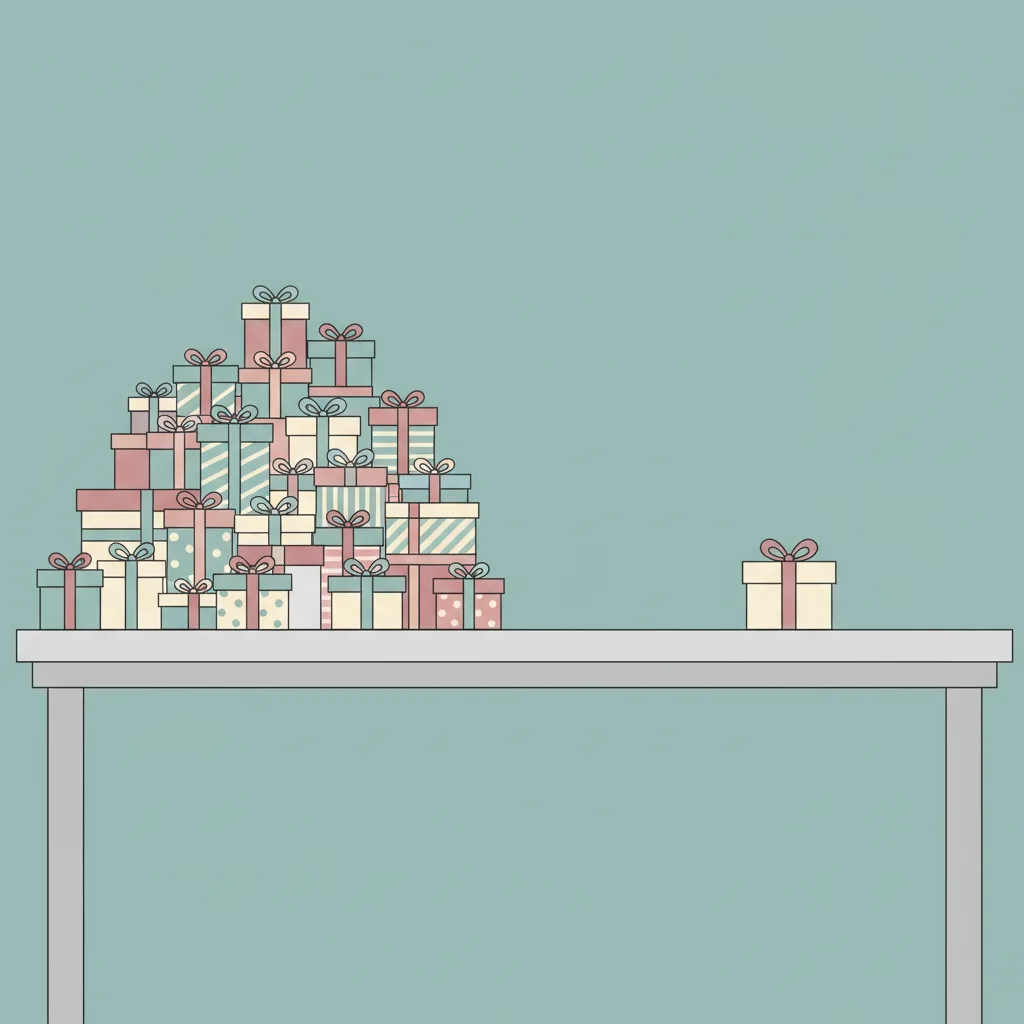
Втрутитися й допомогти дитині, коли їй важко, чи стримати себе й дати їй самій впоратися з розчаруванням
Якщо ви дієте
Втрутитися, щоб врятувати / швидко поступитися
35%
Якщо ви не дієте
Стриматися / не тиснути на дітей достатньо сильно
30%
Відсоток тих, хто згодом шкодує про кожен вибір. Стовпчики та повний реєстр показані нижче.
Family
Остання перевірка 2026-05-05
Якість доказів 3.63/5
Восьмивимірна оцінка перевірки за
рубрикою якості
. Кожен вимір оцінений 1–5.
D1 Перевірка джерел
4/5
D2 Авторитет та незалежність джерела
3/5
D3 Точність частоти жалю
3/5
D4 Порівнянність джерел
4/5
D5 Шаблон Гіловича
4/5
D6 Якість прози
4/5
D7 Повнота застережень
4/5
D8 Якість вибірки
3/5
Середнє3.63/5
Замінні дані — для цього рішення не існує прямого дослідження жалю. Показники отримані з оцінок задоволеності та даних про бар'єри доступу, а не з питань, що безпосередньо стосувалися жалю. Дивіться застереження нижче.
Жаль за дію
Втрутитися, щоб врятувати / швидко поступитися
35%
35% батьків у США самоідентифікуються як схильні поступатися надто швидко (проти 30%, які надто сильно стоять на своєму) — самозвітна дисциплінарна схильність, а не виміряний жаль
американські батьки з дітьми до 18, національно репрезентативно
поперечно, опитування вересень–жовтень 2022
Жаль за бездіяльність
Стриматися / не тиснути на дітей достатньо сильно
30%
30% батьків у США самоідентифікуються як такі, що недостатньо наполягають на своїх дітях (проти 25%, які тиснуть надто сильно) — самозвітна схильність до підштовхування до досягнень, а не виміряний жаль
американські батьки з дітьми до 18, національно репрезентативно
поперечно, опитування вересень–жовтень 2022
% шкодує про цей вибір
Втрутитися, щоб врятувати / швидко поступитисяСтриматися / не тиснути на дітей достатньо сильно
35%30%
action dominates — Дія переважає — більшість шкодує, що діяла.
Пов’язані рішення
Семантично близькі рішення — та сама сфера, інші компроміси.
35% of US parents say they tend to give in too quickly, while 30% say they fail to push their children hard enough, from the same Pew Research Center survey of 3,757 nationally representative US parents fielded in late 2022. Both figures are self-identification proxies, not retrospective regret rates: parents are recognising a present tendency, not judging a completed childhood in hindsight. The action-side has a slim 5-point lead, distinguishing this question from the more lopsided pattern in the broader helicopter-parenting literature; the margin is narrow enough that both errors are meaningfully represented in parental self-assessment.
The behavioral outcomes literature, however, does identify a directional cost on the rescue side. Leonard, Martinez, Dashineau, Park, and Mackey (2021) published an experimental study in Child Development showing that children assigned to a taking-over condition persisted less on a subsequent task than those in a teaching or baseline condition. The study isolates the micro-behavior that defines this dilemma: the moment a parent steps in while a child is still grappling. The Mott Poll (October 2023, n=1,044 parents of children aged 5–11) found that while nearly 75% of parents say they encourage independence, fewer than half report their children regularly complete age-appropriate tasks alone. For 9–11-year-olds, 80% of parents agreed unsupervised free time is developmentally valuable, but fewer than half allowed their child to walk or bike to a friend’s house independently. The attitude-behavior gap suggests the 35% who acknowledge giving in too quickly may undercount the true share whose rescue impulse is active in practice.
The honest framing, then, is that both errors carry documented costs and roughly equal rates of parental self-recognition, a pattern the Gilovich temporal model would predict as unstable across time. Action regrets (having hovered and solved) tend to feel more acute when visible: a child who cannot tolerate frustration, cannot start a task without help, registers as a present failure. Inaction regrets (not scaffolding enough, watching a child disengage from challenge) tend to crystallize later, when the child avoids hard problems rather than attempting them. The Leonard et al. findings suggest the rescue pathway accumulates its cost earlier and more measurably; the Pew proxies suggest parents sense both errors at roughly comparable rates. The safest reading is that the risk lies not in a single style but in the reflexive quality of the response: intervening before the child has had real time to attempt, or withdrawing support so completely that challenge becomes discouragement.
Джерела: дія
Реєстр тверджень
Кожне число нижче — це те, що повідомило джерело, з дослівною цитатою, на яку ми спиралися, та тим, як ми дійшли до нашої цифри. Натисніть на посилання, щоб перевірити самостійно.
2/3 джерел незалежно перевірено дослівно за вказаним джерелом
[1]Pew Research Center (Minkin & Horowitz 2023) — Parenting in America Today: A Survey Report (2023)
Перевірено
↗ 1 other entry
Первинне дослідження
35% of US parents say they tend to give in too quickly; 30% stick to their guns too much; 30% don't push their children hard enough; 25% push too hard
Витяг
“"Somewhat larger shares say they tend to give in too quickly (35%) rather than stick to their guns too much (30%), praise their children too much (26%) rather than criticize them too much (20%), and not push their children hard enough (30%) rather than push them too hard (25%)."
”
Дані джерела:
2023-01-24
Дата звернення
2026-05-04
Перевірка
Витяг незалежно повторно отримано та дослівно підтверджено за вказаним джерелом під час нашого аудиту обґрунтованості.
Розрахунок
Pew Research Center nationally representative survey of 3,757 US parents with children under 18, collected September 20–October 2, 2022. The 35% who say they give in too quickly is used as the action-side proxy: parents who recognise their own tendency to capitulate when a child pushes back — a behavioural analogue to stepping in before the child has wrestled with a problem. This is a self-identification proxy, not a retrospective regret measure; flagged as "(proxy)". The comparison figure of 30% who say they "stick to their guns too much" confirms the question has a balanced response scale.
[2]Child Development (Leonard, Martinez, Dashineau, Park & Mackey 2021) — Children Persist Less When Adults Take Over
Рецензована публікація
Children assigned to a taking-over condition persisted less on a subsequent task than those in a teaching or baseline condition
Витяг
“"Children assigned to a taking over condition persisted less on a subsequent task compared to those in a teaching or a baseline condition."
”
Дані джерела:
2021-07-01
Дата звернення
2026-05-04
Розрахунок
Leonard, Martinez, Dashineau, Park & Mackey (2021), Child Development 92(4), 1325–1336. This is a behavioral outcomes study, not a regret survey. It directly measures the construct of parental takeover during a child's struggle and finds that takeover reduces the child's subsequent persistence. It contextualizes why parents who give in quickly (action side) accumulate the documented downstream cost — lower child persistence — that would underpin retrospective regret. It does not supply the 35% proxy rate; that comes from Pew 2023 above.
[3]C.S. Mott Children's Hospital National Poll on Children's Health, University of Michigan — Parent efforts insufficient to promote teen independence
Перевірено
Авторитетне довідкове видання
1 in 4 parents (25%) cite themselves as the main barrier to their teen becoming more independent — not taking time or effort to give teens more responsibility
Витяг
“"One quarter of parents cite themselves as the main impediment to their teen becoming more independent, saying it's less time and hassle to do things themselves rather than involve their teen (19%), or that they just don't think about how to give teens more responsibility (7%)."
”
Дані джерела:
2019-07-01
Дата звернення
2026-05-05
Перевірка
Витяг незалежно повторно отримано та дослівно підтверджено за вказаним джерелом під час нашого аудиту обґрунтованості.
Розрахунок
C.S. Mott Children's Hospital National Poll on Children's Health, University of Michigan. N=877 parents with at least one child aged 14–18, fielded February 2019. The 25% self-attribution rate is structurally stronger than the Pew "give in too quickly" framing: parents are attributing causal responsibility to themselves (I am the obstacle), not merely describing a stylistic tendency. This is the closest available population-representative estimate to acknowledging that parental over-intervention in independence is a self-owned pattern — an acknowledgment that plausibly precedes retrospective regret. The sample is restricted to parents of teens (ages 14–18); the rate may differ for parents of younger children where intervention is more socially sanctioned. This source does not directly measure regret; like Pew 2023, it is a proxy.
Незалежність
Independent from Pew 2023 and Leonard et al. 2021. Different institution (University of Michigan), different sample (parents of teens 14–18 vs all children under 18), different question frame (self-as-barrier attribution vs stylistic tendency).
Джерела: бездіяльність
Реєстр тверджень
Кожне число нижче — це те, що повідомило джерело, з дослівною цитатою, на яку ми спиралися, та тим, як ми дійшли до нашої цифри. Натисніть на посилання, щоб перевірити самостійно.
1/2 джерел незалежно перевірено дослівно за вказаним джерелом
[1]Pew Research Center (Minkin & Horowitz 2023) — Parenting in America Today: A Survey Report (2023)
Перевірено
↗ 1 other entry
Первинне дослідження
30% of US parents say they don't push their children hard enough, vs 25% who say they push too hard
Витяг
“"Somewhat larger shares say they tend to give in too quickly (35%) rather than stick to their guns too much (30%), praise their children too much (26%) rather than criticize them too much (20%), and not push their children hard enough (30%) rather than push them too hard (25%)."
”
Дані джерела:
2023-01-24
Дата звернення
2026-05-04
Перевірка
Витяг незалежно повторно отримано та дослівно підтверджено за вказаним джерелом під час нашого аудиту обґрунтованості.
Розрахунок
Same Pew Research Center survey of 3,757 US parents (September–October 2022). The 30% who say they "don't push their children hard enough" is the inaction-side proxy: parents who recognise their own tendency to under- challenge their child. This is the mirror construct to the action side's giving-in-too-quickly: rather than stepping in at the moment of struggle, these parents fail to create challenging situations in the first place. The shared instrument and identical sample make the cross-group comparison internally consistent. Flagged as "(proxy)" because self-identification of a parenting tendency is a weaker claim than retrospective regret.
[2]EurekAlert (University of Michigan C.S. Mott Children's Hospital National Poll on Children's Health, 2023) — Many parents of school-age kids struggle to give them independence
Авторитетне довідкове видання
Nearly 75% of parents say they encourage their child to do things independently, yet fewer than half report their child regularly does tasks like tying shoes or making a simple meal alone; for ages 9-11, 80% agree unsupervised free time is good but fewer than half permit walking or biking to a friend's house
Витяг
“"Nearly three-quarters of parents say they encourage their child to do things independently, yet fewer than half report their child regularly completes age-appropriate independent tasks. For children aged 9–11, 8 in 10 parents agree that free time without adult supervision is good for children, but fewer than half allow their child to walk or bike to a friend's house or play outside unsupervised."
”
Дані джерела:
2023-10-02
Дата звернення
2026-05-04
Розрахунок
C.S. Mott Children's Hospital National Poll on Children's Health, University of Michigan (October 2023), n=1,044 parents of children aged 5–11. This source documents the attitude-behavior gap on the inaction side: parents know they should let children struggle independently but consistently intervene in practice. The gap between "I encourage independence" (75%) and "my child regularly does independent tasks" (<50%) quantifies the shortfall. It does not supply the 30% proxy rate; that comes from Pew 2023 above. It corroborates that under-challenging (inaction side) is a recognised concern among parents even when they endorse independence in principle.
Застереження
Neither figure is a direct regret measurement — both are self-identification proxies from the same Pew Research Center survey (September–October 2022, n=3,757 US parents) and are flagged as "(proxy)" in regret_display. The action-side 35% measures disciplinary give-in ("give in too quickly when child pushes back on rules"), which is an adjacent construct to — but not identical with — stepping in during a struggle with a hard task. The inaction-side 30% measures a perceived failure to challenge sufficiently, which captures the spirit of under-support but is similarly oblique. No large-scale survey appears to ask parents directly "do you regret rescuing your child too often?" or "do you regret holding back when your child struggled?"; such data does not exist in the published literature as of May 2026. The 0.05-point gap between the two proxies places the entry at the exact boundary of the action_dominates/balanced threshold (balanced requires |delta| strictly less than 0.05) and should not be read as a meaningful directional signal in the margin-of-error context of a single questionnaire. Leonard et al. (2021) provides behavioral evidence that parental takeover measurably reduces child persistence, lending directional support to the action-side cost, but outcome evidence and regret evidence are distinct constructs. The Mott Poll (2023) documents a large attitude-behavior gap that implies many parents who do not self-identify as rescuers nonetheless intervene more than they endorse in principle, suggesting the true action- side share may be understated by the Pew proxy. Survey data are drawn from United States samples; parenting norms and cultural expectations regarding child struggle and independence differ substantially across countries.