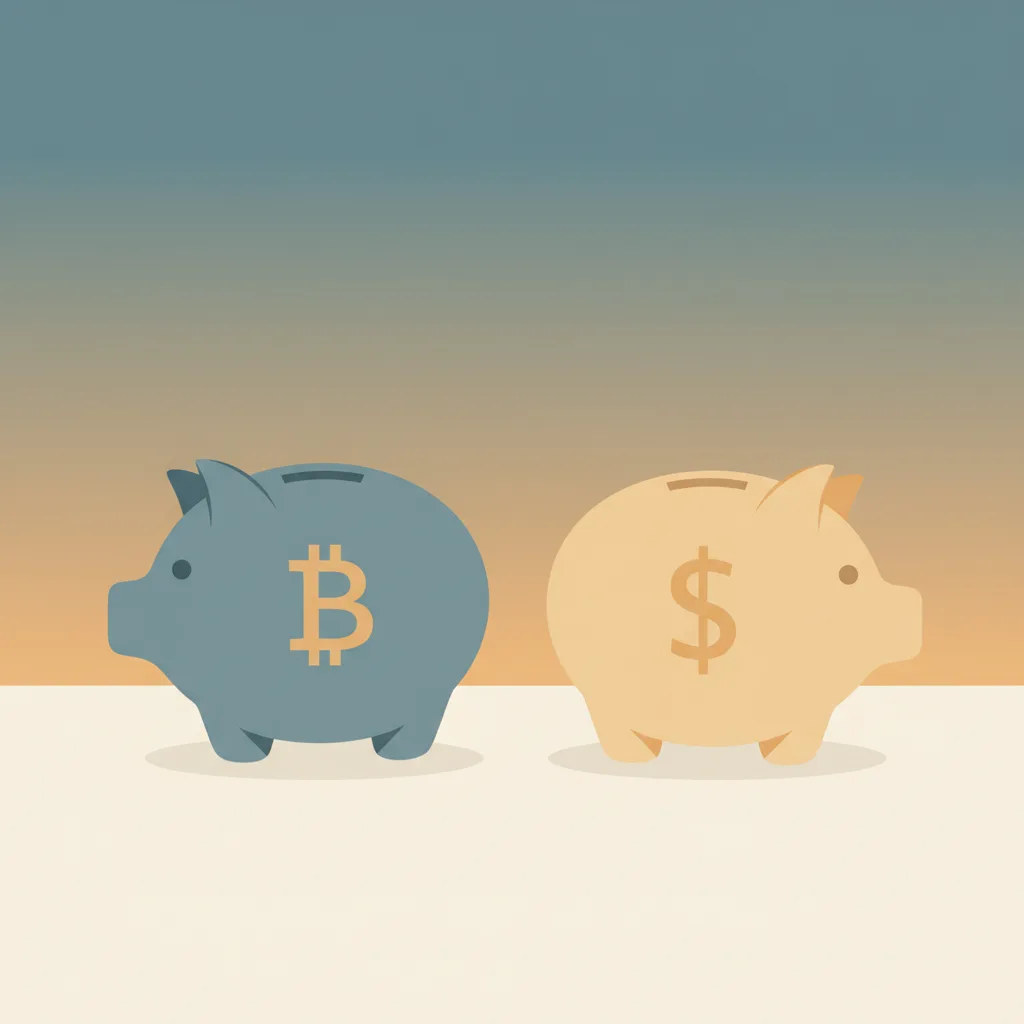
Placer ses économies en cryptomonnaie vs. rester dans des actifs traditionnels
Si vous agissez
Placer son épargne en cryptomonnaie
46%
Si vous n’agissez pas
Rester sur des actifs traditionnels
16%
Au moins un chiffre est une estimation indirecte, et non un taux de regret mesuré. La façon dont chaque chiffre a été obtenu est expliquée plus bas.
Financier
Dernière révision 2026-05-13
Qualité des preuves 4.63/5
Score d’évaluation en huit dimensions selon la
grille de qualité
. Chaque dimension notée de 1 à 5.
D1 Vérification des sources
5/5
D2 Autorité et indépendance des sources
5/5
D3 Précision du taux de regret
3/5
D4 Comparabilité des sources
4/5
D5 Motif de Gilovich
5/5
D6 Qualité de la prose
5/5
D7 Complétude des réserves
5/5
D8 Qualité de l’échantillon
5/5
Moyenne4.63/5
Données indirectes : pour cette décision, au moins un chiffre provient d'une mesure indirecte, comme les conséquences, la satisfaction ou l'intention, ou d'une estimation de la rédaction, et non d'une enquête qui mesure directement le regret. Les notes de chaque côté, plus bas, expliquent comment chaque chiffre a été obtenu.
Si vous agissez
Placer son épargne en cryptomonnaie
46%
46% des investisseurs crypto américains ont dit que leur investissement a fait pire que prévu
Adultes américains ayant investi en cryptomonnaie, représentatifs au niveau national
rétrospective, 2022
Si vous n’agissez pas
Rester sur des actifs traditionnels
16%
16% des personnes qui n'ont pas acheté de crypto regrettent de ne pas l'avoir fait
Adultes américains qui n'ont pas acheté de cryptomonnaie au cours de l'année écoulée
rétrospective, 2022
Chiffre pour chaque choix (la mesure est nommée sur la page)
Placer son épargne en cryptomonnaieRester sur des actifs traditionnels
46%16%
Décisions associées
Décisions sémantiquement similaires — même terrain, compromis différents.
46% of US crypto investors reported their investments did worse than expected, according to Pew Research Center’s nationally representative 2022 survey of 6,034 adults. That figure captures the core tension: cryptocurrency attracted mainstream adoption with promises of outsized returns, but nearly half of those who acted on the opportunity came away disappointed. On the other side, 16% of Americans who did not buy cryptocurrency told ConsumerAffairs in a 2022 survey of 1,074 adults that they regretted staying out — a real but minority experience of inaction regret (34% were glad they didn’t, and 51% were neutral).
The numbers are regime-dependent in ways that matter. Pew’s 46% was recorded near the post-Terra/LUNA collapse, when Bitcoin had fallen roughly 70% from its 2021 peak. A survey taken at the top of a bull market would show higher inaction regret and lower action regret; a survey taken deeper in a bear market might produce even higher action regret. The ConsumerAffairs inaction figure was also captured in 2022, near the same drawdown, which likely muted the missed-gains regret that a bull-market survey would have surfaced. The S&P 500’s roughly 150% gain from 2019 to 2024 provided traditional-asset holders with strong objective grounds for contentment, which likely held down their regret rate.
Gilovich’s temporal model predicts that action regrets are more salient in the short run but fade as people adapt, while inaction regrets persist. That pattern may play out differently here: crypto investors who took large losses have a concrete, specific loss to mourn, while non-investors who missed a bull run are haunted by a counterfactual that grows and shrinks with every market cycle. The 30-point gap favoring action regret is real but unusually volatile for this asset class. Unlike missing a decade of S&P returns, missing a crypto bull run is not a one-time counterfactual — it recurs every time the price makes headlines.
Sources : action
Registre des sources
Chaque chiffre ci-dessous correspond à ce que la source a rapporté, avec la citation textuelle sur laquelle nous nous sommes appuyés et la méthode de calcul. Cliquez sur un lien pour vérifier directement.
[1]Pew Research Center — 46% of Americans who have invested in cryptocurrency say it's done worse than expected
Étude primaire
46% of US adults who had invested in, traded, or used cryptocurrency said their investment had done worse than expected
Extrait
“"Among the 16% of U.S. adults who say they have ever invested in, traded or used a cryptocurrency such as bitcoin or ether, 46% report their investments have done worse than they expected"
”
Données source de
2022-08-23
Consulté le
2026-05-13
Calcul
Pew surveyed 6,034 US adults July 5-17, 2022. Of the 16% who had ever invested in, traded, or used crypto, 46% reported worse-than-expected outcomes. We use this as the action-regret proxy: investments that "did worse than expected" closely parallel the regret construct — the expectation gap is the dominant driver of investment regret. The 2024 Pew update found 38% still reported worse-than-expected results, slightly lower; the 2022 figure is used here as the most methodologically comparable snapshot tied to a specific market period.
[2]Gallup — Cryptocurrency Still Has Limited Main Street Appeal
Étude primaire
14% of Americans currently own cryptocurrency as of June 2025; ownership remains concentrated among younger men
Extrait
“"Although 14% of U.S. adults overall report owning bitcoin or another cryptocurrency, the rate varies significantly by gender and age. Ownership is much higher, at 25%, among men aged 18 to 49 than among men aged 50 and older (12%), women aged 50 and older (9%) and women aged 18 to 49 (8%)."
”
Données source de
2025-06-15
Consulté le
2026-05-14
Calcul
Gallup August 2025 tracking poll. Ownership plateau at 14% suggests that many early investors have not re-entered or have exited the market. Included as context for the stable-but- concentrated investor population; does not alter the action- regret rate.
Sources : inaction
Registre des sources
Chaque chiffre ci-dessous correspond à ce que la source a rapporté, avec la citation textuelle sur laquelle nous nous sommes appuyés et la méthode de calcul. Cliquez sur un lien pour vérifier directement.
[1]ConsumerAffairs — The most regretted financial decisions in America: Survey
Étude primaire
Among US adults who did not buy cryptocurrency in the past year, 16% say they regret it (34% glad they didn't, 51% neutral)
Extrait
“"This study’s data came from a survey of 1,074 adults in the United States. [...] Survey respondents who bought into crypto found themselves sharply divided, with 49% saying they regretted buying and 32% saying they were glad they did."
”
ConsumerAffairs surveyed 1,074 US adults (published 2022-05-10). The crypto-regret graphic splits respondents by whether they bought crypto in the past year. Among those who did NOT buy, 16% say they regret it — a direct inaction-regret measure for non-owners (the remainder: 34% glad they didn't, 51% neutral, totalling ~100% net of rounding). The 16% figure was read directly off the primary "Collectible and crypto regret" infographic (verified via web.archive.org / CDN image, 2026-07-14), not from a secondary paraphrase. This replaces a previously cited Bankrate "September 2022" figure (23%, with a 36%/12% age split) whose URL does not resolve and whose statistic could not be located in any real Bankrate source — it was removed as unverifiable. Both surveys sit near the 2022 crypto drawdown, so measured inaction regret is likely suppressed relative to a bull-market survey. The archived page text gives the sample size and the 49% and 32% split among respondents who bought crypto; the 34%, 51% and 16% split among non-buyers appears only inside the graphic, which the archived text does not reproduce.
Réserves
Le taux de regret d'action (46%) mesure les investissements qui ont « fait pire que prévu », ce qui est un proxy de déception de performance, pas une question directe « je regrette d'investir ». Certains répondants peuvent avoir été insatisfaits tout en croyant encore que la crypto était le bon pari à long terme. La mise à jour Pew 2024 a constaté que le taux était tombé à 38%, suggérant que le 46% original reflète le pessimisme maximal près du creux du marché 2022. Le taux d'inaction (16%) provient d'une enquête ConsumerAffairs distincte auprès de 1 074 adultes américains publiée en 2022, donc les populations ne sont pas directement appariées. Le vrai regret d'inaction fluctue probablement substantiellement avec le prix du Bitcoin : dans un marché haussier, les non-propriétaires éprouvent une FOMO nettement plus élevée, tandis que les investisseurs crypto qui ont acheté près des pics ont le plus de regret. Les deux chiffres sont fortement dépendants du régime, et le 16% a été mesuré près du repli de 2022, lorsque le regret des gains manqués était atténué. Le S&P 500 a gagné environ 150% de 2019 à 2024, ce qui signifie que les détenteurs d'actifs traditionnels qui ont suivi un fonds indiciel avaient une forte justification objective pour leur inaction ; leur taux de regret mesuré peut refléter partiellement cette satisfaction.