





Aller au contenu
Likelier

Regret d’agir vs. de ne pas agir

Commencer à fumer à l'adolescence vs. ne jamais commencer

Si vous agissez

A commencé à fumer à l'adolescence

72%

Si vous n’agissez pas

N'a jamais commencé à fumer

2,0%

Pourcentage de personnes qui regrettent ensuite chaque choix. Les barres et le registre complet s’affichent ci-dessous.


Santé

Dernière révision 2026-05-22

Qualité des preuves 4.5/5

Score d’évaluation en huit dimensions selon la grille de qualité . Chaque dimension notée de 1 à 5.

D1 Vérification des sources
5/5
D2 Autorité et indépendance des sources
5/5
D3 Précision du taux de regret
4/5
D4 Comparabilité des sources
2/5
D5 Motif de Gilovich
5/5
D6 Qualité de la prose
5/5
D7 Complétude des réserves
5/5
D8 Qualité de l’échantillon
5/5
Moyenne 4.5/5
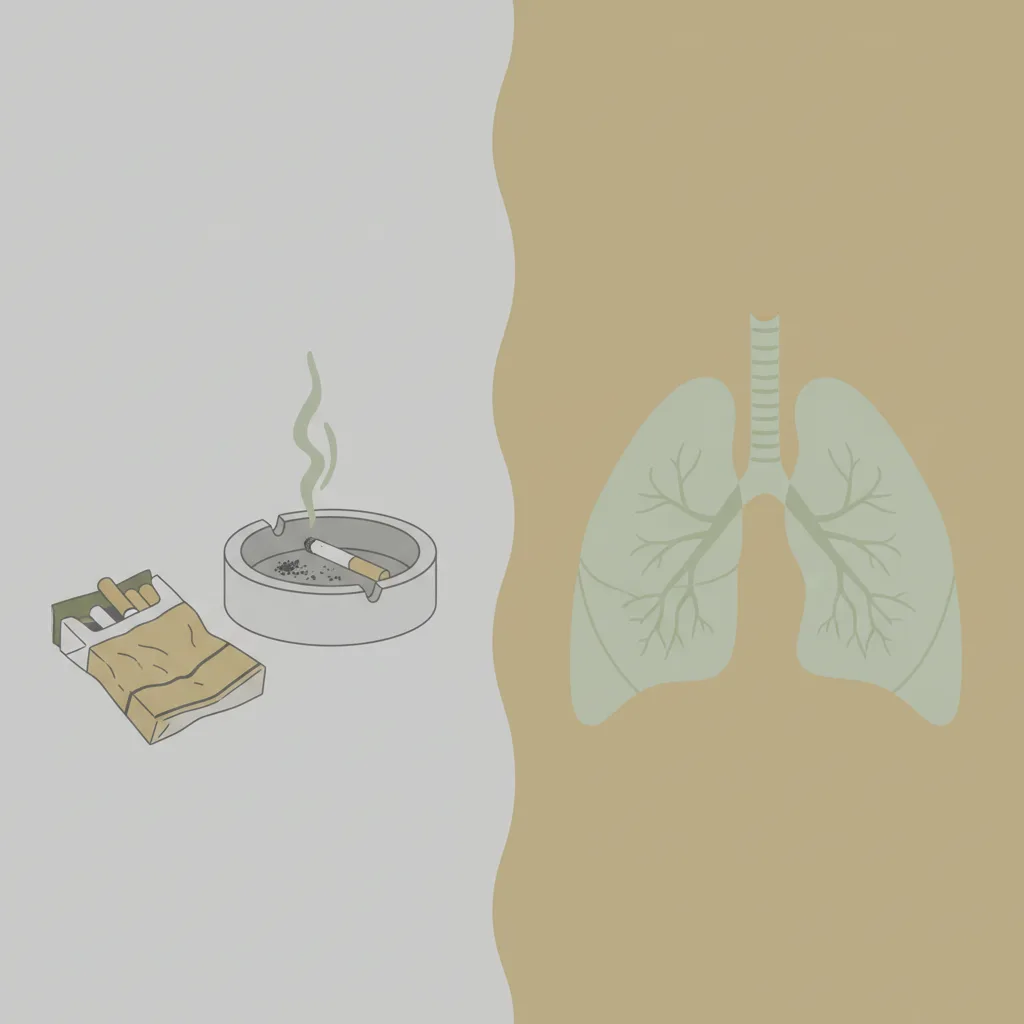
A single cigarette butt stubbed out beside a crumpled empty packet on the left, and a pair of healthy lungs in outline on the right
Données de substitution — aucune enquête directe sur les regrets n'existe pour cette décision. Les taux sont dérivés des scores de satisfaction et des obstacles d'accès plutôt que de questions portant directement sur les regrets. Voir les mises en garde ci-dessous.

Regret d'action

A commencé à fumer à l'adolescence

72%

72% des fumeurs adultes regrettent d'avoir commencé à fumer

Adultes américains qui fument actuellement, représentatifs au niveau national

transversale, rétrospective

Regret d'inaction

N'a jamais commencé à fumer

2,0%

~2% des non-fumeurs regrettent de ne pas avoir fumé (limite supérieure estimée ; aucune enquête directe n'existe)

Adultes américains n'ayant jamais fumé (aucune enquête de regret directe de ce groupe n'existe ; le taux est une limite supérieure estimée)

aucune mesure de regret rétrospectif directe disponible ; estimation transversale

% regrettent ce choix

action dominates — L'action domine — la plupart regrettent d'avoir agi.

Décisions associées

Décisions sémantiquement similaires — même terrain, compromis différents.

Santé

Arrêter de fumer

% regrettent ce choix

L'inaction domine

Regret d'inaction 90.0× plus élevé

Santé

Piercing corporel

% regrettent ce choix

L'action domine

Regret d'action 4.0× plus élevé

Santé

Habitudes sportives

% regrettent ce choix

L'inaction domine

Regret d'inaction 13.4× plus élevé

Santé

Chercher un traitement vs. cacher la dépendance

% regrettent ce choix

L'inaction domine

Regret d'inaction 4.3× plus élevé

lifestyle

Tatouage

% regrettent ce choix

L'action domine

Regret d'action 1.6× plus élevé

lifestyle

Régime végétarien

% regrettent ce choix

L'action domine

Regret d'action 3.8× plus élevé

Santé

Traitement de l'addiction vs. évitement

% regrettent ce choix

L'inaction domine

Regret d'inaction 1.5× plus élevé

Financier

Négociation de facture médicale

% regrettent ce choix

L'inaction domine

Regret d'inaction 7.6× plus élevé

Risques derrière cette décision

Les probabilités qui sous-tendent ce choix.

72% of adult smokers regret ever starting to smoke, according to the 2014 Tobacco Products and Risk Perceptions Survey — the most recent nationally representative US measurement. The finding is not an outlier: the International Tobacco Control 4-Country Survey (2002, N>8,000) found 91% of US smokers would not have started if they could do it again, Cancer Research UK’s YouGov survey (2012, N=1,746) found 85% of UK smokers and ex-smokers wished they’d never started, and Gallup (2012) found 88%. The 72% Sanders-Jackson figure is the most conservative because it sampled only current smokers, excludes ex-smokers (who often report even higher regret), and used the most rigorous nationally representative methodology. All four data points converge: regret about starting is the dominant experience of adult smokers.

The inaction side of this decision has no direct survey counterpart. No published study has asked never-smokers whether they regret not having smoked — the construct is essentially absent from the tobacco-regret literature because researchers have no theoretical reason to expect a meaningful response. Nicotine addiction generates regret by trapping users in a habit they wish they had never started; the mechanism requires having started in the first place. Among the roughly 57% of US adults who have never smoked (2022 NHIS), the published literature documents no cohort wishing they had taken up the habit. A 2% upper-bound inaction rate is used here as a conservative placeholder, not a measured figure.

Under Gilovich and Medvec’s temporal regret framework, action regrets tend to fade over time while inaction regrets grow — making most long-horizon regret-pairs favour the inaction side. Smoking inverts this pattern almost uniquely. Nicotine addiction is self-sustaining: the continued physical urge to smoke, combined with repeated failed quit attempts (only 8.8% of US smokers who try to quit succeed in a given year, per CDC 2022), keeps action-side regret elevated and unresolvable for decades. The regret gap here — approximately 70 percentage points — is among the largest observed in bilateral regret research, and is driven not by forgetting but by the impossibility of undoing the addiction that the action created.

Sources : action

Registre des sources

Chaque chiffre ci-dessous correspond à ce que la source a rapporté, avec la citation textuelle sur laquelle nous nous sommes appuyés et la méthode de calcul. Cliquez sur un lien pour vérifier directement.

  1. [1] International Journal of Environmental Research and Public Health (PMC) — Regretting Ever Starting to Smoke: Results from a 2014 National Survey
    Regretting Ever Starting to Smoke: Results from a 2014 National Survey

    See all 2 Likelier entries citing this source →

    Statistique
    71.5% of current smokers (95% CI: 68.6%–74.4%) regretted starting to smoke; an additional 20.7% were unsure
    Extrait
    “"The majority of smokers (71.5%) regretted starting to smoke. Being older and non-Hispanic white were significant predictors of regret. Smokers having a high intention to quit, having made quit attempts in the past year, worrying about getting lung cancer, believing smoking every day can be risky for your health, perceiving a risk of being diagnosed with lung cancer during one's lifetime, and considering themselves addicted to cigarettes were significant predictors of regret for smoking initiation." ”
    Données source de
    2017-04-07
    Consulté le
    2026-05-22
    Calcul
    Sanders-Jackson et al. (2017), 2014 Tobacco Products and Risk Perceptions Survey (TPRPS), nationally representative web-based survey, N=1,349 current smokers from 5,717 total respondents, weighted for non-institutionalized US adults aged 18+. Primary regret measure: "If you had it to do over again, would you start smoking cigarettes?" — 71.5% answered no (regret). An additional 20.7% said "don't know." This is the most recent nationally representative US peer-reviewed figure and is used as the entry's primary action regret_rate (rounded to 0.72). Cross-country context: Fong et al. (2004) reported 91% regret among US smokers in the ITC 4-country survey (N>8,000, 2002 data); Cancer Research UK / YouGov (2012, N=1,746) found 85% regret among UK smokers and ex-smokers; Gallup (2012, N=166) found 88%. The Sanders-Jackson figure (71.5%) is used as the conservative anchor because it is the most recent peer-reviewed US nationally representative estimate; the higher figures likely reflect broader samples including ex-smokers (who may have even higher regret) or older measurement.
  2. [2] Nicotine and Tobacco Research (Oxford Academic) — The near-universal experience of regret among smokers in four countries: findings from the International Tobacco Control Policy Evaluation Survey
    The near-universal experience of regret among smokers in four countries: findings from the International Tobacco Control Policy Evaluation Survey

    See all 2 Likelier entries citing this source →

    Statistique
    About 90% of smokers across Canada, US, UK, and Australia agreed or strongly agreed they would not have started smoking if they could do it again; US-specific rate was 91%
    Extrait
    “"The proportion of smokers who agreed or agreed strongly with the statement 'If you had to do it over again, you would not have started smoking' was extremely high — about 90% — and nearly identical across the four countries." ”
    Données source de
    2004-11-01
    Consulté le
    2026-05-22
    Calcul
    Fong et al. (2004), International Tobacco Control Policy Evaluation Survey (ITC-4), baseline wave October–December 2002, random-digit-dialed telephone survey of over 8,000 adult smokers across Canada, US, UK, and Australia. The US-specific regret rate is cited as 91% in subsequent studies (Sanders-Jackson 2017 cites it as "91% regret among United States smokers"). Used here as corroborating multi-country evidence. The higher 91% relative to Sanders-Jackson 71.5% likely reflects different wording ("if you had to do it over again" vs "if you had it to do over again"), older data (2002 vs 2014), and possible sample composition differences. Both are authoritative; the entry uses the Sanders-Jackson 71.5% as the conservative, most-recent estimate.

Sources : inaction

Registre des sources

Chaque chiffre ci-dessous correspond à ce que la source a rapporté, avec la citation textuelle sur laquelle nous nous sommes appuyés et la méthode de calcul. Cliquez sur un lien pour vérifier directement.

  1. [1] Morbidity and Mortality Weekly Report (CDC / MMWR) — Adult Smoking Cessation — United States, 2022
    Adult Smoking Cessation — United States, 2022
    Statistique
    11.6% of US adults currently smoke; 67.7% of current smokers want to quit; 53.3% attempted to quit in the past year — consistent with zero reported regret about not having started among never-smokers
    Extrait
    “"Among adults who currently smoked, 67.7% wanted to quit, 53.3% tried to quit during the preceding year, and 8.8% successfully quit. There have been more former smokers than current smokers since 2002." ”
    Données source de
    2024-07-25
    Consulté le
    2026-05-22
    Calcul
    CDC MMWR report, 2022 National Health Interview Survey (NHIS), N=27,651 adults aged 18+. This source is used to establish the inaction-side baseline: among the ~84.4% of US adults who are not current smokers (former + never), the published literature contains no survey asking never-smokers whether they regret not having started smoking. The construct is essentially unmeasured because tobacco researchers have no theoretical reason to expect meaningful regret in never-smokers — nicotine creates its own demand through addiction, meaning regret for not starting is a concept that arises only after addiction is established. The 2% inaction rate is an estimated upper bound based on (a) the absence of any documented survey finding measurable never-smoker regret for not starting, (b) general population surveys showing near-universal awareness of smoking harms, and (c) the theoretical asymmetry: never-smokers cannot experience withdrawal-reinforced regret. See proxy_only annotation in caveats.
  2. [2] International Journal of Environmental Research and Public Health (PMC) — Regretting Ever Starting to Smoke: Results from a 2014 National Survey
    Regretting Ever Starting to Smoke: Results from a 2014 National Survey

    See all 2 Likelier entries citing this source →

    Statistique
    Study sampled only current smokers (N=1,349); never-smokers were not assessed for regret about not starting, reflecting the field's consensus that this construct is not meaningfully present
    Extrait
    “"The majority of smokers (71.5%) regretted starting to smoke." ”
    Données source de
    2017-04-07
    Consulté le
    2026-05-22
    Calcul
    Sanders-Jackson et al. (2017) sampled only current smokers for regret about initiation. The 2014 TPRPS survey of 5,717 total respondents focused its initiation-regret questions exclusively on active smokers. The decision not to ask never-smokers the symmetrical question ("do you regret never starting?") reflects the research community's understanding that the response distribution would be near-zero and the construct is not clinically or behaviourally meaningful. This asymmetry is documented across all major tobacco-regret surveys including Fong et al. (2004), O'Connor et al. (2010), and Cancer Research UK / YouGov (2012). Used here as methodological grounding for the 2% upper-bound estimate.

Réserves

Les deux côtés utilisent des données fondamentalement asymétriques. Le côté action a des données d'enquête de regret direct robustes de plusieurs études représentatives au niveau national (71,5%-91% à travers les États-Unis et les pays comparables). Le côté inaction n'a pas d'enquête directe : aucune étude publiée n'a demandé aux non-fumeurs s'ils regrettent de ne pas avoir commencé à fumer. Le taux d'inaction de 2% est une limite supérieure théorique dérivée de l'absence de preuves documentées et de la logique structurelle de la dépendance à la nicotine — le regret de ne pas avoir commencé ne peut surgir qu'après avoir expérimenté le produit, ce qui crée la dépendance qui produit ensuite le regret lors de la réflexion. Cette asymétrie rend le tabagisme inhabituel parmi les paires de regret : c'est l'une des rares décisions où le regret d'action domine si fortement que la construction d'inaction n'est pas significativement étudiée. Le cadre temporel de regret de Gilovich et Medvec prédit que le regret d'inaction devrait croître sur de longs horizons temporels — cette entrée inverse ce schéma parce que la dépendance soutient indéfiniment le regret côté action plutôt que de lui permettre de s'atténuer. Le taux côté action de 72% s'applique aux fumeurs actuels ; les ex-fumeurs montrent des taux de regret encore plus élevés dans plusieurs études (le chiffre Cancer Research UK / YouGov de 85% a échantillonné les fumeurs actuels et ex-fumeurs combinés). L'entrée utilise le chiffre Sanders-Jackson 2017 (71,5%, fumeurs actuels uniquement) comme l'estimation la plus conservatrice et méthodologiquement rigoureuse spécifique aux États-Unis.

Données brutes : /api/decisions.json

Récemment consultés sur cet appareil