




Aller au contenu
Likelier

Regret d’agir vs. de ne pas agir

Adopter un régime végétarien ou végétalien vs continuer à manger de la viande

Si vous agissez

Devenir végétarien / végétalien

84%

Si vous n’agissez pas

Continuer à manger de la viande

22%

Pourcentage de personnes qui regrettent ensuite chaque choix. Les barres et le registre complet s’affichent ci-dessous.


Mode de vie

Dernière révision 2026-04-26

Qualité des preuves 4.0/5

Score d’évaluation en huit dimensions selon la grille de qualité . Chaque dimension notée de 1 à 5.

D1 Vérification des sources
5/5
D2 Autorité et indépendance des sources
4/5
D3 Précision du taux de regret
2/5
D4 Comparabilité des sources
3/5
D5 Motif de Gilovich
3/5
D6 Qualité de la prose
5/5
D7 Complétude des réserves
5/5
D8 Qualité de l’échantillon
5/5
Moyenne 4.0/5
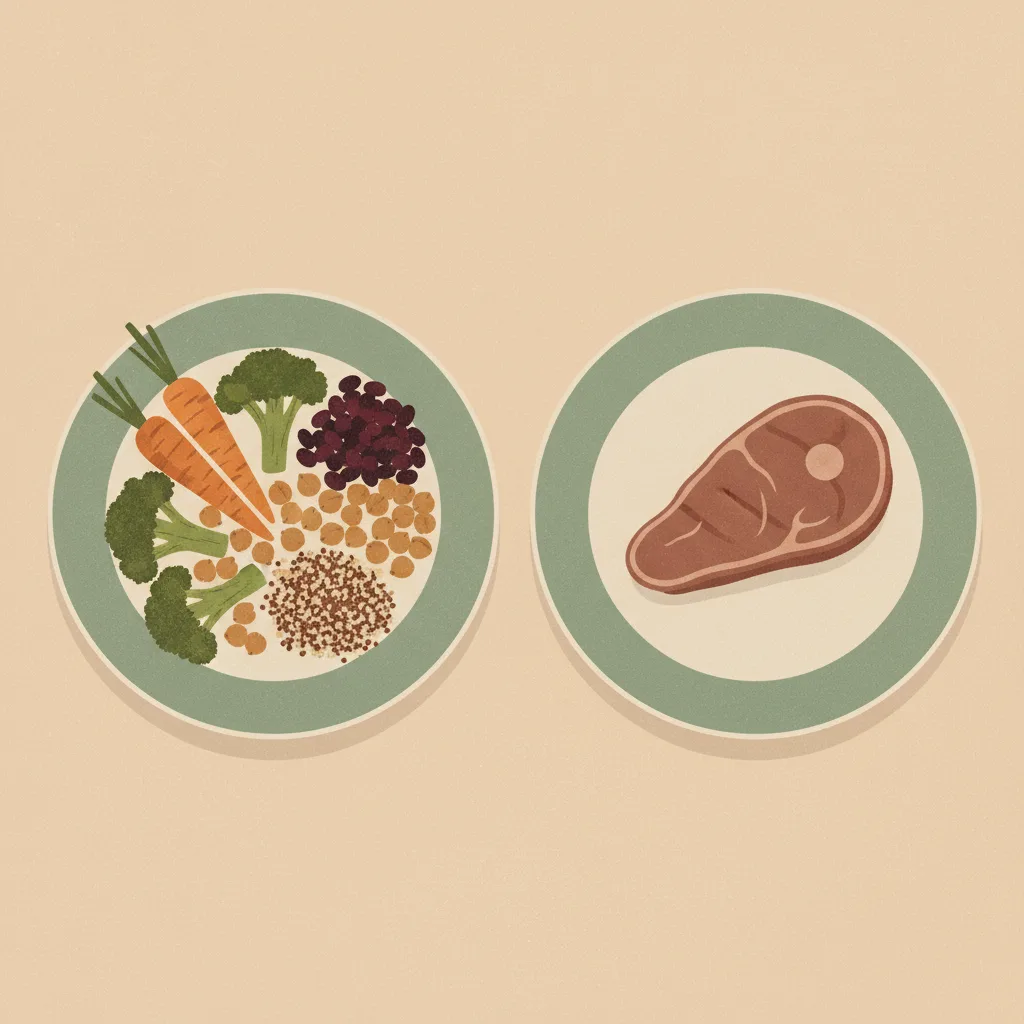
Two plates side by side, one with vegetables and legumes, the other with a cut of meat, both slightly faded.

Regret d'action

Devenir végétarien / végétalien

84%

84% ont abandonné le végétarisme (proxy d'abandon — taux d'abandon, pas regret direct)

Adultes américains ayant essayé le végétarisme ou le véganisme

rétrospective, pas de calendrier fixe

Regret d'inaction

Continuer à manger de la viande

22%

22% se sentent coupables de manger de la viande tout le temps (proxy de culpabilité — pas regret direct)

Adultes britanniques non-véganes, représentatifs au niveau national

rétrospective, pas de calendrier fixe

% regrettent ce choix

action dominates — L'action domine — la plupart regrettent d'avoir agi.

Décisions associées

Décisions sémantiquement similaires — même terrain, compromis différents.

lifestyle

Garder ou replacer son animal

% regrettent ce choix

L'inaction domine

Regret d'inaction 5.7× plus élevé

lifestyle

Tatouage

% regrettent ce choix

L'action domine

Regret d'action 1.6× plus élevé

Santé

Arrêter de fumer

% regrettent ce choix

L'inaction domine

Regret d'inaction 90.0× plus élevé

lifestyle

Jeûne intermittent

% regrettent ce choix

L'action domine

Regret d'action 2.9× plus élevé

lifestyle

VE vs essence

% regrettent ce choix

L'action domine

Regret d'action 2.9× plus élevé

Santé

Piercing corporel

% regrettent ce choix

L'action domine

Regret d'action 4.0× plus élevé

lifestyle

Quitter sa religion

% regrettent ce choix

L'inaction domine

Regret d'inaction 2.9× plus élevé

Santé

Longévité vs accepter vieillissement

% regrettent ce choix

L'inaction domine

Regret d'inaction 1.5× plus élevé

The largest study of vegetarian and vegan retention — Faunalytics’ 2014 survey of 11,399 US adults via Harris Interactive — found that 84% of people who adopted a vegetarian or vegan diet eventually returned to eating meat. That number is the action-side proxy shown above, used directly rather than the previously constructed composite. But lapse rate is not regret rate. Crucially, 37% of the lapsed expressed interest in re-adopting, meaning they do not regret the diet itself — they regret stopping it, or faced barriers they could not overcome. A Faunalytics obstacle analysis found that social isolation (84% were not part of any veg community), food access, and meal prep difficulty — not principled rejection of the diet — drove most lapses.

On the other side, a 2022 Vegan Society survey of 2,000 non-vegan UK adults found that 22% report feeling guilty about eating meat all of the time — a persistent-guilt figure we use as the inaction proxy rather than the combined 71% who report guilt “some” or “all” of the time. Persistent guilt maps more closely to a regret-adjacent construct than intermittent discomfort. Cognitive dissonance research (Bastian et al., 2012) shows that meat-related guilt is often resolved through justification strategies — “the guilt persists but produces no corresponding desire to act.” The Vegan Society, as the commissioning body, has an advocacy interest in high guilt numbers.

What the data establishes is that dietary identity is unstable: most people who try vegetarianism quit (though many want to try again), and roughly one in five meat eaters carries persistent guilt about it. The action-dominates pattern reflects an asymmetry between a very high lapse rate and a modest persistent-guilt rate, but readers should note that lapsing conflates genuine dissatisfaction with situational barriers. Both figures are proxies for different constructs (behavioral abandonment vs affective discomfort), so the large delta should be read with caution.

Sources : action

Registre des sources

Chaque chiffre ci-dessous correspond à ce que la source a rapporté, avec la citation textuelle sur laquelle nous nous sommes appuyés et la méthode de calcul. Cliquez sur un lien pour vérifier directement.

1/2 sources vérifiées de manière indépendante, mot pour mot, par rapport à la source citée

  1. [1] Faunalytics / Harris Interactive — A Summary of Faunalytics' Study of Current and Former Vegetarians and Vegans Vérifié
    A Summary of Faunalytics' Study of Current and Former Vegetarians and Vegans
    Statistique
    84% of people who have adopted a vegetarian or vegan diet subsequently abandon it; 53% lasted less than one year; 37% of the lapsed are interested in re-adopting
    Extrait
    “"84% of vegetarians/vegans abandon their diet. About a third (34%) of lapsed vegetarians/vegans maintained the diet for three months or less, and slightly more than half (53%) adhered to the diet for less than one year. The only motivation cited by a majority (58%) of former vegetarians/vegans was health." ”
    Données source de
    2014-12-02
    Consulté le
    2026-04-26
    Vérification
    Extrait récupéré et confirmé de manière indépendante, mot pour mot, par rapport à la source citée lors de notre audit de vérification.
    Calcul
    Faunalytics commissioned Harris Interactive to survey 11,399 US adults aged 17+. Of those who had ever identified as vegetarian/vegan, 84% had reverted to eating meat. We use the 84% lapse rate directly as the action-side proxy. This is NOT a regret measure — it counts anyone who tried vegetarianism even briefly as a "former vegetarian." Crucially, 37% of lapsed expressed interest in re-adopting, meaning many lapsed for situational reasons (social isolation, food access) rather than because they regret the decision in principle.
  2. [2] Faunalytics — Bringing Back Former Vegans And Vegetarians: An Obstacle Analysis
    Bringing Back Former Vegans And Vegetarians: An Obstacle Analysis
    Statistique
    Food dissatisfaction is the most common struggle; accessibility and meal preparation time are the primary must-haves for re-adoption
    Extrait
    “"Dissatisfaction with veg*n food is the most common struggle, with nearly half of lapsed veg*ns experiencing cravings, boredom with their veg*n diet, feeling hungry on the diet, and other issues related to food dissatisfaction." ”
    Données source de
    2019-10-01
    Consulté le
    2026-04-26
    Calcul
    Faunalytics obstacle analysis of former veg*ns. Confirms that many lapsed for practical/situational reasons (access, time, social isolation) rather than regretting the decision in principle. 84% of former veg*ns were not part of any vegetarian community, and 63% disliked sticking out from the crowd.

Sources : inaction

Registre des sources

Chaque chiffre ci-dessous correspond à ce que la source a rapporté, avec la citation textuelle sur laquelle nous nous sommes appuyés et la méthode de calcul. Cliquez sur un lien pour vérifier directement.

  1. [1] The Vegan Society / Attest — Younger people feel more guilty about eating meat than older people, Vegan Society research finds
    Younger people feel more guilty about eating meat than older people, Vegan Society research finds
    Statistique
    22% of non-vegan UK adults feel guilty about eating meat all of the time; an additional 49% feel guilty some of the time
    Extrait
    “"49 per cent of respondents felt guilty about eating meat 'some' of the time, while a further 22 per cent felt guilty 'all' of the time. Even amongst those not limiting their consumption of meat and animal products at all, 45 per cent said they felt guilty about it 'some' or 'all' of the time." ”
    Données source de
    2022-11-01
    Consulté le
    2026-04-26
    Calcul
    Vegan Society commissioned Attest to survey 2,000 non-vegan UK adults (working age, nationally representative for age, gender, and region) in October 2022. We use the 22% "guilty all the time" figure rather than the combined 71% (some + all), because persistent guilt is a closer proxy for regret-adjacent affect than intermittent guilt. The Vegan Society as commissioning body has an advocacy interest in high guilt numbers. Guilt about eating meat is NOT the same as regret about not going vegetarian — cognitive dissonance research shows meat-guilt is often resolved through justification strategies.
  2. [2] Faunalytics / Harris Interactive — A Summary of Faunalytics' Study of Current and Former Vegetarians and Vegans
    A Summary of Faunalytics' Study of Current and Former Vegetarians and Vegans
    Statistique
    88% of US adults have never tried vegetarianism or veganism; 10% are former veg*ns; 2% are current veg*ns
    Extrait
    “"About 88 percent of the U.S. population had never attempted a vegetarian or vegan diet, yet among the 12 percent who tried, only 2 percent had stuck with it." ”
    Données source de
    2014-12-02
    Consulté le
    2026-04-26
    Calcul
    Faunalytics population data. 88% of US adults have never tried vegetarianism, providing context: the vast majority of meat eaters have not even considered the alternative seriously, making "regret about not going vegetarian" a narrow phenomenon even if guilt about meat is widespread.

Réserves

Aucun côté ne mesure le regret directement. Les 84% côté action sont un taux d'abandon — ils comptent toute personne ayant essayé le végétarisme et qui est revenue en arrière, y compris les expériences de moins de 3 mois. L'abandon n'est pas le regret : 37% des personnes ayant abandonné ont exprimé un intérêt pour la ré-adoption, et l'analyse des obstacles de Faunalytics a constaté que les barrières pratiques (isolement social, accès à la nourriture, difficulté de préparation des repas) ont conduit la plupart des abandons plutôt que le rejet de principe. Les 84% bruts doivent être lus comme « le régime n'a pas tenu » plutôt que « ils regrettent d'avoir essayé ». Les 22% côté inaction sont une culpabilité persistante (« tout le temps ») de manger de la viande, pas un regret de ne pas être devenu végétarien. La recherche sur la dissonance cognitive (Bastian et al., 2012) montre que la culpabilité liée à la viande est souvent résolue par des stratégies de justification sans changement de comportement. Les deux échantillons proviennent de pays différents (États-Unis vs Royaume-Uni) et de décennies différentes (2014 vs 2022). Le schéma de dominance d'action reflète l'asymétrie entre un taux d'abandon élevé et un taux de culpabilité persistante modeste, mais les deux sont des proxies pour des constructions différentes (abandon comportemental vs inconfort affectif). Le grand delta (0,62) surestime la différence dans le regret réel parce que l'abandon confond le regret avec les barrières situationnelles.

Données brutes : /api/decisions.json

Récemment consultés sur cet appareil