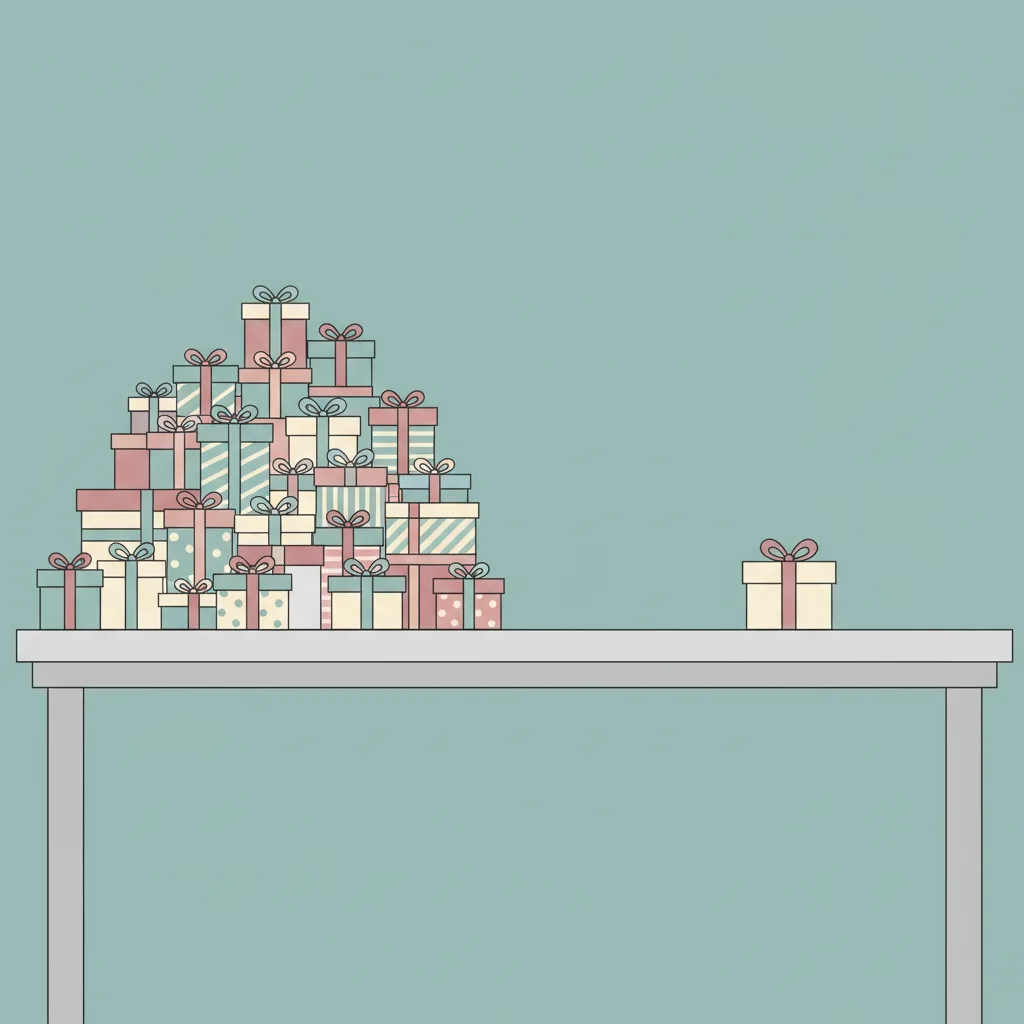
Membelikan cucu (atau anak) setiap mainan dan hadiah yang diminta vs. menahan diri dalam memberi hadiah dan berkata tidak
Jika Anda bertindak
Memanjakan dengan hadiah — jarang menolak
40%
Jika Anda tidak bertindak
Memberi hadiah secukupnya — menolak, mengikuti batas orang tua
14%
Persentase orang yang kemudian menyesali setiap pilihan. Diagram batang dan catatan lengkap ditampilkan di bawah.
Family
Terakhir ditinjau 2026-05-05
Kualitas bukti 3.88/5
Skor tinjauan delapan dimensi terhadap
rubrik kualitas
. Setiap dimensi dinilai 1–5.
D1 Verifikasi sumber
4/5
D2 Otoritas & independensi sumber
4/5
D3 Akurasi tingkat penyesalan
3/5
D4 Keterbandingan sumber
4/5
D5 Pola Gilovich
5/5
D6 Kualitas prosa
4/5
D7 Kelengkapan peringatan
4/5
D8 Kualitas sampel
3/5
Rata-rata3.88/5
Data proksi — tidak ada survei penyesalan langsung untuk keputusan ini. Tingkat diturunkan dari skor kepuasan dan data hambatan akses daripada pertanyaan yang langsung menanyakan tentang penyesalan. Lihat peringatan di bawah.
Penyesalan atas tindakan
Memanjakan dengan hadiah — jarang menolak
40%
40% orang tua mengatakan kakek-nenek terlalu lunak atau permisif (proxy)
Orang tua AS dari anak usia 0-18 yang melaporkan ketidaksepakatan dengan kakek-nenek (subset dari sampel representatif nasional n=2.016)
lintas-seksional, dilakukan Januari-Februari 2020
Penyesalan atas kelambanan
Memberi hadiah secukupnya — menolak, mengikuti batas orang tua
14%
14% orang tua mengatakan kakek-nenek terlalu ketat atau keras (proxy)
Orang tua AS dari anak usia 0-18 yang melaporkan ketidaksepakatan dengan kakek-nenek (subset dari sampel representatif nasional n=2.016)
lintas-seksional, dilakukan Januari-Februari 2020
% menyesal dengan pilihan ini
Memanjakan dengan hadiah — jarang menolakMemberi hadiah secukupnya — menolak, mengikuti batas orang tua
40%14%
action dominates — Bertindak mendominasi — sebagian besar menyesali karena bertindak.
Keputusan terkait
Keputusan yang serupa secara semantik — area yang sama, kompromi yang berbeda.
Among US parents who report disagreements with a grandparent about child-rearing, 40% attribute those disagreements to grandparents being too soft or lenient, compared with only 14% who say grandparents are too tough, a nearly 3:1 ratio within the same response scale from a C.S. Mott Children’s Hospital National Poll of 2,016 nationally representative US parents fielded in January–February 2020. The asymmetry holds even though the dominant cultural script around grandparenting celebrates indulgence: “spoiling” is often described as a grandparent’s right, yet parents experiencing it in practice flag the leniency direction at three times the rate of the restraint direction. Both rates come from the same survey and the same subset of disagreement-reporting parents, making the cross-group comparison the most direct parallel evidence available on this bilateral question. Neither figure measures grandparent self-regret about their choices; both reflect parental observation of the downstream costs, and are flagged throughout as proxy estimates.
The child-development literature independently supports the direction of this asymmetry. Bredehoft, Mennicke, Potter, and Clarke (1998), writing in the Journal of Family and Consumer Sciences Education, surveyed 730 adults and found that the 124 who self-identified as adult children of overindulgence reported, as a great majority (71%), lasting difficulty as adults knowing what is enough or what is normal, a consequence that persisted long after the material gifts were forgotten. On the developmental side, Dauch, Imwalle, Ocasio, and Metz (2018) published an experiment in Infant Behavior and Development showing that toddlers given access to four toys rather than sixteen played for longer durations and in markedly more sophisticated ways, suggesting that abundance itself displaces the focused engagement that promotes cognitive and attentional development. The restraint literature does not argue that gift refusal has no costs; a grandparent who is consistently tight or withholding creates a different friction, but the outcome evidence clusters more heavily against excess than against moderation.
The Gilovich framework predicts that action regrets (having been too generous, having never said no) are salient and interpersonally costly in the present (parents notice and object), while inaction regrets (having been too restrained) tend to crystallize later and more privately, if at all. The 2.9:1 ratio in parental conflict reports is consistent with this temporal asymmetry. The primary caveat is that the Mott data captures a relational friction between generations, not a direct self-regret measurement by the gift-giving party; grandparents themselves may weight the same behavior differently. Research identifying relational and structural overindulgence as more harmful than pure material excess also suggests the action-side risk may be somewhat overstated when isolated to toy and gift quantity specifically.
Sumber: tindakan
Buku besar klaim
Setiap angka di bawah ini adalah apa yang dilaporkan masing-masing sumber, dengan kutipan kata demi kata yang kami andalkan dan bagaimana kami sampai pada angka kami. Klik tautan mana saja untuk memverifikasi langsung.
3/3 sumber diverifikasi secara independen kata demi kata terhadap sumber terkutip
[1]C.S. Mott Children's Hospital National Poll on Children's Health, University of Michigan — When parents and grandparents disagree
Terverifikasi
Sumber referensi
40% of parents say disagreements with grandparents occur because grandparents are too soft on the child; 14% say grandparents are too tough; 6% report major disagreements and 37% minor disagreements
Kutipan
“"Among parents who say they have had disagreements with a grandparent about how the grandparent cares for their child, 40% say the disagreements occur because grandparents are too soft on the child, while 14% say grandparents are too tough."
”
Data sumber dari
2020-08-17
Diakses
2026-05-04
Verifikasi
Kutipan diambil ulang secara independen dan dikonfirmasi kata demi kata terhadap sumber terkutip selama audit pendasaran kami.
Perhitungan
C.S. Mott Children's Hospital National Poll on Children's Health (Vol. 36, Issue 5, August 2020). Survey of 2,016 US parents of children ages 0–18, randomly selected and stratified. Among parents who reported disagreements with a grandparent, 40% attributed those disagreements to grandparents being too lenient or soft. This is used as the action-side proxy for regret: parents registering that uninhibited gift-giving and leniency is a problem conflicting with their child-rearing choices. The 40% is not a direct self-report of grandparent regret — it is parental observation of the costs of overindulgence — flagged as "(proxy)".
[2]Journal of Family and Consumer Sciences Education (Bredehoft, Mennicke, Potter & Clarke) — Perceptions attributed by adults to parental overindulgence during childhood
Terverifikasi
Telaah sejawat
71% of adult children of overindulgence (ACOs; n=124 self-identified from 730 surveyed) reported difficulty as adults knowing what is enough or what is normal; ACOs simultaneously felt loved, confused, guilty, bad and sad about the overindulgence
Kutipan
“"The great majority (71%) of the overindulged subjects reported having difficulty knowing what is enough, or what is normal as adults. ACOs simultaneously felt both positively and negatively about the overindulgence, that is, they felt loved, confused, guilty, bad and sad."
”
Data sumber dari
1998-10-01
Diakses
2026-05-04
Verifikasi
Kutipan diambil ulang secara independen dan dikonfirmasi kata demi kata terhadap sumber terkutip selama audit pendasaran kami.
Perhitungan
Bredehoft, Mennicke, Potter & Clarke (1998), Journal of Family and Consumer Sciences Education, 16(2), 3–17. Survey of 730 subjects; 124 self-identified as adult children of overindulgence (ACO). The 71% figure applies to the ACO subsample (n=124), not to the full 730. This source does not supply the 40% action-rate; it corroborates the direction of harm from overindulgent material gifting by showing that adults retrospectively raised that way report lasting difficulty calibrating sufficiency. The population is different (adult self-report on childhood, not current parental observation), but the convergence supports the action-side framing.
[3]C.S. Mott Children's Hospital National Poll on Children's Health, University of Michigan — Parent efforts to teach children about gratitude
Terverifikasi
Sumber referensi
58% of US parents of children ages 4–10 worry that they are giving their children too much
Kutipan
“"Over half of parents (58%) worry that they are giving their children too much, while 42% say they sometimes are embarrassed by how selfish their child acts."
”
Data sumber dari
2021-10-01
Diakses
2026-05-05
Verifikasi
Kutipan diambil ulang secara independen dan dikonfirmasi kata demi kata terhadap sumber terkutip selama audit pendasaran kami.
Perhitungan
C.S. Mott Children's Hospital National Poll on Children's Health, University of Michigan. N=1,125 parents with at least one child age 4–10, fielded June 2021. The 58% worry-about-over-giving rate documents that concern about material excess is widespread among the parenting generation — even before grandparent gift-giving is layered on top. This source measures worry (a prospective concern), not retrospective regret, and covers parent-to-child giving rather than grandparent-to-grandchild giving. It does not supply the action-side 40% proxy rate; that comes from Mott 2020. It corroborates the cultural prevalence of over-giving concern and provides independent evidence that parents themselves recognise an excess problem in their households, which is relevant context for the grandparent layer of the same dynamic.
Independensi
Independent from Mott 2020 (different survey wave, Vol. 39 Issue 5 vs Vol. 36 Issue 5, different sample frame: parents of children 4–10 vs parents of children 0–18, different topic focus: gratitude vs grandparent disagreements).
Sumber: tidak bertindak
Buku besar klaim
Setiap angka di bawah ini adalah apa yang dilaporkan masing-masing sumber, dengan kutipan kata demi kata yang kami andalkan dan bagaimana kami sampai pada angka kami. Klik tautan mana saja untuk memverifikasi langsung.
1/2 sumber diverifikasi secara independen kata demi kata terhadap sumber terkutip
[1]C.S. Mott Children's Hospital National Poll on Children's Health, University of Michigan — When parents and grandparents disagree
Terverifikasi
Sumber referensi
14% of parents say disagreements with grandparents occur because grandparents are too tough on the child, vs 40% who say grandparents are too soft
Kutipan
“"Among parents who say they have had disagreements with a grandparent about how the grandparent cares for their child, 40% say the disagreements occur because grandparents are too soft on the child, while 14% say grandparents are too tough."
”
Data sumber dari
2020-08-17
Diakses
2026-05-04
Verifikasi
Kutipan diambil ulang secara independen dan dikonfirmasi kata demi kata terhadap sumber terkutip selama audit pendasaran kami.
Perhitungan
Same Mott 2020 survey (n=2,016). The 14% who say grandparents are too tough is used as the inaction-side proxy for regret: the share of cases where restraint and limit-setting is itself the source of conflict and parental concern. This is not grandparent self-regret about being too strict; it is parents flagging that restraint has gone too far. Flagged as "(proxy)". The 40%:14% ratio (2.9:1) from the same survey and same response scale makes the comparison directly valid across sides.
[2]Infant Behavior and Development (Dauch, Imwalle, Ocasio & Metz) — The influence of the number of toys in the environment on toddlers' play
Telaah sejawat
Toddlers with access to 4 toys (vs 16) showed longer duration of toy play and played in more sophisticated ways; fewer toys led to higher-quality, more sustained engagement
Kutipan
“"With fewer toys, participants had fewer incidences of toy play, longer durations of toy play, and played with toys in a greater variety of ways. The findings suggest that an environment with fewer toys may better support toddlers' play."
”
Data sumber dari
2018-02-01
Diakses
2026-05-04
Perhitungan
Dauch, Imwalle, Ocasio & Metz (2018), Infant Behavior and Development, 50, 78–87. Experimental study with n=36 toddlers ages 18–30 months; each child played under two conditions (4 toys and 16 toys). This source does not supply the 14% inaction rate; it corroborates the developmental case for restraint in gifting by showing that fewer toys produce demonstrably richer play. The finding supports why restrained gift-giving is not costless but is substantially less problematic than excess — the inaction-dominates concern is not supported by child development data.
Catatan
Kedua tingkat berasal dari survei Mott 2020 yang sama (n=2.016) dan mengukur pengamatan orang tua terhadap perilaku kakek-nenek, bukan penyesalan-diri kakek-nenek tentang pilihan pemberian-hadiah mereka sendiri. 40% dan 14% diambil dari subset orang tua yang melaporkan ketidaksepakatan dengan kakek-nenek — bukan dari sampel penuh — yang berarti penyebut lebih kecil dan perbandingan mencerminkan arah konflik daripada tingkat prevalensi tanpa syarat. Tidak satu angka pun adalah pengukuran penyesalan langsung; keduanya ditandai sebagai "(proxy)". Temuan Bredehoft et al. (1998) bahwa 71% orang dewasa yang terlalu dimanja melaporkan kesulitan abadi mengkalibrasi kecukupan diambil dari sub-sampel yang jauh lebih kecil (n=124 ACO yang teridentifikasi-sendiri dari 730 yang disurvei), menggunakan laporan-diri retrospektif, dan mencakup semua bentuk overindulgence — bukan hanya hadiah materi. Penelitian secara konsisten mengidentifikasi overindulgence relasional dan struktural sebagai lebih berbahaya daripada kelebihan material murni, sehingga risiko sisi-tindakan mungkin agak dilebih-lebihkan jika entri dibaca seolah-olah hanya berlaku untuk kuantitas mainan dan hadiah. Eksperimen Dauch et al. (2018) terbatas pada balita di ruang bermain lab; generalisasi ke akumulasi hadiah dunia-nyata selama berbulan-bulan dan bertahun-tahun masuk akal tetapi tidak diuji langsung. Tidak ada survei skala besar yang secara langsung menanyakan kakek-nenek "apakah Anda menyesali membeli terlalu banyak?" atau "apakah Anda menyesali terlalu membatasi dengan hadiah?" — data semacam itu tampaknya tidak ada dalam literatur yang diterbitkan.