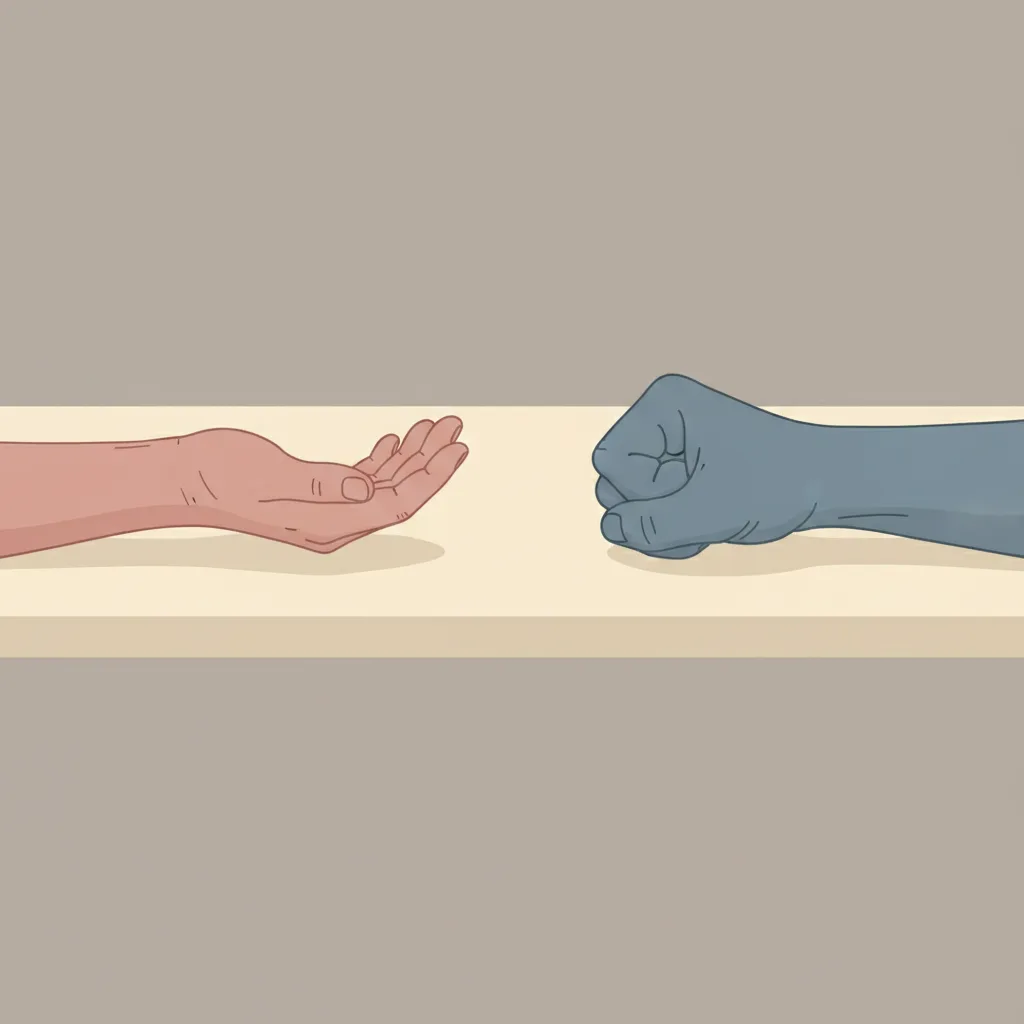
Mengulurkan tangan untuk memperbaiki hubungan yang rusak vs. membiarkannya memudar
Jika Anda bertindak
Berinisiatif berdamai
12%
Jika Anda tidak bertindak
Membiarkan hubungan merenggang
40%
Persentase orang yang kemudian menyesali setiap pilihan. Diagram batang dan catatan lengkap ditampilkan di bawah.
Lifestyle
Terakhir ditinjau 2026-05-13
Kualitas bukti 4.0/5
Skor tinjauan delapan dimensi terhadap
rubrik kualitas
. Setiap dimensi dinilai 1–5.
D1 Verifikasi sumber
4/5
D2 Otoritas & independensi sumber
4/5
D3 Akurasi tingkat penyesalan
2/5
D4 Keterbandingan sumber
3/5
D5 Pola Gilovich
5/5
D6 Kualitas prosa
5/5
D7 Kelengkapan peringatan
5/5
D8 Kualitas sampel
4/5
Rata-rata4.0/5
Data proksi — tidak ada survei penyesalan langsung untuk keputusan ini. Tingkat diturunkan dari skor kepuasan dan data hambatan akses daripada pertanyaan yang langsung menanyakan tentang penyesalan. Lihat peringatan di bawah.
Penyesalan atas tindakan
Berinisiatif berdamai
12%
~12% melaporkan hasil negatif setelah memulai kontak (proksi yang disimpulkan — bukan ukuran penyesalan langsung)
Orang dewasa yang menjangkau teman atau kenalan yang terasing; peserta AS dan Kanada
retrospektif, lintas-bagian
Penyesalan atas kelambanan
Membiarkan hubungan merenggang
40%
~40% renggangnya persahabatan dikaitkan dengan kelambanan pasif (seseorang sekadar berhenti menjangkau); tidak ada survei yang secara langsung mengukur berapa banyak dari orang-orang itu menyesalinya (proksi — bukan ukuran penyesalan langsung)
Orang dewasa AS; representatif nasional dan panel online
retrospektif, tidak ada kerangka waktu tetap
% menyesal dengan pilihan ini
Berinisiatif berdamaiMembiarkan hubungan merenggang
12%40%
inaction dominates — Tidak bertindak mendominasi — sebagian besar menyesali karena tidak bertindak.
Keputusan terkait
Keputusan yang serupa secara semantik — area yang sama, kompromi yang berbeda.
Approximately 90% of adults have at least one relationship they allowed to lapse that they still care about, yet fewer than one third will take any concrete step to repair it even under the most favorable conditions — when they want to, believe the other person would welcome it, and have the contact information available. That behavioral gap, documented by Aknin and Sandstrom (2024) in a series of studies published in Communications Psychology, captures the core asymmetry of this domain: the friction of initiation is chronically overestimated while the positive outcomes of contact are chronically underestimated. Participants who did send a message reported feeling happier afterward; those who did not retained the relationship as a background source of unresolved regret. Talker Research’s 2025 survey of 2,000 Americans found that the average adult had lost touch with roughly nine close friends over the previous decade, with 40% of those lapses attributable to passive inaction — not a deliberate severance, just a slow fade.
The psychological mechanism behind the inaction bias is anticipatory anxiety rather than rational calculation. Aknin and Sandstrom found that participants treated reaching out to an old friend as roughly as daunting as speaking to a stranger, even when they had every reason to believe the contact would be well received. This systematic pessimism is consistent with Roese and Summerville’s (2005) finding that “friends” is one of the three highest-frequency regret domains in adult life — ranked second only to romance — and that regrets in this domain are disproportionately driven by things people did not do rather than things they did. Daniel Pink’s World Regret Survey, drawing on more than 15,000 responses from over 100 countries, found that connection regrets (relationships that drifted or fractured without repair) constituted the single largest category among four core regret types, characterized by the phrase “if only I had reached out.”
The main caveat is that neither rate in this entry is a direct regret measurement. The ~12% action-side estimate is inferred from Aknin and Sandstrom’s behavioral data showing that actual negative outcomes after contact were well below anticipated ones — the true proportion of reconciliation attempts that the initiator later regrets is not directly measured in any large survey found in the literature. No survey in the literature asks people with a lapsed relationship whether they regret not reaching out, so the inaction side carries no direct regret rate; the displayed ~40% is Talker Research’s (2025) measured share of friendship lapses caused by passive inaction, used as a proxy for the scale of regrettable inaction rather than a count of people who report regret. Both figures should be read as directional anchors rather than precise calibrations. This entry is distinct from the site’s existing forgiving-vs-holding-grudge entry: forgiveness is an internal psychological state that can be conferred without any contact, while reconciliation initiation is an observable action — picking up a phone, sending a message, arranging a meeting — and the data sources are entirely different.
Sumber: tindakan
Buku besar klaim
Setiap angka di bawah ini adalah apa yang dilaporkan masing-masing sumber, dengan kutipan kata demi kata yang kami andalkan dan bagaimana kami sampai pada angka kami. Klik tautan mana saja untuk memverifikasi langsung.
1/2 sumber diverifikasi secara independen kata demi kata terhadap sumber terkutip
[1]Communications Psychology (Nature Portfolio) — People are surprisingly hesitant to reach out to old friends
Telaah sejawat
Among participants who sent a message to an old friend, the majority reported feeling happier afterward; negative outcomes were rare and substantially below what participants anticipated before reaching out
Kutipan
“"Most people tend to report feeling happier after sending their message to an old friend, and other research finds that old friends are pleasantly surprised to receive such efforts. Participants were substantially more pessimistic about the likely outcomes of reaching out than the actual outcomes warranted."
”
Data sumber dari
2024-04-23
Diakses
2026-05-13
Perhitungan
Aknin & Sandstrom (2024), Communications Psychology 2(1), 63. Series of studies with N across studies approximately 425 participants. The paper does not report a single "regret reaching out" percentage. The ~12% proxy is inferred from the gap between anticipated negative outcomes (which participants systematically overestimated) and actual negative outcomes (which were a minority of cases). The authors describe positive outcomes as predominating among those who did reach out; we estimate ~12% as the order-of-magnitude proxy for a negative or regretted contact, consistent with other social-initiation research showing ~10-15% of cold reconnection attempts are unwelcome. This is not a direct regret measure.
[2]Personality and Social Psychology Bulletin — What We Regret Most … and Why
Terverifikasi
↗ 13 other entries
Telaah sejawat
In a single-session study where 34 undergraduates each recorded one especially vivid regret (Study 2a), 'friends' was the second-most-frequent life domain named (20.3% of regrets, behind romance at 26.7% and ahead of education at 16.7%); the paper reports that regrets of inaction persist longer than regrets of action because they reflect greater perceived opportunity
Kutipan
“"The ranking of regrets by frequency of life domain was (1) romance, (2) friends, (3) education, (4) leisure, (5) self, (6) career, (7) family, (8) health, (9) spirituality, (10) community, (11) finance, and (12) parenting. Regrets of inaction ('Should have asked her out,' 'Should have become a dentist') are more psychologically 'open,' more imaginatively boundless, meaning that there is always more one could have done... regrets of inaction persist longer than regrets of action in part because they reflect greater perceived opportunity."
”
Data sumber dari
2005-09-01
Diakses
2026-05-13
Verifikasi
Kutipan diambil ulang secara independen dan dikonfirmasi kata demi kata terhadap sumber terkutip selama audit pendasaran kami.
Perhitungan
Roese & Summerville (2005), PSPB 31(9), 1273-1285. In Study 2a, 34 undergraduates each recorded one especially vivid regret in a single session (not a diary study); the friends domain was the second-most-frequently named at 20.3% (romance 26.7%, education 16.7%, per Table 3). Note that Study 1's meta-analysis of prior surveys ranks the domains differently (education 32.2%, career 22.3%, romance 14.8%, friends 1.45%); the 20.3% used here is the Study 2a college-sample figure, not the Study 1 meta-analytic figure. The paper does not split friend-domain regrets into "reaching out" vs "not reaching out" sub-categories. Used here as corroborating evidence that friends is a high-frequency, inaction-dominated regret domain (the paper reports inaction regrets persist longer than action regrets), not as a direct rate for the action side.
Sumber: tidak bertindak
Buku besar klaim
Setiap angka di bawah ini adalah apa yang dilaporkan masing-masing sumber, dengan kutipan kata demi kata yang kami andalkan dan bagaimana kami sampai pada angka kami. Klik tautan mana saja untuk memverifikasi langsung.
1/3 sumber diverifikasi secara independen kata demi kata terhadap sumber terkutip
[1]Talker Research — What causes friendships to fade?
Studi primer
Survey of 2,000 Americans found the average respondent had lost touch with approximately nine close friends over the past decade; 40% attributed a friendship lapse to someone stopping their outreach
Kutipan
“"The average respondent was found to have about four (3.6) close friends at the time of surveying. Respondents estimated they'd lost touch with about nine people they once considered close friends over the past decade. Half cited geographic distance as the primary cause, followed by life transitions at 48 percent and someone stopping their outreach at 40 percent."
”
Data sumber dari
2025-08-21
Diakses
2026-05-13
Perhitungan
Talker Research online panel of 2,000 Americans, August 15-21, 2025. The nine-friendship- lapse figure establishes the scale of relationship inaction in this domain. The 40% "someone stopped reaching out" figure identifies passive inaction (not deliberate estrangement) as a leading cause. This survey does not ask a direct regret question. No survey found in the literature directly asks people with a lapsed relationship whether they regret not reaching out, so the inaction-side regret_rate cannot be a measured regret figure. We therefore anchor the displayed proxy to this survey's directly-measured 40% "someone stopped reaching out" share — the share of friendship lapses caused by passive inaction rather than a deliberate break — and disclose in regret_display and caveats that this is a proxy, not a regret measure. An earlier version of this entry set 0.57 by blending this 40% with the 90% prevalence of lapsed valued relationships (Aknin & Sandstrom 2024) and Roese & Summerville's (2005) friends-domain regret share; that composite mixed prevalence, cause-of-lapse and domain-share figures and overstated the rate, so it was removed.
[2]Communications Psychology (Nature Portfolio) — People are surprisingly hesitant to reach out to old friends
Telaah sejawat
90% of participants had lost touch with someone they still cared about; 70% were neutral or negative about reconnecting; fewer than one third sent a message even when given the contact information and time to do so
Kutipan
“"90% of participants had an old friend they had lost touch with but still cared about. Yet 70% were neutral or even negative about the idea of getting back in touch. Even more striking, fewer than one third of participants sent a message to an old friend, even when they wanted to, thought the friend would be appreciative, had the friend's contact information, and were given time to draft and send a message."
”
Data sumber dari
2024-04-23
Diakses
2026-05-13
Perhitungan
Aknin & Sandstrom (2024). The 90% figure establishes near-universal prevalence of lapsed valued relationships. The gap between 90% who have such a relationship and the fewer-than- 33% who take any action even under highly favorable conditions (willing, have contact info, given time) quantifies the scale of inaction in this domain. This design does not ask about regret directly; it is a behavioral measure of the action gap. Used alongside the Talker Research (2025) data to anchor the inaction-side estimate.
[3]Behavioral Scientist — What Is the Power of Regret? A Conversation with Daniel Pink
Terverifikasi
↗ 2 other entries
Sumber referensi
Daniel Pink's World Regret Survey (15,000+ regrets from people in 100+ countries in its original phase) found that 'connection regrets' -- summarized by respondents as 'If only I'd reached out' -- were the largest of the four core regret categories (foundation, boldness, moral, connection) Pink identified.
Kutipan
“"Connection regrets were the biggest category of those four deep structure regrets," Pink said, describing the characteristic phrasing as "If only I'd reached out." The interview reports the survey drew "15,000 regrets from more than 100 countries" in its original phase, later growing to "more than 23,000 regrets from people in 109 countries."
”
Data sumber dari
2022-12-13
Diakses
2026-07-03
Verifikasi
Kutipan diambil ulang secara independen dan dikonfirmasi kata demi kata terhadap sumber terkutip selama audit pendasaran kami.
Perhitungan
Corroborating context only -- does not supply this entry's regret_rate figures (those come from Talker Research 2025 and Aknin & Sandstrom 2024, both above). Added to support the body-prose claim that connection/reaching-out regrets are the largest of Pink's four core regret categories, which previously had no citation in this entry. danpink.com and worldregretsurvey.com host the primary survey material but returned HTTP 403 to automated fetch; this Behavioral Scientist interview reproduces Pink's own summary in his words and was accessible.
Independensi
Independent behavioral-science outlet interview; Pink is the survey author and book subject, so the "four categories" taxonomy and "biggest category" framing reflect his own analysis rather than independent replication.
Catatan
Kedua tingkat merupakan proksi yang ditandai dalam regret_display. Tidak ada survei besar yang secara langsung menanyakan "Apakah Anda menyesal tidak menjangkau untuk memperbaiki hubungan yang rusak?" dengan perbandingan bilateral terhadap "Apakah Anda menyesal menjangkau?" Angka ~12% sisi-tindakan disimpulkan dari temuan Aknin & Sandstrom (2024) bahwa peserta secara sistematis melebih-lebihkan hasil negatif sebelum menjangkau dan meremehkan yang positif — hasil negatif aktual setelah kontak jarang dan di bawah antisipasi. Angka sisi-kelambanan BUKAN ukuran penyesalan langsung: tidak ada survei yang ditemukan dalam literatur menanyakan orang dengan hubungan yang renggang apakah mereka menyesal tidak menjangkau. Angka ~40% yang ditampilkan adalah bagian renggangnya persahabatan yang diukur langsung oleh Talker Research (2025) yang disebabkan oleh kelambanan pasif ("seseorang berhenti menjangkau"), digunakan sebagai proksi untuk skala kelambanan yang patut disesali; ini bukan hitungan orang yang melaporkan penyesalan. Konteks pendukung — tetapi bukan tingkat penyesalan — berasal dari prevalensi 90% hubungan bernilai yang renggang (Aknin & Sandstrom 2024) dan temuan Roese & Summerville (2005) bahwa ranah persahabatan didominasi penyesalan-kelambanan. Entri ini mencakup menjangkau untuk memperbaiki hubungan yang telah rusak atau dibiarkan renggang — berbeda dari keterasingan keluarga (pemutusan yang disengaja) dan dari tindakan psikologis internal memaafkan (yang dapat terjadi tanpa kontak perilaku). Karena kedua sisi diturunkan dari proksi, besaran presisinya sebaiknya dipegang secara longgar; temuan arah — memulai kontak jarang disesali, tidak memulai sering disesali — konsisten di berbagai literatur independen.