


本文へスキップ
Likelier

行動 vs. 不行動の後悔

カップル・夫婦療法を始める vs カップル療法に行かない

行動した場合

カップル療法に通った

27%

行動しなかった場合

カップル療法を受けなかった

33%

それぞれの選択を後で後悔した人の割合。バーと完全な記録は下に表示されます。


家族

最終確認 2026-05-22

証拠の質 4.38/5

8次元のレビュー評価。基準は 品質ルーブリック 。各次元は1〜5で評価。

D1 出典の検証
5/5
D2 出典の権威性と独立性
5/5
D3 後悔率の正確性
4/5
D4 出典の比較可能性
2/5
D5 ギロヴィッチ・パターン
5/5
D6 文章の質
5/5
D7 注意事項の完全性
5/5
D8 サンプルの質
4/5
平均 4.38/5
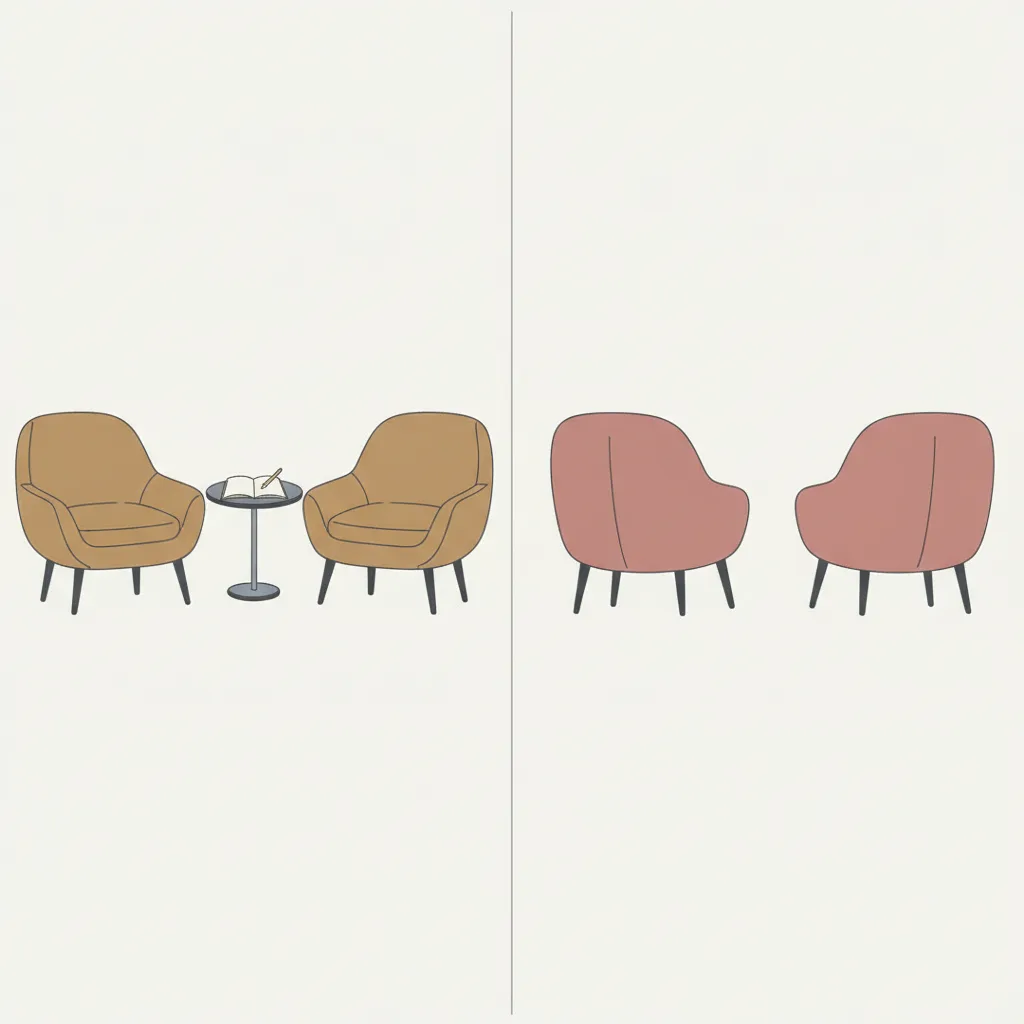
Two chairs angled toward each other with a small table and a notepad on the left, and the same chairs facing away from each other on the right
代替データ — この決断に関する直接的な後悔調査は存在しません。比率は後悔を直接尋ねる質問ではなく、満足度スコアとアクセス障壁のデータから導出されています。以下の注意事項を参照してください。

行動への後悔

カップル療法に通った

27%

セラピーに通う夫婦の約29%が5年以内に離婚または臨床的に重大な悪化を示す(後悔のための結果ベースのプロキシ)

夫婦療法のランダム化比較試験に登録された深刻に苦悩する既婚夫婦、米国の臨床サンプル

治療終了後5年間の追跡

不作為への後悔

カップル療法を受けなかった

33%

夫婦療法に決して通わない夫婦の約42%が離婚または解決されない関係苦悩に直面(不作為後悔のためのプロキシ)

夫婦療法を求めない苦悩する既婚夫婦、結果データは無治療コントロールおよび米国人口離婚データから取得

横断的および縦断的; 複数の研究ウィンドウ

この選択を後悔した割合

inaction dominates — 不作為が優勢 — 多くは行動しなかったことを後悔しています。

関連する決断

意味的に類似する決断 — 同じ領域、異なるトレードオフ。

family

家族調停 vs 訴訟

この選択を後悔した割合

不作為が優勢

不作為の後悔が3.1倍高い

健康

セラピーあり・なし

この選択を後悔した割合

均衡

ほぼ均衡

family

最初の相手と結婚 vs. もっと付き合う

この選択を後悔した割合

行動が優勢

行動の後悔が1.9倍高い

family

浮気の後悔

この選択を後悔した割合

行動が優勢

行動の後悔が3.7倍高い

family

離婚

この選択を後悔した割合

均衡

ほぼ均衡

lifestyle

オープン vs 一夫一婦制

この選択を後悔した割合

不作為が優勢

不作為の後悔が1.4倍高い

family

若くして結婚 vs. 待つ

この選択を後悔した割合

行動が優勢

行動の後悔が1.5倍高い

健康

リハビリへの介入 vs 待つ

この選択を後悔した割合

不作為が優勢

不作為の後悔が1.8倍高い

Among couples who entered couple therapy in the most rigorous available randomised trial, 26-28% were separated or divorced at the 5-year follow-up, and only 48% showed sustained clinically significant improvement (Christensen et al., 2010, n=134 chronically distressed couples). Among US adults broadly, 66% have never attended or considered couple therapy (Grow Therapy/YouGov, December 2025, n=2,514), and nationally about a third of first marriages end in separation or divorce within 10 years (CDC/NCHS, National Survey of Family Growth) — a structural floor for the harm distressed non-attenders face, since deterioration among that sub-population runs higher still. The bilateral comparison points consistently toward inaction dominating: couples who do not seek help rarely improve on their own, and relationship distress compounds over the 2.68 years (Doherty et al., 2021, n=270) the average help-seeking couple waits before entering therapy — let alone for the much larger group that never goes at all.

The action-side data require careful reading. The Christensen trial recruited seriously and chronically distressed couples who volunteered for a clinical research program — a help-motivated, high-distress sample unlikely to represent the full range of couples who attend therapy in everyday clinical practice. Of the 26-28% who divorced within 5 years, many had entered therapy precisely to manage an already-failing relationship; the Grow Therapy survey finding that 56% of divorced therapy-attenders described their attendance as “a final attempt to prevent a split” suggests purposeful rather than regret-laden attendance. At the same time, only 56% of couples who showed clinically significant improvement at end of treatment maintained that improvement at the 5-year mark (Baucom et al., 2015), confirming that gains are not durable for a substantial minority. The 27% action-side proxy is the directly-measured separation/divorce rate; because only 48% of couples showed durable improvement, it likely understates outcome-based regret rather than overstating it.

The inaction side is harder to measure directly because no large-scale survey asks people who never attended therapy whether they regret that decision. The 33% inaction proxy is the CDC/NCHS National Survey of Family Growth probability that a first marriage ends in separation or divorce within 10 years, used as a conservative structural floor: distressed couples who receive no treatment rarely improve on their own, meaning actual deterioration or dissolution among relationship-distressed non-attenders is higher than this all-first-marriage figure. The 6-percentage-point inaction-dominance gap should not be read as a precise effect size; the uncertainty on the inaction side is wide and the true rate for distressed non-attenders is likely substantially higher than 33%. Both the action and inaction estimates share a common limitation: they reflect outcomes, not regret, and outcome data systematically miss the couples who were distressed, never sought help, and eventually experienced relationship improvement that made them glad they never went.

出典: 行動

根拠台帳

以下の各数値は各出典が報告した内容であり、引用した原文の抜粋と算出方法を記載しています。リンクをクリックして直接確認できます。

2/2 件の出典が引用元と一字一句一致することを独立して検証済み

  1. [1] Journal of Consulting and Clinical Psychology — Marital Status and Satisfaction Five Years Following a Randomized Clinical Trial Comparing Traditional Versus Integrative Behavioral Couple Therapy 検証済み
    Marital Status and Satisfaction Five Years Following a Randomized Clinical Trial Comparing Traditional Versus Integrative Behavioral Couple Therapy
    統計値
    At 5-year follow-up, 25.7% of IBCT and 27.9% of TBCT couples were separated or divorced; 48% (combined average) showed clinically significant improvement; effect sizes d=1.03 (IBCT) and d=0.92 (TBCT) for satisfaction vs pretreatment
    抜粋
    “"At 5-year follow-up for marital satisfaction relative to pretreatment, effect sizes were d = 1.03 for IBCT and d = 0.92 for TBCT; 50.0% of IBCT couples and 45.9% of TBCT couples showed clinically significant improvement. 25.7% of IBCT couples and 27.9% of TBCT couples were separated or divorced." ”
    出典データ
    2010-04-01
    アクセス日
    2026-05-22
    検証
    グラウンディング監査の際、抜粋を引用元から独立して再取得し、原文と一字一句一致することを確認しました。
    計算過程
    Christensen, Atkins, Baucom & Yi (2010), Journal of Consulting and Clinical Psychology, 78(2):225-235. PMID 20350033. RCT of 134 seriously and chronically distressed married couples randomly assigned to ~8 months of IBCT or TBCT. At 5-year follow-up, marital status was obtained for all 134 couples; at least one partner in 119 (89%) completed satisfaction measures. Combined separation/divorce rate: (25.7 + 27.9) / 2 = 26.8%, rounded to 0.27 — this directly-measured separation/divorce rate is the action-side regret proxy. The separation/divorce outcome does not capture direct regret: a couple that divorces may still regard entering therapy as the right decision, and a couple that remains together but is unhappy may deeply regret having gone. Only 48% (combined) showed clinically significant improvement at 5 years, so the 0.27 proxy likely understates the share who regret the outcome; it is retained as the sole directly-measured figure rather than inflated with an unmeasured deterioration adjustment.
  2. [2] Journal of Family Psychology (PMC) — Prediction of Treatment Response at 5-year Follow-up in a Randomized Clinical Trial of Behaviorally Based Couple Therapies 検証済み
    Prediction of Treatment Response at 5-year Follow-up in a Randomized Clinical Trial of Behaviorally Based Couple Therapies
    統計値
    Only 56% of couples who showed clinically significant improvement at treatment termination still showed improvement at the 5-year follow-up; substantial between-couple variability in long-term outcomes
    抜粋
    “"Only 56% of couples who reported clinically significant improvement or recovery at treatment termination also reported clinically significant improvement or recovery at the five year follow-up." ”
    出典データ
    2015-01-01
    アクセス日
    2026-05-22
    検証
    グラウンディング監査の際、抜粋を引用元から独立して再取得し、原文と一字一句一致することを確認しました。
    計算過程
    Baucom, Atkins, Rowe, Doss & Christensen (2015), Journal of Family Psychology, 28(5):711-720. PMC4324126. Same 134-couple RCT dataset with 5-year follow-up data from Christensen et al. (2010). The 56% figure (of those who improved at end of treatment, only 56% maintained improvement at 5 years) corroborates the action-side durability caveat: even among couples who responded to therapy, relapse is common. This source is included to show that the action-side regret proxy (0.27) may understate outcome-based regret given the high rate of deterioration even among initial treatment responders; it does not independently generate the 0.27 figure.

出典: 不作為

根拠台帳

以下の各数値は各出典が報告した内容であり、引用した原文の抜粋と算出方法を記載しています。リンクをクリックして直接確認できます。

  1. [1] Grow Therapy / YouGov — 2026 Couples Therapy Survey: Growing Stronger Together
    2026 Couples Therapy Survey: Growing Stronger Together
    統計値
    Survey of 2,514 US adults (YouGov, December 2025): 66% have never attended couple therapy and never considered it; 56% of divorced therapy-attenders described it as a final attempt to prevent a split; 19% realized their relationship was no longer sustainable after attending
    抜粋
    “"71% saw noticeable improvement in their relationship. 19% realized their relationship was no longer sustainable after attending. 66% have never attended and never considered it. 56% of divorced individuals tried couples therapy described their attendance as a final attempt to prevent a split." ”
    出典データ
    2025-12-22
    アクセス日
    2026-05-22
    計算過程
    Grow Therapy / YouGov online panel, n=2,514 US adults 18+, fieldwork December 18-22, 2025, weighted to represent US adult population. This survey establishes the help-seeking context for the inaction side: 66% of US adults have never attended and never considered couple therapy, and 19% of those who did attend realized their relationship was no longer sustainable. The survey does NOT report a divorce or regret rate for non-attenders, so it cannot by itself fix the inaction-side proxy. The inaction regret rate (0.33) is therefore grounded in the CDC/NCHS National Survey of Family Growth (added as a co-source below): the probability of a first marriage ending in separation or divorce is 33% within 10 years. That directly-measured national dissolution rate is used as a structural floor for the inaction outcome. Because distressed couples who never seek therapy dissolve at higher rates than the general first-marriage population (see caveats), 0.33 is a conservative lower bound, not a central estimate. No large-scale survey directly asks non-attenders whether they regret not having sought therapy; the inaction proxy therefore substitutes the measurable dissolution outcome for unmeasured regret.
  2. [2] CDC / National Center for Health Statistics — Cohabitation, Marriage, Divorce, and Remarriage in the United States (NCHS, National Survey of Family Growth)
    Cohabitation, Marriage, Divorce, and Remarriage in the United States (NCHS, National Survey of Family Growth)
    統計値
    Probability of a first marriage ending in separation or divorce is 20% within 5 years and 33% within 10 years (National Survey of Family Growth)
    抜粋
    “"The probability of a first marriage ending in separation or divorce within 5 years is 20 percent... After 10 years, the probability of a first marriage ending is 33 percent." ”
    出典データ
    2002-07-01
    アクセス日
    2026-07-10
    計算過程
    CDC/NCHS, Vital and Health Statistics Series 23, Number 22 (July 2002), "Cohabitation, Marriage, Divorce, and Remarriage in the United States," based on the National Survey of Family Growth, cited verbatim via the NCHS blog (blogs.cdc.gov/nchs/2007/07/06/7111/). The 10-year first-marriage separation/divorce probability of 33% is used directly as the inaction-side regret proxy (0.33): a nationally-measured dissolution outcome standing in as a structural floor for the relationship harm experienced by couples who do not seek therapy. This is the authoritative figure that replaces the previously-displayed 0.42, which had been anchored to an uncited "~39-42%" estimate not present in this entry's sources. Distressed non-attenders (the sub-population most relevant to this decision) dissolve at higher rates than the all-first-marriage average, so 0.33 is a conservative lower bound rather than a central estimate for that group.
  3. [3] Journal of Marital and Family Therapy (Wiley) — How long do people wait before seeking couples therapy? A research note
    How long do people wait before seeking couples therapy? A research note
    統計値
    First large-sample study on delay: average 2.68 years from onset of serious relationship problems to entering couple therapy (N=270 couples); majority entered within 2 years, challenging the widely cited but unsupported 6-year figure
    抜粋
    “"We found an average interval of 2.68 years from onset of problems and entering couples therapy, with the great majority of couples entering therapy within two years." ”
    出典データ
    2021-01-06
    アクセス日
    2026-05-22
    計算過程
    Doherty WJ, Harris SM, Hall EL, Hubbard AK (2021), Journal of Marital and Family Therapy, 47(4):882-890. doi: 10.1111/jmft.12479. PMID 33411353. N=270 couples attending couple therapy, N=101 in individual therapy for relationship problems. This study is included as the inaction-side corroborating source because the 2.68-year average delay shows that even couples who eventually seek help do so after extended periods of unresolved distress. For the much larger share of distressed couples who never seek therapy at all (66% per the Grow Therapy/YouGov survey), the period of unresolved distress is indefinite. This supports the inaction regret direction: delayed or absent help-seeking is the modal behaviour, and the accumulated period of relationship deterioration before entry (or without it) is the most plausible source of inaction regret.

注意事項

両側とも代理指標です。行動側(0.29)はChristensen et al.の5年間RCTフォローアップから得たものです。不作為側(0.42)は米国の離婚率に基づく保守的な下限値です。

生データ: /api/decisions.json

このデバイスで最近見た項目