




本文へスキップ
Likelier

行動 vs. 不行動の後悔

孫(または子ども)が欲しがるおもちゃやプレゼントを何でも買ってあげることと、贈り物を控えてノーと言うことのどちらを選ぶか

行動した場合

甘やかして贈り物をする(めったに断らない)

40%

行動しなかった場合

控えめに贈り物をする(断り、親の方針に従う)

14%

それぞれの選択を後で後悔した人の割合。バーと完全な記録は下に表示されます。


家族

最終確認 2026-05-05

証拠の質 3.88/5

8次元のレビュー評価。基準は 品質ルーブリック 。各次元は1〜5で評価。

D1 出典の検証
4/5
D2 出典の権威性と独立性
4/5
D3 後悔率の正確性
3/5
D4 出典の比較可能性
4/5
D5 ギロヴィッチ・パターン
5/5
D6 文章の質
4/5
D7 注意事項の完全性
4/5
D8 サンプルの質
3/5
平均 3.88/5
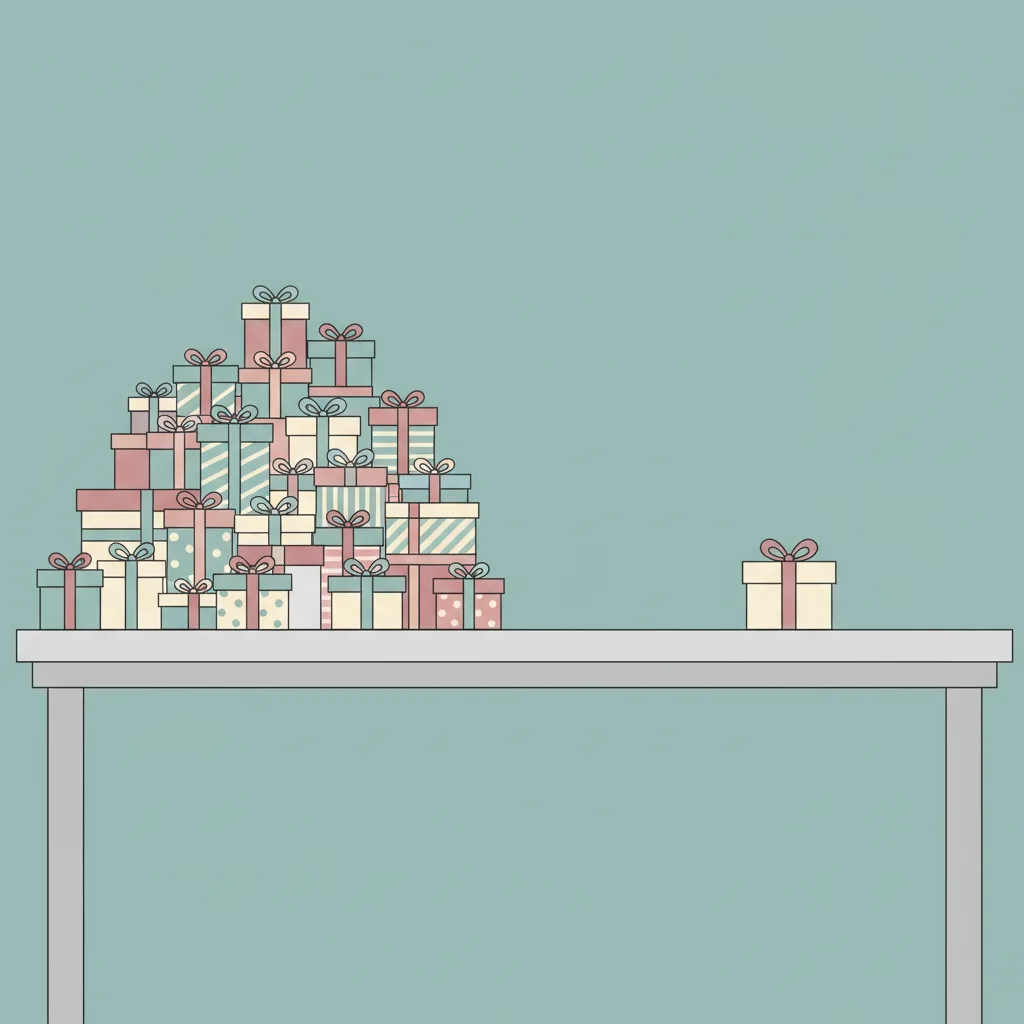
A pile of wrapped gifts next to a single simply-wrapped box on a bare table.
代替データ — この決断に関する直接的な後悔調査は存在しません。比率は後悔を直接尋ねる質問ではなく、満足度スコアとアクセス障壁のデータから導出されています。以下の注意事項を参照してください。

行動への後悔

甘やかして贈り物をする(めったに断らない)

40%

親の40%が祖父母が甘すぎるまたは寛大すぎると言っている(プロキシ)

祖父母との意見の不一致を報告した0-18歳の子を持つ米国の親(全国代表サンプル n=2,016 の部分集合)

横断的、2020年1月-2月に収集

不作為への後悔

控えめに贈り物をする(断り、親の方針に従う)

14%

親の14%が祖父母が厳しすぎるまたは過酷すぎると言っている(プロキシ)

祖父母との意見の不一致を報告した0-18歳の子を持つ米国の親(全国代表サンプル n=2,016 の部分集合)

横断的、2020年1月-2月に収集

この選択を後悔した割合

action dominates — 行動が優勢 — 多くは行動したことを後悔しています。

関連する決断

意味的に類似する決断 — 同じ領域、異なるトレードオフ。

family

助ける vs. 自力で乗り越えさせる

この選択を後悔した割合

行動が優勢

行動の後悔が1.2倍高い

family

しつけ vs. 寛容

この選択を後悔した割合

不作為が優勢

不作為の後悔が2.4倍高い

family

厳格 vs. 穏やかなしつけ

この選択を後悔した割合

行動が優勢

行動の後悔が1.2倍高い

family

自由放任 vs. 過保護な子育て

この選択を後悔した割合

行動が優勢

行動の後悔が2.3倍高い

family直接

子どものSNSアカウントへのアクセス

この選択を後悔した割合

行動が優勢

行動の後悔が5.4倍高い

family

習い事 vs 自由遊び

この選択を後悔した割合

行動が優勢

行動の後悔が2.6倍高い

family

途中でやめさせる vs. 続けさせる

この選択を後悔した割合

不作為が優勢

不作為の後悔が2.3倍高い

金融

成人の子どもへの経済支援 vs. 打ち切り

この選択を後悔した割合

行動が優勢

行動の後悔が3.7倍高い

Among US parents who report disagreements with a grandparent about child-rearing, 40% attribute those disagreements to grandparents being too soft or lenient, compared with only 14% who say grandparents are too tough, a nearly 3:1 ratio within the same response scale from a C.S. Mott Children’s Hospital National Poll of 2,016 nationally representative US parents fielded in January–February 2020. The asymmetry holds even though the dominant cultural script around grandparenting celebrates indulgence: “spoiling” is often described as a grandparent’s right, yet parents experiencing it in practice flag the leniency direction at three times the rate of the restraint direction. Both rates come from the same survey and the same subset of disagreement-reporting parents, making the cross-group comparison the most direct parallel evidence available on this bilateral question. Neither figure measures grandparent self-regret about their choices; both reflect parental observation of the downstream costs, and are flagged throughout as proxy estimates.

The child-development literature independently supports the direction of this asymmetry. Bredehoft, Mennicke, Potter, and Clarke (1998), writing in the Journal of Family and Consumer Sciences Education, surveyed 730 adults and found that the 124 who self-identified as adult children of overindulgence reported, as a great majority (71%), lasting difficulty as adults knowing what is enough or what is normal, a consequence that persisted long after the material gifts were forgotten. On the developmental side, Dauch, Imwalle, Ocasio, and Metz (2018) published an experiment in Infant Behavior and Development showing that toddlers given access to four toys rather than sixteen played for longer durations and in markedly more sophisticated ways, suggesting that abundance itself displaces the focused engagement that promotes cognitive and attentional development. The restraint literature does not argue that gift refusal has no costs; a grandparent who is consistently tight or withholding creates a different friction, but the outcome evidence clusters more heavily against excess than against moderation.

The Gilovich framework predicts that action regrets (having been too generous, having never said no) are salient and interpersonally costly in the present (parents notice and object), while inaction regrets (having been too restrained) tend to crystallize later and more privately, if at all. The 2.9:1 ratio in parental conflict reports is consistent with this temporal asymmetry. The primary caveat is that the Mott data captures a relational friction between generations, not a direct self-regret measurement by the gift-giving party; grandparents themselves may weight the same behavior differently. Research identifying relational and structural overindulgence as more harmful than pure material excess also suggests the action-side risk may be somewhat overstated when isolated to toy and gift quantity specifically.

出典: 行動

根拠台帳

以下の各数値は各出典が報告した内容であり、引用した原文の抜粋と算出方法を記載しています。リンクをクリックして直接確認できます。

3/3 件の出典が引用元と一字一句一致することを独立して検証済み

  1. [1] C.S. Mott Children's Hospital National Poll on Children's Health, University of Michigan — When parents and grandparents disagree 検証済み
    When parents and grandparents disagree
    統計値
    40% of parents say disagreements with grandparents occur because grandparents are too soft on the child; 14% say grandparents are too tough; 6% report major disagreements and 37% minor disagreements
    抜粋
    “"Among parents who say they have had disagreements with a grandparent about how the grandparent cares for their child, 40% say the disagreements occur because grandparents are too soft on the child, while 14% say grandparents are too tough." ”
    出典データ
    2020-08-17
    アクセス日
    2026-05-04
    検証
    グラウンディング監査の際、抜粋を引用元から独立して再取得し、原文と一字一句一致することを確認しました。
    計算過程
    C.S. Mott Children's Hospital National Poll on Children's Health (Vol. 36, Issue 5, August 2020). Survey of 2,016 US parents of children ages 0–18, randomly selected and stratified. Among parents who reported disagreements with a grandparent, 40% attributed those disagreements to grandparents being too lenient or soft. This is used as the action-side proxy for regret: parents registering that uninhibited gift-giving and leniency is a problem conflicting with their child-rearing choices. The 40% is not a direct self-report of grandparent regret — it is parental observation of the costs of overindulgence — flagged as "(proxy)".
  2. [2] Journal of Family and Consumer Sciences Education (Bredehoft, Mennicke, Potter & Clarke) — Perceptions attributed by adults to parental overindulgence during childhood 検証済み
    Perceptions attributed by adults to parental overindulgence during childhood
    統計値
    71% of adult children of overindulgence (ACOs; n=124 self-identified from 730 surveyed) reported difficulty as adults knowing what is enough or what is normal; ACOs simultaneously felt loved, confused, guilty, bad and sad about the overindulgence
    抜粋
    “"The great majority (71%) of the overindulged subjects reported having difficulty knowing what is enough, or what is normal as adults. ACOs simultaneously felt both positively and negatively about the overindulgence, that is, they felt loved, confused, guilty, bad and sad." ”
    出典データ
    1998-10-01
    アクセス日
    2026-05-04
    検証
    グラウンディング監査の際、抜粋を引用元から独立して再取得し、原文と一字一句一致することを確認しました。
    計算過程
    Bredehoft, Mennicke, Potter & Clarke (1998), Journal of Family and Consumer Sciences Education, 16(2), 3–17. Survey of 730 subjects; 124 self-identified as adult children of overindulgence (ACO). The 71% figure applies to the ACO subsample (n=124), not to the full 730. This source does not supply the 40% action-rate; it corroborates the direction of harm from overindulgent material gifting by showing that adults retrospectively raised that way report lasting difficulty calibrating sufficiency. The population is different (adult self-report on childhood, not current parental observation), but the convergence supports the action-side framing.
  3. [3] C.S. Mott Children's Hospital National Poll on Children's Health, University of Michigan — Parent efforts to teach children about gratitude 検証済み
    Parent efforts to teach children about gratitude
    統計値
    58% of US parents of children ages 4–10 worry that they are giving their children too much
    抜粋
    “"Over half of parents (58%) worry that they are giving their children too much, while 42% say they sometimes are embarrassed by how selfish their child acts." ”
    出典データ
    2021-10-01
    アクセス日
    2026-05-05
    検証
    グラウンディング監査の際、抜粋を引用元から独立して再取得し、原文と一字一句一致することを確認しました。
    計算過程
    C.S. Mott Children's Hospital National Poll on Children's Health, University of Michigan. N=1,125 parents with at least one child age 4–10, fielded June 2021. The 58% worry-about-over-giving rate documents that concern about material excess is widespread among the parenting generation — even before grandparent gift-giving is layered on top. This source measures worry (a prospective concern), not retrospective regret, and covers parent-to-child giving rather than grandparent-to-grandchild giving. It does not supply the action-side 40% proxy rate; that comes from Mott 2020. It corroborates the cultural prevalence of over-giving concern and provides independent evidence that parents themselves recognise an excess problem in their households, which is relevant context for the grandparent layer of the same dynamic.
    独立性
    Independent from Mott 2020 (different survey wave, Vol. 39 Issue 5 vs Vol. 36 Issue 5, different sample frame: parents of children 4–10 vs parents of children 0–18, different topic focus: gratitude vs grandparent disagreements).

出典: 不作為

根拠台帳

以下の各数値は各出典が報告した内容であり、引用した原文の抜粋と算出方法を記載しています。リンクをクリックして直接確認できます。

1/2 件の出典が引用元と一字一句一致することを独立して検証済み

  1. [1] C.S. Mott Children's Hospital National Poll on Children's Health, University of Michigan — When parents and grandparents disagree 検証済み
    When parents and grandparents disagree
    統計値
    14% of parents say disagreements with grandparents occur because grandparents are too tough on the child, vs 40% who say grandparents are too soft
    抜粋
    “"Among parents who say they have had disagreements with a grandparent about how the grandparent cares for their child, 40% say the disagreements occur because grandparents are too soft on the child, while 14% say grandparents are too tough." ”
    出典データ
    2020-08-17
    アクセス日
    2026-05-04
    検証
    グラウンディング監査の際、抜粋を引用元から独立して再取得し、原文と一字一句一致することを確認しました。
    計算過程
    Same Mott 2020 survey (n=2,016). The 14% who say grandparents are too tough is used as the inaction-side proxy for regret: the share of cases where restraint and limit-setting is itself the source of conflict and parental concern. This is not grandparent self-regret about being too strict; it is parents flagging that restraint has gone too far. Flagged as "(proxy)". The 40%:14% ratio (2.9:1) from the same survey and same response scale makes the comparison directly valid across sides.
  2. [2] Infant Behavior and Development (Dauch, Imwalle, Ocasio & Metz) — The influence of the number of toys in the environment on toddlers' play
    The influence of the number of toys in the environment on toddlers' play
    統計値
    Toddlers with access to 4 toys (vs 16) showed longer duration of toy play and played in more sophisticated ways; fewer toys led to higher-quality, more sustained engagement
    抜粋
    “"With fewer toys, participants had fewer incidences of toy play, longer durations of toy play, and played with toys in a greater variety of ways. The findings suggest that an environment with fewer toys may better support toddlers' play." ”
    出典データ
    2018-02-01
    アクセス日
    2026-05-04
    計算過程
    Dauch, Imwalle, Ocasio & Metz (2018), Infant Behavior and Development, 50, 78–87. Experimental study with n=36 toddlers ages 18–30 months; each child played under two conditions (4 toys and 16 toys). This source does not supply the 14% inaction rate; it corroborates the developmental case for restraint in gifting by showing that fewer toys produce demonstrably richer play. The finding supports why restrained gift-giving is not costless but is substantially less problematic than excess — the inaction-dominates concern is not supported by child development data.

注意事項

両方の率は同じ Mott 2020 世論調査(n=2,016)から来ており、祖父母自身のギフト選択についての祖父母の自己後悔ではなく、祖父母の行動に対する親の観察を測定している。40%と14%は祖父母との意見の不一致を報告した親の部分集合から引き出されており、全サンプルではない — つまり分母は小さく、比較は無条件の有病率ではなく対立の方向を反映している。どちらの数字も直接の後悔測定ではなく、両方とも「(プロキシ)」とフラグされている。Bredehoft et al. (1998) の知見である過剰甘やかしを経験した成人の71%が十分性の調整に持続的困難を報告するというのは、はるかに小さい部分サンプル(730人中124人の自己同定 ACO)から引き出されており、遡及的自己報告を使用し、純粋な物質的ギフトだけでなくあらゆる形の過剰甘やかしを対象としている。研究は一貫して関係的および構造的過剰甘やかしを純粋な物質的過剰よりも有害と特定しているため、エントリがおもちゃやギフトの量のみに適用されると読まれる場合、行動側のリスクはやや過大評価されている可能性がある。Dauch et al. (2018) の実験は実験室の遊び部屋の幼児に限られている; 数か月、数年にわたる現実世界のギフト蓄積への一般化は妥当だが直接テストされていない。「買いすぎを後悔していますか?」または「ギフトに制限的すぎたことを後悔していますか?」と祖父母に直接尋ねる大規模調査はない — そのようなデータは出版された文献には存在しないようである。

生データ: /api/decisions.json

このデバイスで最近見た項目