



Ga naar inhoud
Likelier

Spijt van handelen vs. niets doen

Samen eten als gezin vs haastig apart eten

Als je handelt

Regelmatige gezinsmaaltijden

9,0%

Als je niets doet

Apart of gehaast eten

62%

Percentage dat later spijt heeft van elke keuze. De balken en het volledige overzicht staan hieronder.


Familie

Laatst beoordeeld 2026-04-26

Kwaliteit van bewijs 4.13/5

Beoordelingsscore op acht dimensies volgens de kwaliteitsrubriek . Elke dimensie krijgt een score van 1 tot 5.

D1 Bronverificatie
5/5
D2 Autoriteit en onafhankelijkheid van bronnen
4/5
D3 Nauwkeurigheid van spijtcijfer
2/5
D4 Vergelijkbaarheid van bronnen
3/5
D5 Gilovich-patroon
5/5
D6 Prozakwaliteit
5/5
D7 Volledigheid van voorbehouden
5/5
D8 Steekproefkwaliteit
4/5
Gemiddelde 4.13/5
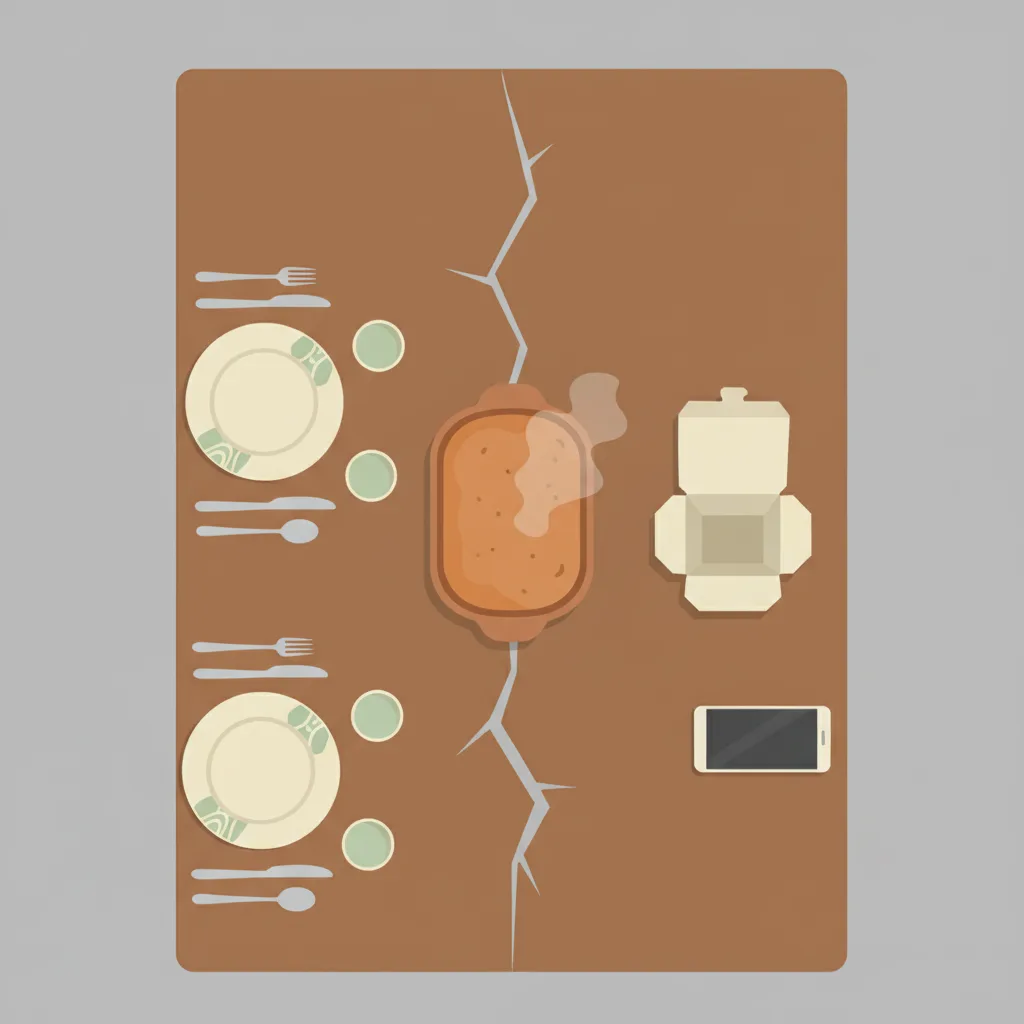
A dining table set for a family meal on one side, a counter with a lone takeout container on the other.

Spijt van handelen

Regelmatige gezinsmaaltijden

9,0%

9% van ouders vinden gezinsmaaltijden niet stress-verlagend (proxy)

Amerikaanse volwassenen, nationaal representatief

retrospectief, geen vast tijdsbestek

Spijt van nalaten

Apart of gehaast eten

62%

62% van ouders wensen dat ze vaker gezinsdiners hadden (aspiratie-kloof proxy)

Amerikaanse ouders met kinderen onder 18

retrospectief, geen vast tijdsbestek

% betreurt deze keuze

inaction dominates — Niets doen domineert — de meesten hebben spijt dat ze niet handelden.

Gerelateerde keuzes

Semantisch vergelijkbare keuzes — zelfde terrein, andere afwegingen.

family

Privé vs openbare school

% betreurt deze keuze

Niet-handelen overheerst

Spijt over niet-handelen 3.2× hoger

family

Thuisblijven vs werken

% betreurt deze keuze

Handelen overheerst

Spijt over handelen 1.3× hoger

family

Ingrijpen vs. zelf laten uitzoeken

% betreurt deze keuze

Handelen overheerst

Spijt over handelen 1.2× hoger

family

Disciplineren vs doorlaten

% betreurt deze keuze

Niet-handelen overheerst

Spijt over niet-handelen 2.4× hoger

lifestyle

Frequent snacken

% betreurt deze keuze

Niet-handelen overheerst

Spijt over niet-handelen 1.8× hoger

family

Gestructureerd vs vrij spel

% betreurt deze keuze

Handelen overheerst

Spijt over handelen 2.6× hoger

family

Gezinsgrootte

% betreurt deze keuze

Niet-handelen overheerst

Spijt over niet-handelen 2.6× hoger

family

Verpleeghuis vs thuiszorg

% betreurt deze keuze

Handelen overheerst

Spijt over handelen 2.3× hoger

A YouGov poll found that 62% of parents with children under 18 wish they had family dinners more often — the dominant inaction-side signal in this entry. On the action side, a 2022 American Heart Association survey of 1,000 US adults found that 9% of parents do not report stress reduction from regular family meals — and 84% wish they could share meals more often. The resulting 7:1 ratio between inaction-side aspiration and action-side dissatisfaction is striking but relies on asymmetric measurements — one asks about stress relief, the other about aspirational frequency — so the exact magnitude should be handled with caution.

The downstream associations of infrequent family meals are better documented than the regret itself. Harrison et al.’s systematic review of 14 studies confirmed inverse associations between family meal frequency and depression, substance use, and suicidal ideation in adolescents. These are correlational findings subject to obvious confounding — families that manage regular dinners differ socioeconomically and structurally from those that don’t — but the consistency across studies and populations makes the direction of effect reasonably secure. The aspiration gap (wanting more family meals) likely reflects both genuine awareness of these benefits and cultural messaging about what “good families” do.

The counterweight is real but poorly quantified. A 2025 BMC Public Health review argued that the “family dinner ideal” places uneven pressure on low-income, single-parent, and shift-working households, and that evidence for what specifically about the shared meal produces benefits — as opposed to the general family stability it proxies — remains thin. Quality of interaction appears to matter more than mere co-presence at a table. The aspiration gap here likely reflects genuine loss when connection opportunities are forfeited, but some of the 62% who wish for more dinners may be responding to cultural expectation rather than lived deprivation. Neither rate is a direct regret measure, and both are flagged as proxies accordingly.

Bronnen: handelen

Bronnenverantwoording

Elk getal hieronder is wat elke bron rapporteerde, met het letterlijke citaat waarop we ons baseerden en hoe we tot ons cijfer kwamen. Klik op een link om rechtstreeks te verifiëren.

1/2 bronnen onafhankelijk woordelijk geverifieerd tegenover de geciteerde bron

  1. [1] American Heart Association / Wakefield Research — New survey: 91% of parents say their family is less stressed when they eat together
    New survey: 91% of parents say their family is less stressed when they eat together
    Statistiek
    91% of parents say their family is less stressed when they regularly connect over a meal; 84% wish they could share a meal together more often
    Fragment
    “"91 percent of parents notice their family is less stressed when they regularly connect over a meal. The survey also found that 84% of adults say they wish they could eat more meals with others." ”
    Brongegevens van
    2022-10-10
    Geraadpleegd
    2026-04-26
    Berekening
    Wakefield Research for AHA, 1,000 nationally representative US adults ages 18+, September 14–20 2022, online survey. MOE +/-3.1pp at 95% CI. The 9% who do not report stress reduction is the complement of the 91% headline. We use this as an upper-bound proxy for action-regret: among parents who do eat together, a small minority find no benefit. This is a satisfaction complement, not a regret measure — flagged as "(proxy)".
  2. [2] BMC Public Health — Unpacking family meals: state-of-the-art review critiquing the Western ideals, positioning and promotion of family meals Geverifieerd
    Unpacking family meals: state-of-the-art review critiquing the Western ideals, positioning and promotion of family meals
    Statistiek
    Family meal promotion reinforces unrealistic expectations on resource-pressured families; evidence on what specifically helps is limited
    Fragment
    “"Evidence surrounding what specifically about the family meal offers health benefits is limited, and family meals carry a level of moral value, evoking pressure for parents to 'achieve' a family meal ideal, unattainable for many." ”
    Brongegevens van
    2025-02-11
    Geraadpleegd
    2026-04-26
    Verificatie
    Fragment onafhankelijk opnieuw opgehaald en woord voor woord bevestigd tegenover de geciteerde bron tijdens onze onderbouwingsaudit.
    Berekening
    Narrative review, not a prevalence study. Included to establish that the action side is not costless: logistical burden and social pressure are real downsides for some families. Does not supply its own regret percentage.

Bronnen: niet handelen

Bronnenverantwoording

Elk getal hieronder is wat elke bron rapporteerde, met het letterlijke citaat waarop we ons baseerden en hoe we tot ons cijfer kwamen. Klik op een link om rechtstreeks te verifiëren.

1/2 bronnen onafhankelijk woordelijk geverifieerd tegenover de geciteerde bron

  1. [1] YouGov — Most parents wish they were having family dinners more often
    Most parents wish they were having family dinners more often
    Statistiek
    62% of parents with children under 18 wish they could have family dinners 'much more often' or 'somewhat more often'
    Fragment
    “"Roughly six in 10 (62%) parents with children under 18 say they would like to have family dinners 'much more often' or 'somewhat more often.' Parents of children and teenagers (87%) are especially likely to say they have a family dinner with all members of their home at least once a week." ”
    Brongegevens van
    2019-10-28
    Geraadpleegd
    2026-04-26
    Berekening
    YouGov online survey, 1,220 US adults (938 sharing a household), October 21–22 2019, weighted to be nationally representative. The 62% is among parents with children under 18 who wish dinners happened more often. This measures aspiration gap (wanting more of something you believe is good), not classical retrospective regret. Flagged as "(aspiration-gap proxy)".
  2. [2] Canadian Family Physician (Harrison et al.) — Systematic review of the effects of family meal frequency on psychosocial outcomes in youth Geverifieerd
    Systematic review of the effects of family meal frequency on psychosocial outcomes in youth
    Statistiek
    Frequent family meals are inversely associated with substance use, depression, suicidal ideation, and violent behaviour in adolescents
    Fragment
    “"Overall, results show that frequent family meals are inversely associated with disordered eating, alcohol and substance use, violent behaviour, and feelings of depression or thoughts of suicide in adolescents, and there is a positive relationship between frequent family meals and increased self-esteem and school success." ”
    Brongegevens van
    2015-02-01
    Geraadpleegd
    2026-04-26
    Verificatie
    Fragment onafhankelijk opnieuw opgehaald en woord voor woord bevestigd tegenover de geciteerde bron tijdens onze onderbouwingsaudit.
    Berekening
    Systematic review of 14 studies from MEDLINE and PsycINFO (searches 1948–2011). Not a prevalence figure; included to establish the consequence basis for why parents aspire to more family meals — the downstream associations are well documented, though correlational and subject to confounding.

Kanttekeningen

Geen van beide cijfers is een directe spijtmeting — beide zijn expliciet gemarkeerd als proxies in regret_display. Het 9% actie-zijde cijfer is het complement van ouders die stressvermindering rapporteren van gezinsmaaltijden — een tevredenheid-inversie proxy, geen maat van iemand die zegt "ik heb spijt van samen eten". Het 62% inactie-zijde cijfer vangt wensen voor meer diners (aspiratiekloof), wat dichter bij culturele verwachting ligt dan klassieke retrospectieve spijt. Geen grootschalige enquête vraagt direct "heeft u spijt van niet samen eten als gezin?" De AHA 2022-enquête vond ook dat 84% wensten dat ze vaker maaltijden konden delen, wat de YouGov-richting bevestigt. De YouGov-steekproef omvat ouders die al regelmatig samen eten maar meer willen, wat het inactiepercentage opblaast ten opzichte van echte nooit-deed-het spijt. De Harrison et al. systematische review over tienermiddelengebruik (frequent niet-samen-dineerders meer kans op tabaksgebruik) is correlationeel en onderhevig aan confounding: families die samen eten verschillen van degenen die dat niet doen op manieren voorbij de maaltijd zelf. De BMC Public Health review merkt op dat het "gezinsdiner-ideaal" disproportionele druk legt op huishoudens met laag inkomen en alleenstaande ouders, dus de aspiratiekloof kan deels culturele norming weerspiegelen in plaats van bewijs van netto schade van gemiste maaltijden. De 7:1 ratio tussen inactie- en actiepercentages is richtinggevend robuust maar overdrijft de echte spijtasymmetrie gezien de zwakke proxy aan de actiezijde.

Ruwe data: /api/decisions.json

Recent bekeken op dit apparaat