
Ga naar inhoud
Likelier

Spijt van handelen vs. niets doen

Kinderen naar een privéschool sturen vs openbare school

Als je handelt

Particulier onderwijs

13%

Als je niets doet

Openbaar onderwijs

41%

Percentage dat later spijt heeft van elke keuze. De balken en het volledige overzicht staan hieronder.


Familie

Laatst beoordeeld 2026-04-26

Kwaliteit van bewijs 4.38/5

Beoordelingsscore op acht dimensies volgens de kwaliteitsrubriek . Elke dimensie krijgt een score van 1 tot 5.

D1 Bronverificatie
5/5
D2 Autoriteit en onafhankelijkheid van bronnen
4/5
D3 Nauwkeurigheid van spijtcijfer
2/5
D4 Vergelijkbaarheid van bronnen
5/5
D5 Gilovich-patroon
5/5
D6 Prozakwaliteit
5/5
D7 Volledigheid van voorbehouden
5/5
D8 Steekproefkwaliteit
4/5
Gemiddelde 4.38/5
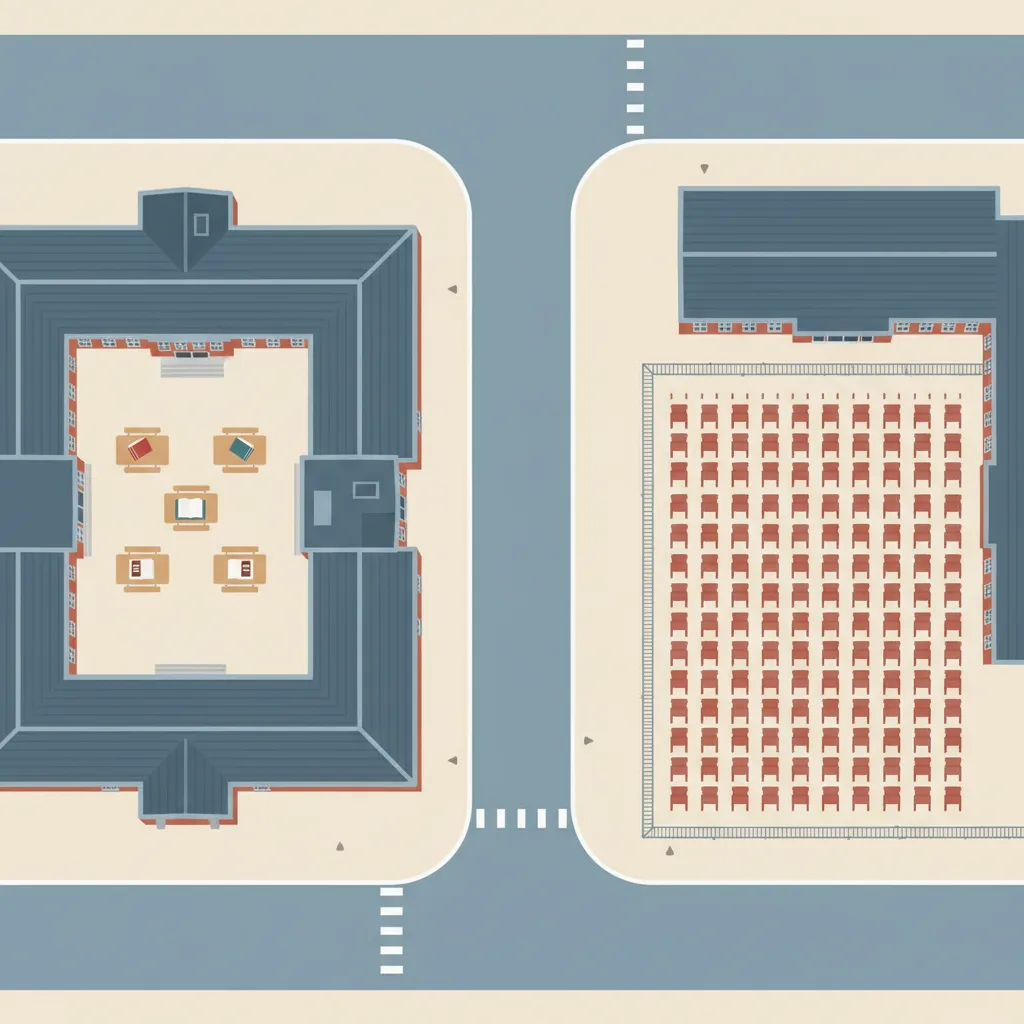
Two school buildings side by side, one with a small class and one with a large crowd, seen from above.

Spijt van handelen

Particulier onderwijs

13%

13% van privéschool-ouders zouden niet dezelfde school opnieuw kiezen (proxy — herkeuze waarschijnlijkheid)

Amerikaanse ouders van K-12 studenten, nationaal representatief

retrospectief, geen vast tijdsbestek

Spijt van nalaten

Openbaar onderwijs

41%

41% van openbare-school ouders zouden niet dezelfde school opnieuw kiezen (proxy — herkeuze waarschijnlijkheid)

Amerikaanse ouders van K-12 studenten, nationaal representatief

retrospectief, geen vast tijdsbestek

% betreurt deze keuze

inaction dominates — Niets doen domineert — de meesten hebben spijt dat ze niet handelden.

Gerelateerde keuzes

Semantisch vergelijkbare keuzes — zelfde terrein, andere afwegingen.

family

Thuisblijven vs werken

% betreurt deze keuze

Handelen overheerst

Spijt over handelen 1.3× hoger

family

Gestructureerd vs vrij spel

% betreurt deze keuze

Handelen overheerst

Spijt over handelen 2.6× hoger

family

Gezinsgrootte

% betreurt deze keuze

Niet-handelen overheerst

Spijt over niet-handelen 2.6× hoger

family

Ingrijpen vs. zelf laten uitzoeken

% betreurt deze keuze

Handelen overheerst

Spijt over handelen 1.2× hoger

family

Gezinsmaaltijden

% betreurt deze keuze

Niet-handelen overheerst

Spijt over niet-handelen 6.9× hoger

family

Laten stoppen vs. afmaken

% betreurt deze keuze

Niet-handelen overheerst

Spijt over niet-handelen 2.3× hoger

familyDirect

Kindertoegang tot sociale media

% betreurt deze keuze

Handelen overheerst

Spijt over handelen 5.4× hoger

family

Vrij vs helikopteropvoeding

% betreurt deze keuze

Handelen overheerst

Spijt over handelen 2.3× hoger

41% of traditional public-school parents say they would not choose the same school again, according to a nationally representative 50CAN/Edge Research survey. Among private-school parents the figure is only 13% — more than three times lower. Pew Research corroborates the gap from a different angle: 79% of private-school families report high satisfaction with educational quality, compared with 55% of public-school families. Neither instrument measures regret directly, but the consistency across surveys and constructs suggests the asymmetry is real, not an artifact of question wording.

The demand-side data makes the inaction story sharper. EdChoice’s 2024 Schooling in America survey found that 36% of parents would prefer private school, yet only 9% actually enroll — a 4:1 gap driven almost entirely by tuition costs and geographic access. That gap complicates the Gilovich framing: most public-school “inaction” is involuntary, constrained by money rather than by indecision. A parent who cannot afford private school and later wishes they could have is experiencing frustrated aspiration, not the freely-chosen inaction that typically intensifies over time in the regret literature.

Selection bias is the largest confounder. Private-school families are wealthier, more likely to have two parents in the household, and more educationally engaged on every metric NCES tracks. Their higher satisfaction may reflect resources and involvement rather than anything intrinsic to private schooling. Randomized voucher studies (e.g., Milwaukee, DC Opportunity Scholarship) show modest academic gains and higher parental satisfaction, but the effect sizes are far smaller than the raw satisfaction gap implies. The directional finding — parents who chose private school regret it less — holds up; the magnitude should be read with the income gradient firmly in mind.

Bronnen: handelen

Bronnenverantwoording

Elk getal hieronder is wat elke bron rapporteerde, met het letterlijke citaat waarop we ons baseerden en hoe we tot ons cijfer kwamen. Klik op een link om rechtstreeks te verifiëren.

2/2 bronnen onafhankelijk woordelijk geverifieerd tegenover de geciteerde bron

  1. [1] 50CAN / Edge Research — The State of Educational Opportunity in America Geverifieerd
    The State of Educational Opportunity in America
    Statistiek
    87% of private-school parents would choose the same school again, vs 59% of traditional public-school parents
    Fragment
    “"87 percent of private school parents and 82 percent of parochial/religious school parents would make the same choice, while the number drops to 59 percent for traditional public school parents." ”
    Brongegevens van
    2024-10-15
    Geraadpleegd
    2026-04-26
    Verificatie
    Fragment onafhankelijk opnieuw opgehaald en woord voor woord bevestigd tegenover de geciteerde bron tijdens onze onderbouwingsaudit.
    Berekening
    50CAN / Edge Research national survey. We derive action-regret as 1 − 0.87 = 0.13 (13% would not choose the same school). This is a proxy for regret — "would not choose again" conflates dissatisfaction, changed circumstances, and active regret.
  2. [2] Pew Research Center — Parents differ sharply by party over what their K-12 children should learn in school Geverifieerd
    Parents differ sharply by party over what their K-12 children should learn in school
    Statistiek
    79% of private-school parents report high satisfaction with the quality of their child's education, vs 55% of public-school parents
    Fragment
    “"About eight-in-ten parents answering about a child in private school (79%) express high levels of satisfaction with the quality of education their child is receiving, compared with a narrower majority (55%) of those answering about a child who is in public school." ”
    Brongegevens van
    2022-10-26
    Geraadpleegd
    2026-04-26
    Verificatie
    Fragment onafhankelijk opnieuw opgehaald en woord voor woord bevestigd tegenover de geciteerde bron tijdens onze onderbouwingsaudit.
    Berekening
    Pew Research Center survey of U.S. parents of K-12 children (fielded Oct 2022). The 79% vs 55% satisfaction gap corroborates the 50CAN "would choose again" differential but measures a different construct (satisfaction vs hypothetical re-choice).

Bronnen: niet handelen

Bronnenverantwoording

Elk getal hieronder is wat elke bron rapporteerde, met het letterlijke citaat waarop we ons baseerden en hoe we tot ons cijfer kwamen. Klik op een link om rechtstreeks te verifiëren.

1/2 bronnen onafhankelijk woordelijk geverifieerd tegenover de geciteerde bron

  1. [1] 50CAN / Edge Research — The State of Educational Opportunity in America
    The State of Educational Opportunity in America
    Statistiek
    Only 59% of traditional public-school parents would choose the same school again
    Fragment
    “"87 percent of private school parents would make the same choice, while the number drops to 59 percent for traditional public school parents." ”
    Brongegevens van
    2024-10-15
    Geraadpleegd
    2026-04-26
    Berekening
    Inaction-regret derived as 1 − 0.59 = 0.41. The 41% includes parents who would switch to private, charter, magnet, or homeschool — not exclusively to private school. This overstates the "wish I'd gone private" sentiment specifically.
  2. [2] EdChoice — Beyond Enrollment: What Parents Really Want from Their Children's Education Geverifieerd
    Beyond Enrollment: What Parents Really Want from Their Children's Education
    Statistiek
    36% of parents would most like to enroll in private school, but only 9% actually do
    Fragment
    “"The most popular schooling option was private schooling, with over a third of parents (36%) stating they would most like to enroll their children that way. This is four times the rate of students enrolled in private schools (9%)." ”
    Brongegevens van
    2024-08-01
    Geraadpleegd
    2026-04-26
    Verificatie
    Fragment onafhankelijk opnieuw opgehaald en woord voor woord bevestigd tegenover de geciteerde bron tijdens onze onderbouwingsaudit.
    Berekening
    EdChoice 2024 Schooling in America Survey, n = 2,319 parents. The 4:1 ratio between stated preference and actual enrollment signals a large pool of constrained inaction — parents who want private school but face cost, location, or admissions barriers. This contextualizes but does not directly measure regret.

Kanttekeningen

Beide zijden putten uit dezelfde 50CAN/Edge Research enquête, dus de spijt-percentage vergelijking is intern consistent, maar de vraag "zou u dezelfde school opnieuw kiezen" vermengt spijt met veranderde omstandigheden — een ouder die buurten verhuisde kan "nee" antwoorden zonder spijt te hebben van de originele beslissing. De NCES tevredenheidsdata (79% vs 55%) gebruikt een ander instrument en jaar (2019 vs 2024), dus de twee datasets bevestigen de richting maar niet de exacte magnitude. Selectiebias is de olifant: families die privéschool-collegegeld betalen zijn welvarender en educatief meer betrokken; hun hogere tevredenheid kan inkomen en betrokkenheid weerspiegelen, niet schooltype alleen. De EdChoice 36%-wil-vs-9%-ingeschreven kloof suggereert dat kosten de primaire barrière zijn, wat betekent dat inactie hier vaak onvrijwillig is — een afwijking van Gilovich's raamwerk, dat aanneemt dat de agent had kunnen handelen.

Ruwe data: /api/decisions.json

Recent bekeken op dit apparaat