







Ga naar inhoud
Likelier

Spijt van handelen vs. niets doen

Studeren aan een private universiteit vs kiezen voor een vergelijkbare openbare universiteit

Als je handelt

Particuliere universiteit

17%

Als je niets doet

Openbare universiteit

14%

Percentage dat later spijt heeft van elke keuze. De balken en het volledige overzicht staan hieronder.


Carrière

Laatst beoordeeld 2026-05-01

Kwaliteit van bewijs 4.38/5

Beoordelingsscore op acht dimensies volgens de kwaliteitsrubriek . Elke dimensie krijgt een score van 1 tot 5.

D1 Bronverificatie
5/5
D2 Autoriteit en onafhankelijkheid van bronnen
4/5
D3 Nauwkeurigheid van spijtcijfer
2/5
D4 Vergelijkbaarheid van bronnen
5/5
D5 Gilovich-patroon
5/5
D6 Prozakwaliteit
5/5
D7 Volledigheid van voorbehouden
5/5
D8 Steekproefkwaliteit
4/5
Gemiddelde 4.38/5
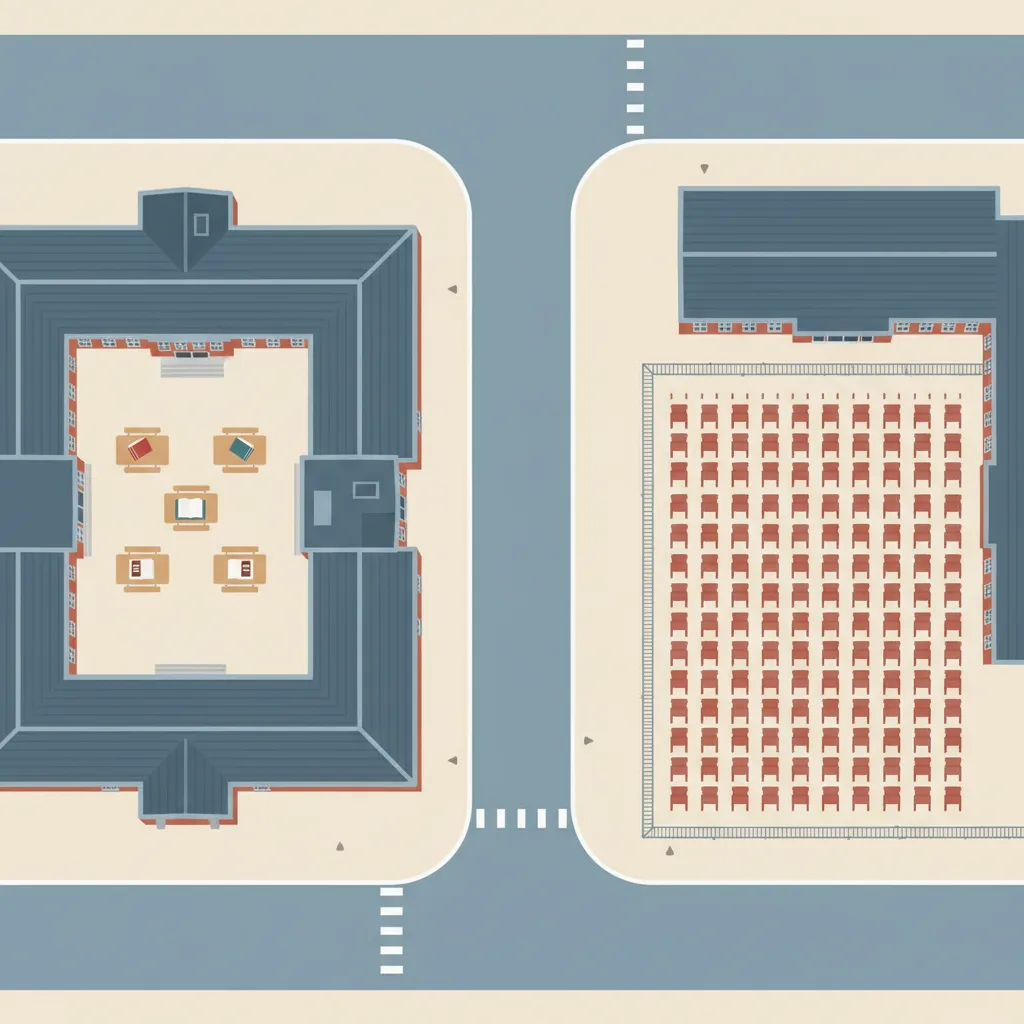
Two university campuses seen from above, one with a manicured courtyard and one with a sprawling modern campus.

Spijt van handelen

Particuliere universiteit

17%

17% van privé-college afgestudeerden zeggen dat hun diploma de financiële kosten niet waard was (proxy)

Amerikaanse volwassenen die een privé non-profit vier-jarig college bezochten, nationaal representatief

retrospectief, geen vast tijdsbestek

Spijt van nalaten

Openbare universiteit

14%

14% van openbare-college afgestudeerden zeggen dat hun diploma de financiële kosten niet waard was (proxy)

Amerikaanse volwassenen die een openbaar vier-jarig college bezochten, nationaal representatief

retrospectief, geen vast tijdsbestek

% betreurt deze keuze

balanced — Ongeveer in balans — beide keuzes leveren vergelijkbare spijt op.

Gerelateerde keuzes

Semantisch vergelijkbare keuzes — zelfde terrein, andere afwegingen.

careerDirect

Uitvallen vs. graad afronden

% betreurt deze keuze

Handelen overheerst

Spijt over handelen 1.1× hoger

careerDirect

Studiekeuze

% betreurt deze keuze

Niet-handelen overheerst

Spijt over niet-handelen 1.6× hoger

career

Studiebeslissing

% betreurt deze keuze

Handelen overheerst

Spijt over handelen 1.2× hoger

Financieel

Studieschuld vs. goedkoper pad

% betreurt deze keuze

Niet-handelen overheerst

Spijt over niet-handelen 1.3× hoger

career

AI-geschreven schoolwerk

% betreurt deze keuze

In evenwicht

Grotendeels in evenwicht

family

Privé vs openbare school

% betreurt deze keuze

Niet-handelen overheerst

Spijt over niet-handelen 3.2× hoger

career

Salarisonderhandeling

% betreurt deze keuze

Niet-handelen overheerst

Spijt over niet-handelen 1.2× hoger

career

Korea: overheidsdienst vs. private sector

% betreurt deze keuze

Handelen overheerst

Spijt over handelen 1.6× hoger

Only 17% of private-university graduates had not yet seen a financial payoff from their degree, compared with 14% of public-university graduates, according to a 2014 Pew Research Center survey of 2,002 US adults. The difference is three percentage points — within the margin of error — making this one of the clearest “balanced” findings in the regret literature. This is a payoff-to-date question, not a direct “was it worth the cost” regret item: of the 17% of private graduates without a payoff yet, a further 5% told Pew they expect their education to pay off in the future, leaving only about 12% who said it will not pay off or were unsure (about 7% for public graduates). Both groups overwhelmingly report that college paid off, and neither camp shows the sustained, growing regret that Gilovich and Medvec associate with the inaction side of most long-term dilemmas.

A useful corroborating data point comes from the Strada-Gallup Education Consumer Pulse survey of approximately 90,000 US adults: 28% of respondents said they would choose a different institution if they could decide again, compared with 36% who would choose a different field of study. The survey does not break its findings out by public-versus-private attendance, so it cannot confirm or refute an asymmetry between the two — but it does suggest that institution-choice regret is real yet secondary to field-of-study regret, which is consistent with the Pew finding that the public/private gap is small enough to sit inside the margin of error.

Three limitations shape how this entry should be read. First, the primary data are from 2013, before the steepest phase of private-tuition growth and the student-debt expansion of the late 2010s; contemporary graduates carrying larger private-school debt loads may show a larger asymmetry. Second, both figures measure satisfaction retrospectively from a population that successfully graduated; students who enrolled at private universities and did not complete their degree are absent and likely report higher regret. Third, this entry is specific to the United States, where a sharp public/private cost divide exists. In most of Europe, the financial and prestige gap between private and public higher education is structured differently, and these numbers do not transfer.

Bronnen: handelen

Bronnenverantwoording

Elk getal hieronder is wat elke bron rapporteerde, met het letterlijke citaat waarop we ons baseerden en hoe we tot ons cijfer kwamen. Klik op een link om rechtstreeks te verifiëren.

  1. [1] Pew Research Center — Public and private college grads about equal in satisfaction with their lives
    Public and private college grads about equal in satisfaction with their lives
    Statistiek
    83% of private college graduates and 86% of public college graduates said they had already seen a payoff from their education
    Fragment
    “"Roughly equal shares of 83% among private school graduates and 86% among public school graduates said they had already seen a payoff." ”
    Brongegevens van
    2014-05-19
    Geraadpleegd
    2026-05-01
    Berekening
    Pew Research survey of 2,002 US adults conducted Oct 7-27, 2013. Action proxy derived as 1 - 0.83 = 0.17 (17% of private-college graduates had not yet seen a financial payoff from their education). This is a payoff-to-date perception, NOT a direct "was it worth the cost" regret measure. The 17% is not all dissatisfied: Pew reports a further 5% of private graduates "expect to see their educations pay off in the future", so the share who said it will not pay off or are unsure is the remainder, roughly 12%. Survey covered all college graduates; selection between private and public was not controlled. Subgroup sample sizes for private-college and public-college respondents within the n=2,002 survey are not separately reported; per-subgroup margin of error is wider than the approximately plus-or-minus 2.5 pp noted for the full sample.
  2. [2] Gallup / Strada Education Network — Half of U.S. Adults Would Change at Least One Education Decision
    Half of U.S. Adults Would Change at Least One Education Decision

    See all 4 Likelier entries citing this source →

    Statistiek
    51% of US adults would change at least one aspect of their education experience; 28% would select a different institution
    Fragment
    “"Fifty-one percent of U.S. adults would change at least one aspect of their education experience. Significantly fewer (28%) would select a different institution." ”
    Brongegevens van
    2017-06-01
    Geraadpleegd
    2026-05-01
    Berekening
    Strada-Gallup Education Consumer Pulse survey, n approximately 90,000 US adults, June 2016 through March 2017. Report does not isolate private-4yr vs public-4yr regret rates as separate figures; used here as corroboration that institution-choice regret exists but is secondary to field-of-study regret.

Bronnen: niet handelen

Bronnenverantwoording

Elk getal hieronder is wat elke bron rapporteerde, met het letterlijke citaat waarop we ons baseerden en hoe we tot ons cijfer kwamen. Klik op een link om rechtstreeks te verifiëren.

  1. [1] Pew Research Center — Public and private college grads about equal in satisfaction with their lives
    Public and private college grads about equal in satisfaction with their lives
    Statistiek
    83% of private college graduates and 86% of public college graduates said they had already seen a payoff from their education
    Fragment
    “"Roughly equal shares of 83% among private school graduates and 86% among public school graduates said they had already seen a payoff." ”
    Brongegevens van
    2014-05-19
    Geraadpleegd
    2026-05-01
    Berekening
    Same Pew 2013/2014 survey as action_side (n = 2,002). Inaction proxy derived as 1 - 0.86 = 0.14 (14% of public-college graduates had not yet seen a financial payoff from their education). This is a payoff-to-date perception, NOT a direct "was it worth the cost" regret measure. A further 7% of public graduates "expect to see their educations pay off in the future", so the share who said it will not pay off or are unsure is the remainder, roughly 7%. Subgroup sample sizes for private-college and public-college respondents within the n=2,002 survey are not separately reported; per-subgroup margin of error is wider than the approximately plus-or-minus 2.5 pp noted for the full sample.
  2. [2] Gallup / Strada Education Network — Half of U.S. Adults Would Change at Least One Education Decision
    Half of U.S. Adults Would Change at Least One Education Decision

    See all 4 Likelier entries citing this source →

    Statistiek
    51% of US adults would change at least one aspect of their education experience; 36% would choose a different field of study; 28% would select a different institution
    Fragment
    “"Fifty-one percent of U.S. adults would change at least one aspect of their education experience. Thirty-six percent of U.S. adults who pursued or completed a postsecondary degree would choose a different field of study. Significantly fewer (28%) would select a different institution." ”
    Brongegevens van
    2017-06-01
    Geraadpleegd
    2026-05-01
    Berekening
    The 28% who would choose a different institution includes all institution-type switches and is not specific to public-to-private transitions. Used here to establish that institution-choice regret exists but is secondary to major/field regret.

Kanttekeningen

Beide zijden putten uit dezelfde Pew 2014-enquête, wat de vergelijking intern consistent maakt, maar die enquête mat "was het de financiële investering waard" in plaats van direct te vragen over spijt. De 3-procentpunt kloof valt binnen de foutmarge van de enquête (ongeveer plus-of-minus 2,5 pp voor het volledige sample) en mag niet worden gelezen als bewijs dat privé-universiteit afgestudeerden meer spijt hebben van hun keuze; de eerlijke lezing is dat tevredenheidspercentages statistisch niet te onderscheiden zijn. De data is uit 2013 en dateert van vóór de 2015-2025 versnelling in privé-instelling collegegeld en de groei van studentenschuld; huidige spijtcijfers bij privé-instellingen kunnen hoger zijn. Selectiebias is de grootste confounder: studenten die privé-universiteiten bezoeken verschillen systematisch van openbare-universiteit tegenhangers in gezinsinkomen, academische voorbereiding en professionele netwerken, dus enige uitkomstverschil kan die preexistente voordelen weerspiegelen in plaats van schooltype. De Strada-Gallup bevinding dat selectiviteit in plaats van openbaar/privé type de dominante voorspeller is van onderwijstevredenheid sluit aan bij de gerandomiseerde-voucher literatuur's bescheiden effectgroottes. Geografisch bereik is beperkt tot de Verenigde Staten; in het Verenigd Koninkrijk, het grootste deel van continentaal Europa en Australië draagt het onderscheid tussen privé en staatsuniversiteit verschillende financiële en sociale gewicht dat deze enquêtes niet vangen.

Ruwe data: /api/decisions.json

Recent bekeken op dit apparaat