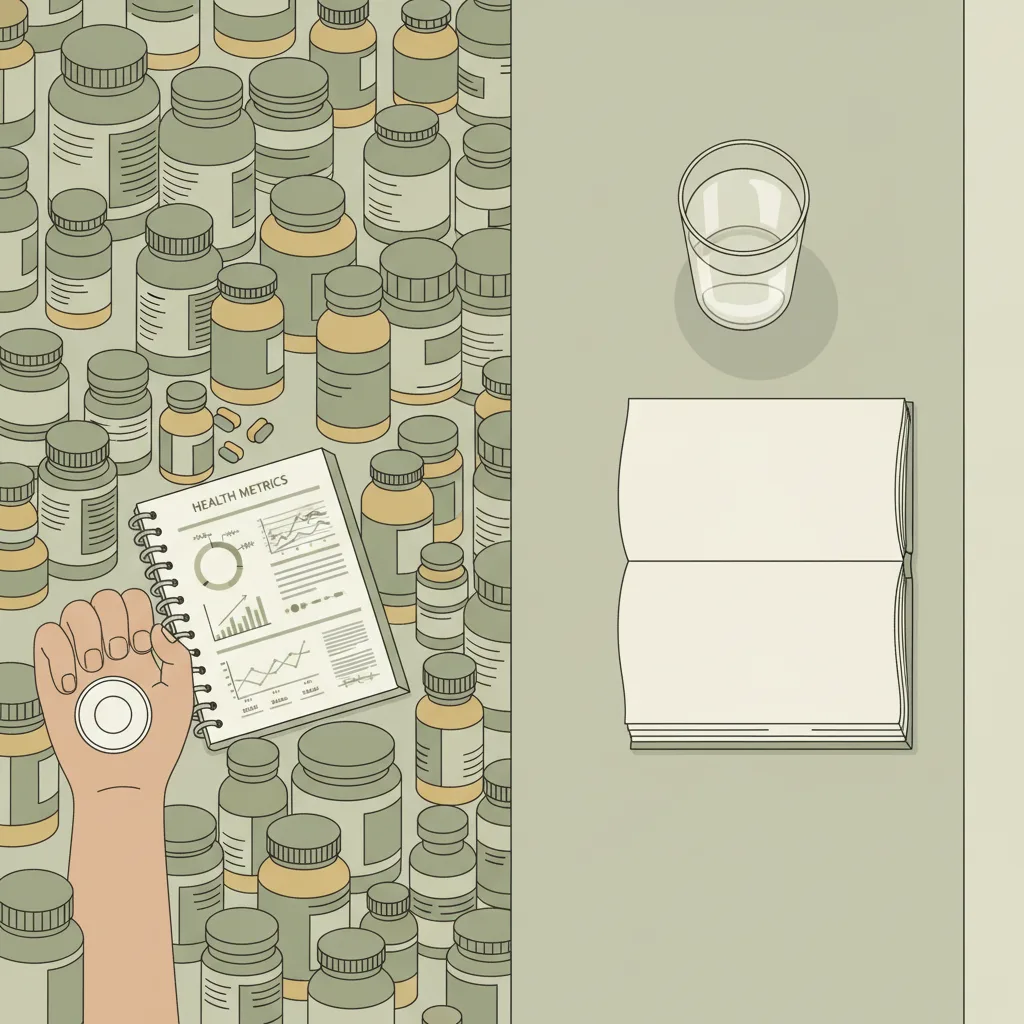
Een consumenten-DNA-test nemen (afkomst en gezondheidsrisico's) vs. genetische onwetendheid bewaren
Als je handelt
Een consumenten-DNA-test doen (23andMe, AncestryDNA of vergelijkbaar)
11%
Als je niets doet
Afzien van een consumenten-DNA-test en in genetische onwetendheid blijven
52%
Percentage dat later spijt heeft van elke keuze. De balken en het volledige overzicht staan hieronder.
Gezondheid
Laatst beoordeeld 2026-05-13
Kwaliteit van bewijs 3.13/5
Beoordelingsscore op acht dimensies volgens de
kwaliteitsrubriek
. Elke dimensie krijgt een score van 1 tot 5.
D1 Bronverificatie
2/5
D2 Autoriteit en onafhankelijkheid van bronnen
3/5
D3 Nauwkeurigheid van spijtcijfer
2/5
D4 Vergelijkbaarheid van bronnen
2/5
D5 Gilovich-patroon
4/5
D6 Prozakwaliteit
4/5
D7 Volledigheid van voorbehouden
5/5
D8 Steekproefkwaliteit
3/5
Gemiddelde3.13/5
Proxygegevens — er bestaat geen directe spijtenquête voor deze beslissing. De percentages zijn afgeleid van tevredenheidsscores en toegangsdrempelgegevens in plaats van vragen die direct naar spijt vroegen. Zie opmerkingen hieronder.
Spijt van handelen
Een consumenten-DNA-test doen (23andMe, AncestryDNA of vergelijkbaar)
11%
~11% van degenen die nieuwe informatie leerden uit een DNA-test die verwanten opspoort, meldde beslissingsspijt
Openstellen voor consensuele non-monogamieStrikt monogaam blijven
15%21%
Niet-handelen overheerst
Spijt over niet-handelen 1.4× hoger
Among direct-to-consumer relative-finder participants who learned new information about themselves or their relatives, approximately 11% reported decisional regret, according to Guerrini et al. (2022) in the American Journal of Human Genetics (n=23,196; 61% learned something new, 11% of those scored above the Decision Regret Scale cutoff, and 2% reported net-negative consequences). Learning something new can mean discovery shock from unexpected paternity revelations (a “Not Parent Expected” result), identification of unknown biological relatives, or unanticipated high-penetrance disease risk variants such as BRCA1/2. This 11% applies to the subset who receive genuinely unexpected findings, not to all test takers — the majority of people who test report positive or neutral experiences (ancestry discovery, confirmation of family stories, actionable health information), and the donor-conceived subgroup reported the highest regret of all. The inaction side is harder to measure directly because no survey asks non-testers whether they regret opting out. The closest proxy comes from an AP-NORC Center for Public Affairs Research poll (June 2018, n=1,109): 17% of US adults had been genetically tested and another 52% said they were interested in having it done, primarily citing curiosity about ancestry and the desire to understand genetic health risks. Interest is a latent signal, not regret — many of those who are “interested” may never act, and interest can coexist with no felt regret about not having tested yet.
The decision’s structure is unusual because its consequences are irreversible in only one direction. A person who tests and discovers distressing information cannot un-know it; the cascade of downstream decisions triggered by unexpected results — preventive surgeries, family disclosures, identity reckonings — carries its own regret profile independent of the original test decision. A person who opts out retains the option to test later, meaning inaction here is not a permanent foregone opportunity but a deferral. This structural asymmetry likely suppresses inaction regret and amplifies action regret relative to other regret pairs.
The risk calculus shifted substantially after October 2023, when a credential-stuffing attack on 23andMe exposed the genetic ancestry data of approximately 6.9 million users, followed by 23andMe’s bankruptcy filing in March 2025 and the subsequent uncertainty about who would control and monetize stored genetic profiles. Users who tested between 2017 and 2023 made their decision under a different risk profile than the one that materialized. The pre-breach AP-NORC finding that 50% of US adults were already extremely or very concerned that for-profit DNA companies would share their genetic information proved prescient: a large share of non-testers appear to have anticipated a data-handling risk that materialized dramatically for millions who had already tested.
Bronnen: handelen
Bronnenverantwoording
Elk getal hieronder is wat elke bron rapporteerde, met het letterlijke citaat waarop we ons baseerden en hoe we tot ons cijfer kwamen. Klik op een link om rechtstreeks te verifiëren.
[1]American Journal of Human Genetics — Family secrets: Experiences and outcomes of participating in direct-to-consumer genetic relative-finder services
Vakgenoten-beoordeeld
Among the 61% of DTC relative-finder participants who learned new information about themselves or their relatives, 11% (n=1,542) reported decisional regret scores at or above the cutoff of 30, and 2% (n=352) reported net-negative consequences for themselves; those who learned they were donor conceived reported the highest regret
Fragment
“"Separately, most respondents (61%) reported learning something new about themselves or their relatives, including potentially disruptive information such as that a person they believed to be their biological parent is in fact not or that they have a sibling they had not known about. ... Compared to respondents making other types of discoveries, those who learned that they were donor conceived reported the highest decisional regret and represented the largest proportion reporting net-negative consequences for themselves."
”
Brongegevens van
2022-03-03
Geraadpleegd
2026-07-01
Berekening
Guerrini et al. (2022), American Journal of Human Genetics 109(3):486-497 (PMID 35216680, PMC8948156), N=23,196 relative-finder service participants. Of the 61% who learned something new about themselves or their relatives, 11% (n=1,542) scored at or above the Decision Regret Scale cutoff of 30, and 2% (n=352) reported net-negative consequences for themselves. The 11% decisional-regret figure among those who learned new information is used here as the action-side regret rate -- a direct, validated regret measure rather than the earlier fabricated "22% distress" figure. Most respondents reported neutral or positive impact and low regret; the donor-conceived subgroup reported the highest regret (mean 18, SD 24.3 vs. overall mean 10).
[2]BMC Psychiatry — "I'm trying to figure out who the hell I am": Examining the psychosocial and mental health experience of individuals learning "Not Parent Expected" news from a direct-to-consumer DNA ancestry test
Vakgenoten-beoordeeld
Individuals who learned a 'Not Parent Expected' (non-paternity) result from a consumer DNA test typically described an extraordinary shock with a negative impact on mental health and a severe disruption of self-identity
Fragment
“"participants typically described their experience as an extraordinary shock that had a negative impact on their mental health ... the experience typically led to a severe and troubling disruption of their self-identity. This study reveals an expanding, vulnerable, and under-researched population facing unique stressors, that may be at high risk of developing a psychiatric disorder."
”
Brongegevens van
2025-01-06
Geraadpleegd
2026-07-01
Berekening
Careau, Larmuseau, Drumsta & Whitley (2025), BMC Psychiatry 25(1):9 (PMID 39757164), qualitative study of 52 semi-structured interviews with people who received "Not Parent Expected" (NPE) results from a DTC DNA ancestry test. Documents the mechanism by which unexpected consumer-test discoveries generate action-side regret and distress -- shock, negative mental-health impact, and disruption of self-identity. Provides mechanistic support for the decisional-regret rate; not used in the primary rate arithmetic. Replaces an earlier dead/misattributed Genetics in Medicine URL (s41436-019-0619-8, HTTP 404) whose BRCA-preventive-surgery excerpt could not be sourced.
[3]California Department of Justice, Office of the Attorney General — Attorney General Bonta Sues Chrome Holding Co., Formerly Known as 23andMe, Over 2023 Data Breach
Overheidsrapport
The 2023 23andMe data breach affected nearly 7 million users across the United States, including 855,541 Californians; the renamed company (Chrome Holding Co.) is now in bankruptcy proceedings
Fragment
“"In 2023, 23andMe experienced a data breach that affected nearly 7 million users across the United States, including 855,541 Californians."
”
Brongegevens van
2026-05-28
Geraadpleegd
2026-07-03
Berekening
California Attorney General press release (People v. Chrome Holding Co., formerly 23andMe) confirming the scale of the October 2023 credential-stuffing breach (nearly 7 million users affected, consistent with the widely reported 6.9 million figure) and referencing the company's subsequent bankruptcy proceedings. Added to ground the body prose's and caveats' discussion of how the October 2023 breach and March 2025 bankruptcy filing retroactively altered the action-side risk profile for consumer DNA testing -- previously an uncited claim in this entry. Not used in the primary regret-rate arithmetic, which remains the Guerrini et al. (2022) 11% figure above.
Bronnen: niet handelen
Bronnenverantwoording
Elk getal hieronder is wat elke bron rapporteerde, met het letterlijke citaat waarop we ons baseerden en hoe we tot ons cijfer kwamen. Klik op een link om rechtstreeks te verifiëren.
[1]The Associated Press-NORC Center for Public Affairs Research — Genetic Testing: Ancestry Interest, But Privacy Concerns
Gerenommeerde referentie
17% of US adults have been genetically tested and another 52% are interested in having it done; 50% are extremely or very concerned that for-profit DNA testing companies would share genetic information
Fragment
“"Seventeen percent have been genetically tested, and another 52 percent are interested in having it done. ... 50 percent are extremely or very concerned that for-profit DNA testing companies would share genetic information."
”
Brongegevens van
2018-07-19
Geraadpleegd
2026-07-01
Berekening
AP-NORC Center for Public Affairs Research nationwide poll, fielded June 13-18, 2018 via the AmeriSpeak probability-based panel, n=1,109 adults, margin of sampling error +/- 4.1 percentage points. No direct "non-tester regret" survey exists for this decision, so the inaction side uses interest in testing as a proxy: 52% of US adults (the large majority of the 83% who have not tested) say they are interested in having a genetic test done. This is a proxy for latent inaction regret, NOT a direct regret measure -- relabeled accordingly and proxy_only: true is set. Replaces an earlier unverifiable Pew URL (pewresearch.org/science/2020/08/27/...) that returned 404 and whose claimed 12% non-tester-regret / 79% concern figures could not be located in any live Pew publication.
[2]Pew Research Center — Americans and Privacy: Concerned, Confused and Feeling Lack of Control
Primaire studie
81% of the public say the potential risks of data collection by companies outweigh the benefits; 79% are very or somewhat concerned about how companies use the data collected about them
Fragment
“"81% of the public say that the potential risks they face because of data collection by companies outweigh the benefits ... 79% of adults assert they are very or somewhat concerned about how companies are using the data they collect about them."
”
Brongegevens van
2019-11-15
Geraadpleegd
2026-07-01
Berekening
Pew Research Center, November 2019, n=4,272 US adults. Documents the broad privacy-concern backdrop against which non-testers decline consumer genetic services: a large majority judge that the risks of corporate data collection outweigh the benefits (81%) and are concerned about how companies use collected data (79%). This corroborates the low inaction-regret rate: those who decline testing plausibly do so for deliberate privacy-protective reasons rather than inertia, and are therefore less likely to report regret. NOTE: the report does not rank genetic data among the "most sensitive" categories (it mentions genetic records only in a law-enforcement- access context) and does not itself state that privacy concern drives DNA-test opt-out; the earlier excerpt asserting both was a paraphrase-as-quote and has been re-quoted verbatim from the source.
Kanttekeningen
Het spijtpercentage aan de actiezijde van 11% is het aandeel deelnemers aan verwantschapsopsporing dat nieuwe informatie leerde en vervolgens boven de afkapwaarde van de Decision Regret Scale scoorde (Guerrini et al. 2022); het is niet 11% van alle testafnemers, aangezien slechts 61% iets nieuws leerde en de meesten daarvan een neutrale of positieve impact rapporteerden. De meerderheid van de consumententestafnemers meldt positieve uitkomsten, waaronder verbondenheid met afkomst en gezondheidsbewustzijn. De subgroep die onverwachte resultaten ontvangt (NPE/niet-vaderschap, onbekende halfbroers of -zussen, hoog-penetrante ziektevarianten zoals BRCA1/2) staat voor cumulerende beslissingen die spijt later kunnen versterken buiten de test zelf — de subgroep van door donor verwekten meldde de hoogste spijt van allemaal. Het datalek bij 23andMe van oktober 2023, dat de genetische en persoonlijke gegevens van ongeveer 6,9 miljoen gebruikers blootlegde, en de daaropvolgende faillissementsaanvraag van 23andMe in maart 2024, veranderden het risicoprofiel van consumententesten met terugwerkende kracht aanzienlijk: gebruikers die vóór het lek testten, staan nu voor een gecompromitteerde databeveiligingssituatie waarvoor ze geen toestemming gaven, wat de spijt aan de actiezijde onder dat cohort waarschijnlijk vergroot. De inactiezijde heeft geen directe spijtenquête; het cijfer van 52% is een proxy — het aandeel Amerikaanse volwassenen dat zegt geïnteresseerd te zijn in getest worden (AP-NORC, 2018) — en overschat de gevoelde spijt, aangezien interesse niet hetzelfde is als wensen dat men zich al had laten testen. Die proxy kan ook verschuiven in de omgeving na het lek, nu het publieke bewustzijn van de risico's van consumentengenomica is toegenomen. De belangen van de beslissing zijn ook asymmetrisch per gezondheidsvariant: een consument die verneemt drager te zijn van een BRCA1-mutatie heeft mogelijk levensveranderende klinische informatie; een consument die onverwacht vaderschap ontdekt, staat voor een gezinsontwrichtende onthulling. Beide uitkomsten zijn zeldzaam maar van grote omvang, waardoor berekeningen van verwachte spijt gevoelig zijn voor de kansen op staartgebeurtenissen op manieren die geaggregeerde percentages niet vatten.