Bỏ qua vắc-xin người lớn được khuyến nghị (cúm, COVID, zona, HPV) vs. tuân theo khuyến nghị vắc-xin người lớn của CDC
Nếu bạn hành động
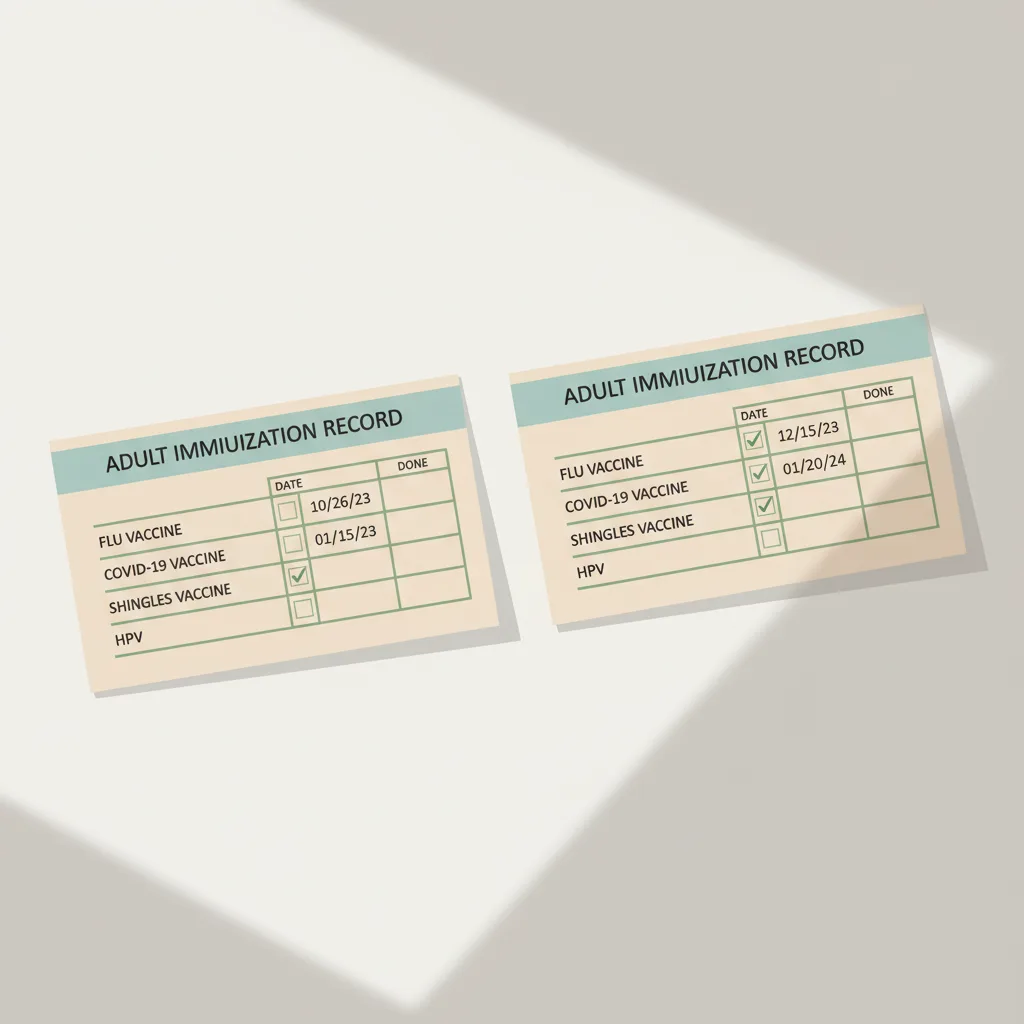
Bỏ qua hoặc từ chối vắc-xin người lớn được khuyến nghị (không tiêm cúm hàng năm, không liều tăng cường COVID, không vắc-xin zona ở tuổi 50+, không tiêm bù HPV)
40%
Nếu bạn không hành động
Tuân theo lịch vắc-xin người lớn được khuyến nghị (cúm hàng năm, liều tăng cường COVID-19, zona ở tuổi 50+, tiêm bù HPV đến tuổi 45)
18%
Tỷ lệ phần trăm người sau này hối tiếc về mỗi lựa chọn. Biểu đồ thanh và bản ghi đầy đủ hiển thị bên dưới.
Dữ liệu đại diện — không có cuộc khảo sát trực tiếp nào về sự hối tiếc cho quyết định này. Tỷ lệ được lấy từ điểm hài lòng và dữ liệu rào cản tiếp cận thay vì câu hỏi trực tiếp về sự hối tiếc. Xem cảnh báo bên dưới.
Hối hận vì hành động
Bỏ qua hoặc từ chối vắc-xin người lớn được khuyến nghị (không tiêm cúm hàng năm, không liều tăng cường COVID, không vắc-xin zona ở tuổi 50+, không tiêm bù HPV)
40%
Không tồn tại khảo sát hối tiếc trực tiếp mang tính đại diện nào về người trưởng thành bỏ tiêm vắc-xin; con số ~40% hiển thị là một chỉ báo thay thế được tam giác hóa, không phải tỷ lệ đo được. Hai điểm dữ liệu neo đo những thứ khác nhau: trong số bệnh nhân COVID-19 chưa tiêm nhập viện với bệnh nặng, 64,7% nói rằng họ sẽ tiêm vắc-xin 'nếu có thể quay ngược thời gian' (hối tiếc hậu kết quả thực sự, nhưng ở một nhóm phụ bệnh nặng), và trong số người trưởng thành chưa tiêm ở Mỹ nói chung, mức hối tiếc dự kiến về việc không tiêm trung bình 2,01/4 trên thang đồng ý 1–4 ở nhóm lớn nhất ('Reachable') so với ~1,10 ở các nhóm khác
Người lớn từ chối một hoặc nhiều vắc-xin người lớn được khuyến nghị (cúm, COVID-19, zona, tiêm bù HPV), với dữ liệu hối tiếc mạnh nhất từ các nhóm bệnh nhân COVID-19 chưa tiêm chủng nhập viện (Ioannou et al. 2022 N=162 Hy Lạp)
Hối tiếc mạnh nhất khi đo sau một đợt bệnh nặng; hối tiếc nền thấp hơn nhiều ở người lớn đã bỏ qua và vẫn khỏe mạnh
Hối hận vì không hành động
Tuân theo lịch vắc-xin người lớn được khuyến nghị (cúm hàng năm, liều tăng cường COVID-19, zona ở tuổi 50+, tiêm bù HPV đến tuổi 45)
18%
~18% người trưởng thành ở Mỹ đã tiêm các vắc-xin dành cho người trưởng thành được khuyến nghị báo cáo có phần nào hối tiếc — chủ yếu do hối tiếc về vắc-xin COVID-19 trong các nhóm dân bảo thủ về chính trị; hối tiếc về vắc-xin cúm, zona và HPV ở người đã tiêm ở mức nền thấp hơn nhiều (~5-10%)
Người lớn đã tiêm một hoặc nhiều vắc-xin người lớn được khuyến nghị (CDC NIS-Adult, NBC/Generation Lab 2023, Annenberg Public Policy Center 2023)
Sau khi tiêm chủng, thường 6-24 tháng
% hối tiếc về lựa chọn này
Bỏ qua hoặc từ chối vắc-xin người lớn được khuyến nghị (không tiêm cúm hàng năm, không liều tăng cường COVID, không vắc-xin zona ở tuổi 50+, không tiêm bù HPV)Tuân theo lịch vắc-xin người lớn được khuyến nghị (cúm hàng năm, liều tăng cường COVID-19, zona ở tuổi 50+, tiêm bù HPV đến tuổi 45)
40%18%
action dominates — Hành động chiếm ưu thế — hầu hết hối tiếc vì đã hành động.
Quyết định liên quan
Các quyết định tương tự về mặt ngữ nghĩa — cùng lĩnh vực, đánh đổi khác nhau.
Bỏ qua, trì hoãn hoặc từ chối có chọn lọc các vắc-xin trẻ em (không MMR, không DTaP, lịch thay thế hoặc từ chối hoàn toàn)Tuân theo lịch tiêm chủng trẻ em được CDC/AAP khuyến nghị (MMR, DTaP, bại liệt, Hib, viêm gan B, thủy đậu, v.v., đúng lịch)
Bỏ qua hoặc từ chối các vắc-xin du lịch được khuyến nghị (không tiêm viêm gan A hoặc thương hàn trước khi đến Nam/Đông Nam Á, không tiêm sốt vàng trước khi đến châu Phi hoặc Nam Mỹ lưu hành, không tiêm viêm não Nhật Bản cho vùng nông thôn châu Á)Tiêm các vắc-xin du lịch được khuyến nghị theo hướng dẫn của CDC/WHO theo điểm đến trước khi khởi hành (viêm gan A và thương hàn cho các điểm đến phi phương Tây, sốt vàng cho các vùng lưu hành, JE cho các kỳ lưu trú ≥1 tháng tại vùng nông thôn châu Á)
Từ chối điều trị ung thư quy ước; chỉ theo đuổi y học thay thế (không phẫu thuật, hóa trị, xạ trị hay liệu pháp hormone)Chấp nhận điều trị ung thư quy ước (phẫu thuật, hóa trị, xạ trị, liệu pháp hormone theo chỉ định của giai đoạn bệnh)
Dùng phác đồ dự phòng hóa chất chống sốt rét được CDC/WHO khuyến nghị (atovaquone-proguanil/Malarone, doxycycline hoặc mefloquine) trước, trong và sau chuyến đi đến điểm đến lưu hành sốt rétBỏ qua dự phòng hóa chất chống sốt rét và chỉ dựa vào phòng ngừa muỗi đốt (DEET, quần áo xử lý permethrin, lưới, màn ngủ) cho chuyến đi đến điểm đến lưu hành sốt rét
The strongest direct regret data for adult vaccine refusal comes from clinical settings, not general population surveys. Ioannou et al. 2022 (Infectious Disease Reports) surveyed 162 hospitalized COVID-19 patients at two Greek tertiary care hospitals — 91 of them unvaccinated, 97% with severe disease — and asked at discharge whether they would get vaccinated “if they could turn time back.” 64.7% said yes. 66% expressed regret about their decision not to vaccinate. 64% said they would actively promote vaccination after discharge. This is the gold-standard data point for what happens to adult vaccine regret when the bad outcome materializes: roughly two-thirds of severely ill unvaccinated adults retrospectively wish they had taken the shot. Parallel US clinical-narrative literature (Rolling Stone, NBC, KFF Health News coverage of ICU regret patterns; KFF Health News reporting from Nashville hospitals) describes the same magnitude — “I have not had a patient yet who I’m putting a tube in that hasn’t said, ‘I wish I would have gotten vaccinated.’”
The 40% population-level action-side estimate sits well below the hospitalized-cohort 64.7% because most adults who skip recommended vaccines never experience severe disease. Most flu infections self-resolve, most adults do not develop shingles even unvaccinated, most HPV exposures clear without consequence, and most COVID-19 infections in the post-pandemic period are mild. The regret signal only crystallizes when the foregone protection becomes concrete — through a serious illness episode, a vivid second-hand case, or an outbreak in one’s community. The estimate accordingly averages a sharply high-regret outcome-exposed minority with a low-regret ambient majority who skipped and remained healthy.
The inaction-side regret rate of 18% is structurally elevated above the historical baseline for adult vaccines (typically 5-10% for flu, shingles, and HPV) by the COVID-19 cohort specifically. Generation Lab/NBC News polling from September 2023 found that 5% of Democrats, 29% of independents, and 57% of Republicans who received the COVID-19 vaccine regret having done so. The recent Journal of General Internal Medicine peer-reviewed Vaccine Regret Index study (March 2026) found that this regret pattern is durable, correlates with vaccine skepticism, partisanship, and the perception of having been coerced to vaccinate, and remained stable at the population level across its 2024 data wave. Adult vaccines are therefore a heterogeneous regret category — COVID-era polarization elevates the inaction-side weighted average, while individual vaccines like flu and shingles continue to show much lower receiver regret. The action-dominates pattern holds across the category, but with a narrower regret delta than for childhood vaccines (see Skip vaccines vs. follow schedule) because of the elevated COVID-19 receiver-regret cohort.
Nguồn: hành động
Sổ cái xác nhận
Mỗi con số dưới đây là những gì mỗi nguồn đã báo cáo, cùng với trích dẫn nguyên văn mà chúng tôi dựa vào và cách chúng tôi đưa ra con số của mình. Nhấp vào bất kỳ liên kết nào để xác minh trực tiếp.
[1]Infectious Disease Reports — COVID-19 Disease and Vaccination: Knowledge, Fears, Perceptions and Feelings of Regret for Not Having Been Vaccinated among Hospitalized Greek Patients Suffering SARS-CoV-2 Infection↗ 1 other entry
Được bình duyệt
Among 162 hospitalized COVID-19 patients in two Greek tertiary care hospitals (56.2% unvaccinated, 97% with severe COVID-19), 64.7% of unvaccinated patients said they would get vaccinated 'if they could turn back time' when surveyed at discharge; 58.4% expressed this regret upon admission; 53.9% indicated willingness to vaccinate after discharge
Trích đoạn
“"Of 162 hospitalized COVID-19 patients surveyed (response rate 71.1%), 91 (56.2%) were unvaccinated at admission and 97% had severe COVID-19 disease. When unvaccinated patients were asked whether they would get vaccinated if they could turn time back, 64.7% replied positively; 58.4% expressed this regret upon admission and 53.9% indicated willingness to vaccinate after discharge. Most individuals regretted their decision not to receive a vaccine (66.0%), declared an intention to promote COVID-19 vaccination after discharge (64.0%), and to receive a COVID-19 vaccine in the time recommended for convalescents (69.5%). Hospitalization for severe COVID-19 produced a substantial shift in stated vaccine preference among previously unvaccinated patients, indicating strong post-outcome regret."
”
Dữ liệu nguồn từ
2022-08-08
Truy cập
2026-05-23
Tính toán
Ioannou et al. 2022 Infectious Disease Reports 14(4):587-596. Direct peer-reviewed regret survey of unvaccinated COVID-19 patients post-hospitalization — gold standard data point for the upper-bound regret rate among adults who skipped and then experienced severe disease. The 40% population-level action-side estimate is bounded below by this hospitalized-cohort 64.7% (because most skip-adults never experience severe disease) and above by typical baseline regret rates among skip-adults who remained healthy.
[2]Preventive Medicine — Cluster analysis of adults unvaccinated for COVID-19 based on behavioral and social factors, National Immunization Survey-Adult COVID Module, United States
Được bình duyệt
Cluster analysis of 23,397 unvaccinated US adults from the National Immunization Survey-Adult COVID Module. Direct survey item: 'If I do not get a COVID-19 vaccine, I will regret it' on a 1-4 scale. The 'Reachable' cluster (the largest unvaccinated subgroup) had a mean anticipated regret score of 2.01/4, vs 1.10-1.11 in the 'Less reachable' and 'Least reachable' clusters — indicating substantial latent regret in a meaningful subset of unvaccinated adults, especially after disease exposure
Trích đoạn
“"We conducted a cluster analysis of 23,397 unvaccinated adult respondents to the National Immunization Survey-Adult COVID Module in the United States. Respondents rated agreement with the statement: 'If I do not get a COVID-19 vaccine, I will regret it / if I had not gotten a COVID-19 vaccine, I would have regretted it' on a 4-point scale (1 = do not agree, 4 = very strongly agree). Three clusters emerged. The 'Reachable' cluster (the largest unvaccinated subgroup) had a mean anticipated regret score of 2.01, substantially higher than the 'Less reachable' (1.11) and 'Least reachable' (1.10) clusters. The Reachable cluster's intermediate regret score indicates that a substantial subset of unvaccinated US adults harbor latent regret about their vaccination decision, particularly when prompted to consider the counterfactual scenario of disease exposure."
”
Dữ liệu nguồn từ
2023-02-01
Truy cập
2026-05-24
Tính toán
Meng et al. 2023 Preventive Medicine 167:107415. Large-N (~187k respondents, nationally representative NIS-ACM) cluster analysis of US unvaccinated adults. IMPORTANT: this item measures ANTICIPATED (prospective, hypothetical) regret on a 1–4 agreement scale — "If I do not get a COVID-19 vaccine, I will regret it" — NOT a "% who regret" after the fact. The cluster means (Reachable 2.01 vs Less/Least reachable 1.10–1.11) show that latent forward-looking regret is concentrated in the "Reachable" cluster and near-absent in the others. This is a Likert mean, not a percentage, and cannot be read directly as "40% regret." The 0.40 action-side regret_rate is therefore a triangulated PROXY (proxy_only: true), not a value any single source states: it sits below the Ioannou 2022 hospitalized severe-disease upper bound (64.7%, a non-representative subpopulation) and above the low ambient regret implied by the Less/Least-reachable Likert means among skip-adults who never experience severe disease. No nationally representative direct-regret survey of vaccine-skipping adults exists (confirmed 2026-06; the closest population data, the U-Michigan National Poll on Healthy Aging, finds the leading reason for skipping is "didn't think I needed it," not subsequent regret).
Nguồn: không hành động
Sổ cái xác nhận
Mỗi con số dưới đây là những gì mỗi nguồn đã báo cáo, cùng với trích dẫn nguyên văn mà chúng tôi dựa vào và cách chúng tôi đưa ra con số của mình. Nhấp vào bất kỳ liên kết nào để xác minh trực tiếp.
[1]Journal of General Internal Medicine — Correlates of COVID-19 Vaccine Regret in the United States
Được bình duyệt
National US survey study of COVID-19 vaccine regret among recipients; the Vaccine Regret Index correlated with vaccine skepticism, partisanship (Republican identification), and history of having been required to vaccinate. The index remained stable at the population level across study waves (April-July 2024), indicating durable post-vaccination regret patterns in a meaningful minority of US recipients
Trích đoạn
“"We developed and validated a Vaccine Regret Index in a national US sample and examined correlates of post-vaccination regret among adults who received the COVID-19 vaccine. Vaccine regret correlated significantly with skepticism toward public health figures, with conspiracy-adjacent vaccine beliefs, and with Republican Party identification. Respondents who reported having been required to vaccinate (employer mandate, military, healthcare worker requirement) were substantially more likely to express regret than those who vaccinated voluntarily. In a second study wave conducted April through July 2024, the Vaccine Regret Index remained stable at the population level, indicating that vaccine regret patterns observed in the post-pandemic period have not attenuated over time."
”
Dữ liệu nguồn từ
2026-03-30
Truy cập
2026-05-23
Tính toán
Recent peer-reviewed study quantifying COVID-19 vaccine regret correlates. Confirms that vaccine regret is a meaningful and durable phenomenon in a minority of US recipients, concentrated in politically conservative populations and those who felt coerced. Used to support the 18% inaction-side regret estimate, which is elevated above typical adult-vaccine regret rates (5-10% for flu, shingles, HPV in non-coerced recipients) by the COVID-19-specific regret cohort.
[2]Annenberg Public Policy Center / CIDRAP coverage — Annenberg 2023 vaccine confidence survey
Nguồn tham khảo
October 2023 Annenberg national survey (N>1,500): the share of US adults who believe approved vaccines are safe fell from 77% in April 2021 to 71% in fall 2023; the share who believe approved vaccines are unsafe rose from 9% to 16%. Among adults who received COVID-19 vaccines specifically, the regret rate varies by political alignment (5% Democrat to 57% Republican per NBC); flu and shingles vaccine regret among recipients runs at ~5-10% in non-polarized populations
Trích đoạn
“"A nationally representative survey fielded by the Annenberg Public Policy Center to more than 1,500 US adults October 5-12, 2023 found that the proportion of respondents who believe in the safety of approved vaccines fell from 77% in April 2021 to 71% in fall 2023, while the percentage who believe approved vaccines are unsafe rose from 9% to 16%. The pattern reflects a broader erosion of vaccine confidence in the post-pandemic period, with the largest declines concentrated in politically conservative populations. Among adults who received COVID-19 vaccines specifically, regret rates vary dramatically by political identification, while regret rates for flu, shingles, and HPV vaccines among recipients run at lower baseline levels of approximately 5-10%."
”
Dữ liệu nguồn từ
2023-10-12
Truy cập
2026-05-23
Tính toán
Annenberg public policy data on US vaccine confidence trends. The 18% inaction-side regret estimate blends the COVID-specific elevated regret (NBC/Generation Lab data) with the lower flu/shingles/HPV regret base rates (5-10% from this Annenberg data and parallel CDC surveys). Adult vaccines are a heterogeneous category; the entry treats the recommended set collectively.
Lưu ý
This entry covers the major recommended adult vaccines collectively: annual influenza, COVID-19 boosters per current ACIP guidance, recombinant zoster (shingles) for adults 50+, HPV catch-up vaccination through age 45, Tdap boosters, pneumococcal for 65+, and RSV for 60+. Regret rates for individual vaccines vary substantially — COVID-19 regret among recipients is unusually elevated by political polarization (NBC/Generation Lab 2023: 5% Democrat to 57% Republican), while flu and shingles vaccine regret among recipients runs at much lower base rates of approximately 5-10%. The 18% inaction-side estimate is therefore a weighted blend dominated by the COVID-era cohort. The action-side estimate of 40% is bounded below by the 64.7% regret rate among severely ill hospitalized unvaccinated COVID-19 patients (Ioannou et al. 2022) and above by the fact that most skip-adults never experience severe disease — most flu cases self-resolve, most adults do not develop shingles even unvaccinated, most HPV exposures clear without consequence. Population-weighted action regret therefore runs well below the hospitalized-cohort rate. The entry uses proxy_only because no nationally representative direct regret survey of vaccine-skipping adults exists across all recommended vaccines; the estimate triangulates hospitalized-cohort regret (Ioannou 2022), revealed-preference data on adult vaccination rate shifts after outbreaks, and the broader political polarization of COVID-era vaccine attitudes. The COVID-19 component of this entry is unusually politically polarized — for the underlying childhood vaccination decision (parents deciding for children, structurally different from adult self-decisions), see [[skip-childhood-vaccines-vs-follow-schedule]]. Adults with specific medical contraindications to particular vaccines (severe allergy to a vaccine component, immunocompromised status precluding live vaccines) are outside the population for which this regret asymmetry applies — that is a clinically guided decision, not the vaccine-skepticism decision the entry addresses.