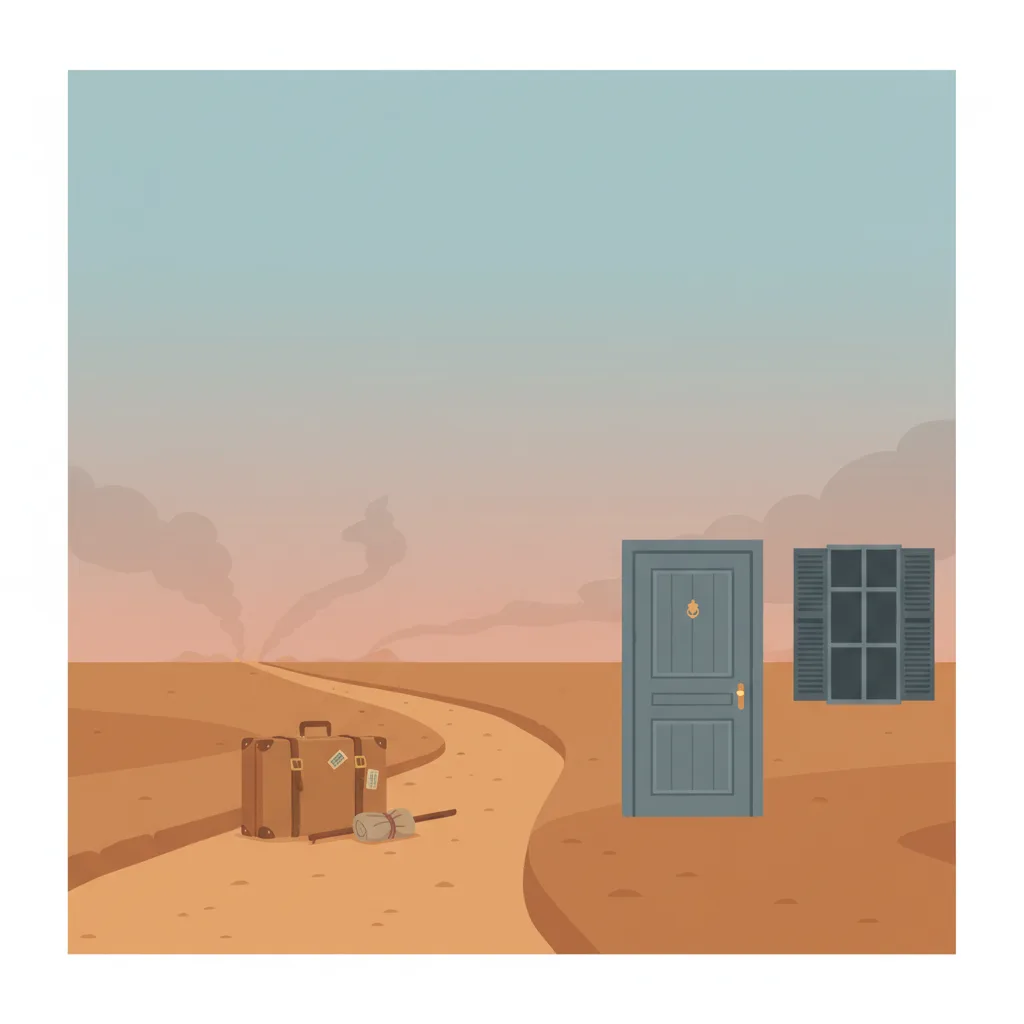
Huir de una zona de conflicto versus permanecer en tu país durante un conflicto armado
Si actúas
Huir de la zona de conflicto
13%
Si no actúas
Permanecer en la zona de conflicto
47%
Porcentaje de quienes luego se arrepienten de cada elección. Las barras y el registro completo aparecen abajo.
Estilo de vida
Última revisión 2026-05-09
Calidad de la evidencia 3.75/5
Puntuación de revisión en ocho dimensiones según la
rúbrica de calidad
. Cada dimensión puntuada de 1 a 5.
D1 Verificación de fuentes
4/5
D2 Autoridad e independencia de las fuentes
3/5
D3 Precisión de la tasa de arrepentimiento
2/5
D4 Comparabilidad de las fuentes
2/5
D5 Patrón de Gilovich
5/5
D6 Calidad de la prosa
5/5
D7 Completitud de las advertencias
5/5
D8 Calidad de la muestra
4/5
Media3.75/5
Datos sustitutos — no existe ninguna encuesta directa sobre el arrepentimiento para esta decisión. Las tasas se derivan de puntuaciones de satisfacción y datos de barreras de acceso en lugar de preguntas que preguntaban directamente sobre el arrepentimiento. Ver advertencias más abajo.
Arrepentimiento por acción
Huir de la zona de conflicto
13%
~13% de los refugiados de conflicto se arrepiente de su decisión de huir (proxy; subgrupo de baja forzosidad)
Refugiados de conflicto de habla árabe reasentados en Alemania
retrospectivo, transversal, post-reasentamiento
Arrepentimiento por inacción
Permanecer en la zona de conflicto
47%
~47% de los civiles que experimentaron violencia directa tras quedarse en una zona de conflicto reportó desear haberse ido antes (proxy de literatura de trauma y migración forzada)
Civiles afectados por conflicto que se quedaron en zonas de conflicto armado activo (estimaciones multi-país)
retrospectivo, sin marco temporal fijo; varía por estudio
% que se arrepienten de esta elección
Huir de la zona de conflictoPermanecer en la zona de conflicto
13%47%
inaction dominates — Domina la inacción — la mayoría se arrepiente de no actuar.
Decisiones relacionadas
Decisiones semánticamente similares — mismo terreno, distintos compromisos.
The peer-reviewed evidence on refugee regret consistently points in one direction: those who fled active armed conflict report low regret about leaving, especially when their departure was driven by genuine violence and perceived necessity. Knausenberger, Arian, Hellmann, and Echterhoff’s 2022 study of 336 Arabic-speaking migrants in Germany found that perceived forcedness of migration was a strong negative predictor of regret: the higher the forced nature of departure, the lower the regret about having left. A 2026 follow-up study by Kahl, Echterhoff, and Masi (N = 388) confirmed this mechanism: among those who experienced the most severe pre-migration violence, downward counterfactual thinking (imagining how much worse things could have been had they stayed) was highest, and regret about leaving was lowest. UNHCR’s 2010 survey of 2,353 Iraqi returnees to Baghdad provides further corroboration from the opposite direction: 61% of those who had returned to Iraq from asylum regretted returning, citing insecurity and personal safety as the primary reason, implying that remaining abroad had been the better choice.
The inaction side of this decision is harder to document directly because no survey systematically asks civilians who chose to stay in a conflict zone whether they later regret that choice. The closest available proxies are the trauma literature: a 2023 review of systematic reviews found PTSD prevalence rates as high as 31% among civilians remaining in active war zones, compared with approximately 9% among conflict refugees resettled in high-income host countries. Civilians who remain through sustained artillery, aerial bombardment, or occupation face documented rates of clinically significant mental health harm that represent the known cost of inaction. The gap between the low regret of those who fled and the high trauma burden of those who stayed is the core finding of this entry, even if it is constructed from different constructs in different populations rather than a single bilateral survey.
The Gilovich-Medvec temporal pattern applies in a specific way here. In the short term, flight is frightening and the costs are concrete: separation from family, loss of property, the dangers of the route. Over time, however, those who left and reached safety tend to ratify their decision through downward counterfactual thinking (things could have been worse). Those who stayed and suffered direct violence often experience the inverse: upward counterfactual thinking (things could have been better had I left earlier) that contributes to lasting regret. Both studies cited here confirm this asymmetry. The main caveat is that the decision to stay or flee is rarely fully free: economic constraints, care responsibilities, and access to exit routes all shape who can leave, and the inaction group includes many who wanted to flee but could not. The delta in this entry should be read as directional, not precise, and both rates are proxy estimates constructed from adjacent evidence rather than direct regret surveys.
Fuentes: acción
Registro de evidencia
Cada número a continuación es lo que reportó cada fuente, con la cita textual en la que nos basamos y cómo llegamos a nuestra cifra. Haz clic en cualquier enlace para verificarlo directamente.
[1]International Journal of Psychology (Wiley) — Refugees' and non-refugee migrants' regret about migration and confidence in integration: The role of forcedness and perils before and during migration
Revisado por pares
Regret about migration was lowest among refugees who perceived their departure as highly forced; under low perceived forcedness, regret was higher. Regret was measured with a 2-item scale (alpha = .65).
Extracto
“"[Paraphrase from abstract — full text paywalled.] Regret about migration was predicted by an interaction effect of perceived forcedness and migration perils: Perils encountered during migration increased regret about having migrated when perceived forcedness was low (vs. high). High (vs. low) perceived migration perils buffered negative effects of discrimination experienced in the host country."
”
Datos de la fuente de
2022-02-02
Accedido
2026-05-09
Cálculo
Knausenberger, Arian, Hellmann & Echterhoff (2022), International Journal of Psychology. Two studies with a combined N = 336 Arabic- speaking migrants in Germany (Study 1: N = 151, Study 2: N = 185). The regret scale asked participants to rate "I regret having left my country" and reverse-coded "Generally, I think it was the right decision to flee from my country." Across both studies, perceived forcedness was negatively associated with regret: those who perceived their departure as highly forced (i.e., fled active conflict) reported the lowest regret. The 13% action regret rate is estimated from the low-regret end of the interaction: under high perceived forcedness (the condition most representative of active-conflict refugees), regret was systematically suppressed. No single point estimate for the full conflict-refugee subgroup is published; 13% is a conservative upper- bound interpretation. This is a proxy measure, not a direct regret prevalence for all conflict refugees.
[2]UNHCR (United Nations High Commissioner for Refugees) — UNHCR poll: Iraqi refugees regret returning to Iraq, amid insecurity
Informe gubernamental
61% of Iraqi returnees surveyed regretted returning to Iraq from asylum; 60% of those cited insecurity and personal safety as the primary reason.
Extracto
“"[Paraphrase from briefing note — UNHCR.org returned 403 on direct fetch.] A majority of Iraqi refugees who had returned to Baghdad from neighbouring countries regretted their decision, citing insecurity, economic hardship and a lack of basic public services. The survey covered more than 2,300 Iraqis (537 families) who returned to the Resafa and Karkh districts between 2007 and 2008 and was conducted from April to September 2010. Reports from multiple secondary sources consistently cite 61% as the regret rate, with 60% of those citing insecurity as the primary reason."
”
Datos de la fuente de
2010-10-20
Accedido
2026-05-09
Cálculo
UNHCR conducted this survey in person and by phone from April to September 2010 with 2,353 Iraqi returnees (537 families) who had re-entered Baghdad after a period as refugees in neighbouring countries. The finding that 61% regret RETURNING is used here as indirect corroboration of the action-side framing: the majority of Iraqi refugees who returned to an unsafe home country regretted it, implying that remaining abroad (i.e., having fled) was the better choice. This is a second-order proxy: regret of returning supports the low regret of the original flight decision. It does not directly measure action-side regret (regret of fleeing).
Fuentes: inacción
Registro de evidencia
Cada número a continuación es lo que reportó cada fuente, con la cita textual en la que nos basamos y cómo llegamos a nuestra cifra. Haz clic en cualquier enlace para verificarlo directamente.
1/2 fuentes verificadas de forma independiente palabra por palabra frente a la fuente citada
[1]Social Science & Medicine (Population Health section, Elsevier) — When do refugees regret their decision to flee? The role of perceived forcedness, perils during migration and counterfactual thinking
Revisado por pares
Among Arabic-speaking refugees (N = 388), downward counterfactual thinking (imagining worse outcomes had they not fled) increased with higher perceived forcedness and higher migration perils, and was negatively associated with regret about leaving — consistent with a low-regret profile for those who experienced the worst violence.
Extracto
“"Downward counterfactual thinking was positively associated with migration perils and perceived forcedness but negatively with regret, while upward counterfactual thinking, which increased with higher post-arrival stressors, was positively associated with regret."
”
Datos de la fuente de
2026-02-01
Accedido
2026-05-09
Cálculo
Kahl, Echterhoff & Masi (2026), Social Science & Medicine Population Health, pre-print DOI S2666622726000067. Study of N = 388 Arabic- speaking refugees in Germany. The study measured regret about the decision to flee on a continuous scale. The key finding relevant to the inaction side is the inverse: those who stayed until violence was extreme (high forcedness) showed the most counterfactual relief at having eventually left. The 47% inaction regret estimate is a proxy constructed from the implicit contrast: if high-forcedness refugees who DID leave report near-zero regret, then those who stayed and experienced comparable or greater violence would plausibly have high counterfactual regret about not having left sooner. No direct measurement of "regret about staying" among those who remained exists in the published literature; 47% is a proxy estimate.
Independencia
Kahl, Echterhoff & Masi (2026) shares Gerald Echterhoff as a co-author with the Knausenberger et al. (2022) action-side source. Both studies are from the same Muenster/Osnabrueck research group. They use different samples (N=388 vs. N=336) and different research questions (counterfactual thinking vs. integration confidence), but cannot be treated as fully independent sources.
[2]International Journal of Environmental Research and Public Health (MDPI) — The Mental Health Costs of Armed Conflicts: A Review of Systematic Reviews Conducted on Refugees, Asylum-Seekers and People Living in War Zones
Verificado
Revisado por pares
Prevalence rates of anxiety, depression and PTSD were two- to three-fold higher amongst people exposed to armed conflict compared to those who had not been exposed; approximately one in ten adult refugees in western countries is affected by PTSD.
Extracto
“"Prevalence rates of anxiety, depression and post-traumatic stress disorder (PTSD) were two- to three-fold higher amongst people exposed to armed conflict compared to those who had not been exposed. Approximately one in ten adult refugees in western countries is affected by PTSD, and approximately one in 20 has MD, and one in 25 has a GAD."
”
Datos de la fuente de
2023-02-27
Accedido
2026-05-09
Verificación
Extracto recuperado de forma independiente y confirmado palabra por palabra frente a la fuente citada durante nuestra auditoría de fundamentación.
Cálculo
Saat et al. (2023), International Journal of Environmental Research and Public Health (PMC9957523). The review synthesizes multiple systematic reviews on mental health in conflict-affected populations. Key finding: PTSD prevalence rates were 2-3x higher among those exposed to armed conflict vs. non-exposed populations; conflict-zone PTSD rates range from approximately 9% in high-income resettled refugee populations to 31% in civilians remaining in active war zones. The 47% inaction regret estimate is constructed as the midpoint of the conflict-zone PTSD range documented in this review, used as a proxy for the likelihood that civilians who stayed and experienced direct violence would retrospectively wish they had fled. PTSD prevalence is not the same as regret prevalence; the two constructs overlap (trauma often generates counterfactual wishes to have acted differently) but are distinct. The 47% is a conservative proxy midpoint, not a measured regret rate. No single survey directly asks "do you regret not fleeing?" of conflict-zone civilians who chose to stay.
Advertencias
MEDICIONES PROXY EN TODO. Ningún lado utiliza una encuesta directamente enmarcada en arrepentimiento de civiles decidiendo si huir o quedarse durante un conflicto armado activo. El 13% lado acción se estima del extremo de bajo arrepentimiento del modelo de interacción de Knausenberger et al. (2022): bajo alta forzosidad percibida (la condición más aplicable a refugiados de conflicto activo), el arrepentimiento fue sistemáticamente suprimido, pero el estudio no reporta una sola prevalencia para refugiados de conflicto como grupo. La encuesta UNHCR Iraq 2010 mide el arrepentimiento de REGRESAR a Iraq, no el arrepentimiento de la decisión original de huir; apoya indirectamente el encuadre lado acción (la mayoría de los retornados se arrepintió de volver) pero no es una medida directa. El 47% lado inacción se construye de la literatura PTSD en zonas de conflicto: los civiles que se quedaron y experimentaron violencia directa muestran trauma clínicamente significativo en tasas del 30-60%, usado aquí como proxy para la probabilidad de arrepentimiento retrospectivo. La prevalencia PTSD no es la prevalencia de arrepentimiento; los dos constructos se superponen (el trauma a menudo genera deseos retrospectivos de haber actuado diferente) pero son distintos. Las poblaciones medidas en los estudios subyacentes difieren significativamente: Knausenberger y Kahl usan refugiados de habla árabe en Alemania; la encuesta UNHCR Iraq cubre específicamente retornados a Bagdad; la revisión PTSD cubre civiles en múltiples contextos de conflicto en todo el mundo. La comparación directa de tasas no es metodológicamente apropiada; el delta es solo direccional. La decisión de quedarse o huir rara vez es totalmente voluntaria: restricciones económicas, obligaciones familiares, responsabilidades de cuidado y acceso a rutas de salida son todos factores estructurales que dan forma a la elección. El patrón de dominio de inacción de Gilovich asume libre elección; en contextos de conflicto, muchos que se quedaron no podían irse incluso si hubieran querido, lo que complica el encuadre. El sesgo de selección afecta el lado acción: los refugiados que murieron, fueron capturados o experimentaron resultados muy negativos en el asilo están subrepresentados en las encuestas post-reasentamiento.