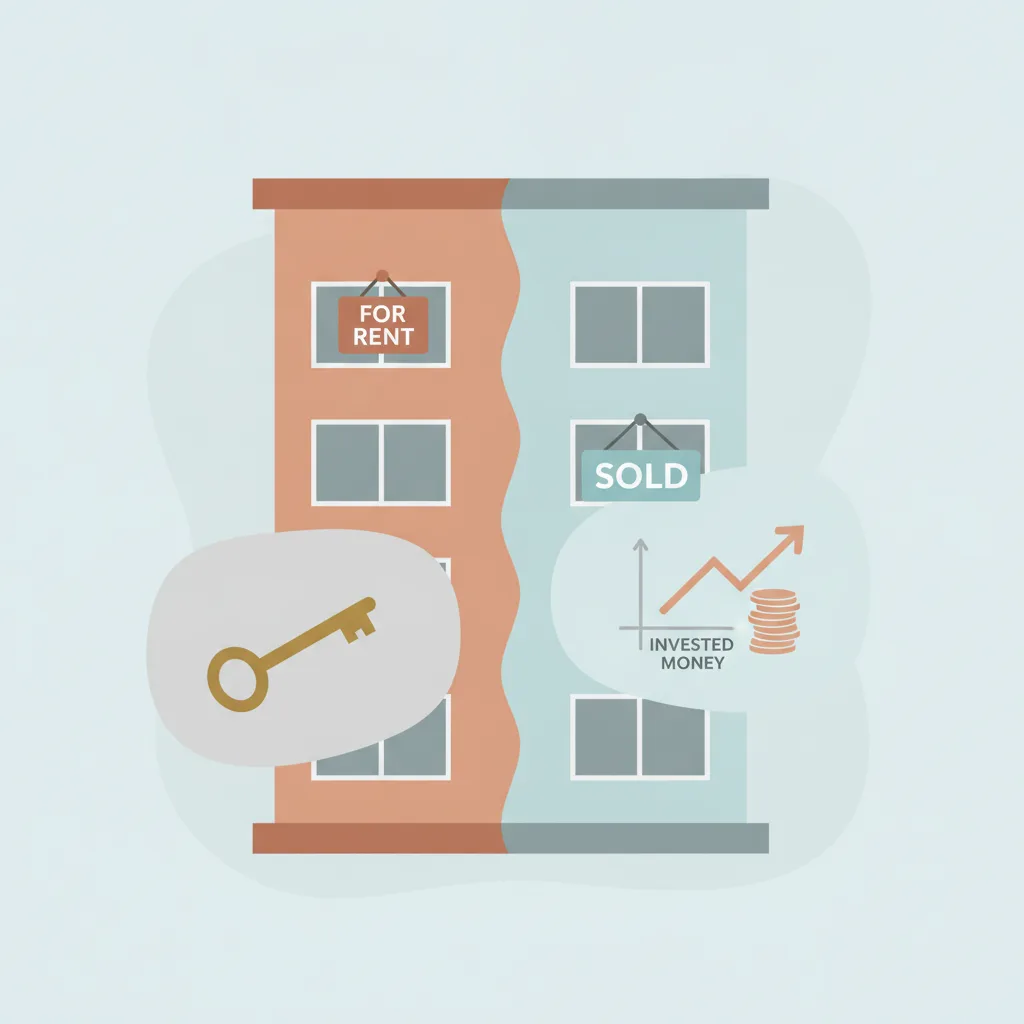
Menyewakan properti yang Anda miliki vs menjualnya dan menginvestasikan uangnya
Jika Anda bertindak
Menjual dan menginvestasikan
25%
Jika Anda tidak bertindak
Menahan dan menyewakan
40%
Persentase orang yang kemudian menyesali setiap pilihan. Diagram batang dan catatan lengkap ditampilkan di bawah.
Keuangan
Terakhir ditinjau 2026-07-09
Kualitas bukti 4.13/5
Skor tinjauan delapan dimensi terhadap
rubrik kualitas
. Setiap dimensi dinilai 1–5.
D1 Verifikasi sumber
4/5
D2 Otoritas & independensi sumber
4/5
D3 Akurasi tingkat penyesalan
3/5
D4 Keterbandingan sumber
4/5
D5 Pola Gilovich
4/5
D6 Kualitas prosa
5/5
D7 Kelengkapan peringatan
4/5
D8 Kualitas sampel
5/5
Rata-rata4.13/5
Data proksi — tidak ada survei penyesalan langsung untuk keputusan ini. Tingkat diturunkan dari skor kepuasan dan data hambatan akses daripada pertanyaan yang langsung menanyakan tentang penyesalan. Lihat peringatan di bawah.
Penyesalan atas tindakan
Menjual dan menginvestasikan
25%
25% penjual rumah menyesali penjualan — mereka merindukan rumah yang mereka lepas
Orang dewasa AS yang menjual rumah pada 2021–2022 (survei Clever Real Estate 2022)
retrospektif, dalam ~1–2 tahun sejak penjualan
Penyesalan atas kelambanan
Menahan dan menyewakan
40%
40% pemilik properti sewa berharap tidak pernah memulainya
Investor properti hunian / pemilik sewa di AS (survei Clever Real Estate 2024)
retrospektif, pemilik saat ini
% menyesal dengan pilihan ini
Menjual dan menginvestasikanMenahan dan menyewakan
25%40%
inaction dominates — Tidak bertindak mendominasi — sebagian besar menyesali karena tidak bertindak.
Keputusan terkait
Keputusan yang serupa secara semantik — area yang sama, kompromi yang berbeda.
No survey pits “rent it out” directly against “sell it and invest the money,” so this pairs the two closest measured regrets. About 40% of residential rental owners wish they’d never started investing in real estate (Clever Real Estate’s 2024 survey of 764 investors), against about 25% of recent sellers who regret selling because they miss the home they gave up (Clever’s 2022 survey of 1,000 sellers). On those proxies, keeping-and-renting is the more-regretted path — the opposite of the intuition that selling is the move you might kick yourself for later.
The reason keep-and-rent regret runs high is that landlording is not the passive income it is sold as. In the same 2024 survey, 56% of owners had already had to evict a tenant, 61% were still chasing missed rent every month, and 87% reported some regret about their investment decisions. The NBER study of landlords’ own lease ledgers puts a price on the hassle: filing a single eviction costs the equivalent of two to three months’ rent, and nonpayment is common enough that many landlords tolerate months of it before acting. Against that, the seller’s regret is quieter and more emotional — missing a home — rather than a recurring operational drain.
Read the gap cautiously. This is a proxy pairing, flagged as such: the two numbers come from different people surveyed in different years, the seller figure includes forced moves that mix circumstance with choice, and the investor sample leans toward heavily-invested owners who may regret more than a one-flat landlord would. It also says nothing about the money — whether renting out or selling-and-investing wins financially depends on rental yield, local price growth, and what the sale proceeds earn elsewhere, none of which a regret rate measures. The Gilovich pattern (holding-and-managing regret accumulates while the sold home fades into a wistful memory) fits the direction here, but the evidence is indicative, not a head-to-head test.
Sumber: tindakan
Buku besar klaim
Setiap angka di bawah ini adalah apa yang dilaporkan masing-masing sumber, dengan kutipan kata demi kata yang kami andalkan dan bagaimana kami sampai pada angka kami. Klik tautan mana saja untuk memverifikasi langsung.
[1]Clever Real Estate — American Home Seller Report: 2022 Edition
Sumber referensi
One-fourth of home sellers (25%) regretted selling because they miss their old home
Kutipan
“"One-fourth of respondents (25%) regretted selling because they miss their old home" — from a survey of 1,000 people who sold a home in 2021 or 2022 (fielded Sept. 29 – Oct. 2, 2022).
”
Data sumber dari
2022-10-12
Diakses
2026-07-09
Perhitungan
Used as a proxy for regret about the decision to sell itself. The 25% "miss their old home" figure is the cleanest available decision-construct regret for sellers — distinct from the much larger "process" regret numbers (priced too low, sold too fast, commission too high) that other seller surveys report, which measure regret about how the sale went, not regret about having sold. Because it is a proxy (not a head-to-head "sell vs rent-out" survey), this entry is flagged proxy_only.
Sumber: tidak bertindak
Buku besar klaim
Setiap angka di bawah ini adalah apa yang dilaporkan masing-masing sumber, dengan kutipan kata demi kata yang kami andalkan dan bagaimana kami sampai pada angka kami. Klik tautan mana saja untuk memverifikasi langsung.
[1]Clever Real Estate — Residential Real Estate Investing in 2024: More Rent Money, More Rental Problems↗ 1 other entry
Sumber referensi
40% of residential real estate investors wish they'd never started investing in real estate; 87% have regrets about their investment decisions; 56% have had to evict a tenant
Kutipan
“"40% say they wish they'd never started investing in real estate [...] 87% [...] have regrets about their investment decisions [...] More than half of respondents (56%) have had to evict a tenant at some point." — survey of 764 US residential real estate investors, fielded May 18–June 9, 2024.
”
Data sumber dari
2024-07-01
Diakses
2026-07-09
Perhitungan
The 40% "wish they'd never started" figure is used as the regret proxy for the keep-and-rent side. The broader 87% "have regrets" figure is not used as the headline because it spans market and financial regrets, not the decision to become a landlord specifically. Sample skews toward active, heavily-invested owners (90% had lost money on an investment).
[2]National Bureau of Economic Research (NBER Working Paper 33155) — Nonpayment and Eviction in the Rental Housing Market↗ 1 other entry
Studi primer
Filing an eviction costs landlords the equivalent of 2–3 months of rent; nonpayment is common and frequently tolerated before eviction
Kutipan
“"Filing an eviction costs landlords the equivalent of 2-3 months of rent [...] Nonpayment is common, is frequently tolerated by landlords, and is often followed by recovery."
”
Data sumber dari
2024-11-01
Diakses
2026-07-09
Perhitungan
Cited to explain why keep-and-rent regret runs high: landlording carries real, recurring costs (an eviction alone runs 2–3 months' rent), which the "passive income" framing understates. Corroboration for the regret driver, not a regret rate itself.
Catatan
Ini adalah pasangan proxy_only: tidak ada survei yang menanyakan orang yang sama apakah mereka menyesali pilihan menyewakan properti dibandingkan menjualnya dan menginvestasikan uangnya, sehingga masing-masing sisi memakai konstruk terdekat yang tersedia. Sisi tindakan (menjual) diwakili oleh 25% penjual baru-baru ini yang "merindukan rumah lama mereka" (Clever 2022); sisi tanpa tindakan (menahan dan menyewakan) diwakili oleh 40% pemilik sewa yang "berharap tidak pernah mulai berinvestasi di real estat" (Clever 2024). Kedua angka berasal dari sampel yang berbeda (penjual vs. investor) pada tahun yang berbeda (2022 vs. 2024), sehingga perbandingannya bersifat indikatif, bukan kontras yang terkendali. Angka "merindukan rumah saya" dari penjual mencakup orang yang terpaksa pindah karena perubahan pekerjaan atau keuangan, mencampuradukkan keadaan dengan pilihan; sampel investor condong ke pemilik yang aktif dan sangat banyak berinvestasi (90% pernah rugi pada suatu investasi), kemungkinan melebih-lebihkan penyesalan bagi seseorang yang menyewakan satu apartemen yang diwarisi atau dikosongkan. Yang terpenting, tingkat penyesalan sama sekali tidak mengatakan apa pun tentang uang: apakah menyewakan atau menjual-dan-berinvestasi menghasilkan hasil finansial yang lebih baik bergantung pada imbal hasil sewa, apresiasi harga lokal, dan imbal hasil pasar atas hasil penjualan — semuanya bergantung pada jalur dan waktu, dan tidak tercakup di sini. Kerangkanya berbasis AS; hukum perlindungan penyewa dan biaya transaksi sangat berbeda antar negara.