




Vai al contenuto
Likelier

Rimpianto per l’azione vs. l’inazione

Adottare una dieta vegetariana o vegana vs continuare a mangiare carne

Se agisci

Diventare vegetariani/vegani

84%

Se non agisci

Continuare a mangiare carne

22%

Percentuale di chi poi rimpiange ciascuna scelta. Le barre e il registro completo dei dati compaiono sotto.


Stile di vita

Ultima revisione 2026-04-26

Qualità delle prove 4.0/5

Punteggio di revisione su otto dimensioni rispetto alla griglia di qualità . Ogni dimensione valutata da 1 a 5.

D1 Verifica delle fonti
5/5
D2 Autorità e indipendenza delle fonti
4/5
D3 Precisione del tasso di rimpianto
2/5
D4 Comparabilità delle fonti
3/5
D5 Schema di Gilovich
3/5
D6 Qualità della prosa
5/5
D7 Completezza degli avvertimenti
5/5
D8 Qualità del campione
5/5
Media 4.0/5
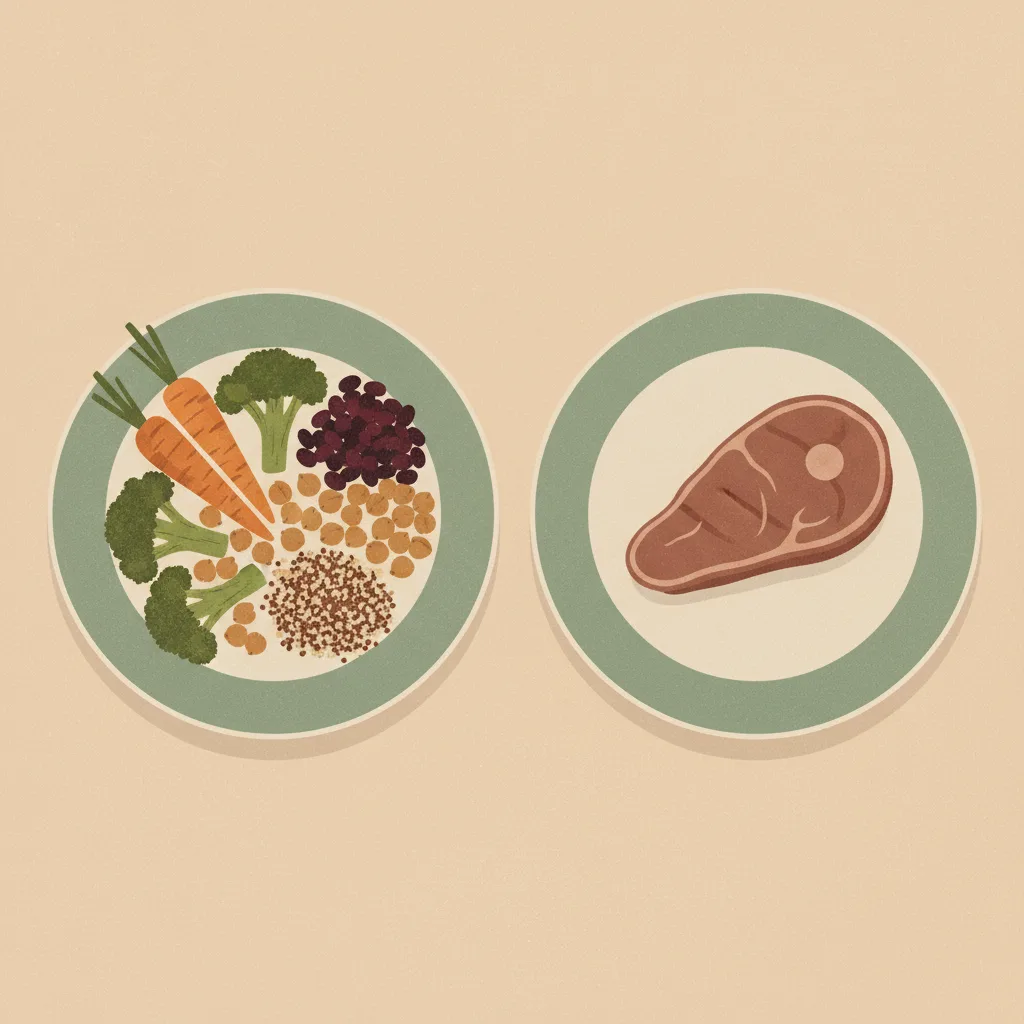
Two plates side by side, one with vegetables and legumes, the other with a cut of meat, both slightly faded.

Rimpianto per azione

Diventare vegetariani/vegani

84%

L'84% ha abbandonato il vegetarianismo (proxy di abbandono — tasso di abbandono, non rimpianto diretto)

Adulti statunitensi che hanno provato il vegetarianismo o veganismo

retrospettivo, nessun arco temporale fisso

Rimpianto per inazione

Continuare a mangiare carne

22%

Il 22% si sente in colpa per mangiare carne tutto il tempo (proxy di colpa — non rimpianto diretto)

Adulti britannici non vegani, rappresentativo a livello nazionale

retrospettivo, nessun arco temporale fisso

% rimpiange questa scelta

action dominates — L'azione domina — la maggior parte si pente di aver agito.

Decisioni correlate

Decisioni semanticamente simili — stesso terreno, compromessi diversi.

lifestyle

Tenere o dare in adozione l'animale

% rimpiange questa scelta

L'inazione prevale

Rimpianto per l'inazione 5.7× maggiore

lifestyle

Tatuaggio

% rimpiange questa scelta

L'azione prevale

Rimpianto per l'azione 1.6× maggiore

Salute

Smettere di fumare

% rimpiange questa scelta

L'inazione prevale

Rimpianto per l'inazione 90.0× maggiore

lifestyle

Digiuno intermittente

% rimpiange questa scelta

L'azione prevale

Rimpianto per l'azione 2.9× maggiore

lifestyle

Elettrica vs benzina

% rimpiange questa scelta

L'azione prevale

Rimpianto per l'azione 2.9× maggiore

Salute

Piercing corporeo

% rimpiange questa scelta

L'azione prevale

Rimpianto per l'azione 4.0× maggiore

lifestyle

Abbandonare la religione

% rimpiange questa scelta

L'inazione prevale

Rimpianto per l'inazione 2.9× maggiore

Salute

Longevità vs accettare invecchiamento

% rimpiange questa scelta

L'inazione prevale

Rimpianto per l'inazione 1.5× maggiore

The largest study of vegetarian and vegan retention — Faunalytics’ 2014 survey of 11,399 US adults via Harris Interactive — found that 84% of people who adopted a vegetarian or vegan diet eventually returned to eating meat. That number is the action-side proxy shown above, used directly rather than the previously constructed composite. But lapse rate is not regret rate. Crucially, 37% of the lapsed expressed interest in re-adopting, meaning they do not regret the diet itself — they regret stopping it, or faced barriers they could not overcome. A Faunalytics obstacle analysis found that social isolation (84% were not part of any veg community), food access, and meal prep difficulty — not principled rejection of the diet — drove most lapses.

On the other side, a 2022 Vegan Society survey of 2,000 non-vegan UK adults found that 22% report feeling guilty about eating meat all of the time — a persistent-guilt figure we use as the inaction proxy rather than the combined 71% who report guilt “some” or “all” of the time. Persistent guilt maps more closely to a regret-adjacent construct than intermittent discomfort. Cognitive dissonance research (Bastian et al., 2012) shows that meat-related guilt is often resolved through justification strategies — “the guilt persists but produces no corresponding desire to act.” The Vegan Society, as the commissioning body, has an advocacy interest in high guilt numbers.

What the data establishes is that dietary identity is unstable: most people who try vegetarianism quit (though many want to try again), and roughly one in five meat eaters carries persistent guilt about it. The action-dominates pattern reflects an asymmetry between a very high lapse rate and a modest persistent-guilt rate, but readers should note that lapsing conflates genuine dissatisfaction with situational barriers. Both figures are proxies for different constructs (behavioral abandonment vs affective discomfort), so the large delta should be read with caution.

Fonti: azione

Registro delle fonti

Ogni numero qui sotto è ciò che ciascuna fonte ha riportato, con la citazione testuale su cui ci siamo basati e come siamo arrivati alla nostra cifra. Clicca su qualsiasi link per verificare direttamente.

1/2 fonti verificate in modo indipendente e alla lettera rispetto alla fonte citata

  1. [1] Faunalytics / Harris Interactive — A Summary of Faunalytics' Study of Current and Former Vegetarians and Vegans Verificato
    A Summary of Faunalytics' Study of Current and Former Vegetarians and Vegans
    Statistica
    84% of people who have adopted a vegetarian or vegan diet subsequently abandon it; 53% lasted less than one year; 37% of the lapsed are interested in re-adopting
    Estratto
    “"84% of vegetarians/vegans abandon their diet. About a third (34%) of lapsed vegetarians/vegans maintained the diet for three months or less, and slightly more than half (53%) adhered to the diet for less than one year. The only motivation cited by a majority (58%) of former vegetarians/vegans was health." ”
    Dati originali da
    2014-12-02
    Consultato
    2026-04-26
    Verifica
    Estratto recuperato in modo indipendente e confermato parola per parola rispetto alla fonte citata durante il nostro audit di attendibilità.
    Calcolo
    Faunalytics commissioned Harris Interactive to survey 11,399 US adults aged 17+. Of those who had ever identified as vegetarian/vegan, 84% had reverted to eating meat. We use the 84% lapse rate directly as the action-side proxy. This is NOT a regret measure — it counts anyone who tried vegetarianism even briefly as a "former vegetarian." Crucially, 37% of lapsed expressed interest in re-adopting, meaning many lapsed for situational reasons (social isolation, food access) rather than because they regret the decision in principle.
  2. [2] Faunalytics — Bringing Back Former Vegans And Vegetarians: An Obstacle Analysis
    Bringing Back Former Vegans And Vegetarians: An Obstacle Analysis
    Statistica
    Food dissatisfaction is the most common struggle; accessibility and meal preparation time are the primary must-haves for re-adoption
    Estratto
    “"Dissatisfaction with veg*n food is the most common struggle, with nearly half of lapsed veg*ns experiencing cravings, boredom with their veg*n diet, feeling hungry on the diet, and other issues related to food dissatisfaction." ”
    Dati originali da
    2019-10-01
    Consultato
    2026-04-26
    Calcolo
    Faunalytics obstacle analysis of former veg*ns. Confirms that many lapsed for practical/situational reasons (access, time, social isolation) rather than regretting the decision in principle. 84% of former veg*ns were not part of any vegetarian community, and 63% disliked sticking out from the crowd.

Fonti: inazione

Registro delle fonti

Ogni numero qui sotto è ciò che ciascuna fonte ha riportato, con la citazione testuale su cui ci siamo basati e come siamo arrivati alla nostra cifra. Clicca su qualsiasi link per verificare direttamente.

  1. [1] The Vegan Society / Attest — Younger people feel more guilty about eating meat than older people, Vegan Society research finds
    Younger people feel more guilty about eating meat than older people, Vegan Society research finds
    Statistica
    22% of non-vegan UK adults feel guilty about eating meat all of the time; an additional 49% feel guilty some of the time
    Estratto
    “"49 per cent of respondents felt guilty about eating meat 'some' of the time, while a further 22 per cent felt guilty 'all' of the time. Even amongst those not limiting their consumption of meat and animal products at all, 45 per cent said they felt guilty about it 'some' or 'all' of the time." ”
    Dati originali da
    2022-11-01
    Consultato
    2026-04-26
    Calcolo
    Vegan Society commissioned Attest to survey 2,000 non-vegan UK adults (working age, nationally representative for age, gender, and region) in October 2022. We use the 22% "guilty all the time" figure rather than the combined 71% (some + all), because persistent guilt is a closer proxy for regret-adjacent affect than intermittent guilt. The Vegan Society as commissioning body has an advocacy interest in high guilt numbers. Guilt about eating meat is NOT the same as regret about not going vegetarian — cognitive dissonance research shows meat-guilt is often resolved through justification strategies.
  2. [2] Faunalytics / Harris Interactive — A Summary of Faunalytics' Study of Current and Former Vegetarians and Vegans
    A Summary of Faunalytics' Study of Current and Former Vegetarians and Vegans
    Statistica
    88% of US adults have never tried vegetarianism or veganism; 10% are former veg*ns; 2% are current veg*ns
    Estratto
    “"About 88 percent of the U.S. population had never attempted a vegetarian or vegan diet, yet among the 12 percent who tried, only 2 percent had stuck with it." ”
    Dati originali da
    2014-12-02
    Consultato
    2026-04-26
    Calcolo
    Faunalytics population data. 88% of US adults have never tried vegetarianism, providing context: the vast majority of meat eaters have not even considered the alternative seriously, making "regret about not going vegetarian" a narrow phenomenon even if guilt about meat is widespread.

Avvertenze

Nessun lato misura direttamente il rimpianto. L'84% lato azione è un tasso di abbandono — conta chiunque abbia provato il vegetarianismo e sia tornato indietro, inclusi esperimenti di meno di 3 mesi. Abbandonare non è pentirsi: il 37% di chi ha abbandonato ha espresso interesse a riadottarlo, e l'analisi degli ostacoli di Faunalytics ha rilevato che le barriere pratiche (isolamento sociale, accesso al cibo, difficoltà di preparazione dei pasti) hanno guidato la maggior parte degli abbandoni piuttosto che il rifiuto di principio. Il grezzo 84% dovrebbe essere letto come "la dieta non è rimasta" piuttosto che "si pentono di aver provato". Il 22% lato inazione è una colpa persistente ("tutto il tempo") per mangiare carne, non rimpianto per non essere diventati vegetariani. La ricerca sulla dissonanza cognitiva (Bastian et al., 2012) mostra che la colpa legata alla carne è spesso risolta attraverso strategie di giustificazione senza cambiamento comportamentale. I due campioni provengono da paesi diversi (USA vs Regno Unito) e decenni diversi (2014 vs 2022). Il modello action-dominates riflette l'asimmetria tra un alto tasso di abbandono e un modesto tasso di colpa persistente, ma entrambi sono proxy per costrutti diversi (abbandono comportamentale vs disagio affettivo). Il grande delta (0,62) sovrastima la differenza nel rimpianto effettivo perché l'abbandono confonde il rimpianto con le barriere situazionali.

Dati grezzi: /api/decisions.json

Visti di recente su questo dispositivo