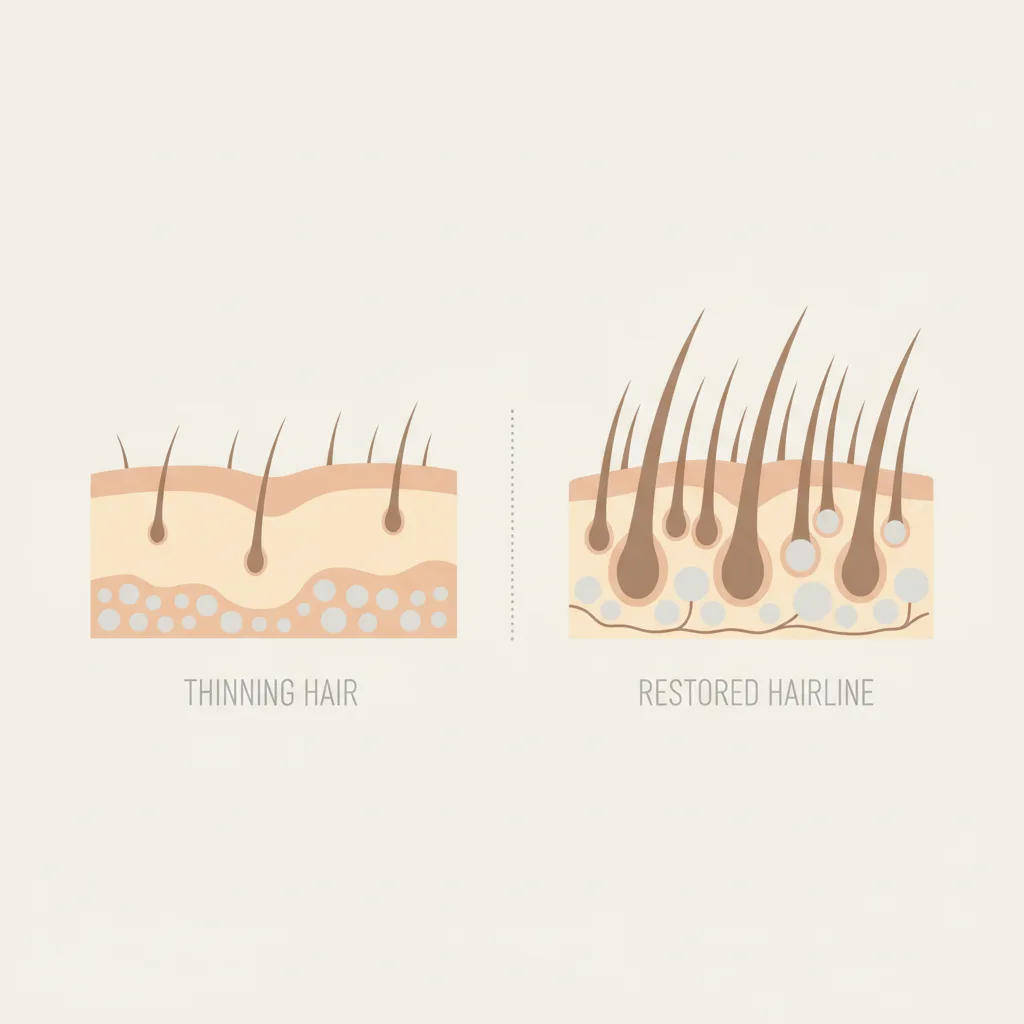
Een haartransplantatie ondergaan versus leven met haarverlies
Als je handelt
Een haartransplantatie ondergaan
5,0%
Als je niets doet
Leven met haarverlies (geen transplantatie)
25%
Percentage dat later spijt heeft van elke keuze. De balken en het volledige overzicht staan hieronder.
Gezondheid
Laatst beoordeeld 2026-05-10
Kwaliteit van bewijs 4.0/5
Beoordelingsscore op acht dimensies volgens de
kwaliteitsrubriek
. Elke dimensie krijgt een score van 1 tot 5.
D1 Bronverificatie
5/5
D2 Autoriteit en onafhankelijkheid van bronnen
4/5
D3 Nauwkeurigheid van spijtcijfer
2/5
D4 Vergelijkbaarheid van bronnen
3/5
D5 Gilovich-patroon
5/5
D6 Prozakwaliteit
5/5
D7 Volledigheid van voorbehouden
5/5
D8 Steekproefkwaliteit
3/5
Gemiddelde4.0/5
Proxygegevens — er bestaat geen directe spijtenquête voor deze beslissing. De percentages zijn afgeleid van tevredenheidsscores en toegangsdrempelgegevens in plaats van vragen die direct naar spijt vroegen. Zie opmerkingen hieronder.
Spijt van handelen
Een haartransplantatie ondergaan
5,0%
~5% ontevreden (bereik 2–15% per kliniekkwaliteit)
Mannelijke androgenetische alopecia patiënten die FUE-transplantatie ondergaan, klinische studies
12 maanden na procedure
Spijt van nalaten
Leven met haarverlies (geen transplantatie)
25%
~25% (proxy: mannen met AGA die matig-tot-ernstige psychologische stress ervaren van onbehandeld haarverlies)
Mannen met androgenetische alopecia, multinationale enquête
dwarsdoorsnede; haarverlies voortdurend
% betreurt deze keuze
Een haartransplantatie ondergaanLeven met haarverlies (geen transplantatie)
5,0%25%
inaction dominates — Niets doen domineert — de meesten hebben spijt dat ze niet handelden.
Gerelateerde keuzes
Semantisch vergelijkbare keuzes — zelfde terrein, andere afwegingen.
Among men who undergo follicular unit extraction (FUE) hair transplantation at accredited centers, clinical studies consistently find high satisfaction: a PMC-indexed study of 152 patients reported 98% good or satisfactory results at 12 months, with only 1.97% classified as poor outcomes. A larger study of 875 male AGA patients found satisfaction with appearance rising by over 30 points on standardized scales post-operatively. The picture darkens at lower-quality clinics — ISHRS census data indicate 5.4% of patients seek repair surgery from a different physician due to prior dissatisfaction, and independent reports place density-related disappointment at 10—15% where donor supply is inadequate or technique substandard. A conservative central estimate of ~5% action regret sits between the clinical-study floor and the repair-surgery rate.
On the inaction side, the psychological literature is unambiguous: untreated androgenetic alopecia carries a substantial and persistent quality-of-life burden. A multinational European study of 729 men with AGA found that 62% believed hair loss could diminish self-esteem — with 43% citing lost attractiveness, 42% baldness fears and 21% depression — yet fewer than 10% were actively pursuing treatment. A 2024 mixed-methods survey found men with AGA scoring life satisfaction at 5.70 against a national norm of 7.38 — a gap that persists for years. No published survey directly asks untreated men whether they regret not having a hair transplant, so the inaction rate (25%) is a proxy anchored to severe-distress prevalence among non-treating men.
The Gilovich inaction-dominates pattern is directionally plausible here: the decision not to pursue transplantation leaves an open counterfactual (“what if I had done it when my pattern was stabilizing?”) that the mind can sustain indefinitely, while the decision to pursue surgery — if performed at a qualified center with realistic expectations — tends to close the counterfactual with a positive outcome. The main caveat is selection: surgery patients in clinical studies are pre-screened for candidacy, whereas psychosocial burden studies sample all men with AGA regardless of transplant eligibility. The ~20-point gap in proxied rates should be read as directional evidence of inaction dominance, not a precise regret differential.
Bronnen: handelen
Bronnenverantwoording
Elk getal hieronder is wat elke bron rapporteerde, met het letterlijke citaat waarop we ons baseerden en hoe we tot ons cijfer kwamen. Klik op een link om rechtstreeks te verifiëren.
1/2 bronnen onafhankelijk woordelijk geverifieerd tegenover de geciteerde bron
[1]Journal of Pharmacy and Bioallied Sciences (PMC) — Clinical Outcome and Safety Profile of Patients Underwent Hair Transplantation Surgery by Follicular Unit Extraction
Geverifieerd
Vakgenoten-beoordeeld
98.03% of patients reported good or satisfactory results at 12 months; 1.97% reported poor results
Fragment
“"Clients' remarks noted at the end on one year revealed 86.18% as good results, 11.84% as satisfactory and 1.97% as poor results."
”
Brongegevens van
2021-11-23
Geraadpleegd
2026-05-10
Verificatie
Fragment onafhankelijk opnieuw opgehaald en woord voor woord bevestigd tegenover de geciteerde bron tijdens onze onderbouwingsaudit.
Berekening
Prospective study of 152 male androgenetic alopecia patients undergoing FUE transplantation (July 2017 -- February 2018). Satisfaction assessed at 12-month follow-up. "Poor results" (1.97%) is used as the floor for action-side dissatisfaction. We apply a 5% estimate rather than the 1.97% floor because: (a) this single-center study likely selects motivated patients with adequate donor hair; (b) ISHRS census data indicates 5.4% of patients seek repair surgery from a different physician due to prior dissatisfaction; (c) independent estimates place dissatisfaction from unmet density expectations at 10--15%. A 5% central estimate sits conservatively between the clinical study floor and ISHRS repair-seeking rate. "Poor results" is a technical outcome measure, not a direct regret question -- see caveats.
[2]Journal of Cosmetic Dermatology — The relationship between self-esteem and hair transplantation satisfaction in male androgenetic alopecia patients
Vakgenoten-beoordeeld
Satisfaction with appearance rose by 30.25 points post-operatively (p<0.05); self-esteem increased 1.56 points; n=875 completers
Fragment
“"[Paraphrase from abstract -- full text paywalled] Among 875 male AGA patients completing 9-month follow-up, postoperative self-esteem scores increased significantly (RSES +1.56 points, p<0.05) and satisfaction with appearance rose by 30.25 points (p<0.05). Patients with low pre-operative self-esteem trended toward worse postoperative satisfaction."
”
Brongegevens van
2019-04-01
Geraadpleegd
2026-05-10
Berekening
Large-sample prospective study (n=875 completers of 1,106 enrolled). Used as secondary corroboration that the vast majority of patients experience meaningful satisfaction improvement. The finding that low pre-operative self-esteem predicts worse outcomes is relevant to interpreting aggregate satisfaction rates -- clinical populations screened by surgeons for realistic expectations will outperform unscreened estimates.
Bronnen: niet handelen
Bronnenverantwoording
Elk getal hieronder is wat elke bron rapporteerde, met het letterlijke citaat waarop we ons baseerden en hoe we tot ons cijfer kwamen. Klik op een link om rechtstreeks te verifiëren.
[1]Current Medical Research and Opinion — The psychosocial impact of hair loss among men: a multinational European study
Vakgenoten-beoordeeld
62% of men believed hair loss could diminish self-esteem; 43% reported concern about lost attractiveness, 42% baldness fears, 21% depression; <10% were currently pursuing treatment (75% never had)
Fragment
“"Among 1536 respondents, 729 (47%) reported hair loss. Over 70% considered hair important to their image and 62% believed hair loss could diminish self-esteem. Concerns included lost attractiveness (43%), baldness fears (42%), aging (37%), social impact (22%) and depression (21%). Fewer than 10% were currently pursuing treatment; 75% had never pursued it."
”
Brongegevens van
2005-10-01
Geraadpleegd
2026-05-10
Berekening
Telephone survey of 1,536 European men aged 18-45 (Germany, France, Italy, Spain, UK), of whom 729 (47%) reported experiencing hair loss. The study reports that 62% believed hair loss could diminish self-esteem, with 43% citing lost attractiveness, 42% baldness fears and 21% depression, while fewer than 10% were currently pursuing treatment. We use ~25% as a conservative proxy for persistent inaction regret among untreated men, anchored to the cluster of severe-distress responses (21% depression, plus the much larger share reporting diminished self-esteem) among the ~90% who are not pursuing treatment. This is a proxy -- the study does not directly ask whether men regret not getting a hair transplant. (Note: the widely cited "25% find hair loss extremely upsetting / 65% modest-to-moderate distress" figures originate from Cash 1992, J Am Acad Dermatol, not from this 2005 multinational survey; they are therefore not quoted here.)
[2]Skin Health and Disease (Wiley / PMC) — The psychosocial impact of alopecia in men: A mixed-methods survey study
Vakgenoten-beoordeeld
56-57% of men with alopecia reported depleted confidence and wellbeing; life satisfaction 5.70 vs national norm 7.38
Fragment
“"56--57% of participants reported depleted confidence and wellbeing related to their alopecia... Life satisfaction: 5.91 (AA) and 5.70 (AGA) vs. 7.38 national norm. Happiness: 5.79 (AA) and 5.50 (AGA) vs. 7.30 national norm."
”
Brongegevens van
2024-09-30
Geraadpleegd
2026-05-10
Berekening
Mixed-methods survey of men with alopecia areata and androgenetic alopecia (2024). Wellbeing scores substantially below national norms corroborate the persistent psychological burden captured in the 2005 European study. Used as corroborating evidence that untreated hair loss carries lasting quality-of-life cost, supporting a non-trivial inaction-regret proxy. Not a direct regret measure.
Kanttekeningen
Geen van beide percentages is afgeleid van een directe spijtvraag. De actie-zijde (5%) is een conservatieve schatting getrokken uit klinische uitkomstmaten — "slechte resultaten" op 12 maanden in een begeleide klinische studie (1,97%), het ISHRS-gerapporteerde herstel-chirurgiepercentage (5,4%), en onafhankelijke schattingen van dichtheidsontevredenheid (10–15%). Het cijfer vertegenwoordigt patiënten met adequate donorvoorraad en realistische verwachtingen; uitkomsten bij klinieken van lagere kwaliteit of niet-geaccrediteerd zijn substantieel slechter. De inactie-zijde (25%) is een proxy verankerd op de proportie mannen die hun haarverlies als "extreem verontrustend" rapporteren terwijl ze geen behandeling nastreven (Europese enquête, n=729 met AGA). "Extreem verontrustend" is niet synoniem met "heeft spijt van geen transplantatie" — veel mannen accepteren haarverlies zonder spijt van de afwezigheid van interventie, en nog veel meer zijn niet in aanmerking komend wegens onvoldoende donorhaar of voortdurende patroonprogressie. Het verschil (-0,20) weerspiegelt inactie-dominantie: onder mannen die significant haarverlies niet behandelen, is stress zowel vaker als persistenter dan spijt onder degenen die transplantatie ondergaan. Deze vergelijking is echter geen appels-tegen-appels: chirurgiepatiënten zijn voorgeselecteerd voor kandidaatschap (adequaat donorhaar, stabiel patroon, realistische verwachtingen), terwijl de psychosociale-lastsstudies alle mannen met AGA bemonsteren ongeacht transplantatiegeschiktheid. Het Gilovich inactie-domineert patroon is richtinggevend plausibel maar de kwantitatieve kloof moet gelezen worden als bij benadering.