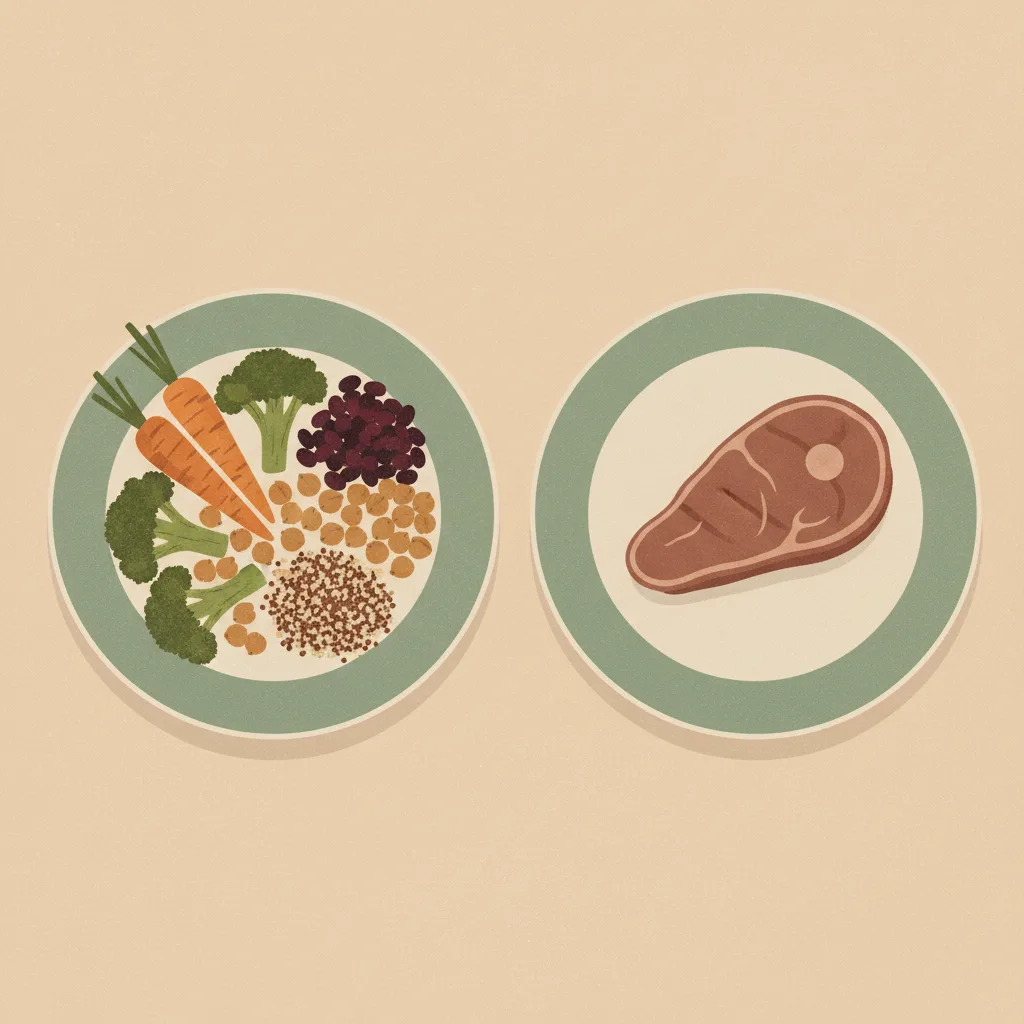
Vegetarisch of veganistisch eten vs vlees blijven eten
Als je handelt
Vegetariër/veganist worden
84%
Als je niets doet
Vlees blijven eten
22%
Minstens één cijfer is een indirecte schatting, geen gemeten percentage spijt. Hoe elk getal tot stand kwam, staat hieronder.
Levensstijl
Laatst beoordeeld 2026-04-26
Kwaliteit van bewijs 4.0/5
Beoordelingsscore op acht dimensies volgens de
kwaliteitsrubriek
. Elke dimensie krijgt een score van 1 tot 5.
D1 Bronverificatie
5/5
D2 Autoriteit en onafhankelijkheid van bronnen
4/5
D3 Nauwkeurigheid van spijtcijfer
2/5
D4 Vergelijkbaarheid van bronnen
3/5
D5 Gilovich-patroon
3/5
D6 Prozakwaliteit
5/5
D7 Volledigheid van voorbehouden
5/5
D8 Steekproefkwaliteit
5/5
Gemiddelde4.0/5
Indirecte gegevens: voor deze beslissing komt minstens één cijfer uit een indirecte maat, zoals gevolgen, tevredenheid of intentie, of uit een schatting van de redactie, en niet uit een enquête die rechtstreeks naar spijt vraagt. De toelichting bij elke kant hieronder legt uit hoe het getal tot stand kwam.
Als je handelt
Vegetariër/veganist worden
84%
84% gestopt met vegetarisme (vervallen proxy — opzegpercentage, geen directe spijt)
Amerikaanse volwassenen die vegetarisme of veganisme hebben geprobeerd
retrospectief, geen vast tijdsbestek
Als je niets doet
Vlees blijven eten
22%
22% voelen zich altijd schuldig over vlees eten (schuldproxy — geen directe spijt)
UK niet-vegan volwassenen, nationaal representatief
retrospectief, geen vast tijdsbestek
Cijfer voor elke keuze (de maat staat op de pagina benoemd)
Vegetariër/veganist wordenVlees blijven eten
84%22%
Gerelateerde keuzes
Semantisch vergelijkbare keuzes — zelfde terrein, andere afwegingen.
Of the people who adopted a vegetarian or vegan diet, 84% eventually
returned to eating meat. The figure comes from Faunalytics’ 2014 survey
of 11,399 US adults via Harris Interactive, the largest study of
vegetarian and vegan retention. It serves directly as the action-side
proxy above, in place of the previously constructed composite.
A lapse is not the same as regret, though. 37% of the lapsed expressed
interest in re-adopting the diet. For them the regret attaches to
stopping, or to barriers they could not overcome, and not to the diet
itself. A Faunalytics obstacle analysis points to those barriers. Most lapses
were driven by social isolation (84% were not part of any veg community), food access and the difficulty of preparing meals.
Principled rejection of the diet was not the main driver.
The inaction side uses a 2022 Vegan Society survey of 2,000 non-vegan UK
adults, in which 22% report feeling guilty about eating meat all of the
time. That persistent-guilt figure is the proxy here. The combined 71% who
report guilt “some” or “all” of the time was set aside, because persistent
guilt maps more closely onto a regret-adjacent construct than intermittent discomfort does.
The Vegan Society commissioned the survey and has an advocacy interest in
high guilt numbers. Cognitive dissonance research (Bastian et al., 2012)
also shows that meat eaters often resolve this guilt through
justification strategies: “the guilt persists but produces no
corresponding desire to act.”
So dietary identity is unstable. Most people who try
vegetarianism quit, though many want to try again, and roughly one in five
meat eaters carries persistent guilt about eating meat. The action-dominates
pattern reflects a very high lapse rate set against a modest guilt
rate, and the lapse rate mixes genuine dissatisfaction with situational
barriers. Both numbers are proxies for different constructs, behavioral
abandonment on one side and affective discomfort on the other. The large
gap between them should be read with caution.
Bronnen: handelen
Bronnenverantwoording
Elk getal hieronder is wat elke bron rapporteerde, met het letterlijke citaat waarop we ons baseerden en hoe we tot ons cijfer kwamen. Klik op een link om rechtstreeks te verifiëren.
1/2 bronnen onafhankelijk woordelijk geverifieerd tegenover de geciteerde bron
[1]Faunalytics / Harris Interactive — A Summary of Faunalytics' Study of Current and Former Vegetarians and Vegans
Geverifieerd
Primaire studie
84% of people who have adopted a vegetarian or vegan diet subsequently abandon it; 53% lasted less than one year; 37% of the lapsed are interested in re-adopting
Fragment
“"84% of vegetarians/vegans abandon their diet. About a third (34%) of lapsed vegetarians/vegans maintained the diet for three months or less Slightly more than half (53%) adhered to the diet for less than one year. The only motivation cited by a majority (58%) of former vegetarians/vegans was health"
”
Brongegevens van
2014-12-02
Geraadpleegd
2026-04-26
Verificatie
Fragment onafhankelijk opnieuw opgehaald en woord voor woord bevestigd tegenover de geciteerde bron tijdens onze onderbouwingsaudit.
Berekening
Faunalytics commissioned Harris Interactive to survey 11,399 US adults aged 17+. Of those who had ever identified as vegetarian/vegan, 84% had reverted to eating meat. We use the 84% lapse rate directly as the action-side proxy. This is NOT a regret measure — it counts anyone who tried vegetarianism even briefly as a "former vegetarian." Crucially, 37% of lapsed expressed interest in re-adopting, meaning many lapsed for situational reasons (social isolation, food access) rather than because they regret the decision in principle.
[2]Faunalytics — Bringing Back Former Vegans And Vegetarians: An Obstacle Analysis
Primaire studie
Food dissatisfaction is the most common struggle; accessibility and meal preparation time are the primary must-haves for re-adoption
Fragment
“"Dissatisfaction with veg*n food is the most common struggle. Nearly half of lapsed veg*ns experienced cravings, boredom with their veg*n diet, feeling hungry on the diet, and other issues related to food dissatisfaction."
”
Brongegevens van
2019-10-01
Geraadpleegd
2026-04-26
Berekening
Faunalytics obstacle analysis of former veg*ns. Confirms that many lapsed for practical/situational reasons (access, time, social isolation) rather than regretting the decision in principle. 84% of former veg*ns were not part of any vegetarian community, and 63% disliked sticking out from the crowd.
Bronnen: niet handelen
Bronnenverantwoording
Elk getal hieronder is wat elke bron rapporteerde, met het letterlijke citaat waarop we ons baseerden en hoe we tot ons cijfer kwamen. Klik op een link om rechtstreeks te verifiëren.
[1]The Vegan Society / Attest — Younger people feel more guilty about eating meat than older people, Vegan Society research finds
Primaire studie
22% of non-vegan UK adults feel guilty about eating meat all of the time; an additional 49% feel guilty some of the time
Fragment
“"71% of people in the UK have experienced guilt about eating meat 'some' (49%) or 'all' (22%) of the time.' … 'And, even out of those not limiting their consumption of meat and animal products at all, 45% said they felt guilty about it 'some' or 'all' of the time."
”
Brongegevens van
2022-11-01
Geraadpleegd
2026-04-26
Berekening
Vegan Society commissioned Attest to survey 2,000 non-vegan UK adults (working age, nationally representative for age, gender, and region) in October 2022. We use the 22% "guilty all the time" figure rather than the combined 71% (some + all), because persistent guilt is a closer proxy for regret-adjacent affect than intermittent guilt. The Vegan Society as commissioning body has an advocacy interest in high guilt numbers. Guilt about eating meat is NOT the same as regret about not going vegetarian — cognitive dissonance research shows meat-guilt is often resolved through justification strategies.
[2]Faunalytics — How Many Former Vegetarians and Vegans Are There?
Primaire studie
88% of US adults have never tried vegetarianism or veganism; 10% are former veg*ns; 2% are current veg*ns
Fragment
“"Of U.S. adults age 17 and over: 2% are current vegetarians/vegans 10% are former vegetarians/vegans 88% have never been vegetarian or vegan"
”
Brongegevens van
2014-12-02
Geraadpleegd
2026-04-26
Berekening
Faunalytics population data. 88% of US adults have never tried vegetarianism, providing context: the vast majority of meat eaters have not even considered the alternative seriously, making "regret about not going vegetarian" a narrow phenomenon even if guilt about meat is widespread.
Kanttekeningen
Geen van beide zijden meet spijt direct. De actie-zijde 84% is een vervalpercentage — het telt iedereen die vegetarisme heeft geprobeerd en terugviel, inclusief sub-3-maands experimenten. Vervallen is geen spijt: 37% van de vervallenen uitte interesse in heropname, en de Faunalytics obstakelanalyse vond dat praktische barrières (sociale isolatie, voedseltoegang, maaltijdvoorbereidingsmoeilijkheid) de meeste vervallen aandreven in plaats van principiële afwijzing. De rauwe 84% moet gelezen worden als "het dieet faalde te blijven plakken" in plaats van "ze hebben spijt van proberen." De inactie-zijde 22% is persistente schuld ("altijd") over vlees eten, geen spijt over het falen om vegetarisch te worden. Cognitief dissonantieonderzoek (Bastian et al., 2012) toont dat vlees-gerelateerde schuld vaak wordt opgelost door rechtvaardigingsstrategieën zonder gedragsverandering. De twee samples zijn uit verschillende landen (VS vs UK) en verschillende decennia (2014 vs 2022). Het actie-domineert patroon weerspiegelt de asymmetrie tussen een hoog vervalpercentage en een bescheiden persistent-schuld percentage, maar beide zijn proxies voor verschillende constructen (gedragsmatig opgeven vs affectief ongemak). Het grote verschil (0,62) overdrijft het verschil in werkelijke spijt omdat vervallen spijt vermengt met situationele barrières.