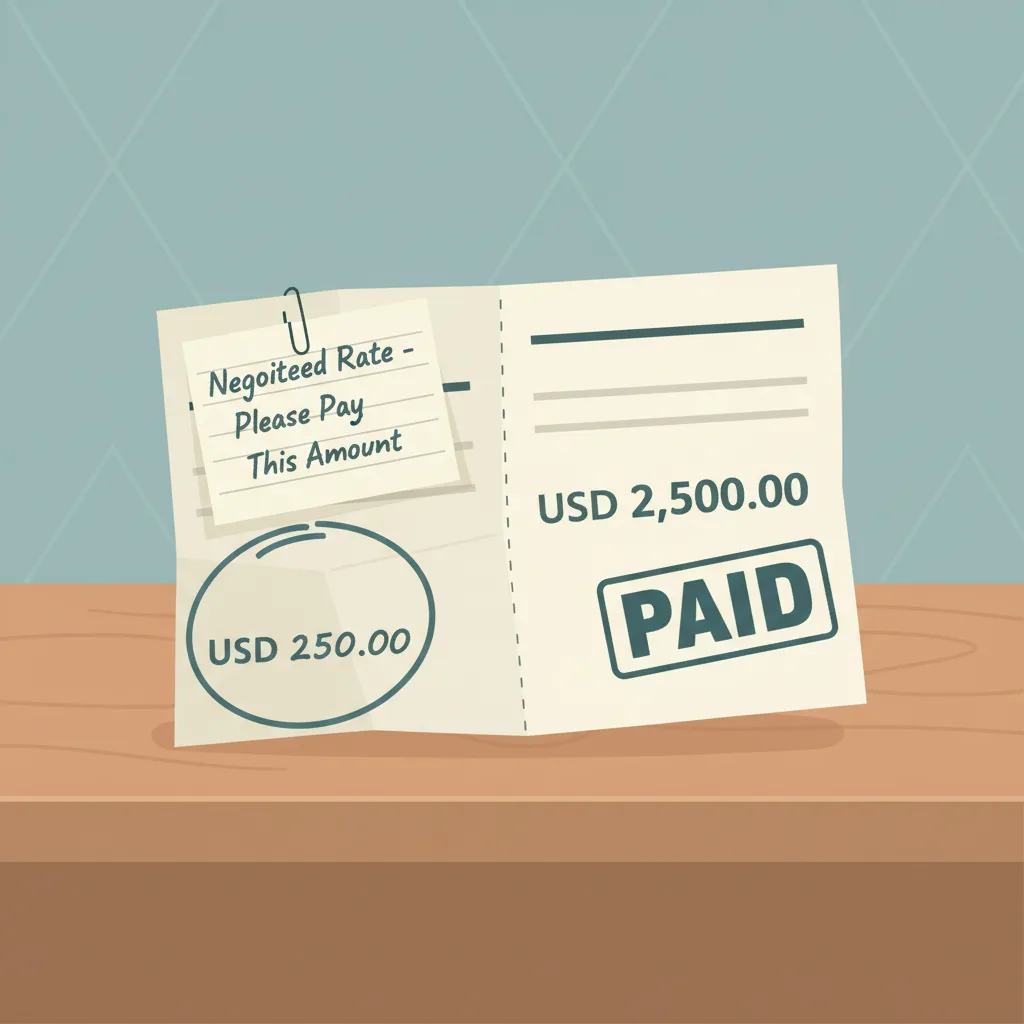
Onderhandelen over een ziekenhuisrekening vs het vermelde bedrag volledig betalen
Als je handelt
Onderhandelen over de ziekenhuisrekening
5,0%
Als je niets doet
Het vermelde bedrag volledig betalen
38%
Percentage dat later spijt heeft van elke keuze. De balken en het volledige overzicht staan hieronder.
Financieel
Laatst beoordeeld 2026-05-11
Kwaliteit van bewijs 4.5/5
Beoordelingsscore op acht dimensies volgens de
kwaliteitsrubriek
. Elke dimensie krijgt een score van 1 tot 5.
D1 Bronverificatie
5/5
D2 Autoriteit en onafhankelijkheid van bronnen
5/5
D3 Nauwkeurigheid van spijtcijfer
2/5
D4 Vergelijkbaarheid van bronnen
4/5
D5 Gilovich-patroon
5/5
D6 Prozakwaliteit
5/5
D7 Volledigheid van voorbehouden
5/5
D8 Steekproefkwaliteit
5/5
Gemiddelde4.5/5
Proxygegevens — er bestaat geen directe spijtenquête voor deze beslissing. De percentages zijn afgeleid van tevredenheidsscores en toegangsdrempelgegevens in plaats van vragen die direct naar spijt vroegen. Zie opmerkingen hieronder.
Spijt van handelen
Onderhandelen over de ziekenhuisrekening
5,0%
~5% van patiënten die medische rekeningen onderhandelen hebben er spijt van (proxy; 93% bereikt ten minste gedeeltelijk succes)
Amerikaanse volwassenen die probeerden een medische rekening te onderhandelen
retrospectief, geen vast tijdsbestek
Spijt van nalaten
Het vermelde bedrag volledig betalen
38%
~38% van patiënten die betaalden zonder te onderhandelen hebben er waarschijnlijk spijt van, gebaseerd op de valse-overtuiging kloof (proxy; 86% van niet-onderhandelaars geloofde dat onderhandelen niet zou helpen — terwijl in feite 62-93% die het probeert slaagt)
Amerikaanse volwassenen die een medische rekening ontvingen en niet probeerden te onderhandelen
retrospectief, geen vast tijdsbestek
% betreurt deze keuze
Onderhandelen over de ziekenhuisrekeningHet vermelde bedrag volledig betalen
5,0%38%
inaction dominates — Niets doen domineert — de meesten hebben spijt dat ze niet handelden.
Gerelateerde keuzes
Semantisch vergelijkbare keuzes — zelfde terrein, andere afwegingen.
Spaargeld in cryptovaluta beleggenIn traditionele beleggingen blijven
46%16%
Handelen overheerst
Spijt over handelen 2.9× hoger
Among US patients who attempted to negotiate a medical bill, 93% had it reduced or eliminated, according to a 2024 LendingTree survey of 2,016 adults — and 66% received exactly what they requested. A peer-reviewed 2024 JAMA Health Forum study (n=1,135, nationally representative) found that patients who challenged bills achieved a price reduction 61.8% of the time, error correction 73.7% of the time, and some form of financial relief 75.8% of the time. Against this evidence, the same JAMA study found that 86.1% of patients who did not challenge their bill believed negotiation would not make a difference — a systematically false belief that the outcome data consistently refutes. LendingTree (2024) found that 41% of those who had medical debt never attempted to negotiate.
The gap between what non-negotiators believe (it won’t help) and what actually happens to those who try (61–93% success) is the clearest available signal of the opportunity cost of inaction. Medical bill negotiation is unfamiliar territory for most US patients, who tend to treat the stated price as fixed — a reasonable assumption in retail contexts that does not translate to healthcare, where list prices (chargemaster rates) are almost never what insurers pay, cash-pay discounts are standard, and billing departments have significant discretion to reduce, restructure, or forgive balances. Hospitals routinely offer self-pay or prompt-pay discounts off billed charges, and medical debt collectors — who typically buy delinquent accounts for a fraction of face value — have substantial room to settle for less than the stated amount. The stated amount on a medical bill is closer to a starting position than a fixed price.
The data here is almost entirely proxy-based. No survey has asked patients “do you regret not negotiating your medical bill?” — the 38% inaction-regret estimate is derived from the false-belief prevalence, not from a direct regret question. The action-side 5% estimate reflects the small minority who tried and got no reduction, noting that even they paid no more than non-negotiators. The JAMA and LendingTree success-rate figures differ because they sample different populations with different methods; the JAMA figure (62% for price reduction specifically) is more methodologically rigorous but based on a smaller, representative sample. Barriers to negotiation are real: 34% of non-negotiators cited discomfort with reaching out and 25.7% cited lack of time — these are genuine constraints, particularly for patients managing serious illness. Income-based charity care programs can further reduce bills independently of negotiation, which may lower the stakes for lower-income patients who qualify automatically.
Bronnen: handelen
Bronnenverantwoording
Elk getal hieronder is wat elke bron rapporteerde, met het letterlijke citaat waarop we ons baseerden en hoe we tot ons cijfer kwamen. Klik op een link om rechtstreeks te verifiëren.
[1]LendingTree — Medical Debt and Bills Survey 2024
Gerenommeerde referentie
93% of patients who negotiated a medical bill had it reduced or eliminated; 59% of those with medical debt had attempted negotiation
Fragment
“"59% of Americans who've had medical debt have negotiated a related bill. 93% of those who negotiated reported at least partial success; 66% received exactly what they requested."
”
Brongegevens van
2024-11-01
Geraadpleegd
2026-05-11
Berekening
LendingTree / QuestionPro survey of n=2,016 US consumers ages 18–78, conducted November 6–8, 2024. The 93% partial-success rate is the most striking figure in the medical negotiation literature: among patients who asked for a reduction, only 7% received no improvement at all. The 66% full-success rate (received exactly what they requested) implies the majority of negotiators got their preferred outcome. The 5% action-regret estimate is conservative and based on the inverse of the partial-success rate: even the 7% who got no reduction paid no more than non-negotiators, and the time cost of attempting is typically a single phone call. Actual action-side regret is likely lower than 5% in practice.
[2]JAMA Health Forum — Disparate Patient Advocacy When Facing Unaffordable and Problematic Medical Bills
Vakgenoten-beoordeeld
Among patients who challenged a bill: 73.7% achieved error correction, 75.8% received financial relief for unaffordable bills, 61.8% achieved a price reduction specifically
Fragment
“"Of those who challenged for billing errors, 73.7% succeeded. Of those who challenged for unaffordable bills, 75.8% received financial relief. Of those specifically seeking a price reduction, 61.8% achieved a price drop."
”
Brongegevens van
2024-08-30
Geraadpleegd
2026-05-11
Berekening
Duffy EL, Frasco MA, Trish E. "Disparate Patient Advocacy When Facing Unaffordable and Problematic Medical Bills." JAMA Health Forum. 2024;5(8):e242744. DOI: 10.1001/jamahealthforum.2024.2744. Nationally representative panel (Understanding America Study), n=1,135 US adults, fielded August–October 2023. This peer-reviewed source independently confirms the high success rate: 62–76% of patients who contacted the billing office got a positive outcome depending on the type of challenge. The 61.8% price-reduction success rate is lower than LendingTree's 93% (partial success) because the JAMA study measures billing-office contact broadly (not all contacts are price negotiations per se) and uses a nationally representative rather than a self-selected panel. Both sources consistently show that attempting negotiation produces positive outcomes far more often than non-negotiators believe.
Bronnen: niet handelen
Bronnenverantwoording
Elk getal hieronder is wat elke bron rapporteerde, met het letterlijke citaat waarop we ons baseerden en hoe we tot ons cijfer kwamen. Klik op een link om rechtstreeks te verifiëren.
1/2 bronnen onafhankelijk woordelijk geverifieerd tegenover de geciteerde bron
[1]JAMA Health Forum — Disparate Patient Advocacy When Facing Unaffordable and Problematic Medical Bills
Geverifieerd
Vakgenoten-beoordeeld
86.1% of patients who did not challenge a medical bill said they believed it would not make a difference; actual success rates for those who tried were 62–76%
Fragment
“"55 of non-challengers (86.1%) reported that they did not think it would make a difference. Secondary reasons for not challenging included feeling uncomfortable reaching out (34.0%) and lacking time (25.7%)."
”
Brongegevens van
2024-08-30
Geraadpleegd
2026-05-11
Verificatie
Fragment onafhankelijk opnieuw opgehaald en woord voor woord bevestigd tegenover de geciteerde bron tijdens onze onderbouwingsaudit.
Berekening
Duffy et al., JAMA Health Forum 2024, n=1,135 nationally representative US adults. The 86.1% figure measures the false belief that negotiation is ineffective. This is not a direct regret measurement; it is a belief-gap proxy: the share of non-negotiators whose stated reason for inaction (it won't help) is empirically contradicted by the experience of those who did try (62–76% success rate). The 38% inaction-regret estimate is derived conservatively: it assumes that patients who paid full price, later learned negotiation was possible and often successful, and received no reduction they were eligible for, report some degree of regret. The gap between the 86.1% false-belief rate (how many non-negotiators held an inaccurate assumption) and the 38% regret estimate reflects the fact that learning you held a wrong belief does not automatically translate into regret — some patients may have genuinely lacked time or capacity to negotiate regardless of likelihood of success.
[2]LendingTree — Medical Debt and Bills Survey 2024
Gerenommeerde referentie
41% of Americans who've had medical debt did not attempt to negotiate their bill
Fragment
“"59% of Americans who've had medical debt have negotiated a related bill — meaning 41% did not attempt negotiation."
”
Brongegevens van
2024-11-01
Geraadpleegd
2026-05-11
Berekening
LendingTree 2024, n=2,016. The 41% non-negotiation rate defines the inaction population. Combined with the JAMA finding that 86% of non-challengers held false beliefs about effectiveness, and the 62–93% success rate among those who did try, the non-negotiating population is large and operating on systematically inaccurate assumptions. The 38% inaction-regret proxy is conservative relative to the 86% false-belief prevalence, reflecting the gap between "held a wrong belief" and "regrets the outcome."
Kanttekeningen
PROXY-METINGEN DOORHEEN. Geen gepubliceerde enquête vraagt direct "heeft u spijt van het niet onderhandelen van uw medische rekening?" Beide zijden zijn proxy-constructies: het 5% actie-spijt percentage is afgeleid uit de 7% die geen reductie ontving (LendingTree 2024); het 38% inactie-spijt percentage is afgeleid uit de valse-overtuiging prevalentie onder niet-onderhandelaars (JAMA 2024). De valse-overtuiging proxy is de methodologisch sterkste beschikbare substituut voor een directe spijtmaat — het kwantificeert de specifieke misvatting die inactie aandrijft en die de uitkomstdata weerlegt. Echter, een valse overtuiging produceert niet automatisch spijt; sommige niet-onderhandelaars kunnen geen spijt ervaren zelfs nadat ze hebben geleerd dat onderhandeling vaak slaagt (omdat ze de energie missen, geen voortdurende relatie hebben met de aanbieder, of de rekening betaalden en verder gingen). De LendingTree successcijfers (93%) en JAMA successcijfers (62-76%) verschillen substantieel omdat ze verschillende populaties meten: LendingTree onderzocht degenen met medische schuld (een meer gemotiveerde, financieel gestresste populatie waarschijnlijk om gedeeltelijk succes breder te rapporteren) terwijl JAMA een nationaal representatief panel gebruikte en onderscheidde tussen types uitdaging (factureringsfout vs. betaalbaarheid vs. prijsreductie). Het 61,8% prijsreductie successpercentage van JAMA is het meest relevante en methodologisch rigoureuze cijfer voor directe prijsonderhandeling. Medische rekening-onderhandeling is een proces grotendeels onbekend voor de meeste Amerikaanse patiënten; toegang ertoe is ongelijk per onderwijs, verzekeringsgeletterdheid en tijdsbeschikbaarheid — de 34% niet-onderhandelaars die ongemak noemden en 25,7% die gebrek aan tijd noemden zijn echte barrières, geen irrationele inactie. Liefdadigheidszorg en inkomensgebaseerde kortingsprogramma's bestaan onafhankelijk van onderhandeling en kunnen de effectieve inzet voor lager-inkomens patiënten verminderen.