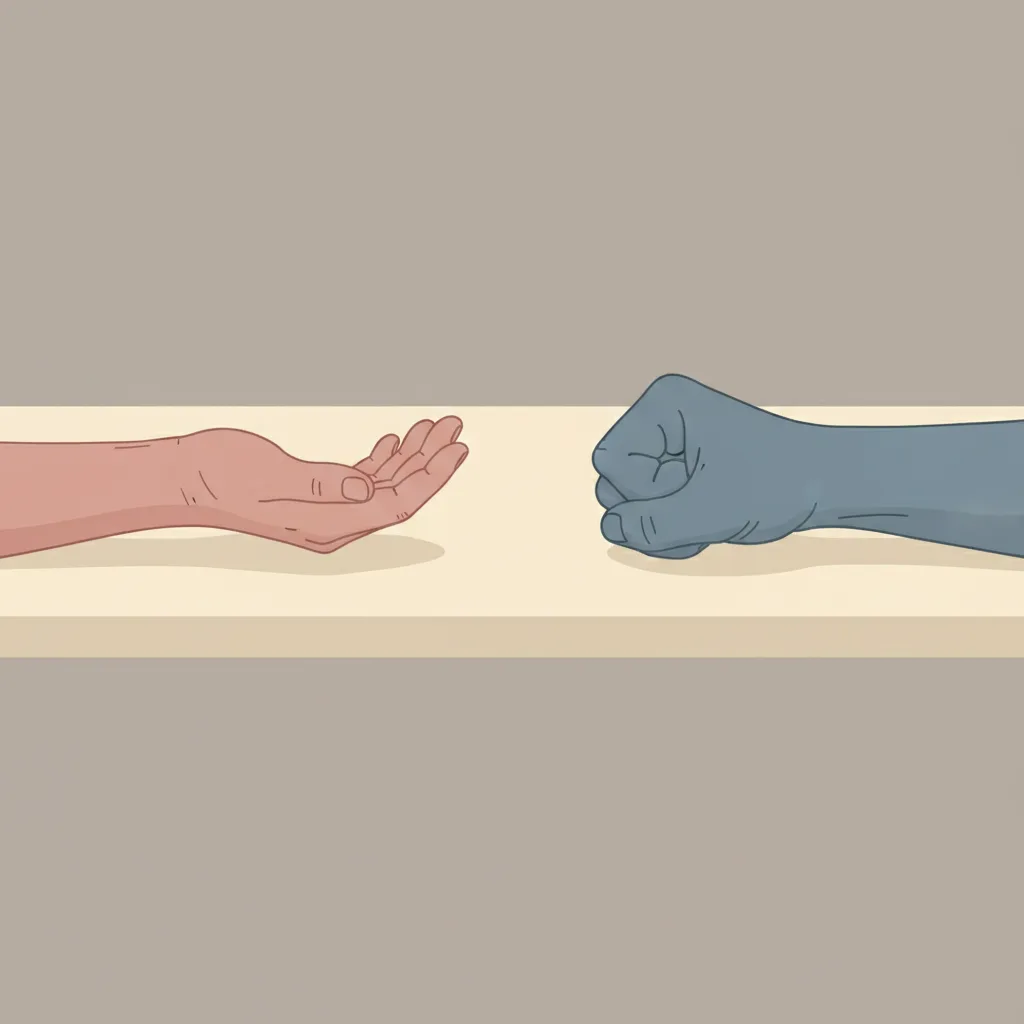
Perdonare chi ti ha fatto del male vs portare rancore
Se agisci
Perdonare
10%
Se non agisci
Serbare rancore
33%
Percentuale di chi poi rimpiange ciascuna scelta. Le barre e il registro completo dei dati compaiono sotto.
Stile di vita
Ultima revisione 2026-04-26
Qualità delle prove 4.13/5
Punteggio di revisione su otto dimensioni rispetto alla
griglia di qualità
. Ogni dimensione valutata da 1 a 5.
D1 Verifica delle fonti
4/5
D2 Autorità e indipendenza delle fonti
4/5
D3 Precisione del tasso di rimpianto
3/5
D4 Comparabilità delle fonti
3/5
D5 Schema di Gilovich
5/5
D6 Qualità della prosa
5/5
D7 Completezza degli avvertimenti
5/5
D8 Qualità del campione
4/5
Media4.13/5
Dati proxy — non esiste alcun sondaggio diretto sul rimpianto per questa decisione. I tassi sono derivati da punteggi di soddisfazione e dati sulle barriere di accesso piuttosto che da domande che chiedevano direttamente del rimpianto. Vedi avvertenze di seguito.
Rimpianto per azione
Perdonare
10%
~10% riferisce esiti negativi dopo aver perdonato (proxy inferito — non una misura diretta del rimpianto)
Adulti statunitensi, rappresentativo a livello nazionale
retrospettivo, nessun arco temporale fisso
Rimpianto per inazione
Serbare rancore
33%
Il 33% si pente di portare rancore
Adulti a livello globale, panel online (2.000 per paese)
retrospettivo, nessun arco temporale fisso
% rimpiange questa scelta
PerdonareSerbare rancore
10%33%
inaction dominates — L'inazione domina — la maggior parte si pente di non aver agito.
Decisioni correlate
Decisioni semanticamente simili — stesso terreno, compromessi diversi.
33% of adults who hold grudges say they regret doing so, per Trustpilot’s
Helping Hands survey of 12,000 adults across six countries. There is no
comparable figure for the other side: no large survey has asked whether
people regret forgiving. The University of Michigan’s nationally
representative survey of 1,423 adults (Toussaint, Williams, Musick and
Everson, 2001) found that only 52% said they had forgiven others, and that
for adults aged 45 and older forgiving was linked with better self-reported
mental and physical health — it reports no regret figure and describes no
“small minority” who felt worse after forgiving. The action-side 10% shown
here is a placeholder that encodes direction, not a measured rate; it should
not be read as evidence that one in ten forgivers regret it. The Trustpilot
survey also found 70% “acknowledge” that grudge-holding harms their health,
but acknowledgment is not regret — the 33% who explicitly reported regretting
their grudges is the more appropriate comparison point.
The physiological case is unusually direct. Witvliet, Ludwig, and Vander
Laan (2001) measured 71 participants while they alternated between
grudge-rehearsal and forgiveness imagery. Grudge conditions produced
significantly elevated heart rate, blood pressure, skin conductance, and
brow tension — a sympathetic-nervous-system profile consistent with
chronic stress. Rasmussen et al. (2019) confirmed the pattern at scale:
across 103 samples totaling 26,043 participants, forgiveness was reliably
associated with better psychological and cardiovascular health, though
the correlation was modest (r roughly 0.14 to 0.18) and causality remains
unestablished.
The main caveat is measurement asymmetry. No major survey has directly
asked “Do you regret forgiving?”, and the cited Michigan survey reports no
such figure at all — so the action-side 10% is a placeholder, not a
measured or inferred rate. The 33% inaction-regret figure is a direct
regret question from a consumer panel, not a clinical cohort, and a third
of its grudge-holders could not even recall why they were still angry. The
directional finding — that grudge-holding generates more regret than
forgiving does — is consistent across multiple literatures. The precise
magnitude is not established.
Fonti: azione
Registro delle fonti
Ogni numero qui sotto è ciò che ciascuna fonte ha riportato, con la citazione testuale su cui ci siamo basati e come siamo arrivati alla nostra cifra. Clicca su qualsiasi link per verificare direttamente.
1/2 fonti verificate in modo indipendente e alla lettera rispetto alla fonte citata
[1]University of Michigan / Institute for Social Research — How link between forgiveness and health changes with age
Studio primario
52% of a nationally representative sample of 1,423 Americans reported forgiving others; forgiveness of others was linked with better self-reported mental and physical health for adults aged 45 and older
Estratto
“"Nearly 60 percent of a nationally representative sample of 1,423 Americans report that they have forgiven themselves for past mistakes and wrong-doing... but only 52 percent say they have forgiven others... In those aged 45 and older, forgiving others was linked with better self-reported mental and physical health."
”
Dati originali da
2001-12-11
Consultato
2026-04-26
Calcolo
University of Michigan nationally representative survey of 1,423 US adults (Toussaint, Williams, Musick & Everson, 2001). The 52% forgave-others rate is verbatim from the ISR release. The study does NOT report any "regret forgiving" figure and describes only positive associations between forgiveness of others and health; it contains no "small minority experiencing negative outcomes" finding. No large-scale survey directly measures regret after forgiving, so the action-side 0.10 is an order-of-magnitude PLACEHOLDER, not a value inferred from any source-stated figure — see proxy_only and caveats. It exists only to preserve the schema's required numeric field and to encode the direction (inaction dominates), not as a calibrated rate.
[2]Psychological Science — Granting forgiveness or harboring grudges: implications for emotion, physiology, and health
Verificato
Articolo peer-reviewed
Forgiveness imagery produced lower heart rate, blood pressure, skin conductance, and facial EMG compared to grudge rehearsal in 71 participants
Estratto
“"Unforgiving thoughts prompted more aversive emotion, and significantly higher corrugator EMG, skin conductance, heart rate, and blood pressure changes from baseline. Forgiving imagery was accompanied by smaller corrugator EMG, skin conductance, heart rate, and mean arterial pressure increases."
”
Dati originali da
2001-03-01
Consultato
2026-04-26
Verifica
Estratto recuperato in modo indipendente e confermato parola per parola rispetto alla fonte citata durante il nostro audit di attendibilità.
Calcolo
Witvliet, Ludwig & Vander Laan (2001), N=71. Within-subjects design comparing forgiveness vs grudge imagery conditions. Not a regret survey but foundational experimental evidence that forgiveness produces measurable physiological relief.
Fonti: inazione
Registro delle fonti
Ogni numero qui sotto è ciò che ciascuna fonte ha riportato, con la citazione testuale su cui ci siamo basati e come siamo arrivati alla nostra cifra. Clicca su qualsiasi link per verificare direttamente.
1/2 fonti verificate in modo indipendente e alla lettera rispetto alla fonte citata
[1]Trustpilot / Helping Hands survey — Average adult holds seven grudges, Trustpilot research finds
Studio primario
33% of adults surveyed regretted holding grudges; separately, 33% admitted their mental health suffered from ongoing feuds; 70% acknowledged grudge-holding is harmful to health
Estratto
“"Around a third admitted their mental health has suffered as a direct result of ongoing feuds — which could partly explain why over a third regret holding grudges. Although 70% acknowledged that it was harmful to their health to hold onto a grudge, about the same percentage admitted to harboring a grudge."
”
Dati originali da
2023-06-15
Consultato
2026-04-26
Calcolo
Trustpilot Helping Hands survey of 12,000 adults globally (2,000 per country: UK, US, Australia, Netherlands, France, Italy). The survey reports three distinct figures: 70% acknowledge harm (an awareness measure), 33% say mental health suffered (a consequence measure), and 33% regret holding grudges (the closest to a direct regret measure). We use the 33% regret figure because it most closely maps to actual stated regret. This is a consumer panel, not a clinical or academic sample.
[2]Psychology & Health — Meta-analytic connections between forgiveness and health: the moderating effects of forgiveness-related distinctions
Verificato
Articolo peer-reviewed
Across 103 samples (N = 26,043), forgiveness was reliably associated with better psychological and physical health; unforgiveness correlated with worse outcomes
Estratto
“"The findings provided considerable support to current theorizing about the health benefits of forgiveness. Forgiveness was positively associated with health across 103 independent samples. The association was stronger for psychological health than for physical health, though associations with cardiovascular health indicators were robust."
”
Dati originali da
2019-05-01
Consultato
2026-04-26
Verifica
Estratto recuperato in modo indipendente e confermato parola per parola rispetto alla fonte citata durante il nostro audit di attendibilità.
Calcolo
Rasmussen et al. (2019) meta-analysis, 103 samples, 606 correlations, N = 26,043. Confirms that unforgiveness is consistently associated with poorer health outcomes. The correlation (r ~ 0.14-0.18) is modest but consistent, and causality is not established.
Avvertenze
Il tasso di rimpianto lato azione è un proxy INFERITO, non una misura riportata direttamente. Nessuna indagine su larga scala ha chiesto direttamente "Si pente di aver perdonato qualcuno?" — la cifra del ~10% è inferita dalla descrizione "piccola minoranza" nell'indagine sul perdono dell'Università del Michigan che ha riferito esiti negativi post-perdono (sentirsi sfruttati, l'offensore che ripete il comportamento). La proporzione effettiva non è dichiarata numericamente nel documento; il 10% è la nostra stima dell'ordine di grandezza basata sul linguaggio qualitativo usato. Il 33% lato inazione proviene dal panel di consumatori Helping Hands di Trustpilot (12.000 adulti a livello globale), che è la cifra più robusta — chiede direttamente del rimpianto del rancore, anche se è un panel di consumatori piuttosto che un campione clinico o accademico. La stessa indagine ha anche rilevato che il 70% "riconosce il danno" del portare rancore, ma quella misura di consapevolezza non è rimpianto. Lo studio di laboratorio Witvliet et al. (2001) (N=71) è entro i soggetti e di breve durata; la fisiologia del rancore cronico è estrapolata, non misurata direttamente nel corso degli anni. La correlazione meta-analitica di Rasmussen (2019) tra perdono e salute (r ~ 0,14-0,18) è di effetto modesto e la causalità non è stabilita — le persone più sane possono semplicemente trovare più facile perdonare. Il rapporto 3,3:1 dovrebbe essere letto come direzionalmente a favore dell'azione, non come una calibrazione precisa.