






Ga naar inhoud
Likelier

Spijt van handelen vs. niets doen

Je kleinkind (of kind) elk speelgoed en cadeau geven dat het vraagt vs. je inhouden bij het geven van cadeaus en nee zeggen

Als je handelt

Gul cadeaus geven — zelden nee zeggen

40%

Als je niets doet

Terughoudend cadeaus geven — nee zeggen, ouderlijke grenzen volgen

14%

Percentage dat later spijt heeft van elke keuze. De balken en het volledige overzicht staan hieronder.


Familie

Laatst beoordeeld 2026-05-05

Kwaliteit van bewijs 3.88/5

Beoordelingsscore op acht dimensies volgens de kwaliteitsrubriek . Elke dimensie krijgt een score van 1 tot 5.

D1 Bronverificatie
4/5
D2 Autoriteit en onafhankelijkheid van bronnen
4/5
D3 Nauwkeurigheid van spijtcijfer
3/5
D4 Vergelijkbaarheid van bronnen
4/5
D5 Gilovich-patroon
5/5
D6 Prozakwaliteit
4/5
D7 Volledigheid van voorbehouden
4/5
D8 Steekproefkwaliteit
3/5
Gemiddelde 3.88/5
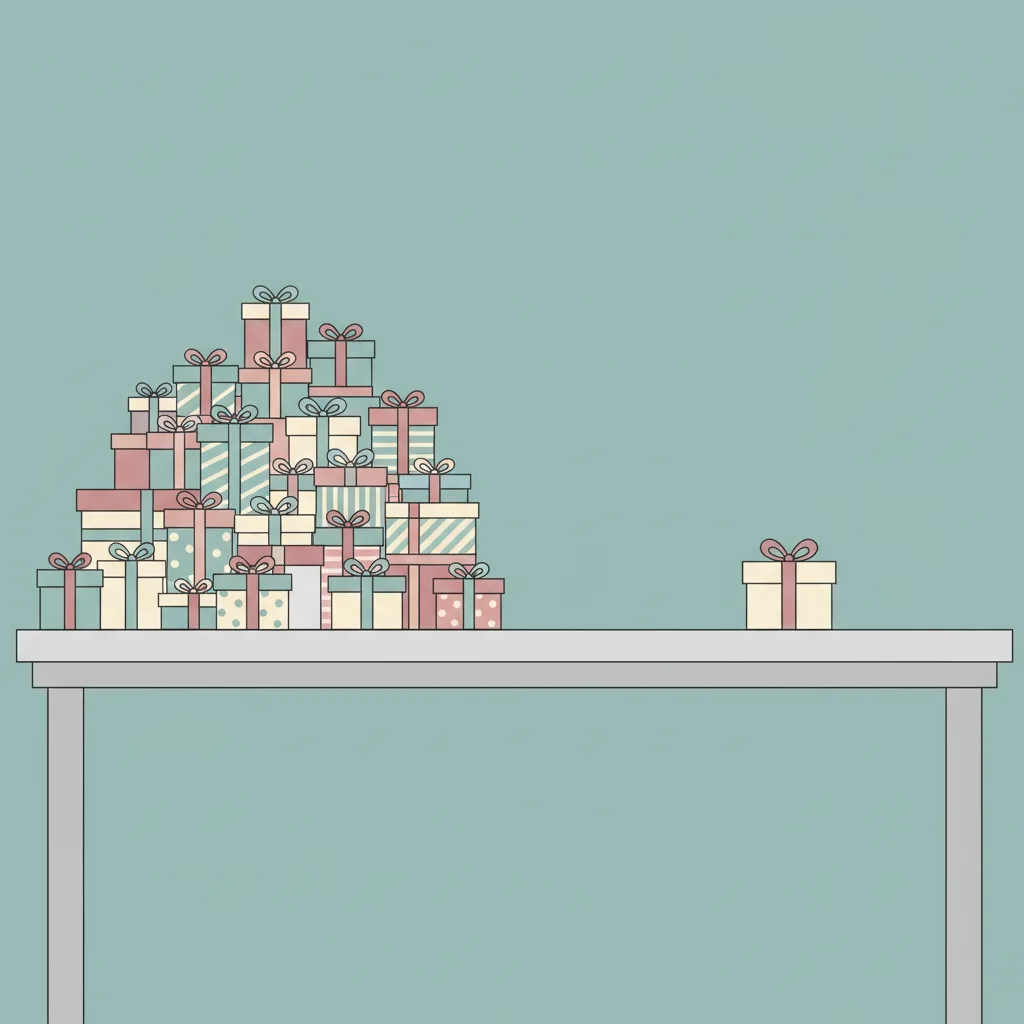
A pile of wrapped gifts next to a single simply-wrapped box on a bare table.
Proxygegevens — er bestaat geen directe spijtenquête voor deze beslissing. De percentages zijn afgeleid van tevredenheidsscores en toegangsdrempelgegevens in plaats van vragen die direct naar spijt vroegen. Zie opmerkingen hieronder.

Spijt van handelen

Gul cadeaus geven — zelden nee zeggen

40%

40% van ouders zegt dat grootouders te zacht of toegeeflijk zijn (proxy)

Amerikaanse ouders van kinderen 0-18 jaar die onenigheid met een grootouder rapporteerden (subset van nationaal representatieve steekproef n=2.016)

cross-sectioneel, verzameld januari-februari 2020

Spijt van nalaten

Terughoudend cadeaus geven — nee zeggen, ouderlijke grenzen volgen

14%

14% van ouders zegt dat grootouders te streng of hard zijn (proxy)

Amerikaanse ouders van kinderen 0-18 jaar die onenigheid met een grootouder rapporteerden (subset van nationaal representatieve steekproef n=2.016)

cross-sectioneel, verzameld januari-februari 2020

% betreurt deze keuze

action dominates — Handelen domineert — de meesten hebben spijt dat ze handelden.

Gerelateerde keuzes

Semantisch vergelijkbare keuzes — zelfde terrein, andere afwegingen.

family

Ingrijpen vs. zelf laten uitzoeken

% betreurt deze keuze

Handelen overheerst

Spijt over handelen 1.2× hoger

family

Disciplineren vs doorlaten

% betreurt deze keuze

Niet-handelen overheerst

Spijt over niet-handelen 2.4× hoger

family

Harde vs zachte discipline

% betreurt deze keuze

Handelen overheerst

Spijt over handelen 1.2× hoger

family

Vrij vs helikopteropvoeding

% betreurt deze keuze

Handelen overheerst

Spijt over handelen 2.3× hoger

familyDirect

Kindertoegang tot sociale media

% betreurt deze keuze

Handelen overheerst

Spijt over handelen 5.4× hoger

family

Gestructureerd vs vrij spel

% betreurt deze keuze

Handelen overheerst

Spijt over handelen 2.6× hoger

family

Laten stoppen vs. afmaken

% betreurt deze keuze

Niet-handelen overheerst

Spijt over niet-handelen 2.3× hoger

Financieel

Volwassen kind ondersteunen vs. stoppen

% betreurt deze keuze

Handelen overheerst

Spijt over handelen 3.7× hoger

Among US parents who report disagreements with a grandparent about child-rearing, 40% attribute those disagreements to grandparents being too soft or lenient, compared with only 14% who say grandparents are too tough, a nearly 3:1 ratio within the same response scale from a C.S. Mott Children’s Hospital National Poll of 2,016 nationally representative US parents fielded in January–February 2020. The asymmetry holds even though the dominant cultural script around grandparenting celebrates indulgence: “spoiling” is often described as a grandparent’s right, yet parents experiencing it in practice flag the leniency direction at three times the rate of the restraint direction. Both rates come from the same survey and the same subset of disagreement-reporting parents, making the cross-group comparison the most direct parallel evidence available on this bilateral question. Neither figure measures grandparent self-regret about their choices; both reflect parental observation of the downstream costs, and are flagged throughout as proxy estimates.

The child-development literature independently supports the direction of this asymmetry. Bredehoft, Mennicke, Potter, and Clarke (1998), writing in the Journal of Family and Consumer Sciences Education, surveyed 730 adults and found that the 124 who self-identified as adult children of overindulgence reported, as a great majority (71%), lasting difficulty as adults knowing what is enough or what is normal, a consequence that persisted long after the material gifts were forgotten. On the developmental side, Dauch, Imwalle, Ocasio, and Metz (2018) published an experiment in Infant Behavior and Development showing that toddlers given access to four toys rather than sixteen played for longer durations and in markedly more sophisticated ways, suggesting that abundance itself displaces the focused engagement that promotes cognitive and attentional development. The restraint literature does not argue that gift refusal has no costs; a grandparent who is consistently tight or withholding creates a different friction, but the outcome evidence clusters more heavily against excess than against moderation.

The Gilovich framework predicts that action regrets (having been too generous, having never said no) are salient and interpersonally costly in the present (parents notice and object), while inaction regrets (having been too restrained) tend to crystallize later and more privately, if at all. The 2.9:1 ratio in parental conflict reports is consistent with this temporal asymmetry. The primary caveat is that the Mott data captures a relational friction between generations, not a direct self-regret measurement by the gift-giving party; grandparents themselves may weight the same behavior differently. Research identifying relational and structural overindulgence as more harmful than pure material excess also suggests the action-side risk may be somewhat overstated when isolated to toy and gift quantity specifically.

Bronnen: handelen

Bronnenverantwoording

Elk getal hieronder is wat elke bron rapporteerde, met het letterlijke citaat waarop we ons baseerden en hoe we tot ons cijfer kwamen. Klik op een link om rechtstreeks te verifiëren.

3/3 bronnen onafhankelijk woordelijk geverifieerd tegenover de geciteerde bron

  1. [1] C.S. Mott Children's Hospital National Poll on Children's Health, University of Michigan — When parents and grandparents disagree Geverifieerd
    When parents and grandparents disagree
    Statistiek
    40% of parents say disagreements with grandparents occur because grandparents are too soft on the child; 14% say grandparents are too tough; 6% report major disagreements and 37% minor disagreements
    Fragment
    “"Among parents who say they have had disagreements with a grandparent about how the grandparent cares for their child, 40% say the disagreements occur because grandparents are too soft on the child, while 14% say grandparents are too tough." ”
    Brongegevens van
    2020-08-17
    Geraadpleegd
    2026-05-04
    Verificatie
    Fragment onafhankelijk opnieuw opgehaald en woord voor woord bevestigd tegenover de geciteerde bron tijdens onze onderbouwingsaudit.
    Berekening
    C.S. Mott Children's Hospital National Poll on Children's Health (Vol. 36, Issue 5, August 2020). Survey of 2,016 US parents of children ages 0–18, randomly selected and stratified. Among parents who reported disagreements with a grandparent, 40% attributed those disagreements to grandparents being too lenient or soft. This is used as the action-side proxy for regret: parents registering that uninhibited gift-giving and leniency is a problem conflicting with their child-rearing choices. The 40% is not a direct self-report of grandparent regret — it is parental observation of the costs of overindulgence — flagged as "(proxy)".
  2. [2] Journal of Family and Consumer Sciences Education (Bredehoft, Mennicke, Potter & Clarke) — Perceptions attributed by adults to parental overindulgence during childhood Geverifieerd
    Perceptions attributed by adults to parental overindulgence during childhood
    Statistiek
    71% of adult children of overindulgence (ACOs; n=124 self-identified from 730 surveyed) reported difficulty as adults knowing what is enough or what is normal; ACOs simultaneously felt loved, confused, guilty, bad and sad about the overindulgence
    Fragment
    “"The great majority (71%) of the overindulged subjects reported having difficulty knowing what is enough, or what is normal as adults. ACOs simultaneously felt both positively and negatively about the overindulgence, that is, they felt loved, confused, guilty, bad and sad." ”
    Brongegevens van
    1998-10-01
    Geraadpleegd
    2026-05-04
    Verificatie
    Fragment onafhankelijk opnieuw opgehaald en woord voor woord bevestigd tegenover de geciteerde bron tijdens onze onderbouwingsaudit.
    Berekening
    Bredehoft, Mennicke, Potter & Clarke (1998), Journal of Family and Consumer Sciences Education, 16(2), 3–17. Survey of 730 subjects; 124 self-identified as adult children of overindulgence (ACO). The 71% figure applies to the ACO subsample (n=124), not to the full 730. This source does not supply the 40% action-rate; it corroborates the direction of harm from overindulgent material gifting by showing that adults retrospectively raised that way report lasting difficulty calibrating sufficiency. The population is different (adult self-report on childhood, not current parental observation), but the convergence supports the action-side framing.
  3. [3] C.S. Mott Children's Hospital National Poll on Children's Health, University of Michigan — Parent efforts to teach children about gratitude Geverifieerd
    Parent efforts to teach children about gratitude
    Statistiek
    58% of US parents of children ages 4–10 worry that they are giving their children too much
    Fragment
    “"Over half of parents (58%) worry that they are giving their children too much, while 42% say they sometimes are embarrassed by how selfish their child acts." ”
    Brongegevens van
    2021-10-01
    Geraadpleegd
    2026-05-05
    Verificatie
    Fragment onafhankelijk opnieuw opgehaald en woord voor woord bevestigd tegenover de geciteerde bron tijdens onze onderbouwingsaudit.
    Berekening
    C.S. Mott Children's Hospital National Poll on Children's Health, University of Michigan. N=1,125 parents with at least one child age 4–10, fielded June 2021. The 58% worry-about-over-giving rate documents that concern about material excess is widespread among the parenting generation — even before grandparent gift-giving is layered on top. This source measures worry (a prospective concern), not retrospective regret, and covers parent-to-child giving rather than grandparent-to-grandchild giving. It does not supply the action-side 40% proxy rate; that comes from Mott 2020. It corroborates the cultural prevalence of over-giving concern and provides independent evidence that parents themselves recognise an excess problem in their households, which is relevant context for the grandparent layer of the same dynamic.
    Onafhankelijkheid
    Independent from Mott 2020 (different survey wave, Vol. 39 Issue 5 vs Vol. 36 Issue 5, different sample frame: parents of children 4–10 vs parents of children 0–18, different topic focus: gratitude vs grandparent disagreements).

Bronnen: niet handelen

Bronnenverantwoording

Elk getal hieronder is wat elke bron rapporteerde, met het letterlijke citaat waarop we ons baseerden en hoe we tot ons cijfer kwamen. Klik op een link om rechtstreeks te verifiëren.

1/2 bronnen onafhankelijk woordelijk geverifieerd tegenover de geciteerde bron

  1. [1] C.S. Mott Children's Hospital National Poll on Children's Health, University of Michigan — When parents and grandparents disagree Geverifieerd
    When parents and grandparents disagree
    Statistiek
    14% of parents say disagreements with grandparents occur because grandparents are too tough on the child, vs 40% who say grandparents are too soft
    Fragment
    “"Among parents who say they have had disagreements with a grandparent about how the grandparent cares for their child, 40% say the disagreements occur because grandparents are too soft on the child, while 14% say grandparents are too tough." ”
    Brongegevens van
    2020-08-17
    Geraadpleegd
    2026-05-04
    Verificatie
    Fragment onafhankelijk opnieuw opgehaald en woord voor woord bevestigd tegenover de geciteerde bron tijdens onze onderbouwingsaudit.
    Berekening
    Same Mott 2020 survey (n=2,016). The 14% who say grandparents are too tough is used as the inaction-side proxy for regret: the share of cases where restraint and limit-setting is itself the source of conflict and parental concern. This is not grandparent self-regret about being too strict; it is parents flagging that restraint has gone too far. Flagged as "(proxy)". The 40%:14% ratio (2.9:1) from the same survey and same response scale makes the comparison directly valid across sides.
  2. [2] Infant Behavior and Development (Dauch, Imwalle, Ocasio & Metz) — The influence of the number of toys in the environment on toddlers' play
    The influence of the number of toys in the environment on toddlers' play
    Statistiek
    Toddlers with access to 4 toys (vs 16) showed longer duration of toy play and played in more sophisticated ways; fewer toys led to higher-quality, more sustained engagement
    Fragment
    “"With fewer toys, participants had fewer incidences of toy play, longer durations of toy play, and played with toys in a greater variety of ways. The findings suggest that an environment with fewer toys may better support toddlers' play." ”
    Brongegevens van
    2018-02-01
    Geraadpleegd
    2026-05-04
    Berekening
    Dauch, Imwalle, Ocasio & Metz (2018), Infant Behavior and Development, 50, 78–87. Experimental study with n=36 toddlers ages 18–30 months; each child played under two conditions (4 toys and 16 toys). This source does not supply the 14% inaction rate; it corroborates the developmental case for restraint in gifting by showing that fewer toys produce demonstrably richer play. The finding supports why restrained gift-giving is not costless but is substantially less problematic than excess — the inaction-dominates concern is not supported by child development data.

Kanttekeningen

Beide percentages komen uit dezelfde Mott 2020-peiling (n=2.016) en meten ouderlijke observatie van grootoudergedrag, niet zelf-spijt van grootouders over hun eigen geefkeuzes. De 40% en 14% zijn getrokken uit de subset van ouders die onenigheid met een grootouder rapporteerden — niet uit de volledige steekproef — wat betekent dat de noemer kleiner is en de vergelijking de richting van het conflict weerspiegelt in plaats van een onvoorwaardelijk prevalentiepercentage. Geen van de cijfers is een directe spijtmeting; beide zijn gemarkeerd als "(proxy)". De bevinding van Bredehoft et al. (1998) dat 71% van volwassenen die overindulgentie hebben ervaren aanhoudende moeilijkheid rapporteert om voldoendheid te kalibreren, is getrokken uit een veel kleinere substeekproef (n=124 zelf-geïdentificeerde ACO's van 730 ondervraagden), gebruikt retrospectief zelf-rapport en dekt alle vormen van overindulgentie — niet alleen materiële geschenken. Onderzoek identificeert consistent relationele en structurele overindulgentie als schadelijker dan puur materieel exces, dus het actie-risico kan enigszins worden overdreven als de vermelding wordt gelezen alsof het alleen op de hoeveelheid speelgoed en geschenken van toepassing is. Het Dauch et al. (2018)-experiment is beperkt tot peuters in een laboratoriumspeelkamer; de generalisatie naar echte geschenkenaccumulatie over maanden en jaren is plausibel maar niet direct getest. Geen grootschalige enquête vraagt grootouders direct "heb je spijt van te veel kopen?" of "heb je spijt te restrictief te zijn met geschenken?" — dergelijke data lijken niet te bestaan in de gepubliceerde literatuur.

Ruwe data: /api/decisions.json

Recent bekeken op dit apparaat