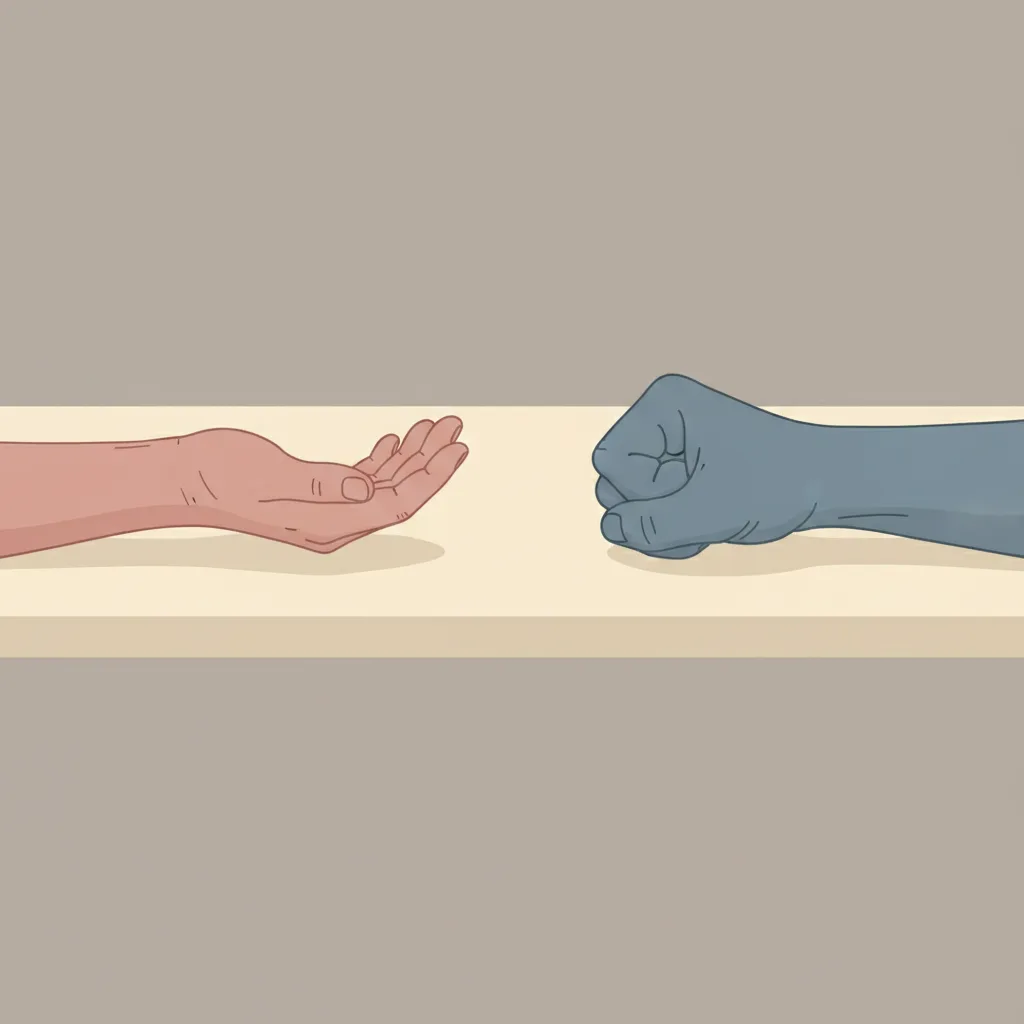
Przebaczenie osobie, która cię skrzywdziła vs żywienie urazy
Jeśli działasz
Przebaczenie
10%
Jeśli nie działasz
Żywienie urazy
33%
Odsetek osób, które później żałują każdego wyboru. Słupki i pełna kartoteka danych poniżej.
Styl życia
Ostatnio sprawdzono 2026-04-26
Jakość dowodów 4.13/5
Ocena recenzji w ośmiu wymiarach względem
rubryki jakości
. Każdy wymiar oceniony w skali 1–5.
D1 Weryfikacja źródeł
4/5
D2 Autorytet i niezależność źródeł
4/5
D3 Dokładność wskaźnika żalu
3/5
D4 Porównywalność źródeł
3/5
D5 Wzorzec Gilovicha
5/5
D6 Jakość tekstu
5/5
D7 Kompletność zastrzeżeń
5/5
D8 Jakość próby
4/5
Średnia4.13/5
Dane zastępcze — dla tej decyzji nie istnieje bezpośrednie badanie żałowania. Wskaźniki są oparte na ocenach zadowolenia i danych o barierach dostępu, a nie na pytaniach bezpośrednio dotyczących żałowania. Zobacz zastrzeżenia poniżej.
Żal za działanie
Przebaczenie
10%
~10% zgłasza negatywne skutki po przebaczeniu (wnioskowane proxy — nie bezpośrednia miara żalu)
33% of adults who hold grudges say they regret doing so, per Trustpilot’s
Helping Hands survey of 12,000 adults across six countries. There is no
comparable figure for the other side: no large survey has asked whether
people regret forgiving. The University of Michigan’s nationally
representative survey of 1,423 adults (Toussaint, Williams, Musick and
Everson, 2001) found that only 52% said they had forgiven others, and that
for adults aged 45 and older forgiving was linked with better self-reported
mental and physical health — it reports no regret figure and describes no
“small minority” who felt worse after forgiving. The action-side 10% shown
here is a placeholder that encodes direction, not a measured rate; it should
not be read as evidence that one in ten forgivers regret it. The Trustpilot
survey also found 70% “acknowledge” that grudge-holding harms their health,
but acknowledgment is not regret — the 33% who explicitly reported regretting
their grudges is the more appropriate comparison point.
The physiological case is unusually direct. Witvliet, Ludwig, and Vander
Laan (2001) measured 71 participants while they alternated between
grudge-rehearsal and forgiveness imagery. Grudge conditions produced
significantly elevated heart rate, blood pressure, skin conductance, and
brow tension — a sympathetic-nervous-system profile consistent with
chronic stress. Rasmussen et al. (2019) confirmed the pattern at scale:
across 103 samples totaling 26,043 participants, forgiveness was reliably
associated with better psychological and cardiovascular health, though
the correlation was modest (r roughly 0.14 to 0.18) and causality remains
unestablished.
The main caveat is measurement asymmetry. No major survey has directly
asked “Do you regret forgiving?”, and the cited Michigan survey reports no
such figure at all — so the action-side 10% is a placeholder, not a
measured or inferred rate. The 33% inaction-regret figure is a direct
regret question from a consumer panel, not a clinical cohort, and a third
of its grudge-holders could not even recall why they were still angry. The
directional finding — that grudge-holding generates more regret than
forgiving does — is consistent across multiple literatures. The precise
magnitude is not established.
Źródła: działanie
Rejestr twierdzeń
Każda liczba poniżej jest tym, co podało dane źródło — z dosłownym cytatem, na którym się oparliśmy, i sposobem, w jaki doszliśmy do naszej wartości. Kliknij dowolny link, żeby zweryfikować bezpośrednio.
1/2 źródeł niezależnie zweryfikowanych słowo w słowo z podanym źródłem
[1]University of Michigan / Institute for Social Research — How link between forgiveness and health changes with age
Badanie pierwotne
52% of a nationally representative sample of 1,423 Americans reported forgiving others; forgiveness of others was linked with better self-reported mental and physical health for adults aged 45 and older
Cytat
“"Nearly 60 percent of a nationally representative sample of 1,423 Americans report that they have forgiven themselves for past mistakes and wrong-doing... but only 52 percent say they have forgiven others... In those aged 45 and older, forgiving others was linked with better self-reported mental and physical health."
”
Dane źródłowe z
2001-12-11
Dostęp
2026-04-26
Obliczenie
University of Michigan nationally representative survey of 1,423 US adults (Toussaint, Williams, Musick & Everson, 2001). The 52% forgave-others rate is verbatim from the ISR release. The study does NOT report any "regret forgiving" figure and describes only positive associations between forgiveness of others and health; it contains no "small minority experiencing negative outcomes" finding. No large-scale survey directly measures regret after forgiving, so the action-side 0.10 is an order-of-magnitude PLACEHOLDER, not a value inferred from any source-stated figure — see proxy_only and caveats. It exists only to preserve the schema's required numeric field and to encode the direction (inaction dominates), not as a calibrated rate.
[2]Psychological Science — Granting forgiveness or harboring grudges: implications for emotion, physiology, and health
Zweryfikowane
Recenzowane naukowo
Forgiveness imagery produced lower heart rate, blood pressure, skin conductance, and facial EMG compared to grudge rehearsal in 71 participants
Cytat
“"Unforgiving thoughts prompted more aversive emotion, and significantly higher corrugator EMG, skin conductance, heart rate, and blood pressure changes from baseline. Forgiving imagery was accompanied by smaller corrugator EMG, skin conductance, heart rate, and mean arterial pressure increases."
”
Dane źródłowe z
2001-03-01
Dostęp
2026-04-26
Weryfikacja
Cytat niezależnie pobrany ponownie i potwierdzony słowo w słowo z podanym źródłem podczas naszego audytu ugruntowania.
Obliczenie
Witvliet, Ludwig & Vander Laan (2001), N=71. Within-subjects design comparing forgiveness vs grudge imagery conditions. Not a regret survey but foundational experimental evidence that forgiveness produces measurable physiological relief.
Źródła: bezczynność
Rejestr twierdzeń
Każda liczba poniżej jest tym, co podało dane źródło — z dosłownym cytatem, na którym się oparliśmy, i sposobem, w jaki doszliśmy do naszej wartości. Kliknij dowolny link, żeby zweryfikować bezpośrednio.
1/2 źródeł niezależnie zweryfikowanych słowo w słowo z podanym źródłem
[1]Trustpilot / Helping Hands survey — Average adult holds seven grudges, Trustpilot research finds
Badanie pierwotne
33% of adults surveyed regretted holding grudges; separately, 33% admitted their mental health suffered from ongoing feuds; 70% acknowledged grudge-holding is harmful to health
Cytat
“"Around a third admitted their mental health has suffered as a direct result of ongoing feuds — which could partly explain why over a third regret holding grudges. Although 70% acknowledged that it was harmful to their health to hold onto a grudge, about the same percentage admitted to harboring a grudge."
”
Dane źródłowe z
2023-06-15
Dostęp
2026-04-26
Obliczenie
Trustpilot Helping Hands survey of 12,000 adults globally (2,000 per country: UK, US, Australia, Netherlands, France, Italy). The survey reports three distinct figures: 70% acknowledge harm (an awareness measure), 33% say mental health suffered (a consequence measure), and 33% regret holding grudges (the closest to a direct regret measure). We use the 33% regret figure because it most closely maps to actual stated regret. This is a consumer panel, not a clinical or academic sample.
[2]Psychology & Health — Meta-analytic connections between forgiveness and health: the moderating effects of forgiveness-related distinctions
Zweryfikowane
Recenzowane naukowo
Across 103 samples (N = 26,043), forgiveness was reliably associated with better psychological and physical health; unforgiveness correlated with worse outcomes
Cytat
“"The findings provided considerable support to current theorizing about the health benefits of forgiveness. Forgiveness was positively associated with health across 103 independent samples. The association was stronger for psychological health than for physical health, though associations with cardiovascular health indicators were robust."
”
Dane źródłowe z
2019-05-01
Dostęp
2026-04-26
Weryfikacja
Cytat niezależnie pobrany ponownie i potwierdzony słowo w słowo z podanym źródłem podczas naszego audytu ugruntowania.
Obliczenie
Rasmussen et al. (2019) meta-analysis, 103 samples, 606 correlations, N = 26,043. Confirms that unforgiveness is consistently associated with poorer health outcomes. The correlation (r ~ 0.14-0.18) is modest but consistent, and causality is not established.
Zastrzeżenia
Wskaźnik żalu po stronie działania to WNIOSKOWANE proxy, a nie bezpośrednio raportowana miara. Żadna duża ankieta nie pytała wprost „Czy żałujesz, że przebaczyłeś komuś?” — wartość ~10% wnioskuje się z opisu „małej mniejszości” w ankiecie University of Michigan o przebaczaniu, którzy zgłosili negatywne skutki po-przebaczalne (poczucie wykorzystania, powtarzające się zachowanie sprawcy). Faktyczny odsetek nie jest podany numerycznie w pracy; 10% to nasze oszacowanie rzędu wielkości na podstawie użytego języka jakościowego. 33% po stronie zaniechania pochodzi z konsumenckiego panelu Trustpilot Helping Hands (12 000 dorosłych globalnie), który jest solidniejszą liczbą — pyta wprost o żal z urazy, choć to panel konsumencki, a nie próba kliniczna czy akademicka. Ta sama ankieta ustaliła też, że 70% „uznaje szkodę” z trzymania urazy, ale ta miara świadomości nie jest żalem. Badanie laboratoryjne Witvliet i in. (2001) (N=71) jest wewnątrzosobowe i krótkotrwałe; przewlekła fizjologia urazy jest ekstrapolowana, a nie bezpośrednio mierzona przez lata. Metaanalityczna korelacja Rasmussen (2019) między przebaczaniem a zdrowiem (r ~ 0,14–0,18) jest skromna co do siły efektu, a przyczynowość nie jest ustalona — zdrowsi ludzie mogą po prostu łatwiej przebaczać. Stosunek 3,3:1 należy czytać jako kierunkowo sprzyjający działaniu, a nie jako precyzyjną kalibrację.