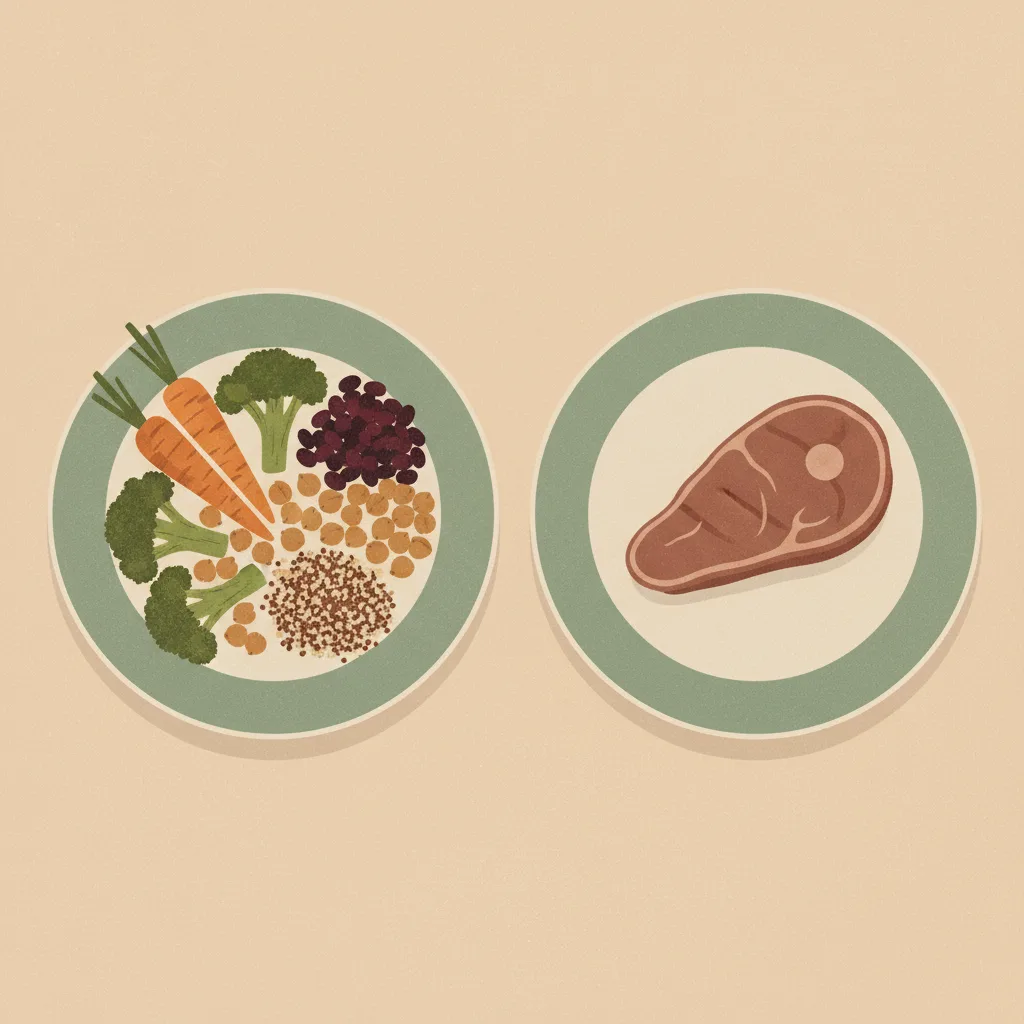
The largest study of vegetarian and vegan retention — Faunalytics’
2014 survey of 11,399 US adults via Harris Interactive — found that
84% of people who adopted a vegetarian or vegan diet eventually returned
to eating meat. That number is the action-side proxy shown above, used
directly rather than the previously constructed composite. But lapse rate
is not regret rate. Crucially, 37% of the lapsed expressed interest in
re-adopting, meaning they do not regret the diet itself — they regret
stopping it, or faced barriers they could not overcome. A Faunalytics
obstacle analysis found that social isolation (84% were not part of any
veg community), food access, and meal prep difficulty — not principled
rejection of the diet — drove most lapses.
On the other side, a 2022 Vegan Society survey of 2,000 non-vegan UK
adults found that 22% report feeling guilty about eating meat all of the
time — a persistent-guilt figure we use as the inaction proxy rather
than the combined 71% who report guilt “some” or “all” of the time.
Persistent guilt maps more closely to a regret-adjacent construct than
intermittent discomfort. Cognitive dissonance research (Bastian et al.,
2012) shows that meat-related guilt is often resolved through
justification strategies — “the guilt persists but produces no
corresponding desire to act.” The Vegan Society, as the commissioning
body, has an advocacy interest in high guilt numbers.
What the data establishes is that dietary identity is unstable: most
people who try vegetarianism quit (though many want to try again), and
roughly one in five meat eaters carries persistent guilt about it.
The action-dominates pattern reflects an asymmetry between a very high
lapse rate and a modest persistent-guilt rate, but readers should note
that lapsing conflates genuine dissatisfaction with situational barriers.
Both figures are proxies for different constructs (behavioral abandonment
vs affective discomfort), so the large delta should be read with caution.
Źródła: działanie
Rejestr twierdzeń
Każda liczba poniżej jest tym, co podało dane źródło — z dosłownym cytatem, na którym się oparliśmy, i sposobem, w jaki doszliśmy do naszej wartości. Kliknij dowolny link, żeby zweryfikować bezpośrednio.
1/2 źródeł niezależnie zweryfikowanych słowo w słowo z podanym źródłem
[1]Faunalytics / Harris Interactive — A Summary of Faunalytics' Study of Current and Former Vegetarians and Vegans
Zweryfikowane
Badanie pierwotne
84% of people who have adopted a vegetarian or vegan diet subsequently abandon it; 53% lasted less than one year; 37% of the lapsed are interested in re-adopting
Cytat
“"84% of vegetarians/vegans abandon their diet. About a third (34%) of lapsed vegetarians/vegans maintained the diet for three months or less, and slightly more than half (53%) adhered to the diet for less than one year. The only motivation cited by a majority (58%) of former vegetarians/vegans was health."
”
Dane źródłowe z
2014-12-02
Dostęp
2026-04-26
Weryfikacja
Cytat niezależnie pobrany ponownie i potwierdzony słowo w słowo z podanym źródłem podczas naszego audytu ugruntowania.
Obliczenie
Faunalytics commissioned Harris Interactive to survey 11,399 US adults aged 17+. Of those who had ever identified as vegetarian/vegan, 84% had reverted to eating meat. We use the 84% lapse rate directly as the action-side proxy. This is NOT a regret measure — it counts anyone who tried vegetarianism even briefly as a "former vegetarian." Crucially, 37% of lapsed expressed interest in re-adopting, meaning many lapsed for situational reasons (social isolation, food access) rather than because they regret the decision in principle.
[2]Faunalytics — Bringing Back Former Vegans And Vegetarians: An Obstacle Analysis
Badanie pierwotne
Food dissatisfaction is the most common struggle; accessibility and meal preparation time are the primary must-haves for re-adoption
Cytat
“"Dissatisfaction with veg*n food is the most common struggle, with nearly half of lapsed veg*ns experiencing cravings, boredom with their veg*n diet, feeling hungry on the diet, and other issues related to food dissatisfaction."
”
Dane źródłowe z
2019-10-01
Dostęp
2026-04-26
Obliczenie
Faunalytics obstacle analysis of former veg*ns. Confirms that many lapsed for practical/situational reasons (access, time, social isolation) rather than regretting the decision in principle. 84% of former veg*ns were not part of any vegetarian community, and 63% disliked sticking out from the crowd.
Źródła: bezczynność
Rejestr twierdzeń
Każda liczba poniżej jest tym, co podało dane źródło — z dosłownym cytatem, na którym się oparliśmy, i sposobem, w jaki doszliśmy do naszej wartości. Kliknij dowolny link, żeby zweryfikować bezpośrednio.
[1]The Vegan Society / Attest — Younger people feel more guilty about eating meat than older people, Vegan Society research finds
Badanie pierwotne
22% of non-vegan UK adults feel guilty about eating meat all of the time; an additional 49% feel guilty some of the time
Cytat
“"49 per cent of respondents felt guilty about eating meat 'some' of the time, while a further 22 per cent felt guilty 'all' of the time. Even amongst those not limiting their consumption of meat and animal products at all, 45 per cent said they felt guilty about it 'some' or 'all' of the time."
”
Dane źródłowe z
2022-11-01
Dostęp
2026-04-26
Obliczenie
Vegan Society commissioned Attest to survey 2,000 non-vegan UK adults (working age, nationally representative for age, gender, and region) in October 2022. We use the 22% "guilty all the time" figure rather than the combined 71% (some + all), because persistent guilt is a closer proxy for regret-adjacent affect than intermittent guilt. The Vegan Society as commissioning body has an advocacy interest in high guilt numbers. Guilt about eating meat is NOT the same as regret about not going vegetarian — cognitive dissonance research shows meat-guilt is often resolved through justification strategies.
[2]Faunalytics / Harris Interactive — A Summary of Faunalytics' Study of Current and Former Vegetarians and Vegans
Badanie pierwotne
88% of US adults have never tried vegetarianism or veganism; 10% are former veg*ns; 2% are current veg*ns
Cytat
“"About 88 percent of the U.S. population had never attempted a vegetarian or vegan diet, yet among the 12 percent who tried, only 2 percent had stuck with it."
”
Dane źródłowe z
2014-12-02
Dostęp
2026-04-26
Obliczenie
Faunalytics population data. 88% of US adults have never tried vegetarianism, providing context: the vast majority of meat eaters have not even considered the alternative seriously, making "regret about not going vegetarian" a narrow phenomenon even if guilt about meat is widespread.
Zastrzeżenia
Żadna strona nie mierzy żalu bezpośrednio. 84% po stronie działania to wskaźnik zaniku — liczy każdego, kto spróbował wegetarianizmu i wrócił, w tym eksperymenty trwające poniżej 3 miesięcy. Zanik to nie żal: 37% zanikłych wyraziło zainteresowanie ponownym przyjęciem, a analiza przeszkód Faunalytics ustaliła, że praktyczne bariery (izolacja społeczna, dostęp do żywności, trudność przygotowania posiłków) napędzały większość zaników, a nie pryncypialne odrzucenie. Surowe 84% należy czytać jako „dieta nie utrzymała się” raczej niż „żałują, że próbowali”. 22% po stronie zaniechania to trwała wina („przez cały czas”) z jedzenia mięsa, nie żal z nieprzejścia na wegetarianizm. Badania dysonansu poznawczego (Bastian i in., 2012) pokazują, że wina związana z mięsem często jest rozwiązywana strategiami uzasadniającymi bez zmiany zachowania. Dwie próby pochodzą z różnych krajów (USA vs Wielka Brytania) i różnych dekad (2014 vs 2022). Wzorzec dominacji działania odzwierciedla asymetrię między wysokim wskaźnikiem zaniku a skromnym wskaźnikiem trwałej winy, ale oba to proxy dla różnych konstruktów (behawioralne porzucenie vs afektywny dyskomfort). Duża delta (0,62) zawyża różnicę w faktycznym żalu, ponieważ zanik miesza żal z barierami sytuacyjnymi.