



Przejdź do treści
Likelier

Żal z działania a żal z bezczynności

Wspólne posiłki rodzinne vs jedzenie w pośpiechu osobno

Jeśli działasz

Wspólne posiłki

9,0%

Jeśli nie działasz

Jedzenie osobno, w pośpiechu

62%

Odsetek osób, które później żałują każdego wyboru. Słupki i pełna kartoteka danych poniżej.


Rodzina

Ostatnio sprawdzono 2026-04-26

Jakość dowodów 4.13/5

Ocena recenzji w ośmiu wymiarach względem rubryki jakości . Każdy wymiar oceniony w skali 1–5.

D1 Weryfikacja źródeł
5/5
D2 Autorytet i niezależność źródeł
4/5
D3 Dokładność wskaźnika żalu
2/5
D4 Porównywalność źródeł
3/5
D5 Wzorzec Gilovicha
5/5
D6 Jakość tekstu
5/5
D7 Kompletność zastrzeżeń
5/5
D8 Jakość próby
4/5
Średnia 4.13/5
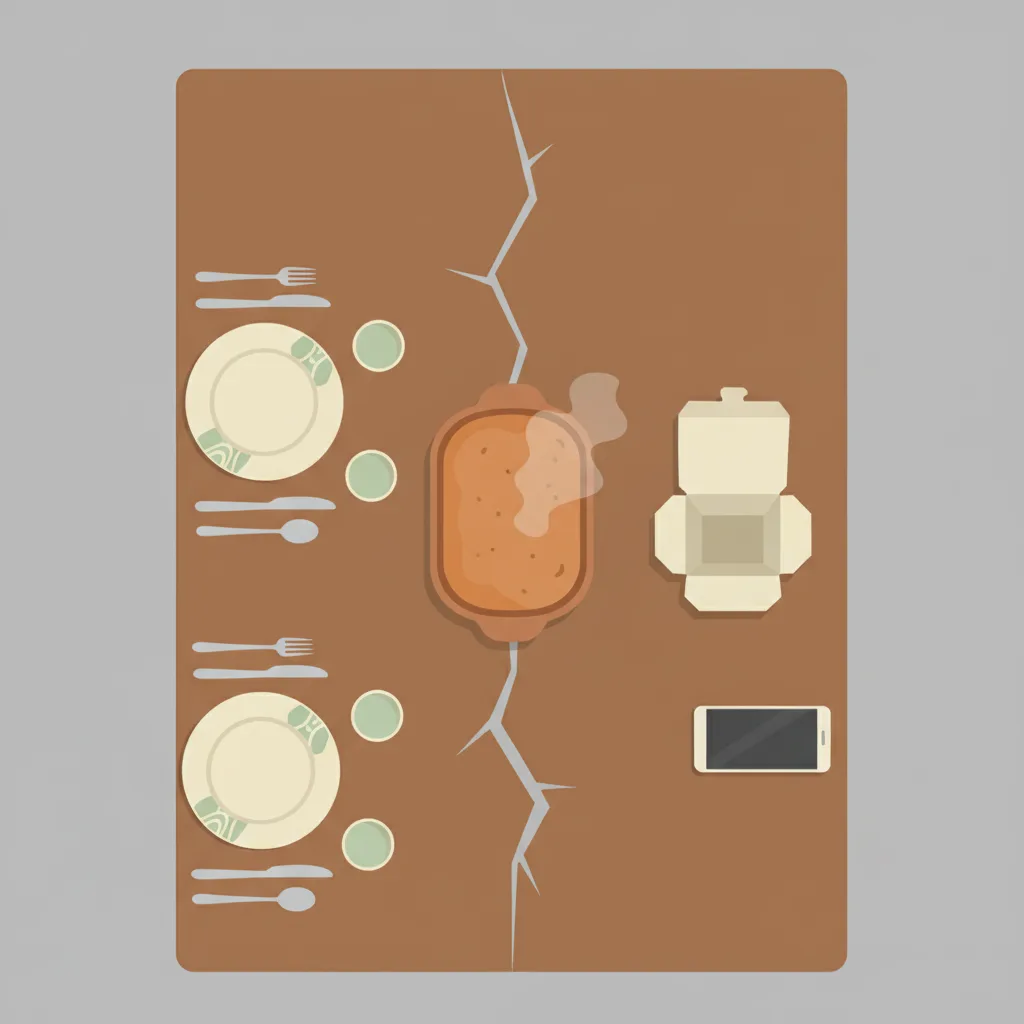
A dining table set for a family meal on one side, a counter with a lone takeout container on the other.

Żal za działanie

Wspólne posiłki

9,0%

9% rodziców nie uważa rodzinnych posiłków za redukujące stres (proxy)

Dorośli Amerykanie, ogólnokrajowo reprezentatywnie

retrospektywnie, bez stałego horyzontu

Żal za zaniechanie

Jedzenie osobno, w pośpiechu

62%

62% rodziców żałuje, że nie jadali rodzinnych kolacji częściej (proxy luki aspiracji)

Amerykańscy rodzice z dziećmi poniżej 18 lat

retrospektywnie, bez stałego horyzontu

% żałuje tej decyzji

inaction dominates — Bezczynność dominuje — większość żałuje, że nie podjęła działania.

Powiązane decyzje

Semantycznie podobne decyzje — ten sam obszar, inne kompromisy.

family

Prywatna vs publiczna

% żałuje tej decyzji

Zaniechanie dominuje

Żal za zaniechaniem 3.2× wyższy

family

Rodzic w domu vs pracujący

% żałuje tej decyzji

Działanie dominuje

Żal za działaniem 1.3× wyższy

family

Ratować vs. dać sobie radzić

% żałuje tej decyzji

Działanie dominuje

Żal za działaniem 1.2× wyższy

family

Dyscyplina vs poblazkliwosc

% żałuje tej decyzji

Zaniechanie dominuje

Żal za zaniechaniem 2.4× wyższy

lifestyle

Częste podjadanie

% żałuje tej decyzji

Zaniechanie dominuje

Żal za zaniechaniem 1.8× wyższy

family

Zajęcia vs swobodna zabawa

% żałuje tej decyzji

Działanie dominuje

Żal za działaniem 2.6× wyższy

family

Wielkość rodziny

% żałuje tej decyzji

Zaniechanie dominuje

Żal za zaniechaniem 2.6× wyższy

family

Dom opieki vs opieka domowa

% żałuje tej decyzji

Działanie dominuje

Żal za działaniem 2.3× wyższy

A YouGov poll found that 62% of parents with children under 18 wish they had family dinners more often — the dominant inaction-side signal in this entry. On the action side, a 2022 American Heart Association survey of 1,000 US adults found that 9% of parents do not report stress reduction from regular family meals — and 84% wish they could share meals more often. The resulting 7:1 ratio between inaction-side aspiration and action-side dissatisfaction is striking but relies on asymmetric measurements — one asks about stress relief, the other about aspirational frequency — so the exact magnitude should be handled with caution.

The downstream associations of infrequent family meals are better documented than the regret itself. Harrison et al.’s systematic review of 14 studies confirmed inverse associations between family meal frequency and depression, substance use, and suicidal ideation in adolescents. These are correlational findings subject to obvious confounding — families that manage regular dinners differ socioeconomically and structurally from those that don’t — but the consistency across studies and populations makes the direction of effect reasonably secure. The aspiration gap (wanting more family meals) likely reflects both genuine awareness of these benefits and cultural messaging about what “good families” do.

The counterweight is real but poorly quantified. A 2025 BMC Public Health review argued that the “family dinner ideal” places uneven pressure on low-income, single-parent, and shift-working households, and that evidence for what specifically about the shared meal produces benefits — as opposed to the general family stability it proxies — remains thin. Quality of interaction appears to matter more than mere co-presence at a table. The aspiration gap here likely reflects genuine loss when connection opportunities are forfeited, but some of the 62% who wish for more dinners may be responding to cultural expectation rather than lived deprivation. Neither rate is a direct regret measure, and both are flagged as proxies accordingly.

Źródła: działanie

Rejestr twierdzeń

Każda liczba poniżej jest tym, co podało dane źródło — z dosłownym cytatem, na którym się oparliśmy, i sposobem, w jaki doszliśmy do naszej wartości. Kliknij dowolny link, żeby zweryfikować bezpośrednio.

1/2 źródeł niezależnie zweryfikowanych słowo w słowo z podanym źródłem

  1. [1] American Heart Association / Wakefield Research — New survey: 91% of parents say their family is less stressed when they eat together
    New survey: 91% of parents say their family is less stressed when they eat together
    Statystyka
    91% of parents say their family is less stressed when they regularly connect over a meal; 84% wish they could share a meal together more often
    Cytat
    “"91 percent of parents notice their family is less stressed when they regularly connect over a meal. The survey also found that 84% of adults say they wish they could eat more meals with others." ”
    Dane źródłowe z
    2022-10-10
    Dostęp
    2026-04-26
    Obliczenie
    Wakefield Research for AHA, 1,000 nationally representative US adults ages 18+, September 14–20 2022, online survey. MOE +/-3.1pp at 95% CI. The 9% who do not report stress reduction is the complement of the 91% headline. We use this as an upper-bound proxy for action-regret: among parents who do eat together, a small minority find no benefit. This is a satisfaction complement, not a regret measure — flagged as "(proxy)".
  2. [2] BMC Public Health — Unpacking family meals: state-of-the-art review critiquing the Western ideals, positioning and promotion of family meals Zweryfikowane
    Unpacking family meals: state-of-the-art review critiquing the Western ideals, positioning and promotion of family meals
    Statystyka
    Family meal promotion reinforces unrealistic expectations on resource-pressured families; evidence on what specifically helps is limited
    Cytat
    “"Evidence surrounding what specifically about the family meal offers health benefits is limited, and family meals carry a level of moral value, evoking pressure for parents to 'achieve' a family meal ideal, unattainable for many." ”
    Dane źródłowe z
    2025-02-11
    Dostęp
    2026-04-26
    Weryfikacja
    Cytat niezależnie pobrany ponownie i potwierdzony słowo w słowo z podanym źródłem podczas naszego audytu ugruntowania.
    Obliczenie
    Narrative review, not a prevalence study. Included to establish that the action side is not costless: logistical burden and social pressure are real downsides for some families. Does not supply its own regret percentage.

Źródła: bezczynność

Rejestr twierdzeń

Każda liczba poniżej jest tym, co podało dane źródło — z dosłownym cytatem, na którym się oparliśmy, i sposobem, w jaki doszliśmy do naszej wartości. Kliknij dowolny link, żeby zweryfikować bezpośrednio.

1/2 źródeł niezależnie zweryfikowanych słowo w słowo z podanym źródłem

  1. [1] YouGov — Most parents wish they were having family dinners more often
    Most parents wish they were having family dinners more often
    Statystyka
    62% of parents with children under 18 wish they could have family dinners 'much more often' or 'somewhat more often'
    Cytat
    “"Roughly six in 10 (62%) parents with children under 18 say they would like to have family dinners 'much more often' or 'somewhat more often.' Parents of children and teenagers (87%) are especially likely to say they have a family dinner with all members of their home at least once a week." ”
    Dane źródłowe z
    2019-10-28
    Dostęp
    2026-04-26
    Obliczenie
    YouGov online survey, 1,220 US adults (938 sharing a household), October 21–22 2019, weighted to be nationally representative. The 62% is among parents with children under 18 who wish dinners happened more often. This measures aspiration gap (wanting more of something you believe is good), not classical retrospective regret. Flagged as "(aspiration-gap proxy)".
  2. [2] Canadian Family Physician (Harrison et al.) — Systematic review of the effects of family meal frequency on psychosocial outcomes in youth Zweryfikowane
    Systematic review of the effects of family meal frequency on psychosocial outcomes in youth
    Statystyka
    Frequent family meals are inversely associated with substance use, depression, suicidal ideation, and violent behaviour in adolescents
    Cytat
    “"Overall, results show that frequent family meals are inversely associated with disordered eating, alcohol and substance use, violent behaviour, and feelings of depression or thoughts of suicide in adolescents, and there is a positive relationship between frequent family meals and increased self-esteem and school success." ”
    Dane źródłowe z
    2015-02-01
    Dostęp
    2026-04-26
    Weryfikacja
    Cytat niezależnie pobrany ponownie i potwierdzony słowo w słowo z podanym źródłem podczas naszego audytu ugruntowania.
    Obliczenie
    Systematic review of 14 studies from MEDLINE and PsycINFO (searches 1948–2011). Not a prevalence figure; included to establish the consequence basis for why parents aspire to more family meals — the downstream associations are well documented, though correlational and subject to confounding.

Zastrzeżenia

Żadna z liczb nie jest bezpośrednim pomiarem żalu — obie są wprost oznaczone jako proxy w regret_display. 9% po stronie działania to dopełnienie rodziców, którzy zgłaszają redukcję stresu z rodzinnych posiłków — proxy inwersji satysfakcji, a nie miara, że ktoś mówi „żałuję, że jedliśmy razem”. 62% po stronie zaniechania uchwytuje życzenie więcej kolacji (luka aspiracji), które jest bliższe oczekiwaniu kulturowemu niż klasycznemu retrospektywnemu żalowi. Żadna duża ankieta nie pyta wprost „czy żałujesz, że nie jedliście razem jako rodzina?”. Ankieta AHA 2022 ustaliła też, że 84% chciałoby częściej dzielić posiłki, co potwierdza kierunek YouGov. Próba YouGov obejmuje rodziców, którzy już regularnie razem jedzą, ale chcą więcej, inflacjując wskaźnik zaniechania względem prawdziwego żalu „nigdy nie robiliśmy”. Przegląd systematyczny Harrison i in. dotyczący używania substancji przez nastolatków (rzadko jadający razem bardziej skłonni używać tytoniu) jest korelacyjny i podlega zafałszowaniom: rodziny, które jedzą razem, różnią się od tych, które nie, w sposób wykraczający poza sam posiłek. Przegląd BMC Public Health zauważa, że „ideał rodzinnej kolacji” nakłada nieproporcjonalną presję na rodziny niskodochodowe i samotnych rodziców, więc luka aspiracji może częściowo odzwierciedlać normowanie kulturowe, a nie dowody na netto szkodę z pominiętych posiłków. Stosunek 7:1 między wskaźnikami zaniechania a działania jest kierunkowo solidny, ale zawyża prawdziwą asymetrię żalu, biorąc pod uwagę słabe proxy po stronie działania.

Dane surowe: /api/decisions.json

Ostatnio oglądane na tym urządzeniu