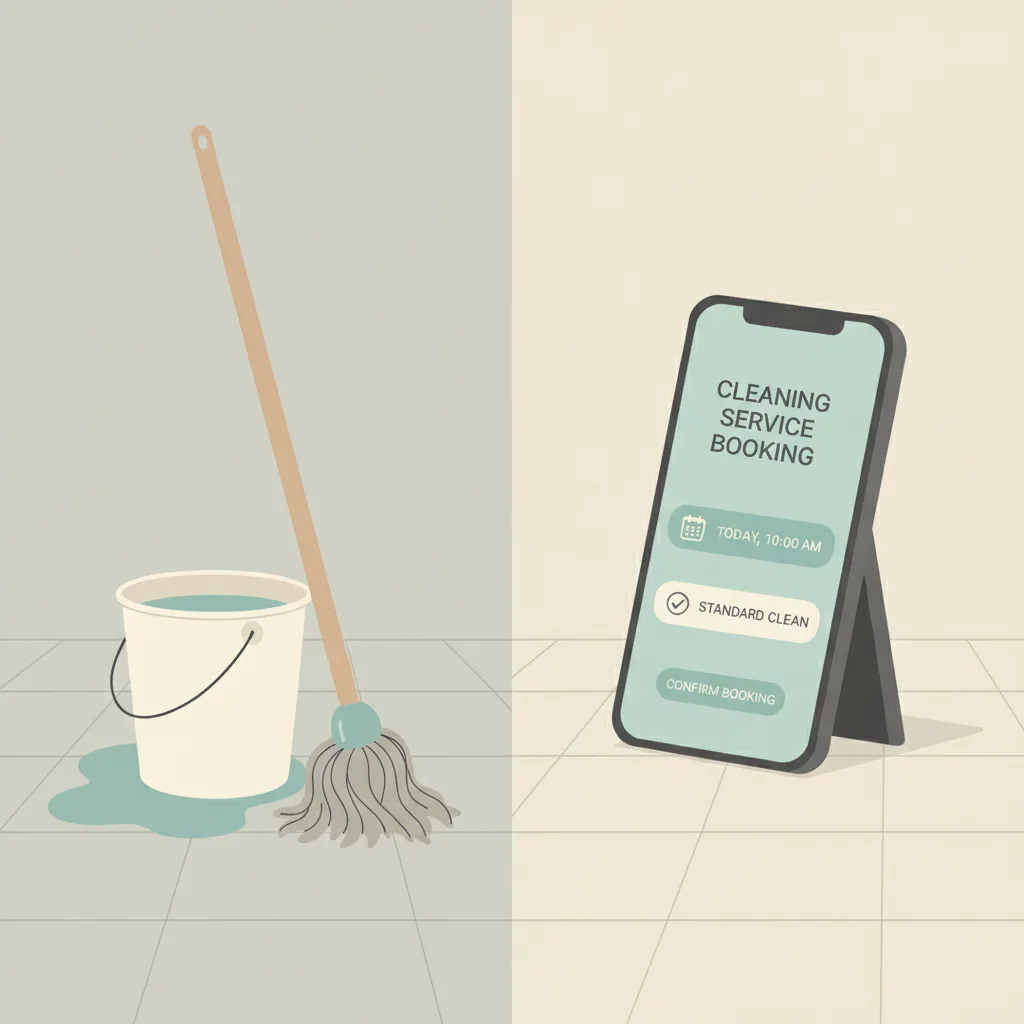
Assumere un addetto alle pulizie vs pulire da soli
Se agisci
Assumere aiuto per le pulizie
9,0%
Se non agisci
Fare le pulizie da soli
50%
Percentuale di chi poi rimpiange ciascuna scelta. Le barre e il registro completo dei dati compaiono sotto.
Stile di vita
Ultima revisione 2026-04-26
Qualità delle prove 4.13/5
Punteggio di revisione su otto dimensioni rispetto alla
griglia di qualità
. Ogni dimensione valutata da 1 a 5.
D1 Verifica delle fonti
5/5
D2 Autorità e indipendenza delle fonti
4/5
D3 Precisione del tasso di rimpianto
2/5
D4 Comparabilità delle fonti
3/5
D5 Schema di Gilovich
5/5
D6 Qualità della prosa
5/5
D7 Completezza degli avvertimenti
5/5
D8 Qualità del campione
4/5
Media4.13/5
Dati proxy — non esiste alcun sondaggio diretto sul rimpianto per questa decisione. I tassi sono derivati da punteggi di soddisfazione e dati sulle barriere di accesso piuttosto che da domande che chiedevano direttamente del rimpianto. Vedi avvertenze di seguito.
Rimpianto per azione
Assumere aiuto per le pulizie
9,0%
Non esiste un sondaggio diretto sul rimpianto; la spesa per risparmiare tempo ha aumentato la felicità in media a tutti i livelli di reddito, quindi il rimpianto per l'azione è considerato basso (proxy nominale di benessere, non un tasso rilevato per sondaggio)
Adulti che lavorano, USA/Canada/Danimarca/Paesi Bassi
retrospettivo, nessun arco temporale fisso
Rimpianto per inazione
Fare le pulizie da soli
50%
~50% delle famiglie benestanti non spende nulla per delegare i compiti sgraditi pur potendoselo permettere (proxy comportamentale di non utilizzo, non un sondaggio sul rimpianto)
Milionari olandesi e adulti che lavorano, 4 paesi
retrospettivo, nessun arco temporale fisso
% rimpiange questa scelta
Assumere aiuto per le pulizieFare le pulizie da soli
9,0%50%
inaction dominates — L'inazione domina — la maggior parte si pente di non aver agito.
Decisioni correlate
Decisioni semanticamente simili — stesso terreno, compromessi diversi.
Among Dutch millionaires — people for whom cost is irrelevant — just
under half spent nothing on outsourcing disliked tasks, according to
Whillans et al.’s PNAS study. That non-outsourcing fraction is the closest
available proxy for inaction in this domain: roughly half of those who
could easily afford to outsource cleaning choose not to. Importantly, the
paper does not report that non-outsourcers have lower life satisfaction —
it reports a positive association for those who do buy time, so the 50%
here is a behavioral non-use figure, not a measured regret rate. On the
action side, Whillans et al. surveyed 6,271 working adults across four
countries and found that those who spent on time-saving services reported
higher life satisfaction; a field experiment gave 60 adults $40 to spend
on a time-saving purchase one weekend and a material purchase the next,
and the time-saving weekend produced higher positive affect (mean 4.00
vs 3.71 on the SPANE scale, d=0.33). The benefit was not moderated by
income or wealth (Z=−0.35, P=0.729), and subsequent research found that
time-saving spending also improved relationship satisfaction regardless of
whether the specific purchase was practical or indulgent.
The paradox is that almost nobody acts on this. When 98 working adults were
asked how they would spend a $40 windfall, only 2% chose time-saving.
Among 818 Dutch millionaires — people for whom cost is irrelevant — nearly
half spent nothing on outsourcing disliked tasks in a typical month. Trübner
(2024) catalogued the barriers in a German sample of 1,479 couples: guilt
about perceived laziness, gendered expectations that housework is a domestic
duty, privacy concerns about strangers in the home, and discomfort with
anything resembling “servant culture.” These are psychological barriers, not
economic ones, and they track cleanly with Gilovich’s inaction-dominance
pattern: people forgo a well-documented happiness gain, and the status quo
persists because the cost of inaction is diffuse and invisible.
The caveat worth flagging is that this entry measures well-being and
behavior, not regret. The evidence shows that buying time tends to raise
happiness; it does not show that people who clean their own homes feel
worse off, and it certainly does not measure whether they regret the
choice — some genuinely prefer the routine, the exercise, or the sense of
control. The rates here are proxies, not direct survey findings, and the
ratio between the two sides should be read as a well-being-and-behavior
asymmetry rather than a regret asymmetry in the strict Gilovich sense. The directional finding
is clear: outsourcing time-draining tasks improves well-being for most people
who try it. Whether not doing so constitutes “regret” depends on how much
you trust revealed preferences over stated ones.
Fonti: azione
Registro delle fonti
Ogni numero qui sotto è ciò che ciascuna fonte ha riportato, con la citazione testuale su cui ci siamo basati e come siamo arrivati alla nostra cifra. Clicca su qualsiasi link per verificare direttamente.
1/2 fonti verificate in modo indipendente e alla lettera rispetto alla fonte citata
In a field experiment (n=60), working adults reported greater end-of-day positive affect after a time-saving purchase (mean 4.00) than a material one (mean 3.71), t(59)=2.57, P=0.007, d=0.33; the benefit was not moderated by income or wealth (Z=-0.35, P=0.729)
Estratto
“"Using large, diverse samples from the United States, Canada, Denmark, and The Netherlands (n = 6,271), we show that individuals who spend money on time-saving services report greater life satisfaction. A field experiment provides causal evidence that working adults report greater happiness after spending money on a time-saving purchase than on a material purchase."
”
Dati originali da
2017-08-08
Consultato
2026-04-26
Calcolo
Whillans et al. surveyed 6,271 adults across four countries and ran a field experiment with 60 working adults spending $40 on a time-saving vs a material purchase on consecutive weekends. The time-saving weekend produced higher positive affect (4.00 vs 3.71 on the SPANE, d=0.33), and the effect did not vary by income or wealth (Z=-0.35, P=0.729). The paper reports a positive well-being effect, not a regret rate or a "no-gain" fraction; the study did not survey regret about hiring cleaning help. The display rate is a well-being proxy, not a surveyed regret figure (see proxy_only and caveats). The study included cleaning, cooking, and errand outsourcing as time-saving categories.
[2]Harvard Business School Working Knowledge — Why Outsourcing Chores Is Good for Your Relationship
Verificato
Fonte di riferimento
Couples who spent money to save time reported greater relationship satisfaction regardless of whether the purchase was practical or fun
Estratto
“"It didn't matter if they bought products or services or if they paid for a practical service like Instacart or a fun treat like gourmet takeout — they still reported greater relationship satisfaction if they spent money to save time."
”
Dati originali da
2023-05-15
Consultato
2026-04-26
Verifica
Estratto recuperato in modo indipendente e confermato parola per parola rispetto alla fonte citata durante il nostro audit di attendibilità.
Calcolo
HBS research building on Whillans's earlier work. Extends the finding from individual happiness to relationship satisfaction, strengthening the case that outsourcing domestic tasks produces broad well-being gains. The effect was consistent across income levels and purchase types.
Fonti: inazione
Registro delle fonti
Ogni numero qui sotto è ciò che ciascuna fonte ha riportato, con la citazione testuale su cui ci siamo basati e come siamo arrivati alla nostra cifra. Clicca su qualsiasi link per verificare direttamente.
Just under half of the 818 surveyed Dutch millionaires — people for whom cost is no barrier — spent no money outsourcing disliked tasks; across samples, those who bought time reported greater life satisfaction
Estratto
“"Despite the potential benefits of buying time, many respondents allocated no discretionary income to buying time, even when they could afford it: just under half of the 818 millionaires that we surveyed spent no money outsourcing disliked tasks."
”
Dati originali da
2017-08-08
Consultato
2026-04-26
Calcolo
The ~50% inaction display is anchored to a real BEHAVIORAL fraction: just under half of the 818 Dutch millionaires — people with no financial barrier — spent no money outsourcing disliked tasks. The paper does NOT report that non-outsourcers had lower life satisfaction; it reports a positive association for those who bought time. The display therefore states the measured construct (the non-outsourcing fraction among the financially able), not a surveyed regret rate. Many non-outsourcers genuinely prefer cleaning themselves, so this is a proxy, not direct regret (see proxy_only and caveats).
[2]International Journal of Consumer Studies / Trübner — Sociocultural barriers to outsourcing housework: Unraveling the non-use of domestic services
Articolo peer-reviewed
Guilt, perceived laziness, and gendered norms are the primary sociocultural barriers preventing households from outsourcing housework even when they can afford it
Estratto
“"Demand for paid domestic services is low, even for households with sufficient financial resources. Women are significantly more likely to be personal and complete rejectors of outsourcing than men, confirming expectations about gendered attitudes toward outsourcing."
”
Dati originali da
2024-01-15
Consultato
2026-04-26
Calcolo
Trübner (2024) surveyed 1,479 German cohabiting couples who had not used domestic services. Five distinct barrier profiles were identified, with guilt and perceived laziness as dominant factors. This explains why the inaction rate remains high even among affluent households — the barrier is psychological, not financial.
Avvertenze
AVVERTENZA PROXY: nessuno dei due tassi è una misura diretta del rimpianto, e nessun sondaggio pubblicato chiede alle persone se rimpiangono di aver assunto (o di non aver assunto) un addetto alle pulizie. Lo studio Whillans su PNAS ha misurato la soddisfazione di vita e l'affetto positivo derivanti dagli acquisti che fanno risparmiare tempo in generale (consegna dei pasti, pulizie, commissioni), non le pulizie isolatamente. Il tasso del 9% sul lato azione NON è una cifra rilevata per sondaggio: l'articolo riporta un effetto positivo sul benessere, non una frazione di "nessun guadagno" o di rimpianto, quindi il basso tasso sul lato azione è un valore segnaposto nominale per "comprare tempo ha aiutato in media". Il tasso del 50% sul lato inazione è una frazione comportamentale di non utilizzo — poco meno della metà degli 818 milionari olandesi non ha speso nulla per delegare i compiti sgraditi pur potendoselo permettere. L'articolo NON riporta che questi non-deleganti avessero una minore soddisfazione di vita; equiparare "ha scelto di non delegare" a "rimpianto" sovrastima l'evidenza. proxy_only è impostato su questa scheda per questo motivo. Non è stato trovato alcun sondaggio pubblicato che chieda direttamente "rimpiangi di aver assunto/di non aver assunto un addetto alle pulizie?". Molte persone preferiscono genuinamente fare le proprie faccende domestiche e non riferiscono alcun rimpianto. Lo studio Trübner sulle barriere è tedesco, non statunitense, e gli atteggiamenti culturali verso l'aiuto domestico variano sostanzialmente. Il bias di autoselezione è presente su entrambi i lati: le persone che assumono addetti alle pulizie possono essere per disposizione più felici, e quelle che rifiutano possono apprezzare l'autosufficienza in modi che compensano qualsiasi costo per il benessere. Il rapporto 5,6:1 va letto come un'asimmetria di benessere, non come un'asimmetria di rimpianto nel senso stretto di Gilovich. I dati primari sul benessere sono tratti da campioni degli Stati Uniti e dell'Europa occidentale; i tassi di soddisfazione e rimpianto in paesi con strutture istituzionali diverse — norme di consumo, costi del lavoro domestico e atteggiamenti verso l'aiuto retribuito — possono differire sostanzialmente.