


本文へスキップ
Likelier

行動 vs. 不行動:各選択の数値

豊胸手術を受けるかどうか

行動した場合

豊胸手術を受ける

7.0%

行動しなかった場合

豊胸手術を受けない

直接の測定はありません

少なくとも1つの数値は間接的な推定値であり、実際に測定した後悔の割合ではありません。各数値の算出方法は下に記載しています。


健康

最終確認 2026-05-10

証拠の質 4.25/5

8次元のレビュー評価。基準は 品質ルーブリック 。各次元は1〜5で評価。

D1 出典の検証
4/5
D2 出典の権威性と独立性
5/5
D3 後悔率の正確性
3/5
D4 出典の比較可能性
3/5
D5 ギロヴィッチ・パターン
4/5
D6 文章の質
5/5
D7 注意事項の完全性
5/5
D8 サンプルの質
5/5
平均 4.25/5
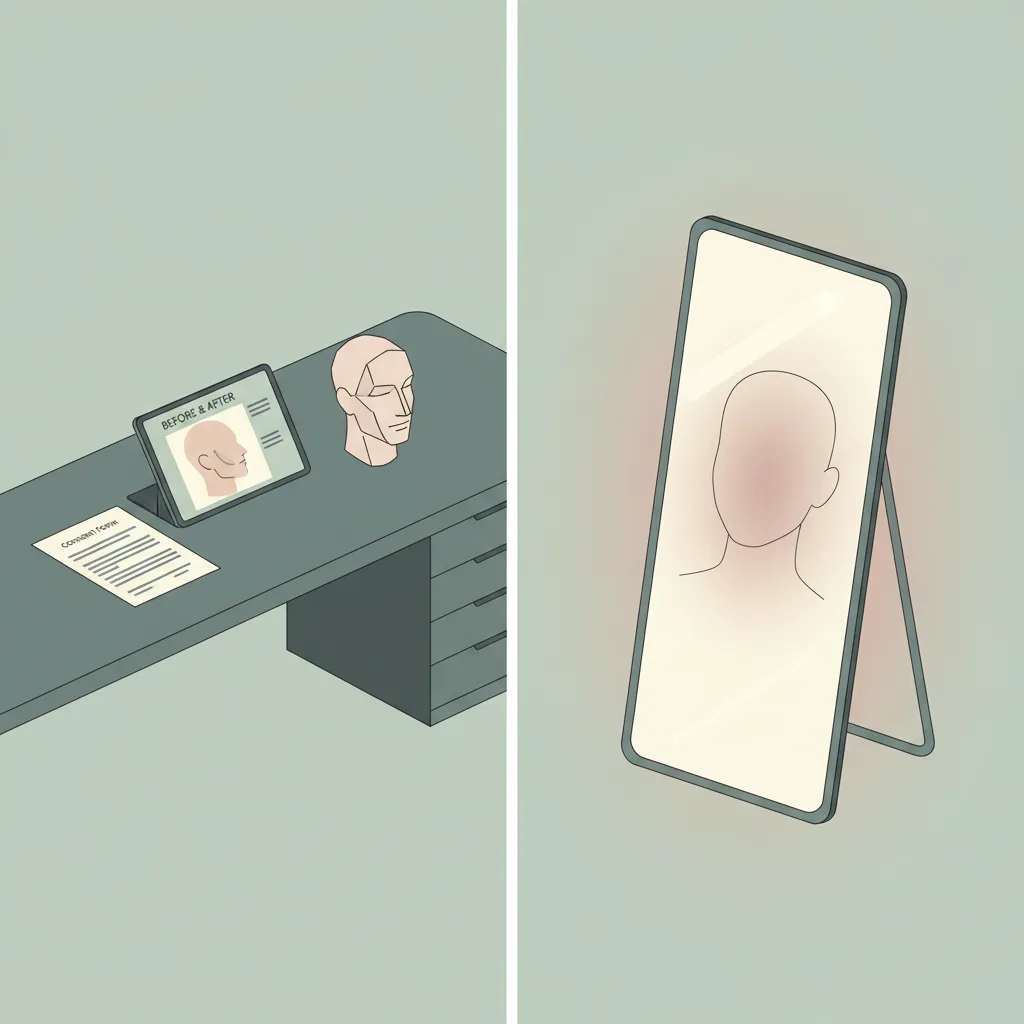
Two identical silhouettes side by side, one with a small surgical consent form resting beneath it, the other bare, on a neutral surface.
間接データ:この決断については、少なくとも1つの数値が、後悔を直接尋ねた調査ではなく、結果、満足度、意向といった間接的な指標、または編集部による推定に基づいています。各数値の算出方法は、下の各選択肢の注記に記載しています。

行動した場合

豊胸手術を受ける

7.0%

約7%が施術を後悔(研究によって5.1–9.1%の範囲)

美容豊胸患者、系統的レビュー

遡及的、通常施術後1-5年

行動しなかった場合

豊胸手術を受けない

直接の測定はありません

この選択肢について数値を示す出典がないため、数値は表示していません。

美容施術を検討したが追求しなかった米国成人女性

遡及的、固定期間なし

各選択の数値(何を測ったかはページに明記)

関連する決断

意味的に類似する決断 — 同じ領域、異なるトレードオフ。

健康

美容整形

各選択の数値(何を測ったかはページに明記)

健康

ブラジリアン・バット・リフト(BBL)

各選択の数値(何を測ったかはページに明記)

健康

リスク低減乳房切除 対 監視

各選択の数値(何を測ったかはページに明記)

健康

ボディピアス

各選択の数値(何を測ったかはページに明記)

健康

韓国:美容整形 vs. 断る

各選択の数値(何を測ったかはページに明記)

健康

精管切除術

各選択の数値(何を測ったかはページに明記)

lifestyle

タトゥー

各選択の数値(何を測ったかはページに明記)

健康

セラピーあり・なし

各選択の数値(何を測ったかはページに明記)

Breast augmentation has one of the lowest regret rates in elective cosmetic surgery. A 2024 systematic review in the American Journal of Surgery — the most comprehensive available, covering regret across surgical subspecialties — places the breast-augmentation-specific range at 5.1–9.1%, with a midpoint around 7%. This is substantially lower than body contouring (11—33%) and far lower than many non-cosmetic elective procedures. A separate 2024 meta-analysis of 18,322 patients using the validated BREAST-Q instrument found large post-operative improvements in psychosocial well-being, sexual well- being, and breast satisfaction — domain gains that explain why regret remains modest despite the physical risks of the procedure.

The complication picture is more sobering than the regret rate suggests. Capsular contracture — abnormal scar tissue that hardens around the implant — is a well-documented long-term risk: the Sientra 10-year cohort reported a 10.8% Kaplan-Meier rate. Implant rupture occurs in approximately 7.8% of patients at 10 years. Both complications can require revision surgery; the FDA maintains a Breast Implant Registry to track long-term outcomes. Among patients who later underwent explant for implant illness, a multicenter longitudinal study of 156 patients found that 83.3% reported retroactive regret about the original augmentation decision — though this population is a small, highly selected subset with unusually severe complications.

On the inaction side, no published survey directly measures regret among women who considered but chose not to get breast augmentation. The ASDS consumer survey (70% of Americans considering some cosmetic procedure) and the Ipsos body-dissatisfaction figure (37% feel dissatisfied whenever they look in the mirror) are too broad to function as inaction-regret proxies: both conflate general appearance concern with surgical-specific regret. The inaction side is a constructed placeholder, not a measurement. No comparison of the two sides should be read as a quantitative claim.

出典: 行動

根拠台帳

以下の各数値は各出典が報告した内容であり、引用した原文の抜粋と算出方法を記載しています。リンクをクリックして直接確認できます。

1/3 件の出典が引用元と一字一句一致することを独立して検証済み

  1. [1] The American Journal of Surgery — A systematic review of patient regret after surgery
    A systematic review of patient regret after surgery

    この出典を引用しているLikelierの全2件を見る →

    統計値
    Regret after breast augmentation: 5.1–9.1%
    抜粋
    “"The percentage of patients reporting regret ranged from 0 to 47.1 ​% in breast reconstruction, 5.1-9.1 ​% in breast augmentation, and 10.82-33.3 ​% in body contouring." ”
    出典データ
    2024-04-30
    アクセス日
    2026-05-10
    計算過程
    2024 AJS systematic review of patient regret across surgical subspecialties. Breast augmentation-specific subrange: 5.1–9.1%. We use 7% as the approximate midpoint. This is the most procedure-specific regret figure available in the peer-reviewed literature for cosmetic breast augmentation.
  2. [2] Journal of Plastic, Reconstructive & Aesthetic Surgery — Quality of life and satisfaction after breast augmentation: A systematic review and meta-analysis of Breast-Q patient-reported outcomes 検証済み
    Quality of life and satisfaction after breast augmentation: A systematic review and meta-analysis of Breast-Q patient-reported outcomes
    統計値
    Significant improvements in psychosocial well-being (+38.10), sexual well-being (+40.20) and satisfaction with breasts (+47.88) after augmentation (39 studies, 18,322 patients); patient-reported physical well-being yielded ambivalent results, varying by technique and follow-up time
    抜粋
    “A total of 39 studies (53 patient cohorts and 18,322 patients) were included in the quantitative synthesis. The pairwise meta-analysis revealed significant improvements in patient-reported psychosocial (MD: +38.10) and sexual well-being (MD: +40.20) as well as satisfaction with breast (MD: +47.88) (all p < 0.00001). … In contrast, patient-reported physical well-being yielded ambivalent results, varying by mammaplasty technique and post-operative follow-up time. ”
    出典データ
    2024-06-01
    アクセス日
    2026-11-16
    検証
    グラウンディング監査の際、抜粋を引用元から独立して再取得し、原文と一字一句一致することを確認しました。
    計算過程
    2024 systematic review and meta-analysis of BREAST-Q outcomes. The high post-operative satisfaction scores (medians from 70 to 79 on a 100-point scale) are consistent with the relatively low 7% regret rate. The large magnitude of improvement across psychosocial and sexual well-being domains explains why regret remains modest despite the risks of complications. Used as corroborating context, not the primary regret rate source.
  3. [3] Brazilian Journal of Plastic Surgery (RBCP) — Breast silicone explant: a multicenter longitudinal study
    Breast silicone explant: a multicenter longitudinal study
    統計値
    83.3% of patients who underwent breast implant explantation reported regret about the original augmentation decision (n=156)
    抜粋
    “"Of the patients evaluated, 83.3% reported regret having had the implant surgery, while 0.6% regretted having had the explant surgery." ”
    出典データ
    2022-01-01
    アクセス日
    2026-07-03
    計算過程
    Multicenter longitudinal observational study of 156 patients who underwent breast silicone explantation (Rev Bras Cir Plast 2022;37, DOI 10.5935/2177-1235.2022RBCP0026). Cited in body prose as context for the explant-for-illness subgroup: patients who progress to explant report very high retroactive regret about the original augmentation decision, but this is a small, highly selected, severe-complication subset, not representative of the general augmentation population used for the 5.1–9.1% action-regret range above. Not used to compute the action_side regret_rate (0.07), which remains anchored to the AJS systematic review.

出典: 不作為

根拠台帳

以下の各数値は各出典が報告した内容であり、引用した原文の抜粋と算出方法を記載しています。リンクをクリックして直接確認できます。

  1. [1] American Society for Dermatologic Surgery (ASDS) — ASDS Survey: Seven Out of Ten Consumers Considering Cosmetic Procedures
    ASDS Survey: Seven Out of Ten Consumers Considering Cosmetic Procedures
    統計値
    70% of consumers considering a cosmetic dermatologic procedure
    抜粋
    “"Seven out of ten consumers are considering cosmetic procedures, according to the ASDS consumer survey. The consideration rate has risen steadily over the past decade." ”
    出典データ
    2025-03-01
    アクセス日
    2026-05-10
    計算過程
    ASDS annual consumer survey. The 70% figure encompasses all cosmetic procedures including minimally invasive (Botox, fillers), not surgical augmentation specifically. No published survey directly asks women who chose not to pursue breast augmentation whether they regret that inaction. No inaction-regret figure is shown: interest in cosmetic procedures is high, but converting curiosity into sustained inaction regret specific to breast augmentation is much rarer, and that has not been measured.
  2. [2] Ipsos — Most Americans Experience Feeling Dissatisfied with How Their Body Looks from Time to Time
    Most Americans Experience Feeling Dissatisfied with How Their Body Looks from Time to Time

    この出典を引用しているLikelierの全3件を見る →

    統計値
    37% of Americans feel dissatisfied with their body whenever they look in the mirror
    抜粋
    “"Most Americans experience feeling dissatisfied with how their body looks from time to time, including nearly two in five who feel this way whenever they look in the mirror." ”
    出典データ
    2018-01-10
    アクセス日
    2026-05-10
    計算過程
    Ipsos nationally representative survey of 1,005 US adults. The 37% body dissatisfaction figure is a broad measure of appearance distress, not a breast-augmentation-specific regret measure. A small fraction of women with persistent chest-related body dissatisfaction who never pursue augmentation may carry lasting inaction regret, but this sub-fraction has not been measured. No inaction-regret figure is shown, because body dissatisfaction is far more common than regret specifically about not pursuing surgery.

注意事項

The two sides are not methodologically comparable. The 7% action-regret estimate is drawn from the 5.1–9.1% subrange in a 2024 AJS systematic review -- genuine peer-reviewed data with procedure-specific granularity. The inaction side is a constructed proxy: no large-sample survey has ever asked women who chose not to get breast augmentation whether they regret that decision. The ASDS cosmetic-consideration rate (70%) and Ipsos body-dissatisfaction rate (37%) are far too broad to function as direct inaction-regret measures. The true inaction rate is unknown. Several factors complicate the action rate as well: studies with longer follow-up tend to show higher regret as complications accumulate (capsular contracture rates reach 10.8% at 10 years per the Sientra cohort, and implant rupture reaches 7.8% at 10 years), while studies at 1--2 years report satisfaction rates above 90%. Regret rates should not be extrapolated to populations outside the United States or to non-elective breast surgery (reconstruction, reduction), which carry very different regret profiles.

生データ: /api/decisions.json

このデバイスで最近見た項目