Qualità delle prove 4.25/5
Punteggio di revisione su otto dimensioni rispetto alla griglia di qualità . Ogni dimensione valutata da 1 a 5.
- D1 Ancoraggio alle fonti
- 4/5
- D2 Autorità delle fonti
- 5/5
- D3 Aritmetica
- 4/5
- D4 Incertezza
- 4/5
- D5 Ambito
- 4/5
- D6 Prosa
- 4/5
- D7 Onestà sulla percezione
- 4/5
- D8 Completezza degli avvertimenti
- 5/5
● i tuoi fattori — clicca su questo rischio ▾ per rivelare
- I tuoi fattori
≈ Probabile come
Percepito
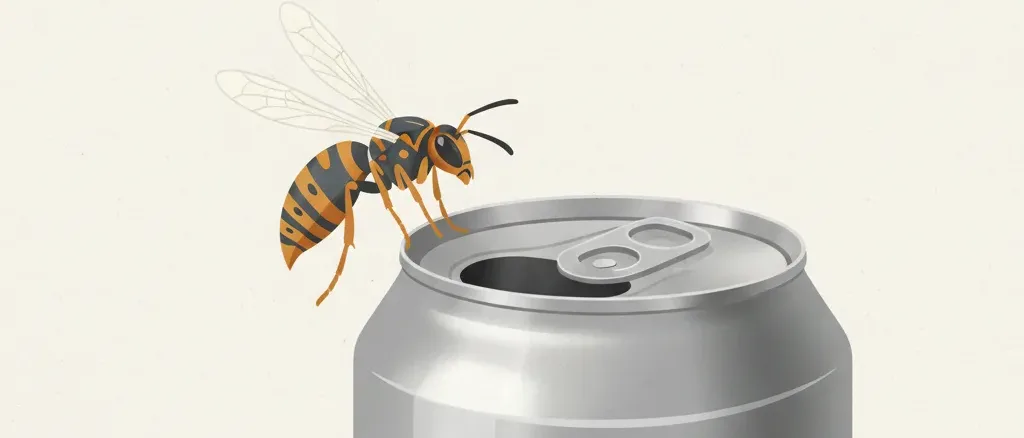
Lo scenario dell'«ape nella lattina di bibita» è una delle storie di pericolo all'aperto più vivide e diffuse. I social media amplificano gli occasionali resoconti di persone che hanno ingoiato un insetto, sentito una puntura in gola e necessitato di cure d'emergenza, il che gonfia notevolmente la frequenza percepita rispetto al tasso reale. La maggior parte di chi ha passato le estati a bere all'aperto sovrastima quanto spesso questo finisca male.
Stima approssimativa: la maggior parte di chi beve all'aperto presume che questo accada diverse volte all'anno a qualcuno che conosce vagamente
Fonte: intuizione editoriale, non sondata
Effettivo
~195 visite d'emergenza stimate all'anno per punture orofaringee (bocca/gola), Stati Uniti
popolazione totale degli USA
Mostra calcolo
Huff, Phillips e Keith (Wilderness & Environmental Medicine, 2025) hanno usato i dati NEISS (2004–2023) e hanno stimato direttamente che tra il 2004 e il 2023 ci sono state circa 3.890 (IC 95 %, 2.458,55–5.320,79) persone con punture orofaringee (bocca e gola) da api, calabroni, vespe gialle o vespe presentatesi ai pronto soccorso statunitensi — circa 195 all'anno nell'arco della finestra di 20 anni. Probabilità annua: 195 / 335.000.000 ≈ 5,8 × 10^-7. Composta su 59 anni di vita adulta rimanente: 1 - (1 - 5,8e-7)^59 ≈ 3,4 × 10^-5 ≈ 1 su 29.000. La banda di incertezza porta l'IC 95 % dello studio stesso attraverso la stessa composizione su tutta la vita (2.458,55–5.320,79 su 20 anni → ~123–266/anno). «Puntura orofaringea» è più ampio dello specifico scenario del bere da lattina/bottiglia, ma lo studio NEISS è l'unica fonte di sorveglianza statunitense che quantifica direttamente questa via.
Avvertenze: Il meccanismo qui non è il soffocamento meccanico — api e vespe sono troppo picc…
Il meccanismo qui non è il soffocamento meccanico — api e vespe sono troppo piccole per ostruire le vie aeree come oggetto fisico. Il pericolo è la puntura stessa: all'interno della bocca o della gola provoca un edema infiammatorio localizzato che può restringere le vie aeree anche negli individui non allergici, e in chi ha un'allergia al veleno può scatenare una piena anafilassi sistemica. La cifra di ~195/anno è la stima nazionale dello studio NEISS del 2025 delle presentazioni al pronto soccorso per puntura orofaringea (~3.890 nel periodo 2004–2023); non è un conteggio diretto di «insetto ingoiato mentre si beve» e può includere altre vie di puntura orale (ad esempio mangiando). I decessi da insetti specificamente ingoiati non sono tracciati separatamente.
Rischi correlati
Altri rischi su temi simili — per esplorare paure correlate.
Puntura d'ape
Quali sono le probabilità di essere uccisi dalla puntura di un'ape, vespa o calabrone?

Anafilassi da puntura
Quali sono le probabilità che una puntura di ape o vespa provochi uno shock anafilattico che richiede un'iniezione di adrenalina?
Morte cane cioccolato
Quali sono le probabilità che un cane muoia per aver mangiato cioccolato?
Puntura mortale di scorpione
Quali sono le probabilità di morire per la puntura di uno scorpione?
Puntura d'ape/vespa fatale
Quali sono le probabilità di morire per una puntura di ape, vespa o calabrone?


Soffocamento del bambino piccolo
Quali sono le probabilità che un neonato o bambino piccolo muoia soffocato mentre mangia?

Scegli lo sfidante
A bee or wasp inside a can or bottle is a genuine, if rare, hazard — and the mechanism is less obvious than most people assume. The danger is not that the insect physically blocks your airway; bees and wasps are small enough to swallow without obstruction. The danger is the sting: delivered inside the mouth, posterior pharynx, or esophagus, it triggers localized inflammatory edema in confined anatomy where even modest swelling can produce stridor, difficulty swallowing, and in severe cases airway compromise — even in people with no prior venom allergy. In those who do have venom allergy (roughly 3% of US adults), an oropharyngeal sting can trigger full systemic anaphylaxis.
A 2025 NEISS analysis by Huff, Phillips, and Keith directly estimated that between 2004 and 2023 approximately 3,890 people presented to US emergency departments with an oropharyngeal (mouth or throat) sting from a bee, hornet, yellow jacket, or wasp — about 195 per year, roughly 5% of all sting ED visits. Spread over 335 million people and 59 remaining adult years, that comes to roughly 1 in 29,000 over a lifetime. The large majority were minor: about 98% of oropharyngeal sting patients were not admitted to the hospital. Deaths from this specific route are not separately tracked in US surveillance; they are absorbed into the ICD-10 X23 “sting” category that averages ~72 per year from all mechanisms combined.
The fear is real but the framing matters: the scenario to worry about is not “the insect itself gets stuck” but “the sting triggers swelling or anaphylaxis in a place the body finds very hard to manage.” Practical risk reduction is simple — check the opening of outdoor cans and bottles before drinking, pour into a clear glass, or use a cup with a lid. These are low-friction habits that effectively eliminate the exposure route without any change to outdoor behavior otherwise.
Curiosità correlate
Le punture in bocca e gola, spesso da un insetto ingerito con cibo o bevande, portano circa 11,000 persone all’anno al pronto soccorso negli USA. La probabilità nell’arco della vita è di circa 1 in 500.
Registro delle fonti
Ogni numero qui sotto è ciò che ciascuna fonte ha riportato, con la citazione testuale su cui ci siamo basati e come siamo arrivati alla nostra cifra. Clicca su qualsiasi link per verificare direttamente.
4/4 fonti verificate in modo indipendente e alla lettera rispetto alla fonte citata
-
[1] Wilderness & Environmental Medicine (Huff, Phillips, Keith) — Oropharyngeal Bee, Hornet, Yellow Jacket, and Wasp Stings: A National Electronic Injury Surveillance System Analysis and Scoping Review Verificato
Oropharyngeal Bee, Hornet, Yellow Jacket, and Wasp Stings: A National Electronic Injury Surveillance System Analysis and Scoping Review- Statistica
An estimated 3890 (95% CI, 2458.55–5320.79) oropharyngeal sting ED presentations in the US over 2004–2023 (~195/year); oropharyngeal stings were ~5.08% of all stings; 98.08% of oropharyngeal sting victims were not admitted- Estratto
“"Between 2004 and 2023, there were an estimated 3890 (95% CI, 2458.55–5320.79) people with oropharyngeal stings from bees, hornets, yellow jackets, or wasps in the United States who presented to emergency departments." "Stings to the oropharyngeal region represented an estimated 5.08% (95% CI, 3.59–6.56) of all stings." "Overall, 98.08% (95% CI, 94.25–100.00) of victims of oropharyngeal stings were not admitted to the hospital." ”
- Dati originali da
- 2025-03-01
- Consultato
- 2026-05-04 · copia archiviata
- Verifica
- Estratto recuperato in modo indipendente e confermato parola per parola rispetto alla fonte citata durante il nostro audit di attendibilità.
- Calcolo
- Used for the direct national estimate: ~3890 oropharyngeal sting ED presentations over 2004–2023 = ~195/year. Annual probability 195/335,000,000 ≈ 5.8e-7; compounded over 59 years ≈ 3.4e-5 ≈ 1 in 29,000. The 95% CI (2458.55–5320.79 over 20 years) is carried through the same compounding for the uncertainty band. The ~1.92% hospitalization sub-fraction (98.08% not admitted) is a severity anchor.
- Indipendenza
- Based on NEISS (National Electronic Injury Surveillance System) consumer product injury data, methodologically independent of NCHS death-certificate mortality counts.
-
[2] Frontiers in Veterinary Science (Marinho & Soto-Blanco) — Toxicological Risk Assessment of the Accidental Ingestion of a Honeybee (Apis mellifera L.) Present in Food Verificato
Toxicological Risk Assessment of the Accidental Ingestion of a Honeybee (Apis mellifera L.) Present in Food- Statistica
The actual number of accidental honeybee ingestion incidents remains unknown; though a rare condition, ingestion may induce an allergic reaction in sensitive individuals- Estratto
“A number of anecdotal reports of accidental ingestion of insects are largely available, but the actual number remains unknown. Thus, although it is a rare condition, there is the risk that the ingestion of a honeybee may induce an allergic reaction to some venom components in sensitive individuals. ”
- Dati originali da
- 2020-10-01
- Consultato
- 2026-05-04 · copia archiviata
- Verifica
- Estratto recuperato in modo indipendente e confermato parola per parola rispetto alla fonte citata durante il nostro audit di attendibilità.
- Calcolo
- Supports the surveillance gap: the peer-reviewed toxicological assessment states that the actual number of accidental ingestion incidents remains unknown (reports are anecdotal). Used to justify the wide uncertainty band and to establish that the Huff 2025 oropharyngeal fraction is the best available approximation. Note: this source addresses honeybees only and does not itself quantify deaths or ER visits.
- Indipendenza
- Toxicological review drawing on venom-composition and clinical toxicology literature, independent of NEISS and NCHS data streams.
-
[3] American Family Physician (Golden DB) — Stinging Insect Allergy Verificato
Stinging Insect AllergySee all 2 Likelier entries citing this source →
- Statistica
Systemic allergic reactions to insect stings are estimated to occur in about 3% of US adults (and about 1% of children)- Estratto
“"Systemic allergic reactions to insect stings are estimated to occur in about 1 percent of children and 3 percent of adults." ”
- Dati originali da
- 2003-06-15
- Consultato
- 2026-07-03 · copia archiviata
- Verifica
- Estratto recuperato in modo indipendente e confermato parola per parola rispetto alla fonte citata durante il nostro audit di attendibilità.
- Calcolo
- Supports the body-prose reference to venom-allergy prevalence (~3% of US adults) used as context for anaphylaxis risk from an oropharyngeal sting. Not used in the native/normalized probability calculation, which is based on the Huff 2025 NEISS oropharyngeal-fraction analysis.
- Indipendenza
- Independent clinical epidemiology review (American Family Physician), methodologically distinct from the NEISS-based Huff 2025 analysis and the honeybee-ingestion toxicological review.
-
[4] Centers for Disease Control and Prevention — Morbidity and Mortality Weekly Report — QuickStats: Number of Deaths from Hornet, Wasp, and Bee Stings Among Males and Females — National Vital Statistics System, United States, 2011-2021 Verificato
QuickStats: Number of Deaths from Hornet, Wasp, and Bee Stings Among Males and Females — National Vital Statistics System, United States, 2011-2021- Statistica
788 total US deaths from hornet, wasp, and bee stings during 2011-2021, an average of 72 deaths per year; classified under ICD-10 code X23- Estratto
“"During 2011-2021, a total of 788 deaths from hornet, wasp, and bee stings occurred (an average of 72 deaths per year). [...] Deaths from hornet, wasp, and bee sting as underlying cause of death were coded as X23, according to the International Classification of Diseases, Tenth Revision." ”
- Dati originali da
- 2023-07-07
- Consultato
- 2026-07-03 · copia archiviata
- Verifica
- Estratto recuperato in modo indipendente e confermato parola per parola rispetto alla fonte citata durante il nostro audit di attendibilità.
- Calcolo
- Supports the body-prose reference to overall Hymenoptera sting deaths (~72/year, ICD-10 X23) used as a severity anchor and to explain why deaths from the specific swallowed-insect/oropharyngeal route are not separately tracked in US surveillance. Not used in the native/normalized oropharyngeal-ED-visit calculation.
- Indipendenza
- NCHS death-certificate mortality data (National Vital Statistics System), methodologically independent of the NEISS-based Huff 2025 ED-visit analysis.