Calidad de la evidencia 4.75/5
Puntuación de revisión en ocho dimensiones según la rúbrica de calidad . Cada dimensión puntuada de 1 a 5.
- D1 Anclaje en las fuentes
- 5/5
- D2 Autoridad de las fuentes
- 5/5
- D3 Aritmética
- 3/5
- D4 Incertidumbre
- 5/5
- D5 Alcance
- 5/5
- D6 Prosa
- 5/5
- D7 Honestidad sobre la percepción
- 5/5
- D8 Completitud de las advertencias
- 5/5
≈ Tan probable como
Percibido
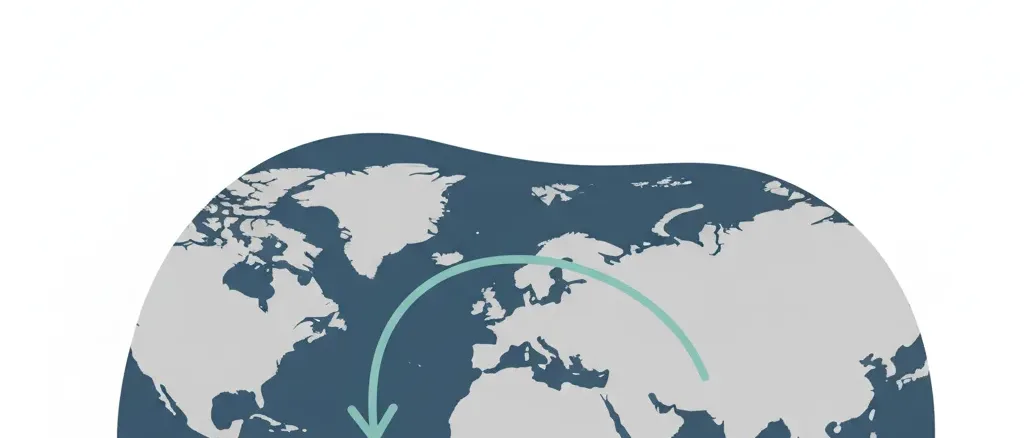
La Circulación de Retorno Meridional del Atlántico no es una expresión de uso cotidiano, y su posible colapso solo ha adquirido visibilidad general recientemente. La cobertura popular tiende a oscilar entre el desdén («los científicos dicen que la cinta transportadora del océano se está ralentizando») y el catastrofismo (titulares que invocan la película «El día después de mañana», cuya representación de una congelación instantánea era ficción científica). El concepto de puntos de inflexión de la circulación oceánica entró en la conciencia pública más amplia tras el informe del IPCC de 2021 y de nuevo tras un discutido artículo de 2023 que predijo un colapso posiblemente a mediados de siglo. La Encuesta de Miedos Estadounidenses de la Universidad de Chapman no rastrea específicamente la conciencia sobre la AMOC; datos más amplios sobre ansiedad climática sugieren que aproximadamente el 48 % de los estadounidenses declara tener miedo o mucho miedo del calentamiento global y el cambio climático (Chapman 2024), pero puntos de inflexión específicos como la AMOC no se desagregan. El riesgo se sitúa en algún punto entre lo activamente temido y lo mayormente desconocido.
Estimación aproximada: ~47,7 % de los adultos estadounidenses declara tener «miedo» o «mucho miedo» del calentamiento global y el cambio climático en general (Encuesta de la Universidad de Chapman, Ola 10, 2024) — no existen datos de encuesta específicos sobre la AMOC
Real
~5 % de probabilidad de colapso abrupto de la AMOC antes de 2100 (IPCC «muy improbable» = 0–10 %, coherente con SROCC 2019 / AR6)
Población mundial — el colapso de la AMOC es un evento a escala planetaria sin probabilidad específica por población
Mostrar cálculo
El IPCC AR6 WG1 (2021) evaluó que la AMOC declinará «muy probablemente» a lo largo del siglo XXI, con «confianza media en que el declive no implicará un colapso abrupto antes de 2100». El SPM (B.2.7) del IPCC SROCC (2019) es la evaluación que aplica el término calibrado de probabilidad «muy improbable (confianza media)» a un colapso de la AMOC. Lenguaje calibrado del IPCC: «muy improbable» = probabilidad del 0–10 %. Usar el 5 % como punto medio de ese rango da la cifra principal. Es una probabilidad de evento civilizatorio, no una probabilidad personal de muerte: el colapso de la AMOC no mataría a nadie instantáneamente, pero desencadenaría una cascada de consecuencias (descensos de la temperatura invernal europea de 5-15 °C, aceleración del aumento del nivel del mar en la costa este de EE. UU., alteración del cinturón de lluvias tropicales) cuya mortalidad indirecta a lo largo de décadas sería sustancial. Los estudios basados en observaciones producen estimaciones significativamente más altas: Ditlevsen y Ditlevsen (2023, Nature Communications) derivaron una fecha central de colapso de 2057 con un IC del 95 % de 2025-2095 a partir de señales estadísticas de alerta temprana en indicadores indirectos de la temperatura de la superficie del mar, lo que implica una probabilidad >50 % dentro de una vida adulta de 50 años. Smolders et al. (2024) estimaron la probabilidad de colapso de la AMOC antes de 2050 en un 59 ± 17 % usando indicadores de salinidad basados en la física. Ambos enfoques son cuestionados por motivos metodológicos por varios oceanógrafos veteranos, y un estudio de conjunto de 34 modelos de 2025 (Baker et al., Nature) halló que la AMOC es resistente al colapso bajo todos los escenarios de forzamiento probados. La amplia banda de incertidumbre (1-40 %) refleja este desacuerdo científico genuino, no una mera incertidumbre estadística en torno a una distribución conocida. Las precisiones de 2025 (añadidas el 2026-06-14) afinan la cuestión del MOMENTO sin resolver la probabilidad: van Westen et al. (2025, JGR Oceans) sitúan el inicio del colapso cerca de 2063 (2026-2095, percentiles 25.º-57.º) bajo SSP2-4.5 con un umbral de inflexión cercano a ~2,5 °C, mientras que Drijfhout et al. (2025, ERL) hallan que en las extensiones de CMIP6 el cierre completo del retorno septentrional se desarrolla después de 2100 durante 50-100 años incluso cuando se comprometió antes. Estas precisiones ajustan la estimación central del inicio y refuerzan la distinción entre inicio y realización, pero ninguna es una reevaluación de una agencia oficial, por lo que la cifra principal del 5 % anclada en el IPCC y la banda del 1-40 % se mantienen sin cambios.
Advertencias: La cifra principal del 5 % sigue el lenguaje calibrado «muy improbable» del IPCC…
La cifra principal del 5 % sigue el lenguaje calibrado «muy improbable» del IPCC (probabilidad del 0–10 %, confianza media) — el término «muy improbable (confianza media)» para el colapso de la AMOC proviene del SPM (B.2.7) del IPCC SROCC (2019), y el AR6 WG1 (2021) lo reformula como «confianza media en que el declive no implicará un colapso abrupto antes de 2100». La cifra principal representa el ancla del consenso científico más que el rango completo de estimaciones publicadas. Los estudios basados en observaciones (Ditlevsen 2023; Smolders et al. 2024) arrojan estimaciones sustancialmente más altas — probabilidad del 50-60 % de colapso hacia mediados de siglo — pero estos métodos son cuestionados por la representatividad de los indicadores indirectos, la longitud de las series temporales y las suposiciones de los modelos. El estudio de conjunto de 34 modelos de Baker et al. 2025 defiende la resistencia de la AMOC bajo todos los escenarios probados, respaldando la evaluación de «muy improbable» del IPCC. El debate científico está genuinamente sin resolver; la banda de incertidumbre (1-40 %) refleja esto más que una mera incertidumbre estadística en torno a un parámetro conocido. El «colapso» de la AMOC en esta entrada significa una reducción abrupta y autosostenida a un estado drásticamente debilitado — no el debilitamiento gradual (actualmente evaluado como «muy probable») que ya está en marcha. Las consecuencias del colapso se desarrollarían a lo largo de años a décadas, no de la noche a la mañana: las temperaturas invernales europeas podrían descender 5-15 °C en escalas de tiempo de 10-30 años, el nivel del mar en la costa este de EE. UU. aumentaría entre 10-50 cm adicionales por encima de las proyecciones de referencia, y los patrones de lluvias tropicales se desplazarían sustancialmente. La cifra a lo largo de la vida es una probabilidad de que el evento se desencadene, no de que sus consecuencias se realicen plenamente, dentro de la vida del adulto de referencia. Dos estudios de 2025 afinan el momento sin mover la cifra principal. Van Westen et al. (2025, JGR Oceans), analizando 25 modelos climáticos, estiman que el colapso de la AMOC podría comenzar hacia 2063 (rango 2026-2095) bajo un escenario de emisiones intermedias y hacia 2055 bajo emisiones altas, con el umbral de inflexión cerca de ~2,5 °C de calentamiento global — pero enfatizan que, una vez iniciado, alcanzar un estado sustancialmente más débil tarda más de 100 años. Drijfhout et al. (2025, Environmental Research Letters), examinando simulaciones de CMIP6 extendidas más allá de 2100, hallan que el cierre completo del retorno profundo septentrional emerge después de 2100 en todos los modelos de emisiones altas (SSP5-8.5) ejecutados hasta ese punto, y en el 37 % de los modelos de emisiones intermedias hacia 2300. Estas precisiones ajustan la estimación central del inicio en relación con la alarma de un único estudio de 2023 pero refuerzan, en lugar de revocar, el encuadre anterior: un inicio a mediados de siglo sería un compromiso, no un colapso consumado dentro de la vida de un adulto vivo.
Riesgos relacionados
Otros riesgos sobre temas similares — para explorar miedos relacionados.
Punto de inflexión del WAIS
¿Cuáles son las probabilidades de que se cruce el punto de inflexión del manto de hielo de la Antártida Occidental durante tu vida?

Catástrofe por gobierno extremista
¿Cuáles son las probabilidades de que un gobierno extremista político arruine catastróficamente su país?

Muerte por cambio climático
¿Cuáles son las probabilidades de morir por los efectos del cambio climático?



Impacto de asteroide
¿Cuáles son las probabilidades de morir por el impacto de un asteroide o cometa?


Muerte por ventisca
¿Cuáles son las probabilidades de morir en una tormenta invernal severa o ventisca?
Elige el contrincante
The Atlantic Meridional Overturning Circulation is the vast network of ocean currents that transports warm surface water northward through the Atlantic and returns cold, deep water southward — the system responsible for northwestern Europe’s mild climate relative to its latitude. IPCC AR6 (2021) assessed that AMOC will “very likely” decline over the 21st century, with “medium confidence that the decline will not involve an abrupt collapse before 2100.” The earlier IPCC SROCC (2019) is the assessment that applied the calibrated “very unlikely (medium confidence)” likelihood term to an AMOC collapse — where “very unlikely” denotes a 0-10% probability. Using the midpoint of that calibrated range gives a ~5% lifetime probability of abrupt collapse before 2100. Caesar and colleagues (2018, Nature) documented that AMOC has already weakened by approximately 15% since the mid-twentieth century, using an independent sea-surface temperature fingerprinting approach that is consistent with RAPID array direct measurements begun in 2004.
The scientific debate is unusually polarised. Observation-based early-warning studies (Boers 2021, Nature Climate Change; Ditlevsen 2023, Nature Communications; van Westen 2024, Science Advances) identify statistical and physical signals consistent with AMOC approaching a tipping threshold, with Ditlevsen’s contested analysis predicting collapse most likely between 2025 and 2095. These findings imply a much higher probability than the IPCC consensus — in some estimates, 50-60% before mid-century. The counterargument came in February 2025 from Baker et al. (Nature), whose 34-model ensemble found AMOC resilient to collapse under all tested forcing scenarios, with Southern Ocean wind-driven upwelling sustaining the circulation even under extreme greenhouse gas concentrations. The IPCC’s “very unlikely” assessment rests primarily on this model-ensemble evidence. Both camps are publishing in leading peer-reviewed journals; the discrepancy is not a matter of one side being wrong in an obvious way.
Should AMOC collapse occur, the consequences within the following few decades would be substantial. Van Westen et al.’s consequence modelling projects European winter temperature drops of 5-15°C across northwestern Europe, with London’s average winter temperature falling from roughly 7°C to near 2°C and Oslo’s to well below -10°C. Sea level on the US East Coast would rise by an additional 10-50 cm above baseline sea level rise projections, as the ocean surface that AMOC currently depresses would rebound northward. The Amazon rainforest would face additional drying as tropical rainfall patterns shift. These are not immediate effects but decadal-to-century timescale consequences of a threshold crossing that, if it occurs, would likely be irreversible on any timescale relevant to human planning.
Datos curiosos relacionados
El IPCC AR6 califica un colapso abrupto de la AMOC antes de 2100 como "muy improbable", una probabilidad de en torno al 5 por ciento. Varios estudios basados en observaciones sostienen que las probabilidades son mayores, y la franja de incertidumbre es amplia.
Registro de evidencia
Cada número a continuación es lo que reportó cada fuente, con la cita textual en la que nos basamos y cómo llegamos a nuestra cifra. Haz clic en cualquier enlace para verificarlo directamente.
-
[1] Intergovernmental Panel on Climate Change (IPCC), Working Group I, Sixth Assessment Report — Climate Change 2021: The Physical Science Basis — Chapter 9: Ocean, Cryosphere and Sea Level Change
Climate Change 2021: The Physical Science Basis — Chapter 9: Ocean, Cryosphere and Sea Level ChangeSee all 2 Likelier entries citing this source →
- Estadística
AMOC will 'very likely' decline over the 21st century for all SSP scenarios; there is 'medium confidence' that the decline will not involve an abrupt collapse before 2100- Extracto
“"The Atlantic Meridional Overturning Circulation (AMOC) will very likely decline over the 21st century for all SSP scenarios. There is medium confidence that the decline will not involve an abrupt collapse before 2100." ”
- Datos de la fuente de
- 2021-08-09
- Accedido
- 2026-05-09 · copia archivada
- Cálculo
- AR6 WG1 Ch9 does not itself assign a numerical probability, nor does it use the "very unlikely" likelihood term for AMOC collapse — it states only "medium confidence that the decline will not involve an abrupt collapse before 2100." The "very unlikely (medium confidence)" characterization of an AMOC collapse is the IPCC SROCC (2019) SPM B.2.7 assessment (see the SROCC source below), which AR6 Ch9 is consistent with. Under the IPCC calibrated-language scale "very unlikely" = 0-10% probability; 5% is taken as the midpoint of that SROCC-defined range for the headline. The IPCC does not give a numerical probability; 5% is the author's interpretation of the calibrated-language midpoint. The 59-year adult lifetime window (age 18 to 77) maps roughly onto the "before 2100" horizon.
-
[2] Intergovernmental Panel on Climate Change (IPCC), SROCC 2019 — Special Report on the Ocean and Cryosphere in a Changing Climate — Summary for Policymakers (section B.2.7)
Special Report on the Ocean and Cryosphere in a Changing Climate — Summary for Policymakers (section B.2.7)- Estadística
AMOC is projected to weaken in the 21st century under all RCPs ('very likely'), although a collapse is 'very unlikely' (medium confidence)- Extracto
“"The AMOC is projected to weaken in the 21st century under all RCPs (very likely), although a collapse is very unlikely (medium confidence)." ”
- Datos de la fuente de
- 2019-09-25
- Accedido
- 2026-07-11 · copia archivada
- Cálculo
- This SROCC SPM statement (B.2.7) is the IPCC assessment that actually applies the "very unlikely (medium confidence)" likelihood term to an AMOC collapse. It is the grounding for the headline: under IPCC calibrated language "very unlikely" = 0-10% probability, and 5% is taken as the midpoint of that range. AR6 WG1 Ch9 (2021) restated this as "medium confidence that the decline will not involve an abrupt collapse before 2100," consistent with SROCC but without repeating the "very unlikely" term. Neither report gives a numerical probability; the 5% midpoint is the author's interpretation of the SROCC-stated calibrated-language range.
-
[3] Nature — Caesar, Rahmstorf et al., 2018 — Observed fingerprint of a weakening Atlantic Ocean overturning circulation
Observed fingerprint of a weakening Atlantic Ocean overturning circulation- Estadística
AMOC has weakened by approximately 3 ± 1 sverdrups (around 15%) since the mid-20th century, revealed by characteristic sea-surface temperature fingerprint- Extracto
“"The AMOC has weakened by about 3 ± 1 sverdrups (around 15 per cent) since the mid-twentieth century, revealed by a characteristic spatial and seasonal sea-surface temperature 'fingerprint' — consisting of a pattern of cooling in the subpolar Atlantic Ocean and warming in the Gulf Stream region." ”
- Datos de la fuente de
- 2018-04-11
- Accedido
- 2026-05-09 · copia archivada
- Cálculo
- Caesar et al. 2018 is the observational foundation for the AMOC weakening narrative. The 15% weakening since the mid-20th century is separate from the collapse-probability question — weakening and collapse are different states, and the IPCC projects continued weakening with high confidence even while assessing collapse as very unlikely. This source establishes that AMOC is not stable at its current state, providing the background against which collapse probability must be assessed.
- Independencia
- Caesar et al. use an independent SST-based fingerprinting approach developed separately from the RAPID array direct measurements (which began in 2004) and from the statistical early-warning methods of Boers 2021 and Ditlevsen 2023. The three methodologies corroborate each other on the weakening trend.
-
[4] Nature Communications — Ditlevsen and Ditlevsen, 2023 — Warning of a forthcoming collapse of the Atlantic meridional overturning circulation
Warning of a forthcoming collapse of the Atlantic meridional overturning circulation- Estadística
Statistical early-warning signals in SST proxies predict central AMOC collapse in 2057 (95% CI: 2025-2095); method is contested by multiple senior oceanographers- Extracto
“"Data-driven estimators for the time of tipping predict a potential AMOC collapse mid-century under the current emission scenario, with a 95% confidence interval of 2025–2095." ”
- Datos de la fuente de
- 2023-07-25
- Accedido
- 2026-05-09 · copia archivada
- Cálculo
- Ditlevsen 2023 derives its estimate from statistical early-warning signals (variance and autocorrelation growth) in North Atlantic SST proxies interpreted as fingerprints of approaching instability. The method is contested: Prof. Penny Holliday (National Oceanography Centre) stated "sea surface temperature of the North Atlantic subpolar gyre is not a clear indicator of the state of the AMOC"; Prof. Niklas Boers (TU Munich) argued "uncertainties in the heavily oversimplified model assumptions... are too high"; Dr. Levke Caesar (Univ. Bremen) stated "the resulting time series are too short." This source represents the upper bound of the scientific plausibility range and is not the headline figure, but it anchors the upper end of the uncertainty band.
- Independencia
- Ditlevsen 2023 is methodologically distinct from the IPCC's model-ensemble approach and from Caesar 2018's SST fingerprinting. It is included to represent the range of scientific opinion rather than as an independent confirmation of any single estimate.
-
[5] Science Advances — van Westen, Kliphuis and Dijkstra, 2024 — Physics-based early warning signal shows that AMOC is on tipping course
Physics-based early warning signal shows that AMOC is on tipping course- Estadística
Freshwater transport indicator (F_ovS) shows significant negative trend over past 40 years, consistent with AMOC approaching tipping point; European temperature drops of 5-15°C projected in collapse scenario- Extracto
“"Reanalysis products indicate that the present-day AMOC is on route to tipping... Temperature trends exceed 1°C per decade across northwestern Europe during collapse." ”
- Datos de la fuente de
- 2024-02-09
- Accedido
- 2026-05-09 · copia archivada
- Cálculo
- Van Westen 2024 uses a physics-based indicator (minimum of AMOC-induced freshwater transport, F_ovS) rather than statistical proxies. It finds a statistically significant negative trend of -1.20 mSv/year over the past 40 years, consistent with approach to tipping, but explicitly states inability to determine when tipping would occur. The consequence model run shows London's average winter temperature falling to ~1.9°C (from ~7°C today) and Oslo's to -16.5°C. These are consequences of full collapse, not of the current trajectory in isolation.
- Independencia
- Van Westen et al. use a different indicator (F_ovS from ocean reanalysis products) than Ditlevsen 2023 (SST statistical signals) or Caesar 2018 (SST fingerprinting), providing genuinely independent physics-based evidence for AMOC approaching instability.
-
[6] Nature — Baker et al. (Met Office and University of Exeter), 2025 — Continued Atlantic overturning circulation even under climate extremes
Continued Atlantic overturning circulation even under climate extremes- Estadística
34-model ensemble finds AMOC resilient to collapse under all tested greenhouse gas and freshwater forcing scenarios; Southern Ocean wind-driven upwelling sustains circulation- Extracto
“"The AMOC is resilient to extreme greenhouse gas and North Atlantic freshwater forcings across 34 climate models." ”
- Datos de la fuente de
- 2025-02-19
- Accedido
- 2026-05-09 · copia archivada
- Cálculo
- Baker et al. 2025 is the primary model-based counterargument. The 34-model ensemble finds that Southern Ocean upwelling — not captured in the observation-based early-warning studies — sustains AMOC circulation even under extreme forcing. This mechanism explains why most CMIP climate models do not show AMOC collapse this century, which IPCC AR6 uses as the primary basis for its "very unlikely" assessment. Baker 2025 is cited here as a materially important dissenting view that anchors the lower end of the uncertainty range. The discrepancy between the observation-based (Ditlevsen, Boers, van Westen) and model-based (Baker, IPCC) views is the fundamental unresolved debate in AMOC science.
- Independencia
- Baker et al. is methodologically opposed to the observation-based early-warning literature — it uses fully coupled climate models rather than statistical signals — and its conclusion directly contradicts the observation-based studies. Both methodologies are active areas of peer-reviewed research; neither has been refuted.
-
[7] Journal of Geophysical Research: Oceans — van Westen, Kliphuis and Dijkstra, 2025 — Physics-Based Indicators for the Onset of an AMOC Collapse Under Climate Change
Physics-Based Indicators for the Onset of an AMOC Collapse Under Climate Change- Estadística
25-model analysis estimates AMOC collapse could begin by 2063 (2026-2095, 25th-57th percentiles) under SSP2-4.5, or by 2055 (2023-2076) under SSP5-8.5; tipping threshold near ~2.5C global warming- Extracto
“"An analysis consisting of 25 different climate models shows that the AMOC could begin to collapse by 2063 (from 2026 to 2095, 25th to 57th percentiles) under an intermediate emission scenario (SSP2-4.5), or by 2055 (from 2023 to 2076, 25th to 75th percentiles) under a high-end emission scenario (SSP5-8.5). When the AMOC collapses, the Northwestern European climate changes drastically and this will likely induce severe societal impacts." ”
- Datos de la fuente de
- 2025-08-24
- Accedido
- 2026-06-14 · copia archivada
- Cálculo
- Van Westen et al. 2025 (JGR Oceans, Vol 130 Issue 8) develops a buoyancy-flux physics-based indicator for the ONSET of AMOC tipping — the moment the system becomes committed, not the moment a weakened state is reached. The paper's body places the multimodel-mean tipping threshold near ~2.5C of global warming above pre-industrial (the abstract states the onset years; the 2.5C / +2.48C figure is in the results text, paraphrased here, not in the verbatim excerpt). Critically, the paper states that once collapse begins it "takes more than 100 years to reach a substantially weaker state" — so a ~2063 onset under SSP2-4.5 describes a committed trajectory, not consequences realised within a focal adult's lifetime. This refines collapse TIMING relative to the contested 2023 single-study alarm but does not itself yield a numerical lifetime probability, so the 5% headline is unchanged; the result is recorded as a caveat and an assumptions addendum.
- Independencia
- Van Westen 2025 (JGR) uses a buoyancy-flux onset indicator across 25 CMIP-class models — distinct from both the SSP-extension shutdown framing of the 2025 ERL CMIP6 study and the F_ovS reanalysis indicator of van Westen 2024 (Science Advances). It sits between the observation-based alarm and the model-based resilience views.