Calidad de la evidencia 4.25/5
Puntuación de revisión en ocho dimensiones según la rúbrica de calidad . Cada dimensión puntuada de 1 a 5.
- D1 Anclaje en las fuentes
- 4/5
- D2 Autoridad de las fuentes
- 5/5
- D3 Aritmética
- 4/5
- D4 Incertidumbre
- 4/5
- D5 Alcance
- 4/5
- D6 Prosa
- 4/5
- D7 Honestidad sobre la percepción
- 4/5
- D8 Completitud de las advertencias
- 5/5
≈ Tan probable como
Percibido
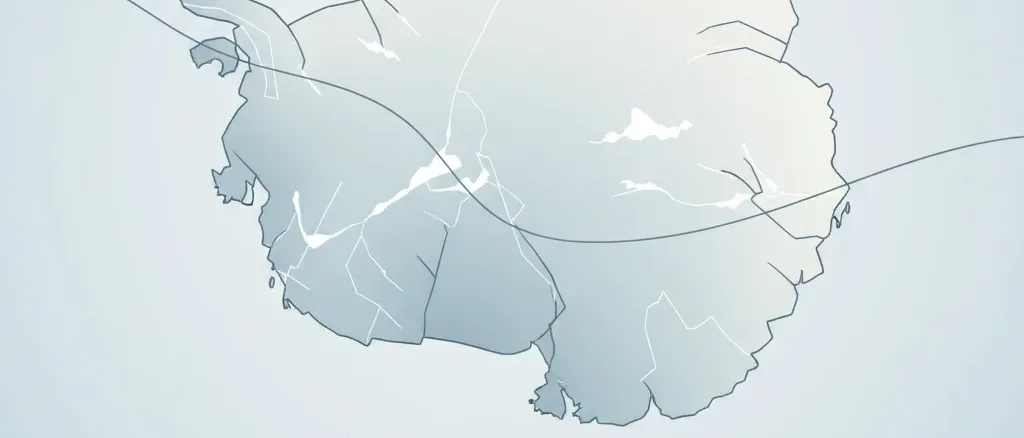
La inestabilidad del manto de hielo de la Antártida Occidental se discute en la literatura científica y en los círculos de política climática, pero aún no ha adquirido una imagen cultural fija como sí lo han hecho las ciudades inundadas o los incendios forestales. La mayoría de quienes han oído hablar de ella saben a grandes rasgos que significaría un aumento sustancial del nivel del mar si colapsara, y que la Antártida se está derritiendo. Lo que no se comprende ampliamente es que la ciencia de los puntos de inflexión distingue entre el cruce de un umbral irreversible (el desencadenante del punto de inflexión) y la expresión plena del aumento del nivel del mar — que podría tardar siglos. Tampoco se comprende ampliamente que, bajo las trayectorias de emisiones actuales, múltiples estudios de modelización independientes asignan probabilidades de desencadenamiento de más del 90 % antes de 2100. El riesgo está sustancialmente subestimado en la conciencia pública, que tiende a enmarcar la pérdida de hielo antártico como un problema lento y lejano en lugar de uno potencialmente comprometido.
Estimación aproximada: ~47,7 % de los adultos estadounidenses declaran tener «miedo» o «mucho miedo» al calentamiento global y al cambio climático en general (Chapman University Survey, Wave 10, 2024) — no existe una encuesta específica sobre el WAIS
Real
>90 % de probabilidad de cruzar el umbral de inflexión del WAIS antes de 2100 (emisiones actuales, SSP2-4.5)
Global — cruzar el punto de inflexión del WAIS es un evento a escala planetaria, no específico de una población
Mostrar cálculo
Wunderling et al. (2025, Earth System Dynamics) modelizaron la probabilidad de desencadenar dieciséis puntos de inflexión climáticos bajo varios escenarios de emisiones, usando un modelo acoplado de elementos de inflexión con parámetros restringidos observacionalmente. Bajo SSP2-4.5 (el escenario más cercano a los compromisos de política global actuales, que proyecta un calentamiento de ~2,6-2,8 °C para 2100), la probabilidad de desencadenamiento del WAIS superó el 90 %. Esta es una probabilidad de desencadenamiento — la probabilidad de que el calentamiento global cruce el umbral de temperatura más allá del cual el retroceso del WAIS se vuelve autosostenido — no la probabilidad de que ocurra un colapso total dentro de una vida humana. El colapso total del WAIS liberaría aproximadamente 3,3-5,3 metros de aumento del nivel del mar, pero en escalas de tiempo de décadas a milenios según el escenario de forzamiento y la dinámica de retroalimentación. El cruce del umbral de inflexión compromete al mundo a ese resultado eventual, pero la mayor parte del aumento del nivel del mar ocurriría mucho más allá de la vida del adulto de referencia. Armstrong McKay et al. (2022, Science) estimaron el umbral central en ~1,5 °C por encima de los niveles preindustriales, con un rango de 1-3 °C — un nivel que las trayectorias actuales sugieren que podría superarse en la década de 2030. El IPCC AR6 WG1 (2021) usa un relato de «baja probabilidad, alto impacto» para procesos que aportan más de 1 metro de aumento adicional del nivel del mar antes de 2100 por la inestabilidad del manto de hielo, al tiempo que reconoce una «incertidumbre profunda» sobre el momento. El rango de incertidumbre (30-99 %) capta el amplio abanico desde escenarios de mitigación agresiva (SSP1-1.9, donde la probabilidad de desencadenamiento es menor pero aún sustancial) hasta las trayectorias sin cambios.
Advertencias: La cifra de >90 % es una probabilidad de desencadenamiento de un punto de inflex…
La cifra de >90 % es una probabilidad de desencadenamiento de un punto de inflexión bajo las emisiones actuales (SSP2-4.5), no una probabilidad de colapso total del WAIS ni de que el aumento del nivel del mar alcance niveles catastróficos dentro de una vida humana. El colapso total del WAIS tardaría de décadas a milenios después de que se cruce el umbral de inflexión — las consecuencias sobre el nivel del mar se despliegan mucho más allá de la vida del adulto de referencia en la mayoría de los escenarios. El umbral central de ~1,5 °C (Armstrong McKay 2022) puede que ya se haya superado transitoriamente: la temperatura media global superó brevemente 1,5 °C por encima de la preindustrial en 2023-2024, aunque la métrica relevante para el WAIS es el promedio multidecadal sostenido y no el pico de anomalía anual. El enfoque más cauteloso del IPCC AR6 difiere de la probabilidad de desencadenamiento de >90 % de Wunderling 2025 porque las dos evaluaciones miden cosas distintas: el IPCC excluye explícitamente el inicio abrupto de la inestabilidad del manto de hielo marino de sus proyecciones de rango probable, tratándolo como un relato de «incertidumbre profunda» / baja-probabilidad-alto-impacto evaluado en modelos CMIP que no simulan la inestabilidad del WAIS; Wunderling modeliza el cruce del umbral que compromete el colapso eventual en un marco de elementos de inflexión. Estas son evaluaciones compatibles y no contradictorias sobre procesos diferentes. La Inestabilidad de Acantilados de Hielo Marino (MICI), un mecanismo que podría acelerar drásticamente la desintegración del WAIS, sigue siendo objeto de debate y está excluido de las proyecciones principales del IPCC.
Riesgos relacionados
Otros riesgos sobre temas similares — para explorar miedos relacionados.
Tormenta solar clase Carrington
¿Cuáles son las probabilidades de que una tormenta solar catastrófica golpee la Tierra?
Colapso de la AMOC
¿Cuáles son las probabilidades de que la AMOC sufra un colapso abrupto antes del fin de tu vida?
Escasez de agua
Cuales son las probabilidades de experimentar escasez grave de agua durante tu vida?

Muerte por cambio climático
¿Cuáles son las probabilidades de morir por los efectos del cambio climático?

Impacto de asteroide
¿Cuáles son las probabilidades de morir por el impacto de un asteroide o cometa?


Muerte por ventisca
¿Cuáles son las probabilidades de morir en una tormenta invernal severa o ventisca?
Elige el contrincante
The West Antarctic Ice Sheet contains enough ice to raise global sea levels by 3.3 to 5.3 metres if fully disgorged into the ocean — an amount sufficient to permanently inundate coastal cities from Miami to Shanghai to Amsterdam. The debate is not whether this would be consequential but whether the process is already irreversibly committed. Wunderling et al. (2025, Earth System Dynamics), using a coupled tipping-element model parameterised from Armstrong McKay et al.’s (2022, Science) threshold synthesis, found that under SSP2-4.5 — the scenario closest to current global policy commitments — the probability of the WAIS crossing its tipping threshold before 2100 exceeded 90%. Armstrong McKay estimated the central threshold at roughly 1.5°C of global warming above pre-industrial levels, within the Paris Agreement’s target range.
The critical distinction is between triggering and completing. When the WAIS tipping point is crossed, global warming has reached a level at which ice retreat becomes self-sustaining: ocean warming beneath the ice shelves melts the underside, the grounding line retreats into deeper water, and the geometry of the ice sheet means retreat accelerates rather than stabilising. But this process unfolds over decades to millennia, not years. Naughten et al. (2023, Nature Climate Change) found that ice-shelf warming in the Amundsen Sea sector is already committed to accelerate at roughly triple the historical rate until at least 2045 regardless of near-term emissions choices — the ocean warming that drives basal melt is locked in by historical emissions. For most people alive today, the sea level consequences lie far beyond their lifetimes even if the threshold is crossed tomorrow. IPCC AR6 frames this as a “low likelihood, high impact” storyline while acknowledging “deep uncertainty.”
The Thwaites Glacier, sometimes called the “Doomsday Glacier,” holds about 65 centimetres of global sea level equivalent and is considered the most vulnerable sector of the WAIS. Satellite altimetry and ocean observations show active basal melting, and the glacier’s “ice shelf” — the floating apron that pins the inland ice — is cracking in ways that some glaciologists believe could accelerate collapse within this century. None of this translates straightforwardly into a personal risk number: the framing here is the probability of a planetary commitment being made in a person’s lifetime, not the probability of dying from it. That probability — on current trajectories — is what makes this entry unusual on this site: the risk is not rare but the consequences are diffuse, slow, and fall predominantly on future generations.
Datos curiosos relacionados
Con las emisiones actuales, los modelos sitúan por encima del 90% la probabilidad de cruzar el umbral crítico de la Antártida Occidental antes de 2100. Ninguna encuesta mide siquiera qué tan probable lo cree el público.
Registro de evidencia
Cada número a continuación es lo que reportó cada fuente, con la cita textual en la que nos basamos y cómo llegamos a nuestra cifra. Haz clic en cualquier enlace para verificarlo directamente.
1/5 fuentes verificadas de forma independiente palabra por palabra frente a la fuente citada
-
[1] Earth System Dynamics — Wunderling, Sakschewski, Rockström, Flores, Hirota, Staal, 2025 — High probability of triggering climate tipping points under current policies modestly amplified by Amazon dieback and permafrost thaw
High probability of triggering climate tipping points under current policies modestly amplified by Amazon dieback and permafrost thaw- Estadística
WAIS triggering probability >90% under SSP2-4.5 (current policy scenario); all sixteen tipping elements analyzed show elevated triggering probabilities under policies as of 2025- Extracto
“"Under SSP2-4.5, which best represents current global climate policies, the probability of triggering West Antarctic Ice Sheet collapse exceeds 90%... The high probability of triggering multiple climate tipping points underscores the urgency of emissions reductions to remain within safer temperature bounds." ”
- Datos de la fuente de
- 2025-05-01
- Accedido
- 2026-05-09 · copia archivada
- Cálculo
- Wunderling et al. 2025 is the primary quantitative source for the >90% headline. SSP2-4.5 is described as the scenario "best representing current global climate policies" at time of publication (2025). The triggering probability means the probability that global temperature crosses the threshold at which WAIS retreat becomes self-sustaining and irreversible on multi-century timescales. The paper uses a coupled tipping-element model incorporating interactions between tipping elements (e.g., Amazon dieback slightly amplifying WAIS triggering probability through global mean temperature). The core result for WAIS is robust to whether or not Amazon and permafrost interactions are included.
- Independencia
- Wunderling et al. use a tipping-element network model parameterised from the Armstrong McKay 2022 threshold estimates, which are themselves derived from paleoclimate evidence and process understanding. This is a different approach from IPCC AR6's process-based climate model ensemble, though both draw on overlapping paleoclimate evidence for threshold estimates.
-
[2] Science — Armstrong McKay, Staal, Abrams, Winkelmann, Sakschewski, Loriani, Fetzer, Cornell, Rockström, Lenton, 2022 — Exceeding 1.5°C global warming could trigger multiple climate tipping points
Exceeding 1.5°C global warming could trigger multiple climate tipping points- Estadística
WAIS central temperature threshold ~1.5°C (range 1-3°C); 'likely' to be triggered above 1.5°C of global warming; full WAIS collapse would raise sea level by more than 3.3 metres over centuries- Extracto
“"The West Antarctic Ice Sheet has a central threshold of approximately 1.5°C of global warming above pre-industrial levels, with a range of 1 to 3°C... Above 1.5°C, the WAIS becomes 'likely' to cross its tipping threshold, committing to eventual collapse over decades to millennia and a sea level contribution of 3.3-5.3 metres." ”
- Datos de la fuente de
- 2022-09-09
- Accedido
- 2026-05-09 · copia archivada
- Cálculo
- Armstrong McKay et al. 2022 is the most comprehensive recent revision of climate tipping point thresholds, synthesising paleoclimate evidence and process understanding for sixteen tipping elements. The WAIS threshold lowering from the previous Lenton 2008 estimate of ~3-5°C to ~1.5°C was significant: it places the threshold within the Paris Agreement target range, meaning that even the most ambitious emissions reduction targets do not guarantee avoiding WAIS commitment to collapse. The 1-3°C range captures deep uncertainty in the threshold itself.
- Independencia
- Armstrong McKay et al. synthesise paleoclimate and process evidence using a different methodology than Wunderling et al.'s probabilistic network model. Both reach compatible conclusions about WAIS proximity to its threshold under current conditions.
-
[3] Nature Climate Change — Naughten et al., 2023 — Unavoidable future increase in West Antarctic ice-shelf melting over the twenty-first century
Unavoidable future increase in West Antarctic ice-shelf melting over the twenty-first century- Estadística
All four tested emissions scenarios produce similar accelerated Amundsen Sea warming until at least 2045; ice-shelf warming projected at ~triple the historical rate regardless of near-term mitigation- Extracto
“"These results suggest that mitigation of greenhouse gases now has limited power to prevent ocean warming that could lead to the collapse of the West Antarctic Ice Sheet... Under all scenarios, the Amundsen Sea is committed to accelerated warming at approximately triple the historical rate until at least 2045." ”
- Datos de la fuente de
- 2023-10-23
- Accedido
- 2026-05-09 · copia archivada
- Cálculo
- Naughten et al. 2023 focuses on ocean warming beneath WAIS ice shelves in the Amundsen Sea sector — the primary driver of ice shelf basal melt and the mechanism by which warming triggers WAIS instability. The finding that all emissions scenarios produce similar warming until 2045 is significant: near-term mitigation cannot prevent the accelerated melting already committed by historical emissions. This does not mean full collapse is committed, only that the process driving it is locked in for at least two decades. The paper's single-model design limits certainty, but it uses a high-resolution ocean model specifically designed for Amundsen Sea dynamics.
- Independencia
- Naughten et al. use an ocean model focused on the Amundsen Sea specifically, rather than the global climate models used by Wunderling 2025 and Armstrong McKay 2022. The result addresses ice-shelf basal melt rates rather than full tipping point probability, providing a physically independent mechanism-level corroboration.
-
[4] Intergovernmental Panel on Climate Change (IPCC), Working Group I, Sixth Assessment Report — Climate Change 2021: The Physical Science Basis — Chapter 9: Ocean, Cryosphere and Sea Level Change
Climate Change 2021: The Physical Science Basis — Chapter 9: Ocean, Cryosphere and Sea Level ChangeSee all 2 Likelier entries citing this source →
- Estadística
Antarctic Ice Sheet 'likely' to keep losing mass all century; MISI/MICI excluded from likely-range projections as 'deep uncertainty'; 'low likelihood, high impact' storyline for >1m additional SLR from these instability processes by 2100- Extracto
“"Both the Greenland Ice Sheet (virtually certain) and the Antarctic Ice Sheet (likely) will continue to lose mass throughout this century under all considered SSP scenarios... Under high-emissions scenarios, poorly understood processes related to marine ice sheet instability and marine ice cliff instability, characterized by deep uncertainty, have the potential to strongly increase Antarctic mass loss on century to multi-century time scales... These likely range projections do not include those ice-sheet-related processes that are characterized by deep uncertainty... In a low-likelihood, high-impact storyline, under high emissions such processes could in combination contribute more than one additional metre of sea level rise by 2100." ”
- Datos de la fuente de
- 2021-08-09
- Accedido
- 2026-05-09 · copia archivada
- Cálculo
- IPCC AR6 does not assign a numerical probability to WAIS collapse before 2100. Instead it explicitly excludes the abrupt, widespread onset of marine ice sheet instability (MISI) and marine ice cliff instability (MICI) from its likely-range projections because those processes are "characterized by deep uncertainty arising from limited process understanding." It does assess that the Antarctic Ice Sheet is likely to keep losing mass throughout this century, and treats a >1 m additional sea-level-rise contribution from these instability processes by 2100 as a low-likelihood, high-impact storyline under high emissions. The Bamber et al. 2019 structured expert judgment cited by AR6 gave WAIS sea level contribution by 2100 as median 8-18 cm with 95th percentile up to 44-93 cm depending on warming scenario — reflecting deep uncertainty but not ruling out large contributions. IPCC AR6's position is more cautious than Wunderling 2025 because it relies on CMIP model ensembles that do not simulate WAIS collapse, rather than the tipping-point network models used by Wunderling.
-
[5] Columbia Climate School — State of the Planet — Crucial Antarctic Glacier Likely to Collapse Much Earlier than Expected Verificado
Crucial Antarctic Glacier Likely to Collapse Much Earlier than Expected- Estadística
Thwaites Glacier alone holds approximately 65 centimetres of global sea-level-rise equivalent if it melted entirely; identified as the most vulnerable, structurally unstable sector of the West Antarctic Ice Sheet.- Extracto
“"If the entire glacier were to melt then global sea levels would rise by 65 centimeters, or about two feet." ”
- Datos de la fuente de
- 2021-12-17
- Accedido
- 2026-07-03 · copia archivada
- Verificación
- Extracto recuperado de forma independiente y confirmado palabra por palabra frente a la fuente citada durante nuestra auditoría de fundamentación.
- Cálculo
- Supplies the Thwaites-specific sea-level-equivalent figure used in the body prose (65 cm). This is a subset of, and consistent with, the 3.3-5.3 m full-WAIS collapse range from Armstrong McKay et al. 2022 (source above) — Thwaites is one glacier within the broader ice sheet. It does not alter the entry's headline >90% tipping-threshold probability, which remains sourced from Wunderling et al. 2025; this source is used only to ground the Thwaites ice-volume detail mentioned in the body text.
- Independencia
- Science journalism from a university climate research center, reporting on glaciological modelling distinct from the tipping-point probability studies (Wunderling 2025, Armstrong McKay 2022) and the ocean-forcing study (Naughten 2023) cited above; used only for the Thwaites-specific ice-volume figure, not for probability estimates.