Calidad de la evidencia 4.25/5
Puntuación de revisión en ocho dimensiones según la rúbrica de calidad . Cada dimensión puntuada de 1 a 5.
- D1 Anclaje en las fuentes
- 4/5
- D2 Autoridad de las fuentes
- 5/5
- D3 Aritmética
- 4/5
- D4 Incertidumbre
- 4/5
- D5 Alcance
- 4/5
- D6 Prosa
- 4/5
- D7 Honestidad sobre la percepción
- 4/5
- D8 Completitud de las advertencias
- 5/5
● tus factores — haz clic en este riesgo ▾ para revelar
- Tus factores
≈ Tan probable como
Percibido
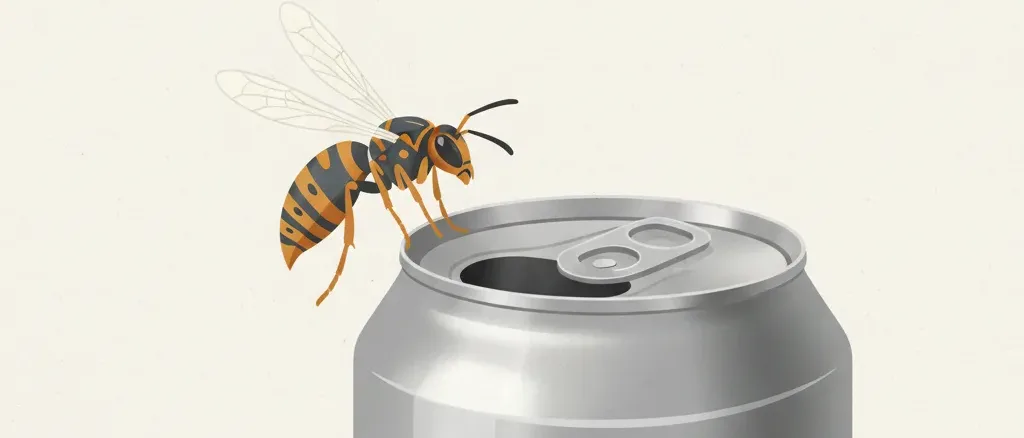
El escenario de la «abeja en la lata de refresco» es una de las historias de peligros al aire libre más vívidas y difundidas. Las redes sociales amplifican los ocasionales informes de casos de personas que tragaron un insecto, sintieron una picadura en la garganta y necesitaron tratamiento de urgencia, lo que infla considerablemente la frecuencia percibida en relación con la tasa real. La mayoría de quienes han pasado veranos bebiendo al aire libre sobreestiman con qué frecuencia esto acaba mal.
Estimación aproximada: la mayoría de los bebedores al aire libre suponen que esto le ocurre varias veces al año a alguien que conocen vagamente
Fuente: intuición editorial, sin encuesta
Real
~195 visitas de urgencias estimadas al año por picadura orofaríngea (boca/garganta), Estados Unidos
población total de EE. UU.
Mostrar cálculo
Huff, Phillips y Keith (Wilderness & Environmental Medicine, 2025) utilizaron datos del NEISS (2004-2023) y estimaron directamente que entre 2004 y 2023 hubo aproximadamente 3890 (IC del 95 %, 2458,55-5320,79) personas con picaduras orofaríngeas (boca y garganta) de abejas, avispones, avispas chaqueta amarilla o avispas que acudieron a servicios de urgencias de EE. UU.: aproximadamente 195 al año a lo largo de la ventana de 20 años. Probabilidad anual: 195 / 335.000.000 ≈ 5,8 × 10^-7. Acumulada a lo largo de 59 años de vida adulta restante: 1 - (1 - 5,8e-7)^59 ≈ 3,4 × 10^-5 ≈ 1 de cada 29.000. La banda de incertidumbre traslada el propio IC del 95 % del estudio a través de la misma acumulación vitalicia (2458,55-5320,79 en 20 años → ~123-266/año). La «picadura orofaríngea» es más amplia que el escenario específico de beber de una lata/botella, pero el estudio del NEISS es la única fuente de vigilancia de EE. UU. que cuantifica directamente esta vía.
Advertencias: El mecanismo aquí no es un atragantamiento mecánico: las abejas y avispas son de…
El mecanismo aquí no es un atragantamiento mecánico: las abejas y avispas son demasiado pequeñas para obstruir las vías respiratorias como objeto físico. El peligro es la propia picadura: dentro de la boca o la garganta causa un edema inflamatorio localizado que puede estrechar las vías respiratorias incluso en personas no alérgicas, y en quienes tienen alergia al veneno puede desencadenar una anafilaxia sistémica completa. La cifra de ~195/año es la propia estimación nacional del estudio del NEISS de 2025 de las presentaciones en urgencias por picadura orofaríngea (~3.890 durante 2004-2023); no es un recuento directo de «insecto tragado al beber» y puede incluir otras vías de picadura oral (p. ej., al comer). Las muertes por insectos específicamente tragados no se registran por separado.
Riesgos relacionados
Otros riesgos sobre temas similares — para explorar miedos relacionados.

Picadura de abeja
¿Cuáles son las probabilidades de morir por la picadura de una abeja, avispa u avispón?

Anafilaxia por picadura
¿Cuáles son las probabilidades de que una picadura de abeja o avispa provoque un shock anafiláctico que requiera una inyección de epinefrina?
Muerte de perro por chocolate
¿Cuáles son las probabilidades de que un perro muera por comer chocolate?
Picadura mortal de escorpión
¿Cuáles son las probabilidades de morir por la picadura de un escorpión?

Picadura fatal de abeja/avispa
¿Cuáles son las probabilidades de morir por la picadura de una abeja, avispa o avispón?


Asfixia infantil al comer
¿Cuáles son las probabilidades de que un bebé o niño pequeño muera por asfixia mientras come?

Mordedura de serpiente
¿Cuáles son las probabilidades de ser matado por una serpiente venenosa?
Elige el contrincante
A bee or wasp inside a can or bottle is a genuine, if rare, hazard — and the mechanism is less obvious than most people assume. The danger is not that the insect physically blocks your airway; bees and wasps are small enough to swallow without obstruction. The danger is the sting: delivered inside the mouth, posterior pharynx, or esophagus, it triggers localized inflammatory edema in confined anatomy where even modest swelling can produce stridor, difficulty swallowing, and in severe cases airway compromise — even in people with no prior venom allergy. In those who do have venom allergy (roughly 3% of US adults), an oropharyngeal sting can trigger full systemic anaphylaxis.
A 2025 NEISS analysis by Huff, Phillips, and Keith directly estimated that between 2004 and 2023 approximately 3,890 people presented to US emergency departments with an oropharyngeal (mouth or throat) sting from a bee, hornet, yellow jacket, or wasp — about 195 per year, roughly 5% of all sting ED visits. Spread over 335 million people and 59 remaining adult years, that comes to roughly 1 in 29,000 over a lifetime. The large majority were minor: about 98% of oropharyngeal sting patients were not admitted to the hospital. Deaths from this specific route are not separately tracked in US surveillance; they are absorbed into the ICD-10 X23 “sting” category that averages ~72 per year from all mechanisms combined.
The fear is real but the framing matters: the scenario to worry about is not “the insect itself gets stuck” but “the sting triggers swelling or anaphylaxis in a place the body finds very hard to manage.” Practical risk reduction is simple — check the opening of outdoor cans and bottles before drinking, pour into a clear glass, or use a cup with a lid. These are low-friction habits that effectively eliminate the exposure route without any change to outdoor behavior otherwise.
Datos curiosos relacionados
Las picaduras en boca y garganta, a menudo por tragar un insecto con comida o bebida, llevan a unas 11,000 personas al año a urgencias en EE. UU. Las probabilidades a lo largo de la vida son de cerca de 1 in 500.
Registro de evidencia
Cada número a continuación es lo que reportó cada fuente, con la cita textual en la que nos basamos y cómo llegamos a nuestra cifra. Haz clic en cualquier enlace para verificarlo directamente.
4/4 fuentes verificadas de forma independiente palabra por palabra frente a la fuente citada
-
[1] Wilderness & Environmental Medicine (Huff, Phillips, Keith) — Oropharyngeal Bee, Hornet, Yellow Jacket, and Wasp Stings: A National Electronic Injury Surveillance System Analysis and Scoping Review Verificado
Oropharyngeal Bee, Hornet, Yellow Jacket, and Wasp Stings: A National Electronic Injury Surveillance System Analysis and Scoping Review- Estadística
An estimated 3890 (95% CI, 2458.55–5320.79) oropharyngeal sting ED presentations in the US over 2004–2023 (~195/year); oropharyngeal stings were ~5.08% of all stings; 98.08% of oropharyngeal sting victims were not admitted- Extracto
“"Between 2004 and 2023, there were an estimated 3890 (95% CI, 2458.55–5320.79) people with oropharyngeal stings from bees, hornets, yellow jackets, or wasps in the United States who presented to emergency departments." "Stings to the oropharyngeal region represented an estimated 5.08% (95% CI, 3.59–6.56) of all stings." "Overall, 98.08% (95% CI, 94.25–100.00) of victims of oropharyngeal stings were not admitted to the hospital." ”
- Datos de la fuente de
- 2025-03-01
- Accedido
- 2026-05-04 · copia archivada
- Verificación
- Extracto recuperado de forma independiente y confirmado palabra por palabra frente a la fuente citada durante nuestra auditoría de fundamentación.
- Cálculo
- Used for the direct national estimate: ~3890 oropharyngeal sting ED presentations over 2004–2023 = ~195/year. Annual probability 195/335,000,000 ≈ 5.8e-7; compounded over 59 years ≈ 3.4e-5 ≈ 1 in 29,000. The 95% CI (2458.55–5320.79 over 20 years) is carried through the same compounding for the uncertainty band. The ~1.92% hospitalization sub-fraction (98.08% not admitted) is a severity anchor.
- Independencia
- Based on NEISS (National Electronic Injury Surveillance System) consumer product injury data, methodologically independent of NCHS death-certificate mortality counts.
-
[2] Frontiers in Veterinary Science (Marinho & Soto-Blanco) — Toxicological Risk Assessment of the Accidental Ingestion of a Honeybee (Apis mellifera L.) Present in Food Verificado
Toxicological Risk Assessment of the Accidental Ingestion of a Honeybee (Apis mellifera L.) Present in Food- Estadística
The actual number of accidental honeybee ingestion incidents remains unknown; though a rare condition, ingestion may induce an allergic reaction in sensitive individuals- Extracto
“A number of anecdotal reports of accidental ingestion of insects are largely available, but the actual number remains unknown. Thus, although it is a rare condition, there is the risk that the ingestion of a honeybee may induce an allergic reaction to some venom components in sensitive individuals. ”
- Datos de la fuente de
- 2020-10-01
- Accedido
- 2026-05-04 · copia archivada
- Verificación
- Extracto recuperado de forma independiente y confirmado palabra por palabra frente a la fuente citada durante nuestra auditoría de fundamentación.
- Cálculo
- Supports the surveillance gap: the peer-reviewed toxicological assessment states that the actual number of accidental ingestion incidents remains unknown (reports are anecdotal). Used to justify the wide uncertainty band and to establish that the Huff 2025 oropharyngeal fraction is the best available approximation. Note: this source addresses honeybees only and does not itself quantify deaths or ER visits.
- Independencia
- Toxicological review drawing on venom-composition and clinical toxicology literature, independent of NEISS and NCHS data streams.
-
[3] American Family Physician (Golden DB) — Stinging Insect Allergy Verificado
Stinging Insect AllergySee all 2 Likelier entries citing this source →
- Estadística
Systemic allergic reactions to insect stings are estimated to occur in about 3% of US adults (and about 1% of children)- Extracto
“"Systemic allergic reactions to insect stings are estimated to occur in about 1 percent of children and 3 percent of adults." ”
- Datos de la fuente de
- 2003-06-15
- Accedido
- 2026-07-03 · copia archivada
- Verificación
- Extracto recuperado de forma independiente y confirmado palabra por palabra frente a la fuente citada durante nuestra auditoría de fundamentación.
- Cálculo
- Supports the body-prose reference to venom-allergy prevalence (~3% of US adults) used as context for anaphylaxis risk from an oropharyngeal sting. Not used in the native/normalized probability calculation, which is based on the Huff 2025 NEISS oropharyngeal-fraction analysis.
- Independencia
- Independent clinical epidemiology review (American Family Physician), methodologically distinct from the NEISS-based Huff 2025 analysis and the honeybee-ingestion toxicological review.
-
[4] Centers for Disease Control and Prevention — Morbidity and Mortality Weekly Report — QuickStats: Number of Deaths from Hornet, Wasp, and Bee Stings Among Males and Females — National Vital Statistics System, United States, 2011-2021 Verificado
QuickStats: Number of Deaths from Hornet, Wasp, and Bee Stings Among Males and Females — National Vital Statistics System, United States, 2011-2021- Estadística
788 total US deaths from hornet, wasp, and bee stings during 2011-2021, an average of 72 deaths per year; classified under ICD-10 code X23- Extracto
“"During 2011-2021, a total of 788 deaths from hornet, wasp, and bee stings occurred (an average of 72 deaths per year). [...] Deaths from hornet, wasp, and bee sting as underlying cause of death were coded as X23, according to the International Classification of Diseases, Tenth Revision." ”
- Datos de la fuente de
- 2023-07-07
- Accedido
- 2026-07-03 · copia archivada
- Verificación
- Extracto recuperado de forma independiente y confirmado palabra por palabra frente a la fuente citada durante nuestra auditoría de fundamentación.
- Cálculo
- Supports the body-prose reference to overall Hymenoptera sting deaths (~72/year, ICD-10 X23) used as a severity anchor and to explain why deaths from the specific swallowed-insect/oropharyngeal route are not separately tracked in US surveillance. Not used in the native/normalized oropharyngeal-ED-visit calculation.
- Independencia
- NCHS death-certificate mortality data (National Vital Statistics System), methodologically independent of the NEISS-based Huff 2025 ED-visit analysis.