Qualité des preuves 4.25/5
Score d’évaluation en huit dimensions selon la grille de qualité . Chaque dimension notée de 1 à 5.
- D1 Ancrage des sources
- 4/5
- D2 Autorité des sources
- 5/5
- D3 Arithmétique
- 4/5
- D4 Incertitude
- 4/5
- D5 Portée
- 4/5
- D6 Prose
- 4/5
- D7 Honnêteté sur la perception
- 4/5
- D8 Complétude des réserves
- 5/5
● vos facteurs — cliquez sur ce risque ▾ pour révéler
- Vos facteurs
≈ Aussi probable que
Perçu
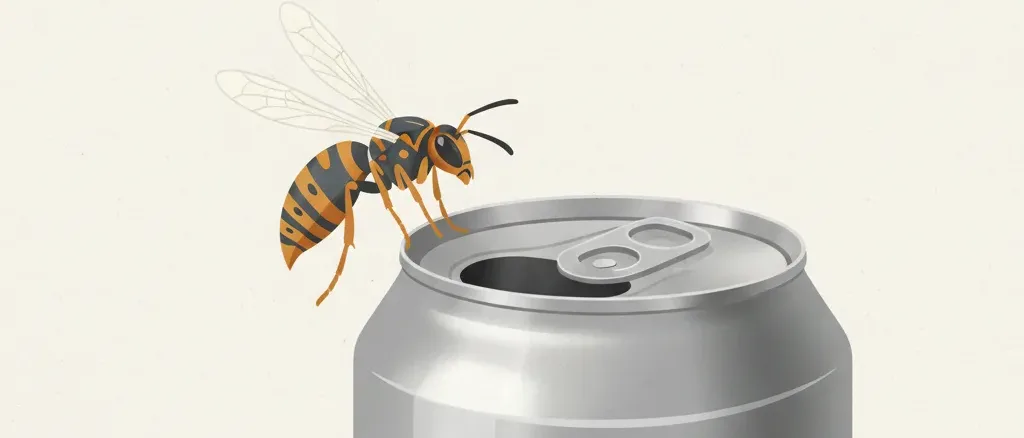
Le scénario de « l'abeille dans la canette de soda » est l'une des histoires de danger en plein air les plus frappantes et les plus répandues. Les réseaux sociaux amplifient les récits occasionnels de personnes ayant avalé un insecte, ressenti une piqûre dans la gorge et nécessité un traitement d'urgence, ce qui gonfle considérablement la fréquence perçue par rapport au taux réel. La plupart des gens qui ont passé des étés à boire en plein air surestiment la fréquence à laquelle cela tourne mal.
Estimation approximative : la plupart de ceux qui boivent en plein air supposent que cela arrive plusieurs fois par an à quelqu'un qu'ils connaissent vaguement
Source : intuition éditoriale, sans sondage
Réel
~195 visites aux urgences estimées pour piqûre oropharyngée (bouche/gorge) par an, États-Unis
population totale des États-Unis
Voir le calcul
Huff, Phillips et Keith (Wilderness & Environmental Medicine, 2025) ont utilisé les données NEISS (2004–2023) et ont directement estimé qu'entre 2004 et 2023, environ 3 890 (IC à 95 %, 2 458,55–5 320,79) personnes présentant des piqûres oropharyngées (bouche et gorge) d'abeilles, de frelons, de guêpes jaunes ou de guêpes se sont présentées aux urgences américaines — soit environ 195 par an sur la fenêtre de 20 ans. Probabilité annuelle : 195 / 335 000 000 ≈ 5,8 × 10^-7. Cumulée sur 59 ans de vie adulte restante : 1 - (1 - 5,8e-7)^59 ≈ 3,4 × 10^-5 ≈ 1 sur 29 000. La fourchette d'incertitude reporte l'IC à 95 % propre à l'étude à travers le même cumul sur la vie (2 458,55–5 320,79 sur 20 ans → ~123–266/an). « Piqûre oropharyngée » est plus large que le scénario spécifique de la boisson en canette/bouteille, mais l'étude NEISS est la seule source de surveillance américaine à quantifier directement cette voie.
Réserves : Le mécanisme ici n'est pas un étouffement mécanique — les abeilles et les guêpes…
Le mécanisme ici n'est pas un étouffement mécanique — les abeilles et les guêpes sont trop petites pour obstruer les voies respiratoires en tant qu'objet physique. Le danger est la piqûre elle-même : à l'intérieur de la bouche ou de la gorge, elle provoque un œdème inflammatoire localisé qui peut rétrécir les voies respiratoires même chez des personnes non allergiques, et chez celles allergiques au venin, elle peut déclencher une anaphylaxie systémique complète. Le chiffre de ~195/an est l'estimation nationale propre à l'étude NEISS de 2025 des présentations aux urgences pour piqûre oropharyngée (~3 890 sur 2004–2023) ; ce n'est pas un décompte direct d'« insecte avalé en buvant » et il peut inclure d'autres voies de piqûre orale (par exemple en mangeant). Les décès dus spécifiquement à des insectes avalés ne sont pas suivis séparément.
Risques connexes
D'autres risques sur des thèmes similaires — pour explorer des peurs connexes.

Piqûre d'abeille
Quelles sont les probabilités d'être tué par une piqûre d'abeille, de guêpe ou de frelon ?

Anaphylaxie après piqûre
Quelles sont les chances qu'une piqûre d'abeille ou de guêpe déclenche un choc anaphylactique nécessitant une injection d'adrénaline ?

Piqûre d'abeille/guêpe fatale
Quelles sont les chances de mourir d'une piqûre d'abeille, de guêpe ou de frelon ?


Étouffement du tout-petit
Quelles sont les probabilités qu'un nourrisson ou tout-petit s'étouffe mortellement en mangeant ?

Choisir le comparé
A bee or wasp inside a can or bottle is a genuine, if rare, hazard — and the mechanism is less obvious than most people assume. The danger is not that the insect physically blocks your airway; bees and wasps are small enough to swallow without obstruction. The danger is the sting: delivered inside the mouth, posterior pharynx, or esophagus, it triggers localized inflammatory edema in confined anatomy where even modest swelling can produce stridor, difficulty swallowing, and in severe cases airway compromise — even in people with no prior venom allergy. In those who do have venom allergy (roughly 3% of US adults), an oropharyngeal sting can trigger full systemic anaphylaxis.
A 2025 NEISS analysis by Huff, Phillips, and Keith directly estimated that between 2004 and 2023 approximately 3,890 people presented to US emergency departments with an oropharyngeal (mouth or throat) sting from a bee, hornet, yellow jacket, or wasp — about 195 per year, roughly 5% of all sting ED visits. Spread over 335 million people and 59 remaining adult years, that comes to roughly 1 in 29,000 over a lifetime. The large majority were minor: about 98% of oropharyngeal sting patients were not admitted to the hospital. Deaths from this specific route are not separately tracked in US surveillance; they are absorbed into the ICD-10 X23 “sting” category that averages ~72 per year from all mechanisms combined.
The fear is real but the framing matters: the scenario to worry about is not “the insect itself gets stuck” but “the sting triggers swelling or anaphylaxis in a place the body finds very hard to manage.” Practical risk reduction is simple — check the opening of outdoor cans and bottles before drinking, pour into a clear glass, or use a cup with a lid. These are low-friction habits that effectively eliminate the exposure route without any change to outdoor behavior otherwise.
Pour aller plus loin
Les piqûres dans la bouche et la gorge, souvent dues à un insecte avalé avec un aliment ou une boisson, envoient environ 11,000 personnes par an aux urgences aux États-Unis. Le risque sur une vie est d’environ 1 in 500.
Registre des sources
Chaque chiffre ci-dessous correspond à ce que la source a rapporté, avec la citation textuelle sur laquelle nous nous sommes appuyés et la méthode de calcul. Cliquez sur un lien pour vérifier directement.
4/4 sources vérifiées de manière indépendante, mot pour mot, par rapport à la source citée
-
[1] Wilderness & Environmental Medicine (Huff, Phillips, Keith) — Oropharyngeal Bee, Hornet, Yellow Jacket, and Wasp Stings: A National Electronic Injury Surveillance System Analysis and Scoping Review Vérifié
Oropharyngeal Bee, Hornet, Yellow Jacket, and Wasp Stings: A National Electronic Injury Surveillance System Analysis and Scoping Review- Statistique
An estimated 3890 (95% CI, 2458.55–5320.79) oropharyngeal sting ED presentations in the US over 2004–2023 (~195/year); oropharyngeal stings were ~5.08% of all stings; 98.08% of oropharyngeal sting victims were not admitted- Extrait
“"Between 2004 and 2023, there were an estimated 3890 (95% CI, 2458.55–5320.79) people with oropharyngeal stings from bees, hornets, yellow jackets, or wasps in the United States who presented to emergency departments." "Stings to the oropharyngeal region represented an estimated 5.08% (95% CI, 3.59–6.56) of all stings." "Overall, 98.08% (95% CI, 94.25–100.00) of victims of oropharyngeal stings were not admitted to the hospital." ”
- Données source de
- 2025-03-01
- Consulté le
- 2026-05-04 · copie archivée
- Vérification
- Extrait récupéré et confirmé de manière indépendante, mot pour mot, par rapport à la source citée lors de notre audit de vérification.
- Calcul
- Used for the direct national estimate: ~3890 oropharyngeal sting ED presentations over 2004–2023 = ~195/year. Annual probability 195/335,000,000 ≈ 5.8e-7; compounded over 59 years ≈ 3.4e-5 ≈ 1 in 29,000. The 95% CI (2458.55–5320.79 over 20 years) is carried through the same compounding for the uncertainty band. The ~1.92% hospitalization sub-fraction (98.08% not admitted) is a severity anchor.
- Indépendance
- Based on NEISS (National Electronic Injury Surveillance System) consumer product injury data, methodologically independent of NCHS death-certificate mortality counts.
-
[2] Frontiers in Veterinary Science (Marinho & Soto-Blanco) — Toxicological Risk Assessment of the Accidental Ingestion of a Honeybee (Apis mellifera L.) Present in Food Vérifié
Toxicological Risk Assessment of the Accidental Ingestion of a Honeybee (Apis mellifera L.) Present in Food- Statistique
The actual number of accidental honeybee ingestion incidents remains unknown; though a rare condition, ingestion may induce an allergic reaction in sensitive individuals- Extrait
“A number of anecdotal reports of accidental ingestion of insects are largely available, but the actual number remains unknown. Thus, although it is a rare condition, there is the risk that the ingestion of a honeybee may induce an allergic reaction to some venom components in sensitive individuals. ”
- Données source de
- 2020-10-01
- Consulté le
- 2026-05-04 · copie archivée
- Vérification
- Extrait récupéré et confirmé de manière indépendante, mot pour mot, par rapport à la source citée lors de notre audit de vérification.
- Calcul
- Supports the surveillance gap: the peer-reviewed toxicological assessment states that the actual number of accidental ingestion incidents remains unknown (reports are anecdotal). Used to justify the wide uncertainty band and to establish that the Huff 2025 oropharyngeal fraction is the best available approximation. Note: this source addresses honeybees only and does not itself quantify deaths or ER visits.
- Indépendance
- Toxicological review drawing on venom-composition and clinical toxicology literature, independent of NEISS and NCHS data streams.
-
[3] American Family Physician (Golden DB) — Stinging Insect Allergy Vérifié
Stinging Insect AllergySee all 2 Likelier entries citing this source →
- Statistique
Systemic allergic reactions to insect stings are estimated to occur in about 3% of US adults (and about 1% of children)- Extrait
“"Systemic allergic reactions to insect stings are estimated to occur in about 1 percent of children and 3 percent of adults." ”
- Données source de
- 2003-06-15
- Consulté le
- 2026-07-03 · copie archivée
- Vérification
- Extrait récupéré et confirmé de manière indépendante, mot pour mot, par rapport à la source citée lors de notre audit de vérification.
- Calcul
- Supports the body-prose reference to venom-allergy prevalence (~3% of US adults) used as context for anaphylaxis risk from an oropharyngeal sting. Not used in the native/normalized probability calculation, which is based on the Huff 2025 NEISS oropharyngeal-fraction analysis.
- Indépendance
- Independent clinical epidemiology review (American Family Physician), methodologically distinct from the NEISS-based Huff 2025 analysis and the honeybee-ingestion toxicological review.
-
[4] Centers for Disease Control and Prevention — Morbidity and Mortality Weekly Report — QuickStats: Number of Deaths from Hornet, Wasp, and Bee Stings Among Males and Females — National Vital Statistics System, United States, 2011-2021 Vérifié
QuickStats: Number of Deaths from Hornet, Wasp, and Bee Stings Among Males and Females — National Vital Statistics System, United States, 2011-2021- Statistique
788 total US deaths from hornet, wasp, and bee stings during 2011-2021, an average of 72 deaths per year; classified under ICD-10 code X23- Extrait
“"During 2011-2021, a total of 788 deaths from hornet, wasp, and bee stings occurred (an average of 72 deaths per year). [...] Deaths from hornet, wasp, and bee sting as underlying cause of death were coded as X23, according to the International Classification of Diseases, Tenth Revision." ”
- Données source de
- 2023-07-07
- Consulté le
- 2026-07-03 · copie archivée
- Vérification
- Extrait récupéré et confirmé de manière indépendante, mot pour mot, par rapport à la source citée lors de notre audit de vérification.
- Calcul
- Supports the body-prose reference to overall Hymenoptera sting deaths (~72/year, ICD-10 X23) used as a severity anchor and to explain why deaths from the specific swallowed-insect/oropharyngeal route are not separately tracked in US surveillance. Not used in the native/normalized oropharyngeal-ED-visit calculation.
- Indépendance
- NCHS death-certificate mortality data (National Vital Statistics System), methodologically independent of the NEISS-based Huff 2025 ED-visit analysis.