Qualidade das evidências 4.75/5
Pontuação de revisão em oito dimensões segundo a grelha de qualidade . Cada dimensão pontuada de 1 a 5.
- D1 Ancoragem nas fontes
- 5/5
- D2 Autoridade das fontes
- 5/5
- D3 Aritmética
- 3/5
- D4 Incerteza
- 5/5
- D5 Âmbito
- 5/5
- D6 Prosa
- 5/5
- D7 Honestidade sobre a perceção
- 5/5
- D8 Completude das ressalvas
- 5/5
≈ Tão provável quanto
Percebido
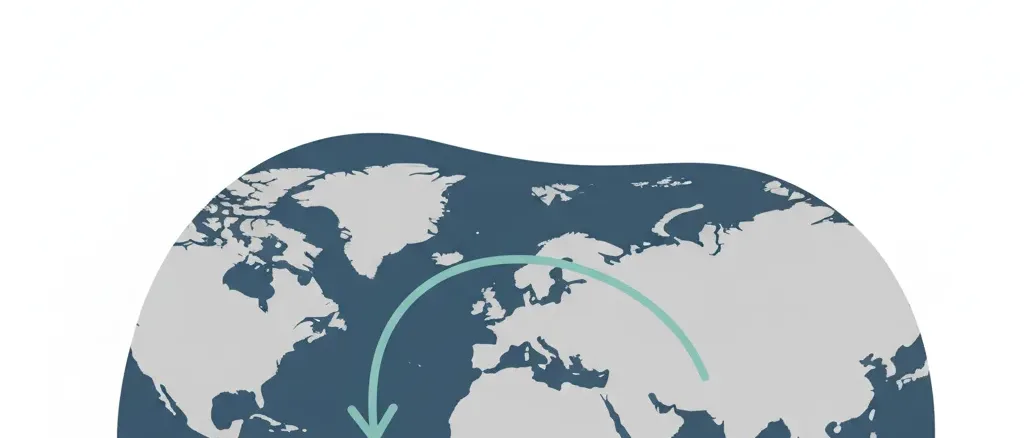
A Circulação de Revolvimento Meridional do Atlântico não é uma expressão do quotidiano, e o seu potencial colapso só recentemente adquiriu visibilidade generalizada. A cobertura popular tende a oscilar entre a desvalorização («os cientistas dizem que a correia transportadora oceânica está a abrandar») e o catastrofismo (manchetes que invocam o filme «O Dia Depois de Amanhã», cuja representação de um congelamento instantâneo era ficção científica). O conceito de pontos de rutura da circulação oceânica entrou numa consciência pública mais ampla após o relatório do IPCC de 2021 e novamente após um contestado artigo de 2023 ter previsto um colapso potencialmente a meio do século. O Survey of American Fears da Universidade Chapman não acompanha especificamente a consciência sobre a AMOC; dados mais amplos sobre ansiedade climática sugerem que cerca de 48 % dos americanos declaram ter medo ou muito medo do aquecimento global e das alterações climáticas (Chapman 2024), mas pontos de rutura específicos como a AMOC não são desagregados. O risco situa-se algures entre ativamente temido e largamente por reconhecer.
Estimativa aproximada: ~47,7 % dos adultos dos EUA declaram ter «medo» ou «muito medo» do aquecimento global e das alterações climáticas em geral (Chapman University Survey, Wave 10, 2024) — não existem dados de inquérito específicos da AMOC
Real
~5 % de probabilidade de colapso abrupto da AMOC antes de 2100 (IPCC «muito improvável» = 0–10 %, SROCC 2019 / AR6 consistente)
População global — o colapso da AMOC é um evento à escala planetária sem probabilidade específica de população
Mostrar cálculo
O IPCC AR6 WG1 (2021) avaliou que a AMOC vai «muito provavelmente» declinar ao longo do século XXI, com «confiança média de que o declínio não envolverá um colapso abrupto antes de 2100». O SPM (B.2.7) do IPCC SROCC (2019) é a avaliação que aplica o termo de probabilidade calibrado «muito improvável (confiança média)» a um colapso da AMOC. Linguagem calibrada do IPCC: «muito improvável» = 0–10 % de probabilidade. Usar 5 % como ponto médio desse intervalo dá o valor de destaque. Trata-se da probabilidade de um evento civilizacional, não de uma probabilidade de morte pessoal: o colapso da AMOC não mataria ninguém instantaneamente, mas desencadearia uma cascata de consequências (quedas da temperatura invernal europeia de 5-15 °C, aceleração da subida do nível do mar na costa leste dos EUA, perturbação da faixa de precipitação tropical) cuja mortalidade indireta ao longo de décadas seria substancial. Estudos baseados em observações produzem estimativas significativamente mais altas: Ditlevsen e Ditlevsen (2023, Nature Communications) derivaram uma data central de colapso de 2057 com IC de 95 % de 2025-2095 a partir de sinais estatísticos de alerta precoce em variáveis indiretas da temperatura da superfície do mar, implicando uma probabilidade >50 % dentro de uma vida adulta de 50 anos. Smolders et al. (2024) estimaram a probabilidade de colapso da AMOC antes de 2050 em 59 ± 17 % usando indicadores de salinidade de base física. Ambas as abordagens são contestadas por motivos metodológicos por vários oceanógrafos seniores, e um estudo de conjunto de 34 modelos de 2025 (Baker et al., Nature) considerou a AMOC resistente ao colapso em todos os cenários de forçamento testados. A ampla banda de incerteza (1–40 %) reflete esta genuína discordância científica, não apenas incerteza estatística em torno de uma distribuição conhecida. Os refinamentos de 2025 (adicionados em 2026-06-14) precisam a questão do CALENDÁRIO sem resolver a probabilidade: van Westen et al. (2025, JGR Oceans) situam o início do colapso perto de 2063 (2026-2095, percentis 25-57) sob SSP2-4.5 com um limiar de rutura perto de ~2,5 °C, enquanto Drijfhout et al. (2025, ERL) concluem que, em extensões do CMIP6, a paragem total do revolvimento setentrional se desenrola após 2100 ao longo de 50-100 anos, mesmo quando comprometida mais cedo. Estes apertam a estimativa central de início e reforçam a distinção início-vs-realização, mas nenhum é uma reavaliação de agência oficial, pelo que o valor de destaque de 5 % ancorado no IPCC e a banda de 1–40 % são mantidos inalterados.
Ressalvas: O valor de destaque de 5 % segue a linguagem calibrada «muito improvável» do IPC…
O valor de destaque de 5 % segue a linguagem calibrada «muito improvável» do IPCC (0–10 % de probabilidade, confiança média) — o termo «muito improvável (confiança média)» para o colapso da AMOC vem do SPM (B.2.7) do IPCC SROCC (2019), tendo o AR6 WG1 (2021) reformulado isto como «confiança média de que o declínio não envolverá um colapso abrupto antes de 2100». O valor de destaque representa a âncora do consenso científico e não a totalidade do intervalo de estimativas publicadas. Estudos baseados em observações (Ditlevsen 2023; Smolders et al. 2024) produzem estimativas substancialmente mais altas — 50–60 % de probabilidade de colapso até meados do século — mas estes métodos são contestados quanto à representatividade das variáveis indiretas, ao comprimento das séries temporais e aos pressupostos dos modelos. O estudo de conjunto de 34 modelos de Baker et al. 2025 defende a resistência da AMOC em todos os cenários testados, apoiando a avaliação «muito improvável» do IPCC. O debate científico está genuinamente por resolver; a banda de incerteza (1–40 %) reflete isto e não apenas incerteza estatística em torno de um parâmetro conhecido. «Colapso» da AMOC nesta entrada significa uma redução abrupta e autossustentada para um estado dramaticamente enfraquecido — não o enfraquecimento gradual (atualmente avaliado como «muito provável») que já está em curso. As consequências do colapso desenrolar-se-iam ao longo de anos a décadas, não de um dia para o outro: as temperaturas invernais europeias poderiam cair 5-15 °C em escalas de tempo de 10-30 anos, o nível do mar na costa leste dos EUA subiria mais 10-50 cm acima das projeções de base, e os padrões de precipitação tropical mudariam substancialmente. O valor ao longo da vida é uma probabilidade de que o evento seja desencadeado, não de que as suas consequências se concretizem plenamente, dentro da vida do adulto de referência. Dois estudos de 2025 precisam o calendário sem mover o valor de destaque. Van Westen et al. (2025, JGR Oceans), analisando 25 modelos climáticos, estimam que o colapso da AMOC poderia começar por volta de 2063 (intervalo 2026-2095) sob um cenário de emissões intermédias e por volta de 2055 sob emissões elevadas, com o limiar de rutura perto de ~2,5 °C de aquecimento global — mas sublinham que, uma vez iniciado, atingir um estado substancialmente mais fraco leva mais de 100 anos. Drijfhout et al. (2025, Environmental Research Letters), examinando simulações do CMIP6 estendidas para além de 2100, concluem que a paragem total do revolvimento profundo setentrional emerge após 2100 em todos os modelos de emissões elevadas (SSP5-8.5) executados até essa data, e em 37 % dos modelos de emissões intermédias até 2300. Estes refinam a estimativa central de início relativamente ao alarme de estudo único de 2023, mas reforçam, em vez de derrubar, o enquadramento acima: um início a meados do século seria um compromisso, não um colapso concluído dentro da vida de um adulto vivo.
Riscos relacionados
Outros riscos sobre temas semelhantes — para explorar medos relacionados.
Ponto de inflexão WAIS
Quais são as chances de o ponto de inflexão do manto de gelo da Antártida Ocidental ser ultrapassado durante a sua vida?

Catástrofe de governo extremista
Quais são as chances de um governo extremista político arruinar catastroficamente seu país?

Morte por mudança climática
Quais são as chances de morrer devido aos efeitos das mudanças climáticas?





Morte por nevasca
Quais são as chances de morrer numa tempestade de inverno severa ou nevasca?
Escolha o comparado
The Atlantic Meridional Overturning Circulation is the vast network of ocean currents that transports warm surface water northward through the Atlantic and returns cold, deep water southward — the system responsible for northwestern Europe’s mild climate relative to its latitude. IPCC AR6 (2021) assessed that AMOC will “very likely” decline over the 21st century, with “medium confidence that the decline will not involve an abrupt collapse before 2100.” The earlier IPCC SROCC (2019) is the assessment that applied the calibrated “very unlikely (medium confidence)” likelihood term to an AMOC collapse — where “very unlikely” denotes a 0-10% probability. Using the midpoint of that calibrated range gives a ~5% lifetime probability of abrupt collapse before 2100. Caesar and colleagues (2018, Nature) documented that AMOC has already weakened by approximately 15% since the mid-twentieth century, using an independent sea-surface temperature fingerprinting approach that is consistent with RAPID array direct measurements begun in 2004.
The scientific debate is unusually polarised. Observation-based early-warning studies (Boers 2021, Nature Climate Change; Ditlevsen 2023, Nature Communications; van Westen 2024, Science Advances) identify statistical and physical signals consistent with AMOC approaching a tipping threshold, with Ditlevsen’s contested analysis predicting collapse most likely between 2025 and 2095. These findings imply a much higher probability than the IPCC consensus — in some estimates, 50-60% before mid-century. The counterargument came in February 2025 from Baker et al. (Nature), whose 34-model ensemble found AMOC resilient to collapse under all tested forcing scenarios, with Southern Ocean wind-driven upwelling sustaining the circulation even under extreme greenhouse gas concentrations. The IPCC’s “very unlikely” assessment rests primarily on this model-ensemble evidence. Both camps are publishing in leading peer-reviewed journals; the discrepancy is not a matter of one side being wrong in an obvious way.
Should AMOC collapse occur, the consequences within the following few decades would be substantial. Van Westen et al.’s consequence modelling projects European winter temperature drops of 5-15°C across northwestern Europe, with London’s average winter temperature falling from roughly 7°C to near 2°C and Oslo’s to well below -10°C. Sea level on the US East Coast would rise by an additional 10-50 cm above baseline sea level rise projections, as the ocean surface that AMOC currently depresses would rebound northward. The Amazon rainforest would face additional drying as tropical rainfall patterns shift. These are not immediate effects but decadal-to-century timescale consequences of a threshold crossing that, if it occurs, would likely be irreversible on any timescale relevant to human planning.
Curiosidades relacionadas
O IPCC AR6 classifica um colapso abrupto da AMOC antes de 2100 como "muito improvável", uma probabilidade de cerca de 5 por cento. Vários estudos baseados em observações defendem que as probabilidades são maiores, e a faixa de incerteza é ampla.
Registro de evidências
Cada número abaixo é o que cada fonte relatou, com a citação literal em que nos baseamos e como chegamos ao nosso valor. Clique em qualquer link para verificar diretamente.
-
[1] Intergovernmental Panel on Climate Change (IPCC), Working Group I, Sixth Assessment Report — Climate Change 2021: The Physical Science Basis — Chapter 9: Ocean, Cryosphere and Sea Level Change
Climate Change 2021: The Physical Science Basis — Chapter 9: Ocean, Cryosphere and Sea Level ChangeSee all 2 Likelier entries citing this source →
- Estatística
AMOC will 'very likely' decline over the 21st century for all SSP scenarios; there is 'medium confidence' that the decline will not involve an abrupt collapse before 2100- Trecho
“"The Atlantic Meridional Overturning Circulation (AMOC) will very likely decline over the 21st century for all SSP scenarios. There is medium confidence that the decline will not involve an abrupt collapse before 2100." ”
- Dados da fonte de
- 2021-08-09
- Acessado
- 2026-05-09 · cópia arquivada
- Cálculo
- AR6 WG1 Ch9 does not itself assign a numerical probability, nor does it use the "very unlikely" likelihood term for AMOC collapse — it states only "medium confidence that the decline will not involve an abrupt collapse before 2100." The "very unlikely (medium confidence)" characterization of an AMOC collapse is the IPCC SROCC (2019) SPM B.2.7 assessment (see the SROCC source below), which AR6 Ch9 is consistent with. Under the IPCC calibrated-language scale "very unlikely" = 0-10% probability; 5% is taken as the midpoint of that SROCC-defined range for the headline. The IPCC does not give a numerical probability; 5% is the author's interpretation of the calibrated-language midpoint. The 59-year adult lifetime window (age 18 to 77) maps roughly onto the "before 2100" horizon.
-
[2] Intergovernmental Panel on Climate Change (IPCC), SROCC 2019 — Special Report on the Ocean and Cryosphere in a Changing Climate — Summary for Policymakers (section B.2.7)
Special Report on the Ocean and Cryosphere in a Changing Climate — Summary for Policymakers (section B.2.7)- Estatística
AMOC is projected to weaken in the 21st century under all RCPs ('very likely'), although a collapse is 'very unlikely' (medium confidence)- Trecho
“"The AMOC is projected to weaken in the 21st century under all RCPs (very likely), although a collapse is very unlikely (medium confidence)." ”
- Dados da fonte de
- 2019-09-25
- Acessado
- 2026-07-11 · cópia arquivada
- Cálculo
- This SROCC SPM statement (B.2.7) is the IPCC assessment that actually applies the "very unlikely (medium confidence)" likelihood term to an AMOC collapse. It is the grounding for the headline: under IPCC calibrated language "very unlikely" = 0-10% probability, and 5% is taken as the midpoint of that range. AR6 WG1 Ch9 (2021) restated this as "medium confidence that the decline will not involve an abrupt collapse before 2100," consistent with SROCC but without repeating the "very unlikely" term. Neither report gives a numerical probability; the 5% midpoint is the author's interpretation of the SROCC-stated calibrated-language range.
-
[3] Nature — Caesar, Rahmstorf et al., 2018 — Observed fingerprint of a weakening Atlantic Ocean overturning circulation
Observed fingerprint of a weakening Atlantic Ocean overturning circulation- Estatística
AMOC has weakened by approximately 3 ± 1 sverdrups (around 15%) since the mid-20th century, revealed by characteristic sea-surface temperature fingerprint- Trecho
“"The AMOC has weakened by about 3 ± 1 sverdrups (around 15 per cent) since the mid-twentieth century, revealed by a characteristic spatial and seasonal sea-surface temperature 'fingerprint' — consisting of a pattern of cooling in the subpolar Atlantic Ocean and warming in the Gulf Stream region." ”
- Dados da fonte de
- 2018-04-11
- Acessado
- 2026-05-09 · cópia arquivada
- Cálculo
- Caesar et al. 2018 is the observational foundation for the AMOC weakening narrative. The 15% weakening since the mid-20th century is separate from the collapse-probability question — weakening and collapse are different states, and the IPCC projects continued weakening with high confidence even while assessing collapse as very unlikely. This source establishes that AMOC is not stable at its current state, providing the background against which collapse probability must be assessed.
- Independência
- Caesar et al. use an independent SST-based fingerprinting approach developed separately from the RAPID array direct measurements (which began in 2004) and from the statistical early-warning methods of Boers 2021 and Ditlevsen 2023. The three methodologies corroborate each other on the weakening trend.
-
[4] Nature Communications — Ditlevsen and Ditlevsen, 2023 — Warning of a forthcoming collapse of the Atlantic meridional overturning circulation
Warning of a forthcoming collapse of the Atlantic meridional overturning circulation- Estatística
Statistical early-warning signals in SST proxies predict central AMOC collapse in 2057 (95% CI: 2025-2095); method is contested by multiple senior oceanographers- Trecho
“"Data-driven estimators for the time of tipping predict a potential AMOC collapse mid-century under the current emission scenario, with a 95% confidence interval of 2025–2095." ”
- Dados da fonte de
- 2023-07-25
- Acessado
- 2026-05-09 · cópia arquivada
- Cálculo
- Ditlevsen 2023 derives its estimate from statistical early-warning signals (variance and autocorrelation growth) in North Atlantic SST proxies interpreted as fingerprints of approaching instability. The method is contested: Prof. Penny Holliday (National Oceanography Centre) stated "sea surface temperature of the North Atlantic subpolar gyre is not a clear indicator of the state of the AMOC"; Prof. Niklas Boers (TU Munich) argued "uncertainties in the heavily oversimplified model assumptions... are too high"; Dr. Levke Caesar (Univ. Bremen) stated "the resulting time series are too short." This source represents the upper bound of the scientific plausibility range and is not the headline figure, but it anchors the upper end of the uncertainty band.
- Independência
- Ditlevsen 2023 is methodologically distinct from the IPCC's model-ensemble approach and from Caesar 2018's SST fingerprinting. It is included to represent the range of scientific opinion rather than as an independent confirmation of any single estimate.
-
[5] Science Advances — van Westen, Kliphuis and Dijkstra, 2024 — Physics-based early warning signal shows that AMOC is on tipping course
Physics-based early warning signal shows that AMOC is on tipping course- Estatística
Freshwater transport indicator (F_ovS) shows significant negative trend over past 40 years, consistent with AMOC approaching tipping point; European temperature drops of 5-15°C projected in collapse scenario- Trecho
“"Reanalysis products indicate that the present-day AMOC is on route to tipping... Temperature trends exceed 1°C per decade across northwestern Europe during collapse." ”
- Dados da fonte de
- 2024-02-09
- Acessado
- 2026-05-09 · cópia arquivada
- Cálculo
- Van Westen 2024 uses a physics-based indicator (minimum of AMOC-induced freshwater transport, F_ovS) rather than statistical proxies. It finds a statistically significant negative trend of -1.20 mSv/year over the past 40 years, consistent with approach to tipping, but explicitly states inability to determine when tipping would occur. The consequence model run shows London's average winter temperature falling to ~1.9°C (from ~7°C today) and Oslo's to -16.5°C. These are consequences of full collapse, not of the current trajectory in isolation.
- Independência
- Van Westen et al. use a different indicator (F_ovS from ocean reanalysis products) than Ditlevsen 2023 (SST statistical signals) or Caesar 2018 (SST fingerprinting), providing genuinely independent physics-based evidence for AMOC approaching instability.
-
[6] Nature — Baker et al. (Met Office and University of Exeter), 2025 — Continued Atlantic overturning circulation even under climate extremes
Continued Atlantic overturning circulation even under climate extremes- Estatística
34-model ensemble finds AMOC resilient to collapse under all tested greenhouse gas and freshwater forcing scenarios; Southern Ocean wind-driven upwelling sustains circulation- Trecho
“"The AMOC is resilient to extreme greenhouse gas and North Atlantic freshwater forcings across 34 climate models." ”
- Dados da fonte de
- 2025-02-19
- Acessado
- 2026-05-09 · cópia arquivada
- Cálculo
- Baker et al. 2025 is the primary model-based counterargument. The 34-model ensemble finds that Southern Ocean upwelling — not captured in the observation-based early-warning studies — sustains AMOC circulation even under extreme forcing. This mechanism explains why most CMIP climate models do not show AMOC collapse this century, which IPCC AR6 uses as the primary basis for its "very unlikely" assessment. Baker 2025 is cited here as a materially important dissenting view that anchors the lower end of the uncertainty range. The discrepancy between the observation-based (Ditlevsen, Boers, van Westen) and model-based (Baker, IPCC) views is the fundamental unresolved debate in AMOC science.
- Independência
- Baker et al. is methodologically opposed to the observation-based early-warning literature — it uses fully coupled climate models rather than statistical signals — and its conclusion directly contradicts the observation-based studies. Both methodologies are active areas of peer-reviewed research; neither has been refuted.
-
[7] Journal of Geophysical Research: Oceans — van Westen, Kliphuis and Dijkstra, 2025 — Physics-Based Indicators for the Onset of an AMOC Collapse Under Climate Change
Physics-Based Indicators for the Onset of an AMOC Collapse Under Climate Change- Estatística
25-model analysis estimates AMOC collapse could begin by 2063 (2026-2095, 25th-57th percentiles) under SSP2-4.5, or by 2055 (2023-2076) under SSP5-8.5; tipping threshold near ~2.5C global warming- Trecho
“"An analysis consisting of 25 different climate models shows that the AMOC could begin to collapse by 2063 (from 2026 to 2095, 25th to 57th percentiles) under an intermediate emission scenario (SSP2-4.5), or by 2055 (from 2023 to 2076, 25th to 75th percentiles) under a high-end emission scenario (SSP5-8.5). When the AMOC collapses, the Northwestern European climate changes drastically and this will likely induce severe societal impacts." ”
- Dados da fonte de
- 2025-08-24
- Acessado
- 2026-06-14 · cópia arquivada
- Cálculo
- Van Westen et al. 2025 (JGR Oceans, Vol 130 Issue 8) develops a buoyancy-flux physics-based indicator for the ONSET of AMOC tipping — the moment the system becomes committed, not the moment a weakened state is reached. The paper's body places the multimodel-mean tipping threshold near ~2.5C of global warming above pre-industrial (the abstract states the onset years; the 2.5C / +2.48C figure is in the results text, paraphrased here, not in the verbatim excerpt). Critically, the paper states that once collapse begins it "takes more than 100 years to reach a substantially weaker state" — so a ~2063 onset under SSP2-4.5 describes a committed trajectory, not consequences realised within a focal adult's lifetime. This refines collapse TIMING relative to the contested 2023 single-study alarm but does not itself yield a numerical lifetime probability, so the 5% headline is unchanged; the result is recorded as a caveat and an assumptions addendum.
- Independência
- Van Westen 2025 (JGR) uses a buoyancy-flux onset indicator across 25 CMIP-class models — distinct from both the SSP-extension shutdown framing of the 2025 ERL CMIP6 study and the F_ovS reanalysis indicator of van Westen 2024 (Science Advances). It sits between the observation-based alarm and the model-based resilience views.