Qualidade das evidências 4.25/5
Pontuação de revisão em oito dimensões segundo a grelha de qualidade . Cada dimensão pontuada de 1 a 5.
- D1 Ancoragem nas fontes
- 4/5
- D2 Autoridade das fontes
- 5/5
- D3 Aritmética
- 4/5
- D4 Incerteza
- 4/5
- D5 Âmbito
- 4/5
- D6 Prosa
- 4/5
- D7 Honestidade sobre a perceção
- 4/5
- D8 Completude das ressalvas
- 5/5
≈ Tão provável quanto
Percebido
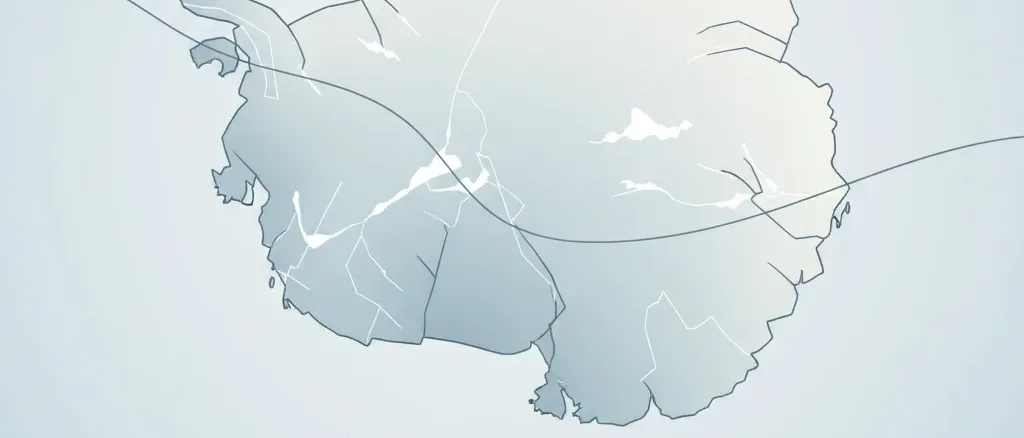
A instabilidade do manto de gelo da Antártida Ocidental é discutida na literatura científica e nos círculos de política climática, mas ainda não adquiriu uma imagem cultural fixa como a das cidades inundadas ou dos incêndios florestais. A maioria das pessoas que ouviu falar dela sabe, grosso modo, que significaria uma subida substancial do nível do mar se colapsasse, e que a Antártida está a derreter. O que não é amplamente compreendido é que a ciência dos pontos de rutura distingue entre a passagem de um limiar irreversível (o gatilho do ponto de rutura) e a plena expressão da subida do nível do mar — que poderia levar séculos. Também não é amplamente compreendido que, nas trajetórias de emissões atuais, vários estudos de modelação independentes atribuem probabilidades de gatilho superiores a 90 % antes de 2100. O risco é substancialmente subestimado na consciência pública, que tende a enquadrar a perda de gelo antártico como um problema lento e distante, em vez de um problema potencialmente comprometido.
Estimativa aproximada: ~47,7 % dos adultos americanos declaram ter «medo» ou «muito medo» do aquecimento global e das alterações climáticas em geral (Chapman University Survey, Wave 10, 2024) — não existe inquérito específico sobre o WAIS
Real
>90 % de probabilidade de ultrapassar o limiar de rutura do WAIS antes de 2100 (emissões atuais, SSP2-4.5)
Global — ultrapassar o ponto de rutura do WAIS é um evento à escala planetária, não específico de uma população
Mostrar cálculo
Wunderling et al. (2025, Earth System Dynamics) modelaram a probabilidade de desencadear dezasseis pontos de rutura climáticos sob vários cenários de emissões, usando um modelo acoplado de elementos de rutura com parâmetros restringidos por observações. Sob o SSP2-4.5 (o cenário mais próximo dos atuais compromissos de política global, projetando um aquecimento de ~2,6-2,8 °C até 2100), a probabilidade de desencadeamento do WAIS excedeu 90 %. Trata-se de uma probabilidade de gatilho — a probabilidade de o aquecimento global ultrapassar o limiar de temperatura para além do qual o recuo do WAIS se torna autossustentado — e não a probabilidade de um colapso total ocorrer durante uma vida humana. O colapso total do WAIS libertaria aproximadamente 3,3-5,3 metros de subida do nível do mar, mas ao longo de escalas de tempo de décadas a milénios, consoante o cenário de forçamento e a dinâmica de retroação. A passagem do limiar de rutura compromete o mundo com esse resultado eventual, mas a maior parte da subida do nível do mar ocorreria muito para além da vida do adulto em foco. Armstrong McKay et al. (2022, Science) estimaram o limiar central em ~1,5 °C acima do nível pré-industrial, com um intervalo de 1-3 °C — um nível que as trajetórias atuais sugerem poder ser ultrapassado na década de 2030. O IPCC AR6 WG1 (2021) usa um enredo de «baixa probabilidade, elevado impacto» para processos que contribuem com mais de 1 metro de subida adicional do nível do mar antes de 2100 devido à instabilidade dos mantos de gelo, reconhecendo simultaneamente uma «profunda incerteza» quanto ao momento. O intervalo de incerteza (30-99 %) capta a ampla gama que vai desde cenários de mitigação agressiva (SSP1-1.9, em que a probabilidade de gatilho é menor, mas ainda substancial) até às trajetórias de manutenção do status quo.
Ressalvas: O valor de >90 % é uma probabilidade de gatilho do ponto de rutura sob as emissõ…
O valor de >90 % é uma probabilidade de gatilho do ponto de rutura sob as emissões atuais (SSP2-4.5), não uma probabilidade de colapso total do WAIS ou de a subida do nível do mar atingir níveis catastróficos durante uma vida humana. O colapso total do WAIS levaria décadas a milénios depois de ultrapassado o limiar de rutura — as consequências para o nível do mar desenrolam-se muito para além da vida do adulto em foco na maioria dos cenários. O limiar central de ~1,5 °C (Armstrong McKay 2022) pode já ter sido ultrapassado transitoriamente: a temperatura média global excedeu brevemente 1,5 °C acima do nível pré-industrial em 2023-2024, embora a métrica relevante para o WAIS seja a média multidecadal sustentada e não o pico anual da anomalia. O enquadramento mais cauteloso do IPCC AR6 difere da probabilidade de gatilho de >90 % de Wunderling 2025 porque as duas avaliações medem coisas diferentes: o IPCC exclui explicitamente o início abrupto da instabilidade do manto de gelo marinho das suas projeções de intervalo provável, tratando-a como um enredo de «profunda incerteza» / baixa probabilidade e elevado impacto avaliado em modelos CMIP que não simulam a instabilidade do WAIS; Wunderling modela a passagem do limiar que compromete o colapso eventual num quadro de elementos de rutura. São avaliações compatíveis, e não contraditórias, sobre processos diferentes. A Instabilidade de Falésias de Gelo Marinho (MICI), um mecanismo que poderia acelerar dramaticamente a desintegração do WAIS, continua contestada e está excluída das principais projeções do IPCC.
Riscos relacionados
Outros riscos sobre temas semelhantes — para explorar medos relacionados.
Tempestade solar classe Carrington
Quais são as chances de uma tempestade solar catastrófica atingir a Terra?
Colapso da AMOC
Quais são as chances de a AMOC sofrer um colapso abrupto antes do fim da sua vida?
Escassez de água
Qual é a probabilidade de experimentar escassez grave de água ao longo da vida?

Morte por mudança climática
Quais são as chances de morrer devido aos efeitos das mudanças climáticas?



Morte por nevasca
Quais são as chances de morrer numa tempestade de inverno severa ou nevasca?
Escolha o comparado
The West Antarctic Ice Sheet contains enough ice to raise global sea levels by 3.3 to 5.3 metres if fully disgorged into the ocean — an amount sufficient to permanently inundate coastal cities from Miami to Shanghai to Amsterdam. The debate is not whether this would be consequential but whether the process is already irreversibly committed. Wunderling et al. (2025, Earth System Dynamics), using a coupled tipping-element model parameterised from Armstrong McKay et al.’s (2022, Science) threshold synthesis, found that under SSP2-4.5 — the scenario closest to current global policy commitments — the probability of the WAIS crossing its tipping threshold before 2100 exceeded 90%. Armstrong McKay estimated the central threshold at roughly 1.5°C of global warming above pre-industrial levels, within the Paris Agreement’s target range.
The critical distinction is between triggering and completing. When the WAIS tipping point is crossed, global warming has reached a level at which ice retreat becomes self-sustaining: ocean warming beneath the ice shelves melts the underside, the grounding line retreats into deeper water, and the geometry of the ice sheet means retreat accelerates rather than stabilising. But this process unfolds over decades to millennia, not years. Naughten et al. (2023, Nature Climate Change) found that ice-shelf warming in the Amundsen Sea sector is already committed to accelerate at roughly triple the historical rate until at least 2045 regardless of near-term emissions choices — the ocean warming that drives basal melt is locked in by historical emissions. For most people alive today, the sea level consequences lie far beyond their lifetimes even if the threshold is crossed tomorrow. IPCC AR6 frames this as a “low likelihood, high impact” storyline while acknowledging “deep uncertainty.”
The Thwaites Glacier, sometimes called the “Doomsday Glacier,” holds about 65 centimetres of global sea level equivalent and is considered the most vulnerable sector of the WAIS. Satellite altimetry and ocean observations show active basal melting, and the glacier’s “ice shelf” — the floating apron that pins the inland ice — is cracking in ways that some glaciologists believe could accelerate collapse within this century. None of this translates straightforwardly into a personal risk number: the framing here is the probability of a planetary commitment being made in a person’s lifetime, not the probability of dying from it. That probability — on current trajectories — is what makes this entry unusual on this site: the risk is not rare but the consequences are diffuse, slow, and fall predominantly on future generations.
Curiosidades relacionadas
Com as emissões atuais, os modelos colocam acima de 90% a probabilidade de cruzar o limiar crítico da Antártida Ocidental antes de 2100. Nenhuma pesquisa sequer mede o quão provável o público acha que isso é.
Registro de evidências
Cada número abaixo é o que cada fonte relatou, com a citação literal em que nos baseamos e como chegamos ao nosso valor. Clique em qualquer link para verificar diretamente.
1/5 fontes verificadas de forma independente palavra por palavra em relação à fonte citada
-
[1] Earth System Dynamics — Wunderling, Sakschewski, Rockström, Flores, Hirota, Staal, 2025 — High probability of triggering climate tipping points under current policies modestly amplified by Amazon dieback and permafrost thaw
High probability of triggering climate tipping points under current policies modestly amplified by Amazon dieback and permafrost thaw- Estatística
WAIS triggering probability >90% under SSP2-4.5 (current policy scenario); all sixteen tipping elements analyzed show elevated triggering probabilities under policies as of 2025- Trecho
“"Under SSP2-4.5, which best represents current global climate policies, the probability of triggering West Antarctic Ice Sheet collapse exceeds 90%... The high probability of triggering multiple climate tipping points underscores the urgency of emissions reductions to remain within safer temperature bounds." ”
- Dados da fonte de
- 2025-05-01
- Acessado
- 2026-05-09 · cópia arquivada
- Cálculo
- Wunderling et al. 2025 is the primary quantitative source for the >90% headline. SSP2-4.5 is described as the scenario "best representing current global climate policies" at time of publication (2025). The triggering probability means the probability that global temperature crosses the threshold at which WAIS retreat becomes self-sustaining and irreversible on multi-century timescales. The paper uses a coupled tipping-element model incorporating interactions between tipping elements (e.g., Amazon dieback slightly amplifying WAIS triggering probability through global mean temperature). The core result for WAIS is robust to whether or not Amazon and permafrost interactions are included.
- Independência
- Wunderling et al. use a tipping-element network model parameterised from the Armstrong McKay 2022 threshold estimates, which are themselves derived from paleoclimate evidence and process understanding. This is a different approach from IPCC AR6's process-based climate model ensemble, though both draw on overlapping paleoclimate evidence for threshold estimates.
-
[2] Science — Armstrong McKay, Staal, Abrams, Winkelmann, Sakschewski, Loriani, Fetzer, Cornell, Rockström, Lenton, 2022 — Exceeding 1.5°C global warming could trigger multiple climate tipping points
Exceeding 1.5°C global warming could trigger multiple climate tipping points- Estatística
WAIS central temperature threshold ~1.5°C (range 1-3°C); 'likely' to be triggered above 1.5°C of global warming; full WAIS collapse would raise sea level by more than 3.3 metres over centuries- Trecho
“"The West Antarctic Ice Sheet has a central threshold of approximately 1.5°C of global warming above pre-industrial levels, with a range of 1 to 3°C... Above 1.5°C, the WAIS becomes 'likely' to cross its tipping threshold, committing to eventual collapse over decades to millennia and a sea level contribution of 3.3-5.3 metres." ”
- Dados da fonte de
- 2022-09-09
- Acessado
- 2026-05-09 · cópia arquivada
- Cálculo
- Armstrong McKay et al. 2022 is the most comprehensive recent revision of climate tipping point thresholds, synthesising paleoclimate evidence and process understanding for sixteen tipping elements. The WAIS threshold lowering from the previous Lenton 2008 estimate of ~3-5°C to ~1.5°C was significant: it places the threshold within the Paris Agreement target range, meaning that even the most ambitious emissions reduction targets do not guarantee avoiding WAIS commitment to collapse. The 1-3°C range captures deep uncertainty in the threshold itself.
- Independência
- Armstrong McKay et al. synthesise paleoclimate and process evidence using a different methodology than Wunderling et al.'s probabilistic network model. Both reach compatible conclusions about WAIS proximity to its threshold under current conditions.
-
[3] Nature Climate Change — Naughten et al., 2023 — Unavoidable future increase in West Antarctic ice-shelf melting over the twenty-first century
Unavoidable future increase in West Antarctic ice-shelf melting over the twenty-first century- Estatística
All four tested emissions scenarios produce similar accelerated Amundsen Sea warming until at least 2045; ice-shelf warming projected at ~triple the historical rate regardless of near-term mitigation- Trecho
“"These results suggest that mitigation of greenhouse gases now has limited power to prevent ocean warming that could lead to the collapse of the West Antarctic Ice Sheet... Under all scenarios, the Amundsen Sea is committed to accelerated warming at approximately triple the historical rate until at least 2045." ”
- Dados da fonte de
- 2023-10-23
- Acessado
- 2026-05-09 · cópia arquivada
- Cálculo
- Naughten et al. 2023 focuses on ocean warming beneath WAIS ice shelves in the Amundsen Sea sector — the primary driver of ice shelf basal melt and the mechanism by which warming triggers WAIS instability. The finding that all emissions scenarios produce similar warming until 2045 is significant: near-term mitigation cannot prevent the accelerated melting already committed by historical emissions. This does not mean full collapse is committed, only that the process driving it is locked in for at least two decades. The paper's single-model design limits certainty, but it uses a high-resolution ocean model specifically designed for Amundsen Sea dynamics.
- Independência
- Naughten et al. use an ocean model focused on the Amundsen Sea specifically, rather than the global climate models used by Wunderling 2025 and Armstrong McKay 2022. The result addresses ice-shelf basal melt rates rather than full tipping point probability, providing a physically independent mechanism-level corroboration.
-
[4] Intergovernmental Panel on Climate Change (IPCC), Working Group I, Sixth Assessment Report — Climate Change 2021: The Physical Science Basis — Chapter 9: Ocean, Cryosphere and Sea Level Change
Climate Change 2021: The Physical Science Basis — Chapter 9: Ocean, Cryosphere and Sea Level ChangeSee all 2 Likelier entries citing this source →
- Estatística
Antarctic Ice Sheet 'likely' to keep losing mass all century; MISI/MICI excluded from likely-range projections as 'deep uncertainty'; 'low likelihood, high impact' storyline for >1m additional SLR from these instability processes by 2100- Trecho
“"Both the Greenland Ice Sheet (virtually certain) and the Antarctic Ice Sheet (likely) will continue to lose mass throughout this century under all considered SSP scenarios... Under high-emissions scenarios, poorly understood processes related to marine ice sheet instability and marine ice cliff instability, characterized by deep uncertainty, have the potential to strongly increase Antarctic mass loss on century to multi-century time scales... These likely range projections do not include those ice-sheet-related processes that are characterized by deep uncertainty... In a low-likelihood, high-impact storyline, under high emissions such processes could in combination contribute more than one additional metre of sea level rise by 2100." ”
- Dados da fonte de
- 2021-08-09
- Acessado
- 2026-05-09 · cópia arquivada
- Cálculo
- IPCC AR6 does not assign a numerical probability to WAIS collapse before 2100. Instead it explicitly excludes the abrupt, widespread onset of marine ice sheet instability (MISI) and marine ice cliff instability (MICI) from its likely-range projections because those processes are "characterized by deep uncertainty arising from limited process understanding." It does assess that the Antarctic Ice Sheet is likely to keep losing mass throughout this century, and treats a >1 m additional sea-level-rise contribution from these instability processes by 2100 as a low-likelihood, high-impact storyline under high emissions. The Bamber et al. 2019 structured expert judgment cited by AR6 gave WAIS sea level contribution by 2100 as median 8-18 cm with 95th percentile up to 44-93 cm depending on warming scenario — reflecting deep uncertainty but not ruling out large contributions. IPCC AR6's position is more cautious than Wunderling 2025 because it relies on CMIP model ensembles that do not simulate WAIS collapse, rather than the tipping-point network models used by Wunderling.
-
[5] Columbia Climate School — State of the Planet — Crucial Antarctic Glacier Likely to Collapse Much Earlier than Expected Verificado
Crucial Antarctic Glacier Likely to Collapse Much Earlier than Expected- Estatística
Thwaites Glacier alone holds approximately 65 centimetres of global sea-level-rise equivalent if it melted entirely; identified as the most vulnerable, structurally unstable sector of the West Antarctic Ice Sheet.- Trecho
“"If the entire glacier were to melt then global sea levels would rise by 65 centimeters, or about two feet." ”
- Dados da fonte de
- 2021-12-17
- Acessado
- 2026-07-03 · cópia arquivada
- Verificação
- Trecho obtido novamente de forma independente e confirmado palavra por palavra em relação à fonte citada durante nossa auditoria de fundamentação.
- Cálculo
- Supplies the Thwaites-specific sea-level-equivalent figure used in the body prose (65 cm). This is a subset of, and consistent with, the 3.3-5.3 m full-WAIS collapse range from Armstrong McKay et al. 2022 (source above) — Thwaites is one glacier within the broader ice sheet. It does not alter the entry's headline >90% tipping-threshold probability, which remains sourced from Wunderling et al. 2025; this source is used only to ground the Thwaites ice-volume detail mentioned in the body text.
- Independência
- Science journalism from a university climate research center, reporting on glaciological modelling distinct from the tipping-point probability studies (Wunderling 2025, Armstrong McKay 2022) and the ocean-forcing study (Naughten 2023) cited above; used only for the Thwaites-specific ice-volume figure, not for probability estimates.