Qualidade das evidências 4.25/5
Pontuação de revisão em oito dimensões segundo a grelha de qualidade . Cada dimensão pontuada de 1 a 5.
- D1 Ancoragem nas fontes
- 4/5
- D2 Autoridade das fontes
- 5/5
- D3 Aritmética
- 4/5
- D4 Incerteza
- 4/5
- D5 Âmbito
- 4/5
- D6 Prosa
- 4/5
- D7 Honestidade sobre a perceção
- 4/5
- D8 Completude das ressalvas
- 5/5
● seus fatores — clique neste risco ▾ para revelar
- Os seus fatores
≈ Tão provável quanto
Percebido
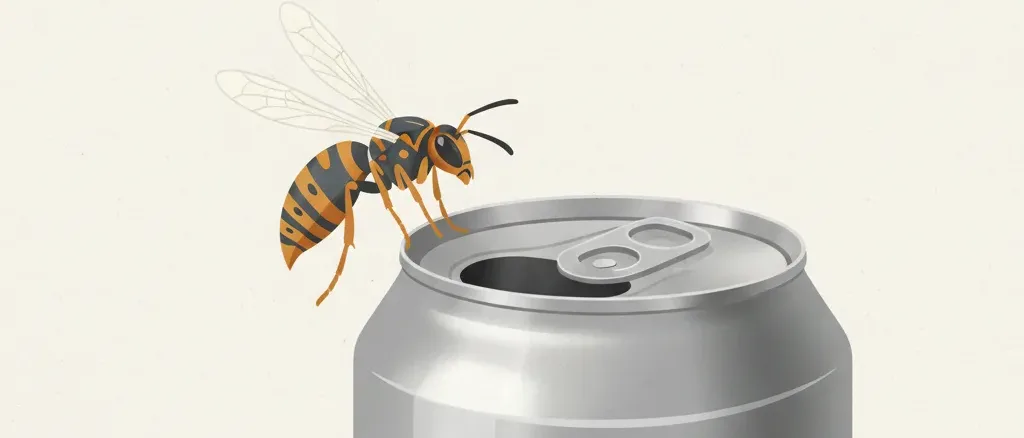
O cenário da «abelha na lata de refrigerante» é uma das histórias de perigo ao ar livre mais vívidas e amplamente divulgadas. As redes sociais amplificam relatos ocasionais de pessoas que engoliram um inseto, sentiram uma picada na garganta e precisaram de tratamento de urgência, o que inflaciona consideravelmente a frequência percebida relativamente à taxa real. A maioria das pessoas que passaram verões a beber ao ar livre sobrestima a frequência com que isto acaba mal.
Estimativa aproximada: a maioria de quem bebe ao ar livre assume que isto acontece várias vezes por ano a alguém que conhece vagamente
Fonte: intuição editorial, não pesquisado
Real
~195 visitas de urgência estimadas por picada orofaríngea (boca/garganta) por ano, Estados Unidos
população total dos EUA
Mostrar cálculo
Huff, Phillips e Keith (Wilderness & Environmental Medicine, 2025) usaram dados do NEISS (2004–2023) e estimaram diretamente que, entre 2004 e 2023, houve aproximadamente 3 890 (IC 95 %, 2 458,55–5 320,79) pessoas com picadas orofaríngeas (boca e garganta) de abelhas, marimbondos, vespas-amarelas ou vespas que recorreram a serviços de urgência nos EUA — cerca de 195 por ano ao longo da janela de 20 anos. Probabilidade anual: 195 / 335 000 000 ≈ 5,8 × 10^-7. Composta ao longo de 59 anos de vida adulta restante: 1 - (1 - 5,8e-7)^59 ≈ 3,4 × 10^-5 ≈ 1 em 29 000. A banda de incerteza transporta o próprio IC 95 % do estudo através da mesma composição ao longo da vida (2 458,55–5 320,79 ao longo de 20 anos → ~123–266/ano). «Picada orofaríngea» é mais abrangente do que o cenário específico de beber de lata/garrafa, mas o estudo do NEISS é a única fonte de vigilância dos EUA que quantifica diretamente esta via.
Ressalvas: O mecanismo aqui não é o engasgamento mecânico — as abelhas e as vespas são dema…
O mecanismo aqui não é o engasgamento mecânico — as abelhas e as vespas são demasiado pequenas para obstruir as vias aéreas como objeto físico. O perigo é a própria picada: dentro da boca ou da garganta causa edema inflamatório localizado que pode estreitar as vias aéreas mesmo em indivíduos não alérgicos, e nos que têm alergia ao veneno pode desencadear anafilaxia sistémica completa. A cifra de ~195/ano é a estimativa nacional do próprio estudo NEISS de 2025 sobre recorrências a urgências por picada orofaríngea (~3 890 ao longo de 2004–2023); não é uma contagem direta de «inseto engolido a beber» e pode incluir outras vias de picada oral (por exemplo, a comer). As mortes por insetos especificamente engolidos não são registadas separadamente.
Riscos relacionados
Outros riscos sobre temas semelhantes — para explorar medos relacionados.

Picada de abelha
Quais são as chances de ser morto por uma picada de abelha, vespa ou marimbondo?

Anafilaxia por picada
Quais são as chances de uma picada de abelha ou vespa desencadear choque anafilático que exija injeção de epinefrina?

Picada fatal de abelha/vespa
Quais são as probabilidades de morrer por picada de abelha, vespa ou marimbondo?


Engasgo de criança
Quais são as chances de um bebê ou criança pequena morrer engasgado enquanto come?

Escolha o comparado
A bee or wasp inside a can or bottle is a genuine, if rare, hazard — and the mechanism is less obvious than most people assume. The danger is not that the insect physically blocks your airway; bees and wasps are small enough to swallow without obstruction. The danger is the sting: delivered inside the mouth, posterior pharynx, or esophagus, it triggers localized inflammatory edema in confined anatomy where even modest swelling can produce stridor, difficulty swallowing, and in severe cases airway compromise — even in people with no prior venom allergy. In those who do have venom allergy (roughly 3% of US adults), an oropharyngeal sting can trigger full systemic anaphylaxis.
A 2025 NEISS analysis by Huff, Phillips, and Keith directly estimated that between 2004 and 2023 approximately 3,890 people presented to US emergency departments with an oropharyngeal (mouth or throat) sting from a bee, hornet, yellow jacket, or wasp — about 195 per year, roughly 5% of all sting ED visits. Spread over 335 million people and 59 remaining adult years, that comes to roughly 1 in 29,000 over a lifetime. The large majority were minor: about 98% of oropharyngeal sting patients were not admitted to the hospital. Deaths from this specific route are not separately tracked in US surveillance; they are absorbed into the ICD-10 X23 “sting” category that averages ~72 per year from all mechanisms combined.
The fear is real but the framing matters: the scenario to worry about is not “the insect itself gets stuck” but “the sting triggers swelling or anaphylaxis in a place the body finds very hard to manage.” Practical risk reduction is simple — check the opening of outdoor cans and bottles before drinking, pour into a clear glass, or use a cup with a lid. These are low-friction habits that effectively eliminate the exposure route without any change to outdoor behavior otherwise.
Curiosidades relacionadas
Picadas na boca e na garganta, muitas vezes por um inseto engolido com comida ou bebida, levam cerca de 11,000 pessoas por ano aos prontos-socorros dos EUA. A probabilidade ao longo da vida é de cerca de 1 in 500.
Registro de evidências
Cada número abaixo é o que cada fonte relatou, com a citação literal em que nos baseamos e como chegamos ao nosso valor. Clique em qualquer link para verificar diretamente.
4/4 fontes verificadas de forma independente palavra por palavra em relação à fonte citada
-
[1] Wilderness & Environmental Medicine (Huff, Phillips, Keith) — Oropharyngeal Bee, Hornet, Yellow Jacket, and Wasp Stings: A National Electronic Injury Surveillance System Analysis and Scoping Review Verificado
Oropharyngeal Bee, Hornet, Yellow Jacket, and Wasp Stings: A National Electronic Injury Surveillance System Analysis and Scoping Review- Estatística
An estimated 3890 (95% CI, 2458.55–5320.79) oropharyngeal sting ED presentations in the US over 2004–2023 (~195/year); oropharyngeal stings were ~5.08% of all stings; 98.08% of oropharyngeal sting victims were not admitted- Trecho
“"Between 2004 and 2023, there were an estimated 3890 (95% CI, 2458.55–5320.79) people with oropharyngeal stings from bees, hornets, yellow jackets, or wasps in the United States who presented to emergency departments." "Stings to the oropharyngeal region represented an estimated 5.08% (95% CI, 3.59–6.56) of all stings." "Overall, 98.08% (95% CI, 94.25–100.00) of victims of oropharyngeal stings were not admitted to the hospital." ”
- Dados da fonte de
- 2025-03-01
- Acessado
- 2026-05-04 · cópia arquivada
- Verificação
- Trecho obtido novamente de forma independente e confirmado palavra por palavra em relação à fonte citada durante nossa auditoria de fundamentação.
- Cálculo
- Used for the direct national estimate: ~3890 oropharyngeal sting ED presentations over 2004–2023 = ~195/year. Annual probability 195/335,000,000 ≈ 5.8e-7; compounded over 59 years ≈ 3.4e-5 ≈ 1 in 29,000. The 95% CI (2458.55–5320.79 over 20 years) is carried through the same compounding for the uncertainty band. The ~1.92% hospitalization sub-fraction (98.08% not admitted) is a severity anchor.
- Independência
- Based on NEISS (National Electronic Injury Surveillance System) consumer product injury data, methodologically independent of NCHS death-certificate mortality counts.
-
[2] Frontiers in Veterinary Science (Marinho & Soto-Blanco) — Toxicological Risk Assessment of the Accidental Ingestion of a Honeybee (Apis mellifera L.) Present in Food Verificado
Toxicological Risk Assessment of the Accidental Ingestion of a Honeybee (Apis mellifera L.) Present in Food- Estatística
The actual number of accidental honeybee ingestion incidents remains unknown; though a rare condition, ingestion may induce an allergic reaction in sensitive individuals- Trecho
“A number of anecdotal reports of accidental ingestion of insects are largely available, but the actual number remains unknown. Thus, although it is a rare condition, there is the risk that the ingestion of a honeybee may induce an allergic reaction to some venom components in sensitive individuals. ”
- Dados da fonte de
- 2020-10-01
- Acessado
- 2026-05-04 · cópia arquivada
- Verificação
- Trecho obtido novamente de forma independente e confirmado palavra por palavra em relação à fonte citada durante nossa auditoria de fundamentação.
- Cálculo
- Supports the surveillance gap: the peer-reviewed toxicological assessment states that the actual number of accidental ingestion incidents remains unknown (reports are anecdotal). Used to justify the wide uncertainty band and to establish that the Huff 2025 oropharyngeal fraction is the best available approximation. Note: this source addresses honeybees only and does not itself quantify deaths or ER visits.
- Independência
- Toxicological review drawing on venom-composition and clinical toxicology literature, independent of NEISS and NCHS data streams.
-
[3] American Family Physician (Golden DB) — Stinging Insect Allergy Verificado
Stinging Insect AllergySee all 2 Likelier entries citing this source →
- Estatística
Systemic allergic reactions to insect stings are estimated to occur in about 3% of US adults (and about 1% of children)- Trecho
“"Systemic allergic reactions to insect stings are estimated to occur in about 1 percent of children and 3 percent of adults." ”
- Dados da fonte de
- 2003-06-15
- Acessado
- 2026-07-03 · cópia arquivada
- Verificação
- Trecho obtido novamente de forma independente e confirmado palavra por palavra em relação à fonte citada durante nossa auditoria de fundamentação.
- Cálculo
- Supports the body-prose reference to venom-allergy prevalence (~3% of US adults) used as context for anaphylaxis risk from an oropharyngeal sting. Not used in the native/normalized probability calculation, which is based on the Huff 2025 NEISS oropharyngeal-fraction analysis.
- Independência
- Independent clinical epidemiology review (American Family Physician), methodologically distinct from the NEISS-based Huff 2025 analysis and the honeybee-ingestion toxicological review.
-
[4] Centers for Disease Control and Prevention — Morbidity and Mortality Weekly Report — QuickStats: Number of Deaths from Hornet, Wasp, and Bee Stings Among Males and Females — National Vital Statistics System, United States, 2011-2021 Verificado
QuickStats: Number of Deaths from Hornet, Wasp, and Bee Stings Among Males and Females — National Vital Statistics System, United States, 2011-2021- Estatística
788 total US deaths from hornet, wasp, and bee stings during 2011-2021, an average of 72 deaths per year; classified under ICD-10 code X23- Trecho
“"During 2011-2021, a total of 788 deaths from hornet, wasp, and bee stings occurred (an average of 72 deaths per year). [...] Deaths from hornet, wasp, and bee sting as underlying cause of death were coded as X23, according to the International Classification of Diseases, Tenth Revision." ”
- Dados da fonte de
- 2023-07-07
- Acessado
- 2026-07-03 · cópia arquivada
- Verificação
- Trecho obtido novamente de forma independente e confirmado palavra por palavra em relação à fonte citada durante nossa auditoria de fundamentação.
- Cálculo
- Supports the body-prose reference to overall Hymenoptera sting deaths (~72/year, ICD-10 X23) used as a severity anchor and to explain why deaths from the specific swallowed-insect/oropharyngeal route are not separately tracked in US surveillance. Not used in the native/normalized oropharyngeal-ED-visit calculation.
- Independência
- NCHS death-certificate mortality data (National Vital Statistics System), methodologically independent of the NEISS-based Huff 2025 ED-visit analysis.