Chất lượng bằng chứng 4.25/5
Điểm đánh giá tám chiều theo tiêu chí chất lượng . Mỗi chiều được chấm từ 1–5.
- D1 Cơ sở nguồn
- 4/5
- D2 Uy tín nguồn
- 5/5
- D3 Tính toán
- 4/5
- D4 Sự không chắc chắn
- 4/5
- D5 Phạm vi
- 4/5
- D6 Văn bản
- 4/5
- D7 Sự trung thực về nhận thức
- 4/5
- D8 Tính đầy đủ của lưu ý
- 5/5
● yếu tố của bạn — nhấp vào rủi ro này ▾ để hiển thị
- Yếu tố của bạn
≈ Khả năng tương đương
Nhận thức
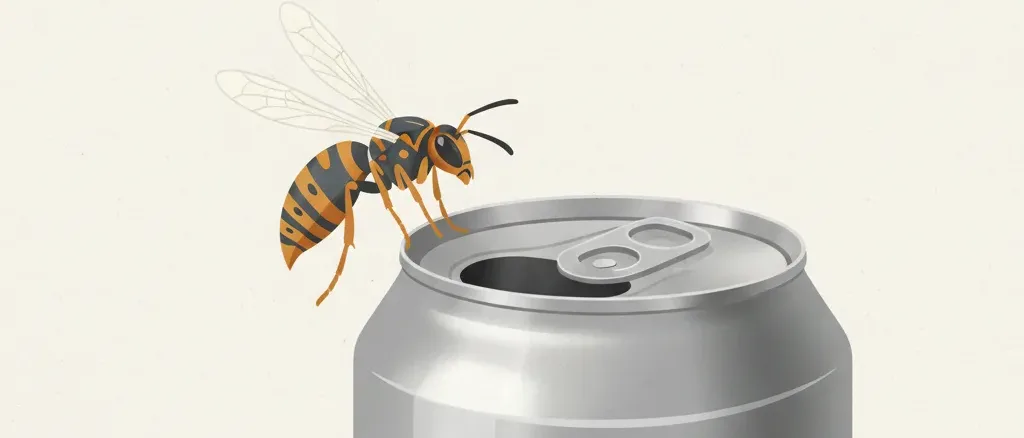
Kịch bản «con ong trong lon nước ngọt» là một trong những câu chuyện về mối nguy ngoài trời sống động và được lan truyền rộng rãi hơn. Mạng xã hội khuếch đại các báo cáo thỉnh thoảng về những người nuốt phải côn trùng, cảm thấy vết đốt trong cổ họng, và cần điều trị cấp cứu, điều này làm phồng tần suất cảm nhận đáng kể so với tỷ lệ thực tế. Hầu hết những người đã trải qua những mùa hè uống ngoài trời đều đánh giá quá cao mức độ thường xuyên mà điều này kết thúc tồi tệ.
Ước tính sơ bộ: hầu hết những người uống ngoài trời cho rằng điều này xảy ra vài lần một năm với ai đó mà họ quen biết mơ hồ
Nguồn: trực giác của biên tập viên, không được thăm dò
Thực tế
~195 lượt cấp cứu ước tính do vết đốt vùng hầu họng (miệng/họng) mỗi năm, Hoa Kỳ
tổng dân số Hoa Kỳ
Hiện cách tính
Huff, Phillips, và Keith (Wilderness & Environmental Medicine, 2025) đã sử dụng dữ liệu NEISS (2004–2023) và trực tiếp ước tính rằng từ năm 2004 đến 2023 có khoảng 3.890 (KTC 95 %, 2.458,55–5.320,79) người bị vết đốt vùng hầu họng (miệng và họng) từ ong, ong bắp cày, ong vàng, hoặc ong vò vẽ đã đến các khoa cấp cứu ở Hoa Kỳ — khoảng 195 mỗi năm trong cửa sổ 20 năm. Xác suất hàng năm: 195 / 335.000.000 ≈ 5,8 × 10^-7. Tính gộp trong 59 năm đời trưởng thành còn lại: 1 - (1 - 5,8e-7)^59 ≈ 3,4 × 10^-5 ≈ 1 trên 29.000. Dải bất định mang theo KTC 95 % của chính nghiên cứu qua cùng phép tính gộp trọn đời (2.458,55–5.320,79 trong 20 năm → ~123–266/năm). «Vết đốt vùng hầu họng» rộng hơn kịch bản uống từ lon/chai cụ thể, nhưng nghiên cứu NEISS là nguồn giám sát duy nhất của Hoa Kỳ trực tiếp định lượng con đường này.
Lưu ý: Cơ chế ở đây không phải là nghẹt thở cơ học — ong và ong bắp cày quá nhỏ để cản …
Cơ chế ở đây không phải là nghẹt thở cơ học — ong và ong bắp cày quá nhỏ để cản trở đường thở như một vật thể vật lý. Mối nguy là chính vết đốt: bên trong miệng hoặc họng, nó gây phù nề viêm cục bộ có thể làm hẹp đường thở ngay cả ở những người không dị ứng, và ở những người có dị ứng nọc độc, nó có thể kích hoạt sốc phản vệ toàn thân đầy đủ. Con số ~195/năm là ước tính toàn quốc của chính nghiên cứu NEISS 2025 về các lượt cấp cứu do vết đốt vùng hầu họng (~3.890 trong giai đoạn 2004–2023); đó không phải là số đếm trực tiếp các ca «nuốt côn trùng khi uống» và có thể bao gồm các con đường khác của vết đốt trong miệng (ví dụ, khi ăn). Các ca tử vong do côn trùng bị nuốt cụ thể không được theo dõi riêng biệt.
Rủi ro liên quan
Các rủi ro khác về chủ đề tương tự — để khám phá những nỗi sợ liên quan.
Sốc phản vệ do ong đốt
Xác suất bị ong đốt gây sốc phản vệ cần tiêm epinephrine là bao nhiêu?


Trẻ nhỏ nghẹt thở
Xác suất một trẻ sơ sinh hoặc trẻ nhỏ bị nghẹt thở đến chết khi ăn là bao nhiêu?

Chọn đối thủ
A bee or wasp inside a can or bottle is a genuine, if rare, hazard — and the mechanism is less obvious than most people assume. The danger is not that the insect physically blocks your airway; bees and wasps are small enough to swallow without obstruction. The danger is the sting: delivered inside the mouth, posterior pharynx, or esophagus, it triggers localized inflammatory edema in confined anatomy where even modest swelling can produce stridor, difficulty swallowing, and in severe cases airway compromise — even in people with no prior venom allergy. In those who do have venom allergy (roughly 3% of US adults), an oropharyngeal sting can trigger full systemic anaphylaxis.
A 2025 NEISS analysis by Huff, Phillips, and Keith directly estimated that between 2004 and 2023 approximately 3,890 people presented to US emergency departments with an oropharyngeal (mouth or throat) sting from a bee, hornet, yellow jacket, or wasp — about 195 per year, roughly 5% of all sting ED visits. Spread over 335 million people and 59 remaining adult years, that comes to roughly 1 in 29,000 over a lifetime. The large majority were minor: about 98% of oropharyngeal sting patients were not admitted to the hospital. Deaths from this specific route are not separately tracked in US surveillance; they are absorbed into the ICD-10 X23 “sting” category that averages ~72 per year from all mechanisms combined.
The fear is real but the framing matters: the scenario to worry about is not “the insect itself gets stuck” but “the sting triggers swelling or anaphylaxis in a place the body finds very hard to manage.” Practical risk reduction is simple — check the opening of outdoor cans and bottles before drinking, pour into a clear glass, or use a cup with a lid. These are low-friction habits that effectively eliminate the exposure route without any change to outdoor behavior otherwise.
Thông tin liên quan
Vết đốt trong miệng và họng, thường do nuốt côn trùng cùng thức ăn hay đồ uống, đưa ước tính 11,000 người mỗi năm vào khoa cấp cứu ở Mỹ. Xác suất trong cả đời là khoảng 1 in 500.
Sổ cái xác nhận
Mỗi con số dưới đây là những gì mỗi nguồn đã báo cáo, cùng với trích dẫn nguyên văn mà chúng tôi dựa vào và cách chúng tôi đưa ra con số của mình. Nhấp vào bất kỳ liên kết nào để xác minh trực tiếp.
4/4 nguồn được xác minh độc lập đúng từng chữ so với nguồn được trích dẫn
-
[1] Wilderness & Environmental Medicine (Huff, Phillips, Keith) — Oropharyngeal Bee, Hornet, Yellow Jacket, and Wasp Stings: A National Electronic Injury Surveillance System Analysis and Scoping Review Đã xác minh
Oropharyngeal Bee, Hornet, Yellow Jacket, and Wasp Stings: A National Electronic Injury Surveillance System Analysis and Scoping Review- Thống kê
An estimated 3890 (95% CI, 2458.55–5320.79) oropharyngeal sting ED presentations in the US over 2004–2023 (~195/year); oropharyngeal stings were ~5.08% of all stings; 98.08% of oropharyngeal sting victims were not admitted- Trích đoạn
“"Between 2004 and 2023, there were an estimated 3890 (95% CI, 2458.55–5320.79) people with oropharyngeal stings from bees, hornets, yellow jackets, or wasps in the United States who presented to emergency departments." "Stings to the oropharyngeal region represented an estimated 5.08% (95% CI, 3.59–6.56) of all stings." "Overall, 98.08% (95% CI, 94.25–100.00) of victims of oropharyngeal stings were not admitted to the hospital." ”
- Dữ liệu nguồn từ
- 2025-03-01
- Truy cập
- 2026-05-04 · bản sao lưu trữ
- Xác minh
- Trích đoạn đã được tải lại độc lập và xác nhận đúng từng chữ so với nguồn được trích dẫn trong quá trình kiểm định căn cứ của chúng tôi.
- Tính toán
- Used for the direct national estimate: ~3890 oropharyngeal sting ED presentations over 2004–2023 = ~195/year. Annual probability 195/335,000,000 ≈ 5.8e-7; compounded over 59 years ≈ 3.4e-5 ≈ 1 in 29,000. The 95% CI (2458.55–5320.79 over 20 years) is carried through the same compounding for the uncertainty band. The ~1.92% hospitalization sub-fraction (98.08% not admitted) is a severity anchor.
- Độc lập
- Based on NEISS (National Electronic Injury Surveillance System) consumer product injury data, methodologically independent of NCHS death-certificate mortality counts.
-
[2] Frontiers in Veterinary Science (Marinho & Soto-Blanco) — Toxicological Risk Assessment of the Accidental Ingestion of a Honeybee (Apis mellifera L.) Present in Food Đã xác minh
Toxicological Risk Assessment of the Accidental Ingestion of a Honeybee (Apis mellifera L.) Present in Food- Thống kê
The actual number of accidental honeybee ingestion incidents remains unknown; though a rare condition, ingestion may induce an allergic reaction in sensitive individuals- Trích đoạn
“A number of anecdotal reports of accidental ingestion of insects are largely available, but the actual number remains unknown. Thus, although it is a rare condition, there is the risk that the ingestion of a honeybee may induce an allergic reaction to some venom components in sensitive individuals. ”
- Dữ liệu nguồn từ
- 2020-10-01
- Truy cập
- 2026-05-04 · bản sao lưu trữ
- Xác minh
- Trích đoạn đã được tải lại độc lập và xác nhận đúng từng chữ so với nguồn được trích dẫn trong quá trình kiểm định căn cứ của chúng tôi.
- Tính toán
- Supports the surveillance gap: the peer-reviewed toxicological assessment states that the actual number of accidental ingestion incidents remains unknown (reports are anecdotal). Used to justify the wide uncertainty band and to establish that the Huff 2025 oropharyngeal fraction is the best available approximation. Note: this source addresses honeybees only and does not itself quantify deaths or ER visits.
- Độc lập
- Toxicological review drawing on venom-composition and clinical toxicology literature, independent of NEISS and NCHS data streams.
-
[3] American Family Physician (Golden DB) — Stinging Insect Allergy Đã xác minh
Stinging Insect AllergySee all 2 Likelier entries citing this source →
- Thống kê
Systemic allergic reactions to insect stings are estimated to occur in about 3% of US adults (and about 1% of children)- Trích đoạn
“"Systemic allergic reactions to insect stings are estimated to occur in about 1 percent of children and 3 percent of adults." ”
- Dữ liệu nguồn từ
- 2003-06-15
- Truy cập
- 2026-07-03 · bản sao lưu trữ
- Xác minh
- Trích đoạn đã được tải lại độc lập và xác nhận đúng từng chữ so với nguồn được trích dẫn trong quá trình kiểm định căn cứ của chúng tôi.
- Tính toán
- Supports the body-prose reference to venom-allergy prevalence (~3% of US adults) used as context for anaphylaxis risk from an oropharyngeal sting. Not used in the native/normalized probability calculation, which is based on the Huff 2025 NEISS oropharyngeal-fraction analysis.
- Độc lập
- Independent clinical epidemiology review (American Family Physician), methodologically distinct from the NEISS-based Huff 2025 analysis and the honeybee-ingestion toxicological review.
-
[4] Centers for Disease Control and Prevention — Morbidity and Mortality Weekly Report — QuickStats: Number of Deaths from Hornet, Wasp, and Bee Stings Among Males and Females — National Vital Statistics System, United States, 2011-2021 Đã xác minh
QuickStats: Number of Deaths from Hornet, Wasp, and Bee Stings Among Males and Females — National Vital Statistics System, United States, 2011-2021- Thống kê
788 total US deaths from hornet, wasp, and bee stings during 2011-2021, an average of 72 deaths per year; classified under ICD-10 code X23- Trích đoạn
“"During 2011-2021, a total of 788 deaths from hornet, wasp, and bee stings occurred (an average of 72 deaths per year). [...] Deaths from hornet, wasp, and bee sting as underlying cause of death were coded as X23, according to the International Classification of Diseases, Tenth Revision." ”
- Dữ liệu nguồn từ
- 2023-07-07
- Truy cập
- 2026-07-03 · bản sao lưu trữ
- Xác minh
- Trích đoạn đã được tải lại độc lập và xác nhận đúng từng chữ so với nguồn được trích dẫn trong quá trình kiểm định căn cứ của chúng tôi.
- Tính toán
- Supports the body-prose reference to overall Hymenoptera sting deaths (~72/year, ICD-10 X23) used as a severity anchor and to explain why deaths from the specific swallowed-insect/oropharyngeal route are not separately tracked in US surveillance. Not used in the native/normalized oropharyngeal-ED-visit calculation.
- Độc lập
- NCHS death-certificate mortality data (National Vital Statistics System), methodologically independent of the NEISS-based Huff 2025 ED-visit analysis.