Chất lượng bằng chứng 4.5/5
Điểm đánh giá tám chiều theo tiêu chí chất lượng . Mỗi chiều được chấm từ 1–5.
- D1 Cơ sở nguồn
- 4/5
- D2 Uy tín nguồn
- 5/5
- D3 Tính toán
- 5/5
- D4 Sự không chắc chắn
- 4/5
- D5 Phạm vi
- 4/5
- D6 Văn bản
- 5/5
- D7 Sự trung thực về nhận thức
- 4/5
- D8 Tính đầy đủ của lưu ý
- 5/5
≈ Khả năng tương đương
Nhận thức
Các bộ nam châm đồ chơi và nam châm mạnh trang trí đã được tiếp thị như đồ chơi để bàn cho người lớn và sản phẩm giảm căng thẳng, nhưng mối nguy khi một đứa trẻ nuốt nhiều nam châm không được hầu hết cha mẹ hiểu rõ. Mô hình tư duy chủ đạo của công chúng coi việc nuốt nam châm giống như nuốt đồng xu — khó chịu nhưng tự khỏi. Điều không được biết rộng rãi là cơ chế về cơ bản khác hẳn đối với hai nam châm mạnh trở lên: chúng hút nhau qua các đoạn ruột khác nhau, tạo ra một điểm áp lực có thể gây thiếu máu cục bộ, thủng, xoắn ruột và hoại tử ruột trong vòng vài giờ. Middelberg và cộng sự (2022) phát hiện rằng gần một nửa số người chăm sóc có con được điều trị vì chấn thương do nam châm mạnh tin rằng nam châm mạnh là đồ chơi trẻ em, và chỉ 7 % biết rằng nam châm trước đó đã bị CPSC rút khỏi thị trường. Mối nguy này bị đánh giá thấp đáng kể so với pin cúc áo, dù khiến trẻ em nhập viện ở tỷ lệ khoảng 20 lần.
Ước tính sơ bộ: Hầu hết cha mẹ không có con số nào cho mối nguy này; gần một nửa trong một khảo sát sau sự cố tin rằng nam châm mạnh là đồ chơi trẻ em (Middelberg 2022)
Nguồn: trực giác của biên tập viên, không được thăm dò
Thực tế
~300-400 ca nhập viện mỗi năm ở trẻ em Mỹ do nuốt nhiều nam châm mạnh
trẻ em Mỹ độ tuổi 0-14, nhập viện do nuốt nhiều nam châm mạnh
Hiện cách tính
CPSC ước tính 26.600 lượt khám cấp cứu liên quan đến nam châm từ 2010-2021 trên tất cả các độ tuổi 0-17 (Federal Register, tháng 9 năm 2022). Sau khi quy định bị hủy bỏ giai đoạn 2017-2020, số lượt khám cấp cứu hàng năm là khoảng 2.300-2.400/năm riêng cho nam châm mạnh. Middelberg et al. (2022, Pediatrics), nghiên cứu thuần tập lâm sàng lớn nhất (596 ca nam châm mạnh được xác nhận trên 25 bệnh viện nhi, 2017-2019), phát hiện 55,7 % phải nhập viện và 95 % số ca là trẻ em dưới 14 tuổi. Áp dụng tỷ lệ nhập viện 56 % cho ~2.400 lượt khám cấp cứu nam châm mạnh/năm cho ra khoảng 300-400 ca nhập viện mỗi năm cho giai đoạn sau khi tái xuất hiện. Trẻ em Mỹ độ tuổi 0-14 có khoảng 61 triệu (Điều tra dân số). Rủi ro tích lũy trong khung 15 năm: 300-400 ca nhập viện/năm × 15 năm / 61.000.000 ≈ 7,4-9,8 × 10⁻⁵, tức khoảng 1 trên 10.000 đến 1 trên 14.000. Con số tiêu đề dùng 1 trên 12.000 làm điểm giữa. Strickland et al. (2020, JPGN) độc lập phát hiện khoảng 1.094 ca «leo thang chăm sóc» do nhiều nam châm trong giai đoạn 2017-2019 (ước tính NEISS có trọng số), phù hợp với 350-400 kết cục nghiêm trọng mỗi năm. Một quy định mới của CPSC (16 CFR Part 1262) có hiệu lực từ tháng 10 năm 2022; tác động của nó lên tỷ lệ ca bệnh chưa thể định lượng được từ dữ liệu công bố.
Lưu ý: Con số tiêu đề 1 trên 12.000 đề cập đến việc nhập viện do nuốt nhiều nam châm mạ…
Con số tiêu đề 1 trên 12.000 đề cập đến việc nhập viện do nuốt nhiều nam châm mạnh trong khung tuổi thơ 0-14. Các kết cục tử vong hiếm hơn khoảng hai bậc độ lớn — khoảng 1 trên 13 triệu mỗi trẻ (5 ca tử vong được xác nhận ở Mỹ trong ~17 năm so với dân số 61 triệu trẻ em độ tuổi 0-14). Mối nguy cụ thể là về nhiều nam châm (hoặc một nam châm cộng với một vật kim loại): việc nuốt một nam châm đơn lẻ gần như luôn tự khỏi. Sự phân biệt này rất quan trọng cho cả việc xử trí lâm sàng lẫn truyền thông rủi ro tới cha mẹ. Phạm vi xác suất nhạy cảm với chu kỳ pháp lý: số ca là ~2.300/năm trước quy định CPSC năm 2014, giảm trong giai đoạn có quy định (2015-2016), tăng vọt trở lại ~2.300-2.400/năm sau khi quy định bị hủy bỏ năm 2016, và quy định liên bang mới năm 2022 (16 CFR Part 1262) có tác động chưa rõ nhưng có khả năng đáng kể lên tỷ lệ ca bệnh tương lai. Ước tính 300-400 ca nhập viện phản ánh giai đoạn sau khi quy định bị hủy bỏ, trước quy định mới (2017-2022); tỷ lệ sau năm 2022 có thể thấp hơn nếu quy định mới đạt được sự tuân thủ tốt hơn quy định bị hủy. Mối nguy nam châm nằm ở một vị trí bất thường so với các mục khác trên trang này: tỷ lệ nhập viện (~1 trên 12.000) cao gấp khoảng 20 lần tỷ lệ chấn thương nghiêm trọng do pin cúc áo (~1 trên 250.000), dù pin cúc áo nhận được nhiều truyền thông y tế công cộng và sự chú ý pháp lý hơn đáng kể. Khoảng cách về khả năng nhận biết được giải thích một phần bởi độ tuổi bệnh nhân trung bình lớn hơn của mối nguy nam châm (7,5 năm, Middelberg) so với dân số chủ yếu là trẻ mới biết đi đối với pin cúc áo.
Rủi ro liên quan
Các rủi ro khác về chủ đề tương tự — để khám phá những nỗi sợ liên quan.

Trẻ quay mặt trước tử vong
Trẻ mới biết đi ngồi ghế xe quay mặt về phía trước có thực sự dễ tử vong hơn trong tai nạn ô tô không?

Loạn sản xương hông trẻ sơ sinh
Tỷ lệ tàn tật do loạn sản xương hông ở trẻ sơ sinh không được điều trị là bao nhiêu?
Trẻ nuốt dị vật (cấp cứu)
Xác suất một đứa trẻ nhỏ nuốt phải dị vật và cần được chăm sóc y tế là bao nhiêu?

Trẻ nuốt gói nicotine
Khả năng một trẻ nhỏ bị báo cáo lên trung tâm chống độc vì nuốt một gói nicotine là bao nhiêu?
Chọn đối thủ
A single swallowed magnet is almost never a serious emergency. Two or more high-powered magnets swallowed at different times — or a magnet swallowed separately from a metal object — are a different problem entirely. When two neodymium magnets are in different loops of intestine, they attract each other strongly across the bowel wall, creating a pressure point that can cause ischemia, perforation, volvulus, and bowel necrosis within hours. Middelberg et al. (2022, Pediatrics), the largest clinical cohort of high-powered magnet injuries — 596 confirmed cases across 25 children’s hospitals over 2017-2019 — found that 55.7% required hospitalization, 46.3% required endoscopy, surgery, or both, and 9.6% had life-threatening morbidity including bowel obstruction, perforation, fistulae, and volvulus. The first documented US pediatric death from high-powered magnet ingestion occurred in a 20-month-old child in 2005/2006; CPSC has confirmed five US deaths since then.
The regulatory history is a study in how consumer product safety can fail at the enforcement stage. CPSC documented 20 serious cases between 2003 and 2006, including 15 bowel perforations and one death. Case counts climbed sharply over the following decade as high-powered neodymium magnet sets (marketed as “Buckyballs,” “Zen Magnets,” and dozens of similar brands) became popular adult desk toys. CPSC published a federal safety rule in 2014 limiting the flux strength of consumer magnets. The rule took effect in 2015, and annual ED visit rates fell. In 2016, the US Court of Appeals for the Tenth Circuit vacated the rule, finding the CPSC’s supporting findings inadequately explained. High-powered magnets returned to market in 2017. By 2017-2019, Strickland and colleagues (2020, JPGN) documented a five-fold increase in multiple-magnet escalation of care and a hospitalization rate of 37.7%. A new federal rule (16 CFR Part 1262) was unanimously adopted by CPSC in September 2022 with a broader product scope than the vacated rule, but post-enforcement case data are not yet published.
The counter-intuitive finding from comparing magnet and button-battery entries is worth stating directly. Button batteries receive substantially more public-health communication and regulatory attention than high-powered magnets. Yet the hospitalization rate for the magnet hazard — roughly 1 in 12,000 children over the 0-14 window — is approximately 20 times higher than the severe-injury rate for button batteries (1 in 250,000 over the 0-6 window). The difference is explained partly by the older age distribution for magnets (median 7.5 years, Middelberg) relative to button batteries (peak age 2 years), which means magnet exposure is more likely to occur in older children who appear less at-risk, and partly by the complexity of the mechanism, which is not intuitive to parents or to emergency physicians who may initially interpret an X-ray showing two overlapping metallic densities as a coin swallowing rather than a two-magnet emergency.
Thông tin liên quan
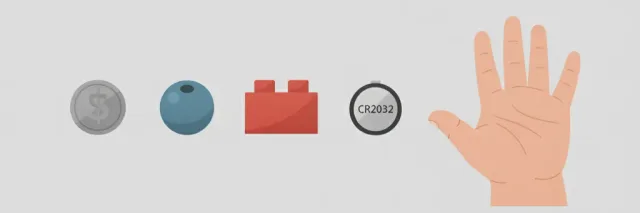
Khoảng 1 trên 90 trẻ em ở Mỹ phải vào cấp cứu vì nuốt dị vật trước 6 tuổi — thường là đồng xu, và 80-90% tự trôi ra. Những ngoại lệ phá vỡ quy luật rồi nó sẽ trôi ra: pin cúc áo, ăn thủng trong vài giờ, và nhiều nam châm, kẹp lấy thành ruột.
Nhập viện do nuốt nhiều nam châm mạnh xảy ra khoảng ~1 trên 12,000 mỗi trẻ ở Mỹ trong giai đoạn 0-14 tuổi. Trong một khảo sát sau sự cố, gần một nửa người chăm sóc vẫn cho rằng những nam châm này là đồ chơi trẻ em.
Sổ cái xác nhận
Mỗi con số dưới đây là những gì mỗi nguồn đã báo cáo, cùng với trích dẫn nguyên văn mà chúng tôi dựa vào và cách chúng tôi đưa ra con số của mình. Nhấp vào bất kỳ liên kết nào để xác minh trực tiếp.
-
[1] Pediatrics — Middelberg et al. (IMPACT of Magnets Research Collaborative), Nationwide Children's Hospital, 2022 — High-Powered Magnet Exposures in Children: A Multi-Center Cohort Study
High-Powered Magnet Exposures in Children: A Multi-Center Cohort Study- Thống kê
596 patients confirmed high-powered magnet exposure (25 children's hospitals, 2017-2019); 55.7% hospitalized; 46.3% required endoscopy/surgery; 9.6% had life-threatening morbidity; 95% of care was for children under 14; median age 7.5 years; nearly half of caregivers believed high-powered magnets were children's toys- Trích đoạn
“"Nearly 600 cases of high-powered magnet-related injuries in the three years after high-powered magnets re-entered the US market (2017 to 2019)... the majority (56%) of children being treated for high-powered magnet-related injuries required hospitalization... nearly one in ten had a potentially life-threatening injury such as bowel obstruction, perforation, infection, bleeding, fistulae or volvulus... 95% of care in this study was for children under 14 years of age... almost half of caregivers believed high-powered magnets were children's toys." ”
- Dữ liệu nguồn từ
- 2022-02-01
- Truy cập
- 2026-05-09 · bản sao lưu trữ
- Tính toán
- The 56% hospitalization rate from 596 confirmed cases across 25 children's hospitals is the primary clinical outcome rate. Applying this to the CPSC's nationally estimated ~600/yr high-powered magnet ED visits gives ~336 hospitalizations/yr. The 9.6% life-threatening morbidity rate (57/596) translates to approximately 57 life-threatening events per year nationally from high-powered magnet ingestion alone.
- Độc lập
- Middelberg et al. use a prospective multi-center cohort design distinct from the NEISS-based population estimates of Strickland 2020 and the CPSC product-incident database. The clinical outcome rates (hospitalization, surgical intervention, life-threatening morbidity) are empirically measured rather than derived from administrative codes.
-
[2] Journal of Pediatric Gastroenterology and Nutrition — Strickland, Reeves, Krishnamurthy, Bhatt, Mahajan, Abbas, 2020 — Magnet Ingestions in Children Presenting to Emergency Departments in the United States, 2009–2019: A Problem in Flux
Magnet Ingestions in Children Presenting to Emergency Departments in the United States, 2009–2019: A Problem in Flux- Thống kê
23,756 weighted NEISS-estimated pediatric magnet-ingestion ED visits 2009-2019; hospitalization rate rose to 37.7% in 2017-2019 (post-rule-vacated period); 5-fold increase in multiple-magnet escalation of care (estimated 1,094 cases) over 2017-2019; annual case increase averaged 6.1%- Trích đoạn
“"An estimated 23,756 children (59% males, 42% < 5 years old) presented with a [suspected magnet ingestion] from 2009 to 2019 with an average annual case increase of 6.1%... From 2017 to 2019, there was a greater proportion of small/round type magnet ingestions and multiple magnet ingestions, and... a 5-fold increase in the escalation of care for multiple magnet ingestions (estimated n = 1,094; CI 505-1,686)." ”
- Dữ liệu nguồn từ
- 2020-12-01
- Truy cập
- 2026-05-09 · bản sao lưu trữ
- Tính toán
- 1,094 escalation-of-care multiple-magnet cases over 2017-2019 (3 years) ≈ 365/yr — consistent with the ~300-400 hospitalization estimate derived from Middelberg's clinical hospitalization rate applied to CPSC's annual ED visit count. Strickland's NEISS-based approach provides an independent population-level estimate that corroborates the Middelberg clinical-cohort approach.
- Độc lập
- Strickland et al. use NEISS (National Electronic Injury Surveillance System), a statistically representative sample of US EDs maintained by CPSC, yielding nationally weighted estimates. This is methodologically independent of the Middelberg multi-center clinical cohort and of the CPSC product-incident administrative database.
-
[3] CDC Morbidity and Mortality Weekly Report, December 8, 2006, Vol. 55, No. 48 — Gastrointestinal Injuries from Magnet Ingestion in Children — United States, 2003–2006
Gastrointestinal Injuries from Magnet Ingestion in Children — United States, 2003–2006- Thống kê
20 CPSC-identified serious magnet GI injury cases (2003-2006); 19 required surgery; 75% had bowel perforation; 1 death (first documented US fatality); all cases involved multiple magnets attracting through intestinal loops- Trích đoạn
“"Since 2003, CPSC has identified one death and 19 other serious cases involving magnets with this type of unusual strength, representing a range of injuries including intestinal perforations (15 cases), obstruction (4), volvulus (3), and peritonitis (4)... The magnets had magnetically joined across two loops of intestine, causing a volvulus that compromised the blood supply to the bowel and led to necrosis, perforation, and sepsis." ”
- Dữ liệu nguồn từ
- 2006-12-08
- Truy cập
- 2026-05-09 · bản sao lưu trữ
- Tính toán
- This MMWR report established the mechanism: all 20 serious cases involved multiple magnets (or magnets plus a metal object) attracted through the bowel wall. Single-magnet ingestion was not represented in the serious-outcome cases. The 75% bowel-perforation rate in this early clinical case series is consistent with the 9.6% life-threatening morbidity rate in Middelberg 2022 — both measure the outcome rate in cases reaching surgical review, which is a selected severe subset. The first US death (a 20-month-old child, 2005/2006) is documented in this report.
-
[4] US Consumer Product Safety Commission, Federal Register, September 21, 2022 — Safety Standard for Magnets, 16 CFR Part 1262
Safety Standard for Magnets, 16 CFR Part 1262- Thống kê
26,600 magnet-related ED visits 2010-2021 (NEISS estimate); 7-8 deaths involving hazardous magnets since 2005 (5 confirmed US deaths); 124 documented surgical cases (2010-2020); new rule requires flux index <50 kG²mm² for all consumer magnet products fitting small-parts cylinder- Trích đoạn
“"CPSC estimates 26,600 magnet ingestions were treated in hospital ERs from 2010 through 2021, and cases have been rising annually since 2018. CPSC is aware of seven deaths involving the ingestion of hazardous magnets (including two outside of the United States)." ”
- Dữ liệu nguồn từ
- 2022-09-21
- Truy cập
- 2026-05-09 · bản sao lưu trữ
- Tính toán
- 26,600 ED visits / 12 years ≈ 2,217/yr on average. Five confirmed US deaths across ~17 years (2005-2022) ≈ 0.3/yr — a low annual fatality rate that translates to approximately 1 in 13 million per child over the 0-14 window. The new federal rule (effective October 2022) applies to all consumer products with separable magnets fitting the small-parts cylinder, not just the "magnet sets" definition that the vacated 2014 rule covered. Post-enforcement case data are not yet available in peer-reviewed literature.