Kualitas bukti 4.75/5
Skor tinjauan delapan dimensi terhadap rubrik kualitas . Setiap dimensi dinilai 1–5.
- D1 Dasar sumber
- 5/5
- D2 Otoritas sumber
- 5/5
- D3 Aritmetika
- 5/5
- D4 Ketidakpastian
- 4/5
- D5 Cakupan
- 5/5
- D6 Prosa
- 5/5
- D7 Kejujuran persepsi
- 4/5
- D8 Kelengkapan peringatan
- 5/5
● faktor Anda — klik risiko ini ▾ untuk menampilkan
- Faktor Anda
≈ Sama mungkinnya dengan
Dipersepsikan
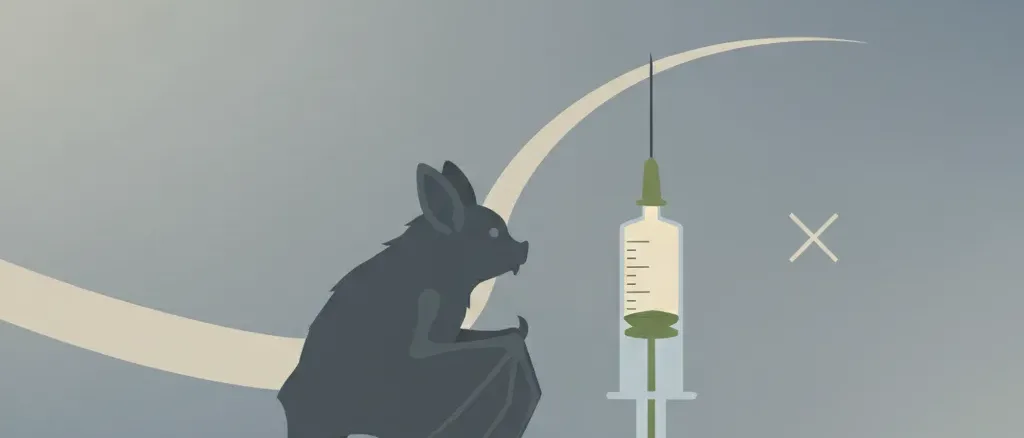
Kelelawar menempati dua posisi berlawanan dalam imajinasi populer. Yang pertama — dan lebih banyak dibahas — adalah mitos terjerat rambut: keyakinan rakyat bahwa kelelawar menukik ke rambut manusia dan terjerat tanpa harapan. Ketakutan itu hampir sepenuhnya keliru; kelelawar yang berekolokasi dapat mendeteksi kawat berdiameter 0,1 mm dalam gelap dan secara aktif menghindari objek termasuk rambut manusia. Posisi kedua, yang jauh kurang dihargai, adalah bahaya kesehatan masyarakat yang nyata: kelelawar adalah sumber utama kematian rabies manusia di Amerika Serikat, bertanggung jawab atas lebih dari 70 % kasus yang diperoleh di dalam negeri sejak 1960. Risiko sesungguhnya tak terlihat justru karena gigitan kelelawar bisa begitu kecil dan tak terasa sakit sehingga luput dari perhatian — membuat populasi secara sistematis kurang menyadari kapan PEP diperlukan.
Sumber: intuisi redaksi, bukan hasil survei
Aktual
kira-kira 6 dari 100.000 penduduk per tahun menerima pengobatan pascapajanan rabies setelah kontak dengan kelelawar (surveilans New York, digunakan sebagai proksi)
penduduk Negara Bagian New York (proksi regional untuk AS)
Tampilkan perhitungan
Tidak ada sumber yang dikutip melaporkan angka PEP khusus-kelelawar tingkat nasional, jadi angka ini adalah proksi regional yang berjangkar pada satu-satunya kumpulan data PEP khusus-kelelawar dalam sumber-sumber di bawah. Surveilans Negara Bagian New York (Emerging Infectious Diseases) melaporkan 11.365 kursus PEP terkait kelelawar sepanjang 1993–2002, yaitu ~1.137 kursus PEP terkait kelelawar per tahun. Populasi New York rata-rata sekitar 18,5 juta sepanjang dekade tersebut (Sensus AS: 17.990.455 pada 1990 dan 18.976.457 pada 2000), memberikan angka PEP terkait kelelawar tahunan sebesar ~1.137 / 18.500.000 ≈ 6,1 per 100.000. Dikompaunkan selama 59 tahun sisa hidup dewasa: 1 − (1 − 6,1 × 10⁻⁵)⁵⁹ ≈ 0,0036, kira-kira 1 dari 280. Ini adalah proksi eksplisit New-York-sebagai-nasional, bukan angka AS yang terukur: New York adalah negara bagian endemik rabies-rakun (di mana CDC MMWR mencatat pajanan rabies manusia berjalan ~600 % lebih tinggi dibanding area khusus-kelelawar), sehingga angka PEP-kelelawar nasional sesungguhnya masuk akal bila berada lebih rendah atau lebih tinggi — pita ketidakpastian mencerminkan hal itu. Penyebut menghitung pemberian PEP — ambang batas yang relevan secara klinis ketika seorang klinisi menilai kontak dengan kelelawar cukup untuk mewajibkan pengobatan. PEP mencakup gigitan, cakaran, dan kontak selaput lendir, termasuk kasus yang secara epidemiologis penting yaitu terbangun di ruangan bersama kelelawar (skenario potensi pajanan yang didefinisikan CDC). Secara terpisah, CDC MMWR memperkirakan ~55.000 orang per tahun menerima PEP setelah kontak dengan hewan yang berpotensi rabies mana pun — tetapi juga menyatakan bahwa pajanan hewan peliharaan menyumbang sebagian besar dari total itu, sehingga tidak membenarkan angka nasional khusus-kelelawar. Rabies tanpa PEP hampir selalu fatal; dengan PEP, keselamatan praktis 100 %.
Catatan: Angka ternormalisasi menghitung pemberian PEP, bukan gigitan yang terkonfirmasi.…
Angka ternormalisasi menghitung pemberian PEP, bukan gigitan yang terkonfirmasi. PEP adalah penyebut yang bermakna secara klinis karena gigitan kelelawar sering tak terdeteksi — riwayat gigitan yang diketahui tidak terungkap pada kira-kira separuh kasus rabies manusia AS yang dikaitkan dengan kelelawar (CDC). Rabies hampir 100 % dapat dicegah dengan PEP yang tepat waktu; ~1–3 kematian rabies manusia AS per tahun terjadi hampir secara eksklusif pada orang yang tidak menerima PEP setelah kontak dengan kelelawar. Mitos terjerat rambut keliru: ekolokasi kelelawar cukup presisi untuk mendeteksi sehelai rambut dalam gelap, dan mereka secara aktif menghindari rintangan saat mengejar serangga. Bahaya sesungguhnya bukanlah kelelawar yang menukik dekat — melainkan gigitan yang mungkin tidak membangunkan orang yang sedang tidur.
Risiko terkait
Risiko lain dengan tema serupa — untuk menjelajahi ketakutan terkait.







Pilih penantang
The United States records roughly 1-3 human rabies deaths per year, and more than 70% of domestically acquired cases since 1960 have been traced to bat exposures (CDC MMWR, 2019). That small annual toll is not evidence that the risk is trivial — it is evidence that post-exposure prophylaxis (PEP) works. The CDC estimates about 55,000 Americans receive rabies PEP each year after contact with any potentially rabid animal — though the same report notes that domestic-animal exposures account for a large portion of that total, so bats are not most of the PEP volume even though they cause most of the rare deaths. No national figure isolates how much PEP is bat-driven. The one bat-specific dataset comes from New York, which logged 11,365 bat-associated PEP courses over 1993–2002 — about 1,100 a year, or roughly 6 per 100,000 residents annually. Treating that as a rough national proxy and compounding it over a lifetime puts the probability of a bat contact serious enough to warrant PEP in the vicinity of 1 in 280 — an explicit regional extrapolation, not a measured US rate. The vast majority of those encounters end with a vaccine series and no illness; the handful of annual rabies deaths happen almost exclusively in people who either did not recognize an exposure occurred or did not seek treatment in time.
The popular fear — that bats will swoop down and become tangled in human hair — is essentially a folk myth with no foundation in bat behavior. Echolocating bats can detect an obstacle as narrow as a single strand of hair in complete darkness; they actively steer around obstacles while pursuing insects. If a bat appears to be diving at someone’s head, it is almost certainly chasing an insect drawn to body heat or breath. The genuine risk mechanism is almost the inverse of the myth: the real exposure scenario is a bat that lands silently on a sleeping person, delivers a bite too small to leave a visible wound or wake the sleeper, and is gone by morning. CDC guidance is explicit: anyone who wakes to find a bat in their room should assume potential exposure and consult a clinician about PEP, even if no bite is visible. History of a known bite was not elicited in roughly half of human rabies cases attributed to bats.
Risk is not uniformly distributed, and the treatment is far less daunting than its reputation. Wildlife rehabilitators, bat researchers, and cavers face substantially higher exposure rates and are advised to receive pre-exposure vaccination — reducing the post-exposure regimen from five doses to two. Casual outdoor enthusiasts active at dusk in wooded or cave-rich areas face a meaningfully elevated bat encounter rate compared to urban residents. Modern rabies PEP for unvaccinated individuals consists of four vaccine doses (given on days 0, 3, 7, and 14) plus a single dose of rabies immune globulin — administered in the arm, not the stomach — and is highly effective when started promptly. The calculus is straightforward: the cost of unnecessary PEP is discomfort and expense; the cost of a missed exposure is, with near certainty, fatal encephalitis.
Fakta terkait
Menerima pengobatan pascapajanan rabies setelah kontak dengan kelelawar terjadi kira-kira 1 dari 240 seumur hidup, dari sekitar 7 dari 100.000 penduduk AS yang mendapat suntikan tiap tahun. Rangkaian vaksin lazim; kematian rabies sungguhan akibat kelelawar di AS tidak.
Buku besar klaim
Setiap angka di bawah ini adalah apa yang dilaporkan masing-masing sumber, dengan kutipan kata demi kata yang kami andalkan dan bagaimana kami sampai pada angka kami. Klik tautan mana saja untuk memverifikasi langsung.
3/4 sumber diverifikasi secara independen kata demi kata terhadap sumber terkutip
-
[1] Centers for Disease Control and Prevention / MMWR — Vital Signs: Trends in Human Rabies Deaths and Exposures — United States, 1938–2018 Terverifikasi
Vital Signs: Trends in Human Rabies Deaths and Exposures — United States, 1938–2018- Statistik
During 2017-2018, an average of 55,000 persons (range 45,453-66,000) per year received PEP for potential rabies exposure; among 89 domestically acquired human rabies cases 1960-2018, 62 (70%) were attributed to bats.- Kutipan
“"During 2017–2018, an average of 55,000 (range = 45,453–66,000) persons were treated for potential rabies exposure each year. During 1960–2018, among 89 infections acquired in the United States, 62 (70%) were attributed to bats." ”
- Data sumber dari
- 2019-06-14
- Diakses
- 2026-05-02 · salinan arsip
- Verifikasi
- Kutipan diambil ulang secara independen dan dikonfirmasi kata demi kata terhadap sumber terkutip selama audit pendasaran kami.
- Perhitungan
- CDC MMWR Vital Signs gives the 2017-2018 average of ~55,000 PEP courses per year from ALL potentially-rabid-animal exposures (range 45,453–66,000). Two figures here are load-bearing but must NOT be conflated: the 70% bat-attribution applies to human rabies DEATHS (62 of 89 US-acquired cases 1960–2018), not to PEP volume. For PEP volume the MMWR states the opposite emphasis — "domestic animal exposures account for a large portion of human PEP usage" — so this source does not supply a bat share of PEP and cannot be used to derive a bat-specific national rate. The 55,000/yr figure supports only an all-animal PEP rate (~55,000 / ~327 million ≈ 16.8 per 100,000/yr, ~1 in 100 lifetime), used here as context, not as the headline. The headline bat-specific figure is anchored instead to the New York bat-PEP dataset below.
- Independensi
- Primary CDC surveillance compiling ICD-coded death records and state health department PEP reporting, independent of the regional New York study below.
-
[2] Emerging Infectious Diseases (CDC) — Bat Rabies and Human Postexposure Prophylaxis, New York, USA Terverifikasi
Bat Rabies and Human Postexposure Prophylaxis, New York, USA- Statistik
In New York State 1993-2002, 6,320 bat-associated rabies exposure incidents and 11,365 bat-associated PEP courses were reported (~1,137 bat-related PEP courses per year); nonbite exposures accounted for 88% of that PEP.- Kutipan
“"During 1993–2002, a total of 6,320 bat-associated rabies exposure incidents and 11,365 PEPs were reported… incidents increased 7-fold and use of PEP increased 9-fold [over the study period]." ”
- Data sumber dari
- 2011-12-01
- Diakses
- 2026-05-02 · salinan arsip
- Verifikasi
- Kutipan diambil ulang secara independen dan dikonfirmasi kata demi kata terhadap sumber terkutip selama audit pendasaran kami.
- Perhitungan
- This is the headline number's anchor. The article reports 11,365 bat-associated PEP courses in New York over 1993–2002 — i.e. all bat-related PEP, ~1,137 per year. (The article does NOT state a bat share of statewide all-animal PEP; an earlier draft's "~30% of NY PEP" claim was unsupported and has been removed.) Dividing by New York's average population of ~18.5 million (US Census: 17,990,455 in 1990, 18,976,457 in 2000) gives a bat-related PEP rate of ~1,137 / 18,500,000 ≈ 6.1 per 100,000/yr. Lifetime over 59 years: 1 − (1 − 6.1e-5)^59 ≈ 0.0036, ~1 in 280. New York is treated as a regional proxy for the US: it is a raccoon-endemic state, so the national bat-PEP rate could be lower or higher, which the uncertainty band [0.0024, 0.0053] is meant to span.
- Independensi
- Regional New York State surveillance database, independent of the national CDC MMWR surveillance — different data collection mechanism, different geographic scope, different time period.
-
[3] Centers for Disease Control and Prevention — Preventing Rabies from Bats
Preventing Rabies from Bats- Statistik
Bat bites can be tiny and may go unnoticed; CDC recommends PEP consideration when a bat is found in a room where someone was sleeping, including if no bite is visible.- Kutipan
“"Bat bites can be tiny, and you may not even know if you were bitten. If you wake up and find a bat in the room, assume you may have been exposed to rabies and see a healthcare provider right away to find out if you need postexposure prophylaxis." ”
- Data sumber dari
- 2024-06-01
- Diakses
- 2026-05-02 · salinan arsip
- Perhitungan
- This source establishes the exposure-definition rationale: CDC defines a potential bat exposure to include scenarios where a bite cannot be excluded (sleeping person, unattended child, intoxicated person), not only confirmed bites. This definitional breadth explains why PEP volume for bat contact substantially exceeds the number of recognized bites.
- Independensi
- CDC guidance document synthesizing epidemiological surveillance and case investigation data; overlaps thematically with the MMWR source but is a separate publication derived from the same agency's surveillance program.
-
[4] Centers for Disease Control and Prevention — Rabies Post-exposure Prophylaxis Guidance Terverifikasi
Rabies Post-exposure Prophylaxis Guidance- Statistik
Modern US rabies PEP for a previously unvaccinated person is a 4-dose vaccine series (days 0, 3, 7, 14) plus a single dose of human rabies immune globulin (HRIG) given once on day 0; vaccine is given intramuscularly in the deltoid (arm), not the abdomen.- Kutipan
“"One injection each on days 0, 3, 7, and 14 ... HRIG is administered only once at the beginning of the PEP course ... Administer 1.0 mL of Human Diploid Cell Rabies Vaccine (HDCV) or Purified Chick Embryo Cell Vaccine (PCECV) intramuscularly in the deltoid area (for children, anterolateral aspect of the thigh is acceptable)." ”
- Data sumber dari
- 2025-07-15
- Diakses
- 2026-07-03 · salinan arsip
- Verifikasi
- Kutipan diambil ulang secara independen dan dikonfirmasi kata demi kata terhadap sumber terkutip selama audit pendasaran kami.
- Perhitungan
- Clinical-protocol source for the body text's description of modern PEP: four vaccine doses (not the historical multi-week abdominal series many readers still picture) plus one HRIG dose, given in the deltoid muscle. Supplies the treatment-regimen detail only; it does not itself supply exposure or mortality counts, which come from the surveillance sources above.
- Independensi
- CDC clinical-care treatment guidance, distinct in purpose and publication from the surveillance/epidemiology sources above (which supply exposure and mortality counts, not the treatment regimen itself).