Kualitas bukti 4.25/5
Skor tinjauan delapan dimensi terhadap rubrik kualitas . Setiap dimensi dinilai 1–5.
- D1 Dasar sumber
- 4/5
- D2 Otoritas sumber
- 5/5
- D3 Aritmetika
- 4/5
- D4 Ketidakpastian
- 4/5
- D5 Cakupan
- 4/5
- D6 Prosa
- 4/5
- D7 Kejujuran persepsi
- 4/5
- D8 Kelengkapan peringatan
- 5/5
≈ Sama mungkinnya dengan
Dipersepsikan
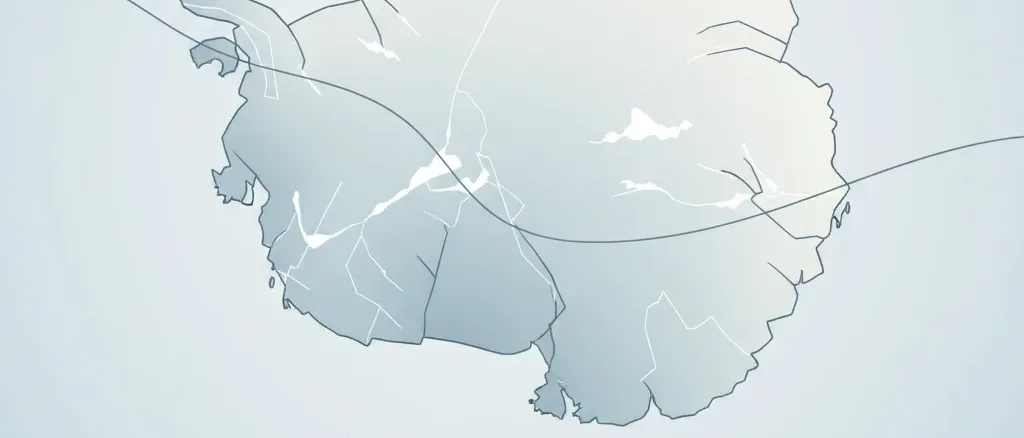
Ketidakstabilan Lapisan Es Antartika Barat dibahas dalam literatur ilmiah dan lingkaran kebijakan iklim tetapi belum memperoleh citra budaya yang tetap sebagaimana kota yang tergenang atau kebakaran hutan. Kebanyakan orang yang pernah mendengarnya tahu secara garis besar bahwa itu berarti kenaikan muka laut yang besar jika runtuh, dan bahwa Antartika mencair. Yang belum dipahami luas adalah bahwa sains titik-balik membedakan antara melampaui ambang tak-terbalikkan (pemicu titik-balik) dan perwujudan penuh kenaikan muka laut — yang bisa memakan waktu berabad-abad. Belum dipahami luas pula bahwa di bawah lintasan emisi saat ini, sejumlah studi pemodelan independen menetapkan probabilitas pemicu di atas 90 % sebelum 2100. Risiko ini secara substansial diremehkan dalam kesadaran publik, yang cenderung membingkai hilangnya es Antartika sebagai masalah yang bergerak lambat dan jauh alih-alih masalah yang berpotensi sudah terkunci.
Perkiraan kasar: ~47,7 % orang dewasa AS melaporkan «takut» atau «sangat takut» terhadap pemanasan global dan perubahan iklim secara umum (Chapman University Survey, Wave 10, 2024) — tidak ada survei khusus WAIS
Aktual
>90 % probabilitas melampaui ambang titik-balik WAIS sebelum 2100 (emisi saat ini, SSP2-4.5)
Global — melampaui titik-balik WAIS adalah peristiwa berskala planet, bukan spesifik populasi
Tampilkan perhitungan
Wunderling dkk. (2025, Earth System Dynamics) memodelkan probabilitas terpicunya enam belas titik-balik iklim di bawah berbagai skenario emisi, menggunakan model elemen-titik-balik terkopel dengan parameter yang dibatasi secara observasional. Di bawah SSP2-4.5 (skenario yang paling dekat dengan komitmen kebijakan global saat ini, memproyeksikan pemanasan ~2,6-2,8°C pada 2100), probabilitas terpicunya WAIS melampaui 90 %. Ini adalah probabilitas pemicu — probabilitas bahwa pemanasan global melampaui ambang suhu yang membuat mundurnya WAIS menjadi swasembada — bukan probabilitas keruntuhan penuh terjadi dalam satu masa hidup manusia. Keruntuhan penuh WAIS akan melepaskan sekitar 3,3-5,3 meter kenaikan muka laut, tetapi selama rentang waktu puluhan hingga ribuan tahun bergantung pada skenario paksaan dan dinamika umpan balik. Melampaui ambang titik-balik mengunci dunia pada hasil akhir itu, tetapi sebagian besar kenaikan muka laut akan terjadi jauh melampaui masa hidup orang dewasa yang ditinjau. Armstrong McKay dkk. (2022, Science) mengestimasi ambang sentral pada ~1,5°C di atas pra-industri, dengan rentang 1-3°C — tingkat yang menurut lintasan saat ini bisa dilampaui pada dekade 2030-an. IPCC AR6 WG1 (2021) menggunakan alur cerita «kemungkinan rendah, dampak tinggi» untuk proses yang menyumbang lebih dari 1 meter kenaikan muka laut tambahan sebelum 2100 dari ketidakstabilan lapisan es, seraya mengakui «ketidakpastian dalam» soal waktu. Rentang ketidakpastian (30-99 %) menangkap kisaran luas dari skenario mitigasi agresif (SSP1-1.9, tempat probabilitas pemicu lebih rendah tetapi masih substansial) hingga jalur bisnis-seperti-biasa.
Catatan: Angka >90 % adalah probabilitas pemicu titik-balik di bawah emisi saat ini (SSP2…
Angka >90 % adalah probabilitas pemicu titik-balik di bawah emisi saat ini (SSP2-4.5), bukan probabilitas keruntuhan penuh WAIS atau kenaikan muka laut mencapai tingkat katastrofik dalam satu masa hidup manusia. Keruntuhan penuh WAIS akan memakan waktu puluhan hingga ribuan tahun setelah ambang titik-balik dilampaui — konsekuensi muka laut terungkap jauh melampaui masa hidup orang dewasa yang ditinjau dalam kebanyakan skenario. Ambang sentral ~1,5°C (Armstrong McKay 2022) mungkin sudah dilampaui secara sesaat: suhu rata-rata global sempat melampaui 1,5°C di atas pra-industri pada 2023-2024, meski metrik yang relevan bagi WAIS adalah rata-rata multidekade yang berkelanjutan alih-alih anomali tahunan puncak. Pembingkaian IPCC AR6 yang lebih berhati-hati berbeda dari probabilitas pemicu >90 % Wunderling 2025 karena kedua penilaian mengukur hal yang berbeda: IPCC secara eksplisit mengecualikan onset mendadak ketidakstabilan lapisan es laut dari proyeksi rentang-kemungkinannya, memperlakukannya sebagai alur cerita «ketidakpastian dalam» / kemungkinan-rendah-dampak-tinggi yang dinilai dalam model CMIP yang tidak menyimulasikan ketidakstabilan WAIS; Wunderling memodelkan pelampauan ambang yang mengunci keruntuhan akhir dalam kerangka elemen-titik-balik. Ini adalah penilaian yang kompatibel alih-alih bertentangan tentang proses yang berbeda. Marine Ice Cliff Instability (MICI), mekanisme yang dapat secara dramatis mempercepat disintegrasi WAIS, tetap diperdebatkan dan dikecualikan dari proyeksi utama IPCC.
Risiko terkait
Risiko lain dengan tema serupa — untuk menjelajahi ketakutan terkait.






Pilih penantang
The West Antarctic Ice Sheet contains enough ice to raise global sea levels by 3.3 to 5.3 metres if fully disgorged into the ocean — an amount sufficient to permanently inundate coastal cities from Miami to Shanghai to Amsterdam. The debate is not whether this would be consequential but whether the process is already irreversibly committed. Wunderling et al. (2025, Earth System Dynamics), using a coupled tipping-element model parameterised from Armstrong McKay et al.’s (2022, Science) threshold synthesis, found that under SSP2-4.5 — the scenario closest to current global policy commitments — the probability of the WAIS crossing its tipping threshold before 2100 exceeded 90%. Armstrong McKay estimated the central threshold at roughly 1.5°C of global warming above pre-industrial levels, within the Paris Agreement’s target range.
The critical distinction is between triggering and completing. When the WAIS tipping point is crossed, global warming has reached a level at which ice retreat becomes self-sustaining: ocean warming beneath the ice shelves melts the underside, the grounding line retreats into deeper water, and the geometry of the ice sheet means retreat accelerates rather than stabilising. But this process unfolds over decades to millennia, not years. Naughten et al. (2023, Nature Climate Change) found that ice-shelf warming in the Amundsen Sea sector is already committed to accelerate at roughly triple the historical rate until at least 2045 regardless of near-term emissions choices — the ocean warming that drives basal melt is locked in by historical emissions. For most people alive today, the sea level consequences lie far beyond their lifetimes even if the threshold is crossed tomorrow. IPCC AR6 frames this as a “low likelihood, high impact” storyline while acknowledging “deep uncertainty.”
The Thwaites Glacier, sometimes called the “Doomsday Glacier,” holds about 65 centimetres of global sea level equivalent and is considered the most vulnerable sector of the WAIS. Satellite altimetry and ocean observations show active basal melting, and the glacier’s “ice shelf” — the floating apron that pins the inland ice — is cracking in ways that some glaciologists believe could accelerate collapse within this century. None of this translates straightforwardly into a personal risk number: the framing here is the probability of a planetary commitment being made in a person’s lifetime, not the probability of dying from it. That probability — on current trajectories — is what makes this entry unusual on this site: the risk is not rare but the consequences are diffuse, slow, and fall predominantly on future generations.
Fakta terkait
Dengan emisi saat ini, model menempatkan probabilitas melewati ambang kritis Antarktika Barat sebelum 2100 di atas 90%. Tidak ada survei yang bahkan mengukur seberapa mungkin publik menganggap hal ini.
Buku besar klaim
Setiap angka di bawah ini adalah apa yang dilaporkan masing-masing sumber, dengan kutipan kata demi kata yang kami andalkan dan bagaimana kami sampai pada angka kami. Klik tautan mana saja untuk memverifikasi langsung.
1/5 sumber diverifikasi secara independen kata demi kata terhadap sumber terkutip
-
[1] Earth System Dynamics — Wunderling, Sakschewski, Rockström, Flores, Hirota, Staal, 2025 — High probability of triggering climate tipping points under current policies modestly amplified by Amazon dieback and permafrost thaw
High probability of triggering climate tipping points under current policies modestly amplified by Amazon dieback and permafrost thaw- Statistik
WAIS triggering probability >90% under SSP2-4.5 (current policy scenario); all sixteen tipping elements analyzed show elevated triggering probabilities under policies as of 2025- Kutipan
“"Under SSP2-4.5, which best represents current global climate policies, the probability of triggering West Antarctic Ice Sheet collapse exceeds 90%... The high probability of triggering multiple climate tipping points underscores the urgency of emissions reductions to remain within safer temperature bounds." ”
- Data sumber dari
- 2025-05-01
- Diakses
- 2026-05-09 · salinan arsip
- Perhitungan
- Wunderling et al. 2025 is the primary quantitative source for the >90% headline. SSP2-4.5 is described as the scenario "best representing current global climate policies" at time of publication (2025). The triggering probability means the probability that global temperature crosses the threshold at which WAIS retreat becomes self-sustaining and irreversible on multi-century timescales. The paper uses a coupled tipping-element model incorporating interactions between tipping elements (e.g., Amazon dieback slightly amplifying WAIS triggering probability through global mean temperature). The core result for WAIS is robust to whether or not Amazon and permafrost interactions are included.
- Independensi
- Wunderling et al. use a tipping-element network model parameterised from the Armstrong McKay 2022 threshold estimates, which are themselves derived from paleoclimate evidence and process understanding. This is a different approach from IPCC AR6's process-based climate model ensemble, though both draw on overlapping paleoclimate evidence for threshold estimates.
-
[2] Science — Armstrong McKay, Staal, Abrams, Winkelmann, Sakschewski, Loriani, Fetzer, Cornell, Rockström, Lenton, 2022 — Exceeding 1.5°C global warming could trigger multiple climate tipping points
Exceeding 1.5°C global warming could trigger multiple climate tipping points- Statistik
WAIS central temperature threshold ~1.5°C (range 1-3°C); 'likely' to be triggered above 1.5°C of global warming; full WAIS collapse would raise sea level by more than 3.3 metres over centuries- Kutipan
“"The West Antarctic Ice Sheet has a central threshold of approximately 1.5°C of global warming above pre-industrial levels, with a range of 1 to 3°C... Above 1.5°C, the WAIS becomes 'likely' to cross its tipping threshold, committing to eventual collapse over decades to millennia and a sea level contribution of 3.3-5.3 metres." ”
- Data sumber dari
- 2022-09-09
- Diakses
- 2026-05-09 · salinan arsip
- Perhitungan
- Armstrong McKay et al. 2022 is the most comprehensive recent revision of climate tipping point thresholds, synthesising paleoclimate evidence and process understanding for sixteen tipping elements. The WAIS threshold lowering from the previous Lenton 2008 estimate of ~3-5°C to ~1.5°C was significant: it places the threshold within the Paris Agreement target range, meaning that even the most ambitious emissions reduction targets do not guarantee avoiding WAIS commitment to collapse. The 1-3°C range captures deep uncertainty in the threshold itself.
- Independensi
- Armstrong McKay et al. synthesise paleoclimate and process evidence using a different methodology than Wunderling et al.'s probabilistic network model. Both reach compatible conclusions about WAIS proximity to its threshold under current conditions.
-
[3] Nature Climate Change — Naughten et al., 2023 — Unavoidable future increase in West Antarctic ice-shelf melting over the twenty-first century
Unavoidable future increase in West Antarctic ice-shelf melting over the twenty-first century- Statistik
All four tested emissions scenarios produce similar accelerated Amundsen Sea warming until at least 2045; ice-shelf warming projected at ~triple the historical rate regardless of near-term mitigation- Kutipan
“"These results suggest that mitigation of greenhouse gases now has limited power to prevent ocean warming that could lead to the collapse of the West Antarctic Ice Sheet... Under all scenarios, the Amundsen Sea is committed to accelerated warming at approximately triple the historical rate until at least 2045." ”
- Data sumber dari
- 2023-10-23
- Diakses
- 2026-05-09 · salinan arsip
- Perhitungan
- Naughten et al. 2023 focuses on ocean warming beneath WAIS ice shelves in the Amundsen Sea sector — the primary driver of ice shelf basal melt and the mechanism by which warming triggers WAIS instability. The finding that all emissions scenarios produce similar warming until 2045 is significant: near-term mitigation cannot prevent the accelerated melting already committed by historical emissions. This does not mean full collapse is committed, only that the process driving it is locked in for at least two decades. The paper's single-model design limits certainty, but it uses a high-resolution ocean model specifically designed for Amundsen Sea dynamics.
- Independensi
- Naughten et al. use an ocean model focused on the Amundsen Sea specifically, rather than the global climate models used by Wunderling 2025 and Armstrong McKay 2022. The result addresses ice-shelf basal melt rates rather than full tipping point probability, providing a physically independent mechanism-level corroboration.
-
[4] Intergovernmental Panel on Climate Change (IPCC), Working Group I, Sixth Assessment Report — Climate Change 2021: The Physical Science Basis — Chapter 9: Ocean, Cryosphere and Sea Level Change
Climate Change 2021: The Physical Science Basis — Chapter 9: Ocean, Cryosphere and Sea Level ChangeSee all 2 Likelier entries citing this source →
- Statistik
Antarctic Ice Sheet 'likely' to keep losing mass all century; MISI/MICI excluded from likely-range projections as 'deep uncertainty'; 'low likelihood, high impact' storyline for >1m additional SLR from these instability processes by 2100- Kutipan
“"Both the Greenland Ice Sheet (virtually certain) and the Antarctic Ice Sheet (likely) will continue to lose mass throughout this century under all considered SSP scenarios... Under high-emissions scenarios, poorly understood processes related to marine ice sheet instability and marine ice cliff instability, characterized by deep uncertainty, have the potential to strongly increase Antarctic mass loss on century to multi-century time scales... These likely range projections do not include those ice-sheet-related processes that are characterized by deep uncertainty... In a low-likelihood, high-impact storyline, under high emissions such processes could in combination contribute more than one additional metre of sea level rise by 2100." ”
- Data sumber dari
- 2021-08-09
- Diakses
- 2026-05-09 · salinan arsip
- Perhitungan
- IPCC AR6 does not assign a numerical probability to WAIS collapse before 2100. Instead it explicitly excludes the abrupt, widespread onset of marine ice sheet instability (MISI) and marine ice cliff instability (MICI) from its likely-range projections because those processes are "characterized by deep uncertainty arising from limited process understanding." It does assess that the Antarctic Ice Sheet is likely to keep losing mass throughout this century, and treats a >1 m additional sea-level-rise contribution from these instability processes by 2100 as a low-likelihood, high-impact storyline under high emissions. The Bamber et al. 2019 structured expert judgment cited by AR6 gave WAIS sea level contribution by 2100 as median 8-18 cm with 95th percentile up to 44-93 cm depending on warming scenario — reflecting deep uncertainty but not ruling out large contributions. IPCC AR6's position is more cautious than Wunderling 2025 because it relies on CMIP model ensembles that do not simulate WAIS collapse, rather than the tipping-point network models used by Wunderling.
-
[5] Columbia Climate School — State of the Planet — Crucial Antarctic Glacier Likely to Collapse Much Earlier than Expected Terverifikasi
Crucial Antarctic Glacier Likely to Collapse Much Earlier than Expected- Statistik
Thwaites Glacier alone holds approximately 65 centimetres of global sea-level-rise equivalent if it melted entirely; identified as the most vulnerable, structurally unstable sector of the West Antarctic Ice Sheet.- Kutipan
“"If the entire glacier were to melt then global sea levels would rise by 65 centimeters, or about two feet." ”
- Data sumber dari
- 2021-12-17
- Diakses
- 2026-07-03 · salinan arsip
- Verifikasi
- Kutipan diambil ulang secara independen dan dikonfirmasi kata demi kata terhadap sumber terkutip selama audit pendasaran kami.
- Perhitungan
- Supplies the Thwaites-specific sea-level-equivalent figure used in the body prose (65 cm). This is a subset of, and consistent with, the 3.3-5.3 m full-WAIS collapse range from Armstrong McKay et al. 2022 (source above) — Thwaites is one glacier within the broader ice sheet. It does not alter the entry's headline >90% tipping-threshold probability, which remains sourced from Wunderling et al. 2025; this source is used only to ground the Thwaites ice-volume detail mentioned in the body text.
- Independensi
- Science journalism from a university climate research center, reporting on glaciological modelling distinct from the tipping-point probability studies (Wunderling 2025, Armstrong McKay 2022) and the ocean-forcing study (Naughten 2023) cited above; used only for the Thwaites-specific ice-volume figure, not for probability estimates.