Kualitas bukti 4.75/5
Skor tinjauan delapan dimensi terhadap rubrik kualitas . Setiap dimensi dinilai 1–5.
- D1 Dasar sumber
- 5/5
- D2 Otoritas sumber
- 5/5
- D3 Aritmetika
- 5/5
- D4 Ketidakpastian
- 4/5
- D5 Cakupan
- 5/5
- D6 Prosa
- 5/5
- D7 Kejujuran persepsi
- 4/5
- D8 Kelengkapan peringatan
- 5/5
≈ Sama mungkinnya dengan
Dipersepsikan
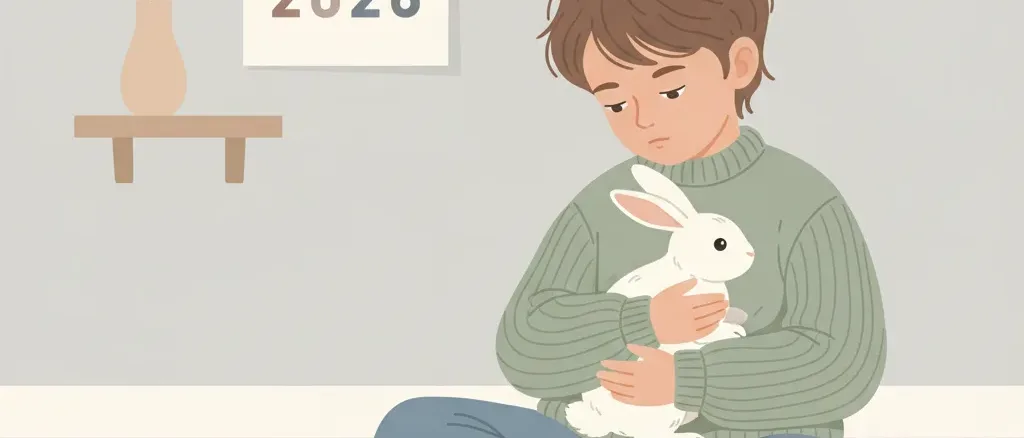
Orang tua dan anak-anak sering mengira kelinci adalah «hewan peliharaan pemula» berumur pendek yang setara dengan hamster — sesuatu yang kemungkinan akan tiada dalam satu atau dua tahun. Dalam praktiknya, kelinci domestik dalam ruangan yang dirawat dengan baik biasanya hidup 8-12 tahun, membuat kelinci yang diberikan kepada anak usia 9 tahun cukup mungkin masih hidup ketika anak itu berusia 13 tahun. Tidak ada survei ketat yang secara langsung mengukur intuisi orang tua tentang masa hidup kelinci dalam konteks kepemilikan hewan peliharaan masa kanak-kanak, sehingga entri ini ditandai berjenis-intuisi.
Perkiraan kasar: banyak orang tua mengira kelinci hidup 2-4 tahun, mirip dengan hamster
Sumber: intuisi redaksi, bukan hasil survei
Aktual
~30 dari 100 kelinci peliharaan dalam ruangan mati dalam 4 tahun setelah diperoleh
Kelinci peliharaan domestik dalam ruangan di rumah tangga keluarga
Tampilkan perhitungan
Sebuah studi retrospektif Jepang atas 898 kelinci peliharaan yang ditangani di klinik hewan eksotis (2006-2020) menemukan masa hidup median 7 tahun (IQR 5-9), dengan 18 % bertahan hidup melampaui 9 tahun. Dengan menerapkan model kelangsungan hidup eksponensial dengan λ = ln(2)/7 ≈ 0,099 per tahun, probabilitas mati dalam 4 tahun setelah diperoleh (pada usia ~8-12 minggu) adalah 1 − e^(−0,099 × 4) ≈ 0,33. House Rabbit Society melaporkan kelinci rumah dalam ruangan biasanya hidup 8-12 tahun dalam kondisi optimal; menggunakan median 10 tahun menghasilkan λ ≈ 0,069 dan P(4 tahun) ≈ 0,24. Estimasi sentral 0,30 membagi antara perawatan tipikal dan optimal, mencerminkan bahwa kelinci pertama seorang anak sering menerima pemeliharaan yang memadai tetapi tidak selalu ahli. Scope adalah subgroup_lifetime: angka itu berlaku untuk jendela 4 tahun setelah perolehan hewan peliharaan, bukan untuk masa hidup dewasa 59 tahun.
Catatan: Scope adalah subgroup_lifetime — ini adalah probabilitas jendela 4 tahun, bukan …
Scope adalah subgroup_lifetime — ini adalah probabilitas jendela 4 tahun, bukan angka masa hidup dewasa 59 tahun. Hasil bervariasi secara signifikan menurut ras (ras kecil seperti Netherland Dwarf hidup lebih lama daripada ras besar seperti Flemish Giant), tempat tinggal dalam ruangan vs. luar ruangan (kelinci luar ruangan memiliki masa hidup median kira-kira setengahnya), status steril/kebiri (tidak mensterilkan membawa risiko kanker rahim seumur hidup yang tinggi pada betina, dan House Rabbit Society melaporkan harapan hidup 8-12 tahun untuk kelinci dalam ruangan yang disteril/dikebiri), usia saat perolehan (kelinci yang lebih tua memiliki lebih sedikit tahun tersisa), dan akses ke perawatan dokter hewan. Kelinci yang diperoleh pada usia 2 tahun alih-alih 8 minggu akan menghadapi risiko kematian 4 tahun yang jauh lebih rendah. Estimasi sentral 30 % mencerminkan kelinci peliharaan dalam ruangan tipikal dengan perawatan rumah-tangga-anak berkualitas rata-rata.
Risiko terkait
Risiko lain dengan tema serupa — untuk menjelajahi ketakutan terkait.
Kucing rumahan kabur
Berapa peluang kucing yang selalu tinggal di dalam rumah mengalami cedera serius atau kematian setelah kabur ke luar?

Hamster mati sebelum remaja
Berapa kemungkinan hamster yang diberikan kepada anak usia 9 tahun mati sebelum anak itu berusia 13 tahun?


Gigitan anjing lepas
Berapa kemungkinan anjing Anda yang tidak diikat menggigit seseorang atau anjing lain?

Kehilangan kakek-nenek di masa kecil
Berapa kemungkinan anak usia 9 tahun kehilangan setidaknya satu kakek-nenek sebelum berusia 18 tahun?

Anak & konten eksplisit
Berapa kemungkinan seorang anak menemukan konten eksplisit atau kekerasan daring sebelum usia 13 tahun?


Keputusan yang dipengaruhi risiko ini
Pilihan yang bergantung pada risiko ini: bagaimana pertimbangannya ditimbang.
Beritahu kebenaran vs. berbohong soal kematian
% menyesal dengan pilihan ini
Ketidakaktifan mendominasi
Penyesalan tidak bertindak ∞× lebih tinggi
Pilih penantang
Domestic rabbits live far longer than most people expect. A well-cared-for indoor pet rabbit has a median lifespan of roughly 7–10 years depending on breed, care quality, and whether it has been spayed or neutered. A child who receives a rabbit at age 9 is likely to still have that animal when they turn 13 — the four-year window that matters here only captures the early portion of a rabbit’s expected life. Applying an exponential survival model to the median lifespan reported in peer-reviewed retrospective data suggests roughly 25–33% of typical pet rabbits die within four years of acquisition. The central estimate of 30% reflects average child-household care, which is adequate but rarely as thorough as the husbandry practiced by dedicated rabbit owners.
The contrast with hamsters is stark and often overlooked. A Syrian hamster — the most common species sold in pet stores — has an average lifespan of two to three years. A hamster acquired at age 9 is nearly certain to be gone before the child turns 12, let alone 13. Rabbits are routinely grouped with hamsters and guinea pigs in the cultural category of “small, easy, short-lived pets,” but that framing is wrong for rabbits. A rabbit is more comparable in longevity to a cat than to a hamster: both can live into their early teens with good care, and both require a decade-long commitment rather than a 1–3 year one.
Several variables shift the probability meaningfully. Outdoor rabbits face predators, extremes of temperature, and diseases that cut life expectancy substantially compared to indoor counterparts. Unspayed female rabbits carry a high lifetime risk of developing uterine cancer, which makes spaying a major longevity intervention, not merely an optional procedure — the House Rabbit Society notes that a spayed or neutered house rabbit has a life expectancy of 8 to 12 years. Small breeds such as Netherland Dwarfs and Mini Lops typically outlive large breeds like Flemish Giants by several years. A rabbit acquired at eight weeks old faces a different 4-year survival curve than one acquired as a two-year-old adult from a rescue. These factors compound: the best-case scenario (indoor, neutered, small breed, rabbit-specialist vet) produces a 4-year mortality risk closer to 18–20%; the worst realistic scenario (outdoor, unspayed female, minimal veterinary care) climbs toward the top of this entry’s uncertainty range, around 45%.
Fakta terkait
Sekitar 3 in 10 kelinci peliharaan dalam ruangan mati dalam 4 tahun setelah seorang anak memperolehnya. Kematian hewan peliharaan pertama cukup umum sehingga keluarga sering menghadapi pertanyaan bagaimana menjelaskannya.
Dalam kohort berkabung di Swedia, 27% orang tua yang menghindari bicara jujur tentang kematian kemudian menyesal tidak melakukannya. Tak satu pun dari 147 orang tua yang berbicara menyesalinya.
Buku besar klaim
Setiap angka di bawah ini adalah apa yang dilaporkan masing-masing sumber, dengan kutipan kata demi kata yang kami andalkan dan bagaimana kami sampai pada angka kami. Klik tautan mana saja untuk memverifikasi langsung.
1/3 sumber diverifikasi secara independen kata demi kata terhadap sumber terkutip
-
[1] Journal of Exotic Pet Medicine (ScienceDirect) — Age at death and cause of death of pet rabbits (Oryctolagus cuniculus) seen at an exotic animal clinic in Tokyo, Japan: a retrospective study of 898 cases (2006–2020)
Age at death and cause of death of pet rabbits (Oryctolagus cuniculus) seen at an exotic animal clinic in Tokyo, Japan: a retrospective study of 898 cases (2006–2020)- Statistik
Median age at death of 898 pet rabbits was 7 years (IQR 5–9); 18% lived beyond 9 years- Kutipan
“"The median age at death was 7 years (interquartile range: 5 to 9 years), and 18% of all rabbits lived beyond 9 years. The main causes of death included neoplasia (n = 223; 24.8%), gastrointestinal disease (n = 135; 15.0%), bacterial abscess (n = 90; 10.0%), urinary disease (n = 85; 9.5%), trauma (n = 44; 4.9%), and cardiac disease (n = 27; 3.0%)." ”
- Data sumber dari
- 2022-07-01
- Diakses
- 2026-05-03 · salinan arsip
- Perhitungan
- Median lifespan of 7 years from this peer-reviewed retrospective is the primary anchor for the central estimate. Applying an exponential survival model: λ = ln(2) / 7 ≈ 0.099 per year. P(rabbit dies within 4 years of acquisition) = 1 − e^(−0.099 × 4) = 1 − 0.671 ≈ 0.33. This population (clinic patients in an exotic-animal practice in Tokyo) likely overrepresents rabbits receiving better-than-average care, so 0.33 may be a slight underestimate relative to the average child's pet rabbit. Used as the lower anchor of the central estimate.
- Independensi
- Drawn from a Japanese exotic-animal clinic's case records (2006–2020); methodologically independent of the UK VetCompass cohort and the House Rabbit Society lifespan guidance.
-
[2] House Rabbit Society — How Long Do Rabbits Live? Terverifikasi
How Long Do Rabbits Live?- Statistik
Indoor house rabbits typically live 8–12 years- Kutipan
“"Indoor house rabbits typically live 8–12 years, depending on their size, breed, and the quality of care they receive. A well-cared-for house rabbit that has been spayed or neutered early in life has a life expectancy of 8 to 12 years." ”
- Data sumber dari
- 2024-01-01
- Diakses
- 2026-05-03 · salinan arsip
- Verifikasi
- Kutipan diambil ulang secara independen dan dikonfirmasi kata demi kata terhadap sumber terkutip selama audit pendasaran kami.
- Perhitungan
- Under ideal indoor care (spayed/neutered, optimal diet), median lifespan is approximately 10 years. Applying exponential survival: λ = ln(2)/10 ≈ 0.069 per year. P(dies within 4 years) = 1 − e^(−0.069 × 4) ≈ 0.24. This represents the lower bound of the uncertainty range — best-case indoor care. The 12-year upper end of HRS's range gives λ = 0.058, P(4 years) ≈ 0.21. The 8-year lower end gives λ = 0.087, P(4 years) ≈ 0.30, consistent with the central estimate. Difference between HRS guidance and clinical studies likely reflects selection bias in both directions: HRS population are committed rabbit owners; clinic patients skew toward unwell rabbits.
- Independensi
- House Rabbit Society is the leading US rabbit welfare organization, drawing on veterinary guidance and member surveys. Methodologically independent of the Japanese and UK academic studies.
-
[3] Veterinary Record / O'Neill et al. (VetCompass Programme) — Morbidity and mortality of domestic rabbits (Oryctolagus cuniculus) under primary veterinary care in England
Morbidity and mortality of domestic rabbits (Oryctolagus cuniculus) under primary veterinary care in England- Statistik
Median age at death among 370 rabbits that died during the study was 4.3 years (IQR 2.1–7.0, range 0.1–14.4)- Kutipan
“"The median age at death of the 370 rabbits that died during the study was 4.3 years (IQR 2.1–7.0, range 0.1–14.4). For males, the median age at death was older (5.2 years, IQR 3.0–8.1, range 0.2–14.4) than for females (3.7 years, IQR 2.0–5.9, range 0.1–11.8)." ”
- Data sumber dari
- 2020-01-01
- Diakses
- 2026-05-03 · salinan arsip
- Perhitungan
- The VetCompass UK figure of 4.3 years is the median age at death among rabbits that died during a 1-year observational window (2013) across 107 clinics — it is NOT a cohort survival median. It captures which rabbits were dying at the time of observation, which skews toward younger ages because older rabbits had not yet died. This number should not be read as "median lifespan = 4.3 years." The Japanese retrospective (7-year median) is a more direct measure of lifespan because it follows rabbits through to death. The UK study is included as independent corroboration of mortality patterns and cause-of-death data (flystrike, GI stasis, anorexia) rather than as a lifespan anchor. The UK study also includes outdoor rabbits, who have significantly shorter lifespans than indoor pets.
- Independensi
- VetCompass draws from primary-care veterinary records across England in 2013; methodologically independent of both the Japanese clinic study and the HRS member-survey data.