Kualitas bukti 4.25/5
Skor tinjauan delapan dimensi terhadap rubrik kualitas . Setiap dimensi dinilai 1–5.
- D1 Dasar sumber
- 4/5
- D2 Otoritas sumber
- 5/5
- D3 Aritmetika
- 4/5
- D4 Ketidakpastian
- 4/5
- D5 Cakupan
- 4/5
- D6 Prosa
- 4/5
- D7 Kejujuran persepsi
- 4/5
- D8 Kelengkapan peringatan
- 5/5
● faktor Anda — klik risiko ini ▾ untuk menampilkan
- Faktor Anda
≈ Sama mungkinnya dengan
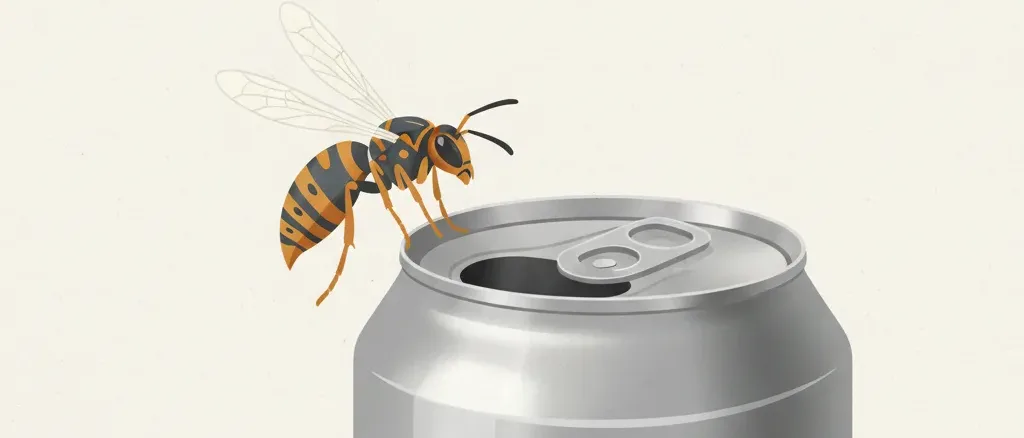
Dipersepsikan
Skenario «lebah di kaleng soda» adalah salah satu kisah bahaya luar ruangan yang lebih mencolok dan luas beredar. Media sosial memperbesar laporan kasus sesekali tentang orang yang menelan serangga, merasakan sengatan di tenggorokan, dan memerlukan penanganan darurat, yang menggelembungkan frekuensi yang dirasakan secara signifikan dibanding angka sebenarnya. Kebanyakan orang yang menghabiskan musim panas minum di luar ruangan menaksir terlalu tinggi seberapa sering hal ini berakhir buruk.
Perkiraan kasar: kebanyakan orang yang minum di luar ruangan mengira ini terjadi beberapa kali setahun pada seseorang yang samar-samar mereka kenal
Sumber: intuisi redaksi, bukan hasil survei
Aktual
~195 perkiraan kunjungan gawat darurat akibat sengatan orofaring (mulut/tenggorokan) per tahun, Amerika Serikat
total populasi AS
Tampilkan perhitungan
Huff, Phillips, dan Keith (Wilderness & Environmental Medicine, 2025) menggunakan data NEISS (2004–2023) dan secara langsung memperkirakan bahwa antara 2004 dan 2023 terdapat sekitar 3890 (95 % CI, 2458,55–5320,79) orang dengan sengatan orofaring (mulut dan tenggorokan) dari lebah, tabuhan, tawon kuning, atau tawon yang datang ke unit gawat darurat AS — kira-kira 195 per tahun sepanjang jendela 20 tahun. Probabilitas tahunan: 195 / 335.000.000 ≈ 5,8 × 10^-7. Dikompaunkan selama 59 tahun sisa hidup dewasa: 1 - (1 - 5,8e-7)^59 ≈ 3,4 × 10^-5 ≈ 1 dari 29.000. Pita ketidakpastian membawa 95 % CI studi itu sendiri melalui pengompaunan seumur hidup yang sama (2458,55–5320,79 selama 20 tahun → ~123–266/tahun). «Sengatan orofaring» lebih luas daripada skenario spesifik minum dari kaleng/botol, tetapi studi NEISS adalah satu-satunya sumber surveilans AS yang secara langsung mengukur rute ini.
Catatan: Mekanisme di sini bukan tersedak mekanis — lebah dan tawon terlalu kecil untuk m…
Mekanisme di sini bukan tersedak mekanis — lebah dan tawon terlalu kecil untuk menyumbat saluran napas sebagai objek fisik. Bahayanya adalah sengatan itu sendiri: di dalam mulut atau tenggorokan sengatan menyebabkan edema inflamasi lokal yang dapat menyempitkan saluran napas bahkan pada individu non-alergi, dan pada mereka yang alergi bisa dapat memicu anafilaksis sistemik penuh. Angka ~195/tahun adalah perkiraan nasional milik studi NEISS 2025 sendiri untuk kunjungan gawat darurat akibat sengatan orofaring (~3.890 selama 2004–2023); ini bukan hitungan langsung «menelan serangga saat minum» dan mungkin mencakup rute sengatan oral lainnya (mis. saat makan). Kematian akibat serangga yang secara spesifik tertelan tidak dilacak secara terpisah.
Risiko terkait
Risiko lain dengan tema serupa — untuk menjelajahi ketakutan terkait.
Anafilaksis dari sengatan
Berapa kemungkinan sengatan lebah atau tawon memicu syok anafilaksis yang memerlukan suntikan epinefrin?

Kematian akibat sengatan lebah/tawon
Berapa peluang meninggal akibat sengatan lebah, tawon, atau hornet?



Pilih penantang
A bee or wasp inside a can or bottle is a genuine, if rare, hazard — and the mechanism is less obvious than most people assume. The danger is not that the insect physically blocks your airway; bees and wasps are small enough to swallow without obstruction. The danger is the sting: delivered inside the mouth, posterior pharynx, or esophagus, it triggers localized inflammatory edema in confined anatomy where even modest swelling can produce stridor, difficulty swallowing, and in severe cases airway compromise — even in people with no prior venom allergy. In those who do have venom allergy (roughly 3% of US adults), an oropharyngeal sting can trigger full systemic anaphylaxis.
A 2025 NEISS analysis by Huff, Phillips, and Keith directly estimated that between 2004 and 2023 approximately 3,890 people presented to US emergency departments with an oropharyngeal (mouth or throat) sting from a bee, hornet, yellow jacket, or wasp — about 195 per year, roughly 5% of all sting ED visits. Spread over 335 million people and 59 remaining adult years, that comes to roughly 1 in 29,000 over a lifetime. The large majority were minor: about 98% of oropharyngeal sting patients were not admitted to the hospital. Deaths from this specific route are not separately tracked in US surveillance; they are absorbed into the ICD-10 X23 “sting” category that averages ~72 per year from all mechanisms combined.
The fear is real but the framing matters: the scenario to worry about is not “the insect itself gets stuck” but “the sting triggers swelling or anaphylaxis in a place the body finds very hard to manage.” Practical risk reduction is simple — check the opening of outdoor cans and bottles before drinking, pour into a clear glass, or use a cup with a lid. These are low-friction habits that effectively eliminate the exposure route without any change to outdoor behavior otherwise.
Fakta terkait
Sengatan di mulut dan tenggorokan, sering kali dari serangga yang tertelan bersama makanan atau minuman, membawa sekitar 11,000 orang per tahun ke UGD di AS. Peluang seumur hidup sekitar 1 in 500.
Buku besar klaim
Setiap angka di bawah ini adalah apa yang dilaporkan masing-masing sumber, dengan kutipan kata demi kata yang kami andalkan dan bagaimana kami sampai pada angka kami. Klik tautan mana saja untuk memverifikasi langsung.
4/4 sumber diverifikasi secara independen kata demi kata terhadap sumber terkutip
-
[1] Wilderness & Environmental Medicine (Huff, Phillips, Keith) — Oropharyngeal Bee, Hornet, Yellow Jacket, and Wasp Stings: A National Electronic Injury Surveillance System Analysis and Scoping Review Terverifikasi
Oropharyngeal Bee, Hornet, Yellow Jacket, and Wasp Stings: A National Electronic Injury Surveillance System Analysis and Scoping Review- Statistik
An estimated 3890 (95% CI, 2458.55–5320.79) oropharyngeal sting ED presentations in the US over 2004–2023 (~195/year); oropharyngeal stings were ~5.08% of all stings; 98.08% of oropharyngeal sting victims were not admitted- Kutipan
“"Between 2004 and 2023, there were an estimated 3890 (95% CI, 2458.55–5320.79) people with oropharyngeal stings from bees, hornets, yellow jackets, or wasps in the United States who presented to emergency departments." "Stings to the oropharyngeal region represented an estimated 5.08% (95% CI, 3.59–6.56) of all stings." "Overall, 98.08% (95% CI, 94.25–100.00) of victims of oropharyngeal stings were not admitted to the hospital." ”
- Data sumber dari
- 2025-03-01
- Diakses
- 2026-05-04 · salinan arsip
- Verifikasi
- Kutipan diambil ulang secara independen dan dikonfirmasi kata demi kata terhadap sumber terkutip selama audit pendasaran kami.
- Perhitungan
- Used for the direct national estimate: ~3890 oropharyngeal sting ED presentations over 2004–2023 = ~195/year. Annual probability 195/335,000,000 ≈ 5.8e-7; compounded over 59 years ≈ 3.4e-5 ≈ 1 in 29,000. The 95% CI (2458.55–5320.79 over 20 years) is carried through the same compounding for the uncertainty band. The ~1.92% hospitalization sub-fraction (98.08% not admitted) is a severity anchor.
- Independensi
- Based on NEISS (National Electronic Injury Surveillance System) consumer product injury data, methodologically independent of NCHS death-certificate mortality counts.
-
[2] Frontiers in Veterinary Science (Marinho & Soto-Blanco) — Toxicological Risk Assessment of the Accidental Ingestion of a Honeybee (Apis mellifera L.) Present in Food Terverifikasi
Toxicological Risk Assessment of the Accidental Ingestion of a Honeybee (Apis mellifera L.) Present in Food- Statistik
The actual number of accidental honeybee ingestion incidents remains unknown; though a rare condition, ingestion may induce an allergic reaction in sensitive individuals- Kutipan
“A number of anecdotal reports of accidental ingestion of insects are largely available, but the actual number remains unknown. Thus, although it is a rare condition, there is the risk that the ingestion of a honeybee may induce an allergic reaction to some venom components in sensitive individuals. ”
- Data sumber dari
- 2020-10-01
- Diakses
- 2026-05-04 · salinan arsip
- Verifikasi
- Kutipan diambil ulang secara independen dan dikonfirmasi kata demi kata terhadap sumber terkutip selama audit pendasaran kami.
- Perhitungan
- Supports the surveillance gap: the peer-reviewed toxicological assessment states that the actual number of accidental ingestion incidents remains unknown (reports are anecdotal). Used to justify the wide uncertainty band and to establish that the Huff 2025 oropharyngeal fraction is the best available approximation. Note: this source addresses honeybees only and does not itself quantify deaths or ER visits.
- Independensi
- Toxicological review drawing on venom-composition and clinical toxicology literature, independent of NEISS and NCHS data streams.
-
[3] American Family Physician (Golden DB) — Stinging Insect Allergy Terverifikasi
Stinging Insect AllergySee all 2 Likelier entries citing this source →
- Statistik
Systemic allergic reactions to insect stings are estimated to occur in about 3% of US adults (and about 1% of children)- Kutipan
“"Systemic allergic reactions to insect stings are estimated to occur in about 1 percent of children and 3 percent of adults." ”
- Data sumber dari
- 2003-06-15
- Diakses
- 2026-07-03 · salinan arsip
- Verifikasi
- Kutipan diambil ulang secara independen dan dikonfirmasi kata demi kata terhadap sumber terkutip selama audit pendasaran kami.
- Perhitungan
- Supports the body-prose reference to venom-allergy prevalence (~3% of US adults) used as context for anaphylaxis risk from an oropharyngeal sting. Not used in the native/normalized probability calculation, which is based on the Huff 2025 NEISS oropharyngeal-fraction analysis.
- Independensi
- Independent clinical epidemiology review (American Family Physician), methodologically distinct from the NEISS-based Huff 2025 analysis and the honeybee-ingestion toxicological review.
-
[4] Centers for Disease Control and Prevention — Morbidity and Mortality Weekly Report — QuickStats: Number of Deaths from Hornet, Wasp, and Bee Stings Among Males and Females — National Vital Statistics System, United States, 2011-2021 Terverifikasi
QuickStats: Number of Deaths from Hornet, Wasp, and Bee Stings Among Males and Females — National Vital Statistics System, United States, 2011-2021- Statistik
788 total US deaths from hornet, wasp, and bee stings during 2011-2021, an average of 72 deaths per year; classified under ICD-10 code X23- Kutipan
“"During 2011-2021, a total of 788 deaths from hornet, wasp, and bee stings occurred (an average of 72 deaths per year). [...] Deaths from hornet, wasp, and bee sting as underlying cause of death were coded as X23, according to the International Classification of Diseases, Tenth Revision." ”
- Data sumber dari
- 2023-07-07
- Diakses
- 2026-07-03 · salinan arsip
- Verifikasi
- Kutipan diambil ulang secara independen dan dikonfirmasi kata demi kata terhadap sumber terkutip selama audit pendasaran kami.
- Perhitungan
- Supports the body-prose reference to overall Hymenoptera sting deaths (~72/year, ICD-10 X23) used as a severity anchor and to explain why deaths from the specific swallowed-insect/oropharyngeal route are not separately tracked in US surveillance. Not used in the native/normalized oropharyngeal-ED-visit calculation.
- Independensi
- NCHS death-certificate mortality data (National Vital Statistics System), methodologically independent of the NEISS-based Huff 2025 ED-visit analysis.