Якість доказів 4.25/5
Восьмивимірна оцінка перевірки за рубрикою якості . Кожен вимір оцінений 1–5.
- D1 Прив’язка до джерел
- 4/5
- D2 Авторитет джерела
- 5/5
- D3 Арифметика
- 4/5
- D4 Невизначеність
- 4/5
- D5 Сфера
- 4/5
- D6 Проза
- 4/5
- D7 Чесність сприйняття
- 4/5
- D8 Повнота застережень
- 5/5
● ваші чинники — натисніть на цей ризик ▾ для відображення
- Ваші фактори
≈ Так само ймовірно, як
Сприйнятий
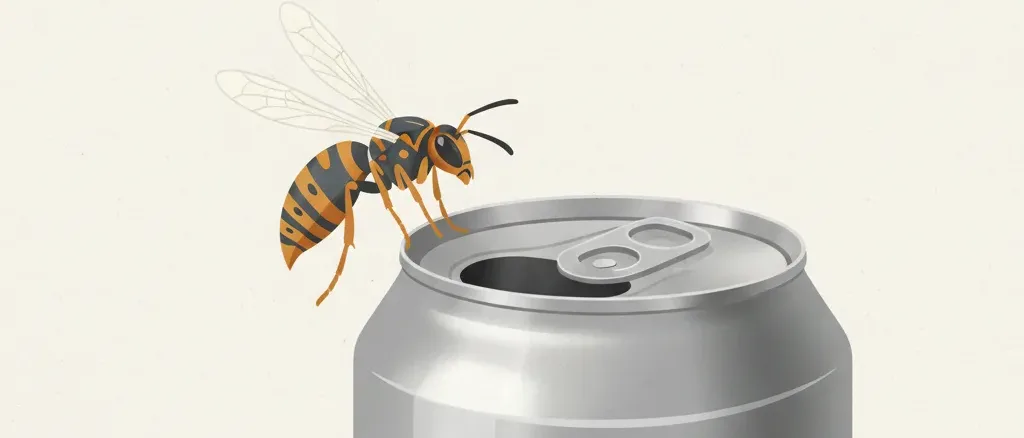
Сценарій «бджола в банці газованки» — одна з яскравіших і широко поширюваних історій про небезпеки на відкритому повітрі. Соцмережі підсилюють поодинокі повідомлення про людей, які проковтнули комаху, відчули укус у горлі й потребували невідкладного лікування, що суттєво завищує сприйману частоту порівняно з фактичним показником. Більшість тих, хто провів літо, п'ючи на вулиці, переоцінюють, як часто це закінчується погано.
Грубна оцінка: більшість тих, хто п'є на вулиці, вважають, що це трапляється кілька разів на рік із кимось, кого вони приблизно знають
Джерело: редакційна інтуїція, не опитування
Фактичний
~195 оцінюваних звернень до невідкладної допомоги через ротоглоткові (рот/горло) укуси на рік, Сполучені Штати
загальне населення США
Показати обчислення
Huff, Phillips та Keith (Wilderness & Environmental Medicine, 2025) використали дані NEISS (2004–2023) і безпосередньо оцінили, що між 2004 і 2023 роками було приблизно 3890 (95 % ДІ, 2458,55–5320,79) людей із ротоглотковими (рот і горло) укусами бджіл, шершнів, жовтих ос або інших ос, які звернулися до відділень невідкладної допомоги США, — приблизно 195 на рік за 20-річний період. Річна ймовірність: 195 / 335 000 000 ≈ 5,8 × 10^-7. Розрахована за 59 років решти дорослого життя: 1 − (1 − 5,8e-7)^59 ≈ 3,4 × 10^-5 ≈ 1 з 29 000. Смуга невизначеності переносить власний 95 % ДІ дослідження через те саме довічне обчислення (2458,55–5320,79 за 20 років → ~123–266/рік). «Ротоглотковий укус» ширший за конкретний сценарій пиття з банки/пляшки, але дослідження NEISS — єдине наглядове джерело США, яке безпосередньо кількісно оцінює цей шлях.
Застереження: Механізм тут — не механічне удушення: бджоли й оси надто малі, щоб перекрити дих…
Механізм тут — не механічне удушення: бджоли й оси надто малі, щоб перекрити дихальні шляхи як фізичний об'єкт. Небезпека — сам укус: усередині рота чи горла він спричиняє локалізований запальний набряк, який може звузити дихальні шляхи навіть у неалергічних людей, а в тих, хто має алергію на отруту, може запустити повну системну анафілаксію. Цифра ~195/рік — це власна національна оцінка дослідження NEISS 2025 року щодо звернень до невідкладної допомоги через ротоглоткові укуси (~3890 за 2004–2023); це не прямий підрахунок «проковтнутої комахи під час пиття» і може включати інші шляхи орального укусу (наприклад, під час їжі). Смерті саме від проковтнутих комах окремо не відстежуються.
Пов’язані ризики
Інші ризики на схожі теми — для вивчення пов’язаних страхів.

Анафілаксія після укусу
Які шанси, що укус бджоли чи оси спровокує анафілактичний шок із потребою в ін'єкції адреналіну?




Обрати порівнюваний
A bee or wasp inside a can or bottle is a genuine, if rare, hazard — and the mechanism is less obvious than most people assume. The danger is not that the insect physically blocks your airway; bees and wasps are small enough to swallow without obstruction. The danger is the sting: delivered inside the mouth, posterior pharynx, or esophagus, it triggers localized inflammatory edema in confined anatomy where even modest swelling can produce stridor, difficulty swallowing, and in severe cases airway compromise — even in people with no prior venom allergy. In those who do have venom allergy (roughly 3% of US adults), an oropharyngeal sting can trigger full systemic anaphylaxis.
A 2025 NEISS analysis by Huff, Phillips, and Keith directly estimated that between 2004 and 2023 approximately 3,890 people presented to US emergency departments with an oropharyngeal (mouth or throat) sting from a bee, hornet, yellow jacket, or wasp — about 195 per year, roughly 5% of all sting ED visits. Spread over 335 million people and 59 remaining adult years, that comes to roughly 1 in 29,000 over a lifetime. The large majority were minor: about 98% of oropharyngeal sting patients were not admitted to the hospital. Deaths from this specific route are not separately tracked in US surveillance; they are absorbed into the ICD-10 X23 “sting” category that averages ~72 per year from all mechanisms combined.
The fear is real but the framing matters: the scenario to worry about is not “the insect itself gets stuck” but “the sting triggers swelling or anaphylaxis in a place the body finds very hard to manage.” Practical risk reduction is simple — check the opening of outdoor cans and bottles before drinking, pour into a clear glass, or use a cup with a lid. These are low-friction habits that effectively eliminate the exposure route without any change to outdoor behavior otherwise.
Пов’язані факти
Укуси в роті та горлі, часто від комахи, проковтнутої з їжею чи напоєм, щороку відправляють близько 11,000 людей до відділень невідкладної допомоги в США. Довічна ймовірність — близько 1 in 500.
Реєстр тверджень
Кожне число нижче — це те, що повідомило джерело, з дослівною цитатою, на яку ми спиралися, та тим, як ми дійшли до нашої цифри. Натисніть на посилання, щоб перевірити самостійно.
4/4 джерел незалежно перевірено дослівно за вказаним джерелом
-
[1] Wilderness & Environmental Medicine (Huff, Phillips, Keith) — Oropharyngeal Bee, Hornet, Yellow Jacket, and Wasp Stings: A National Electronic Injury Surveillance System Analysis and Scoping Review Перевірено
Oropharyngeal Bee, Hornet, Yellow Jacket, and Wasp Stings: A National Electronic Injury Surveillance System Analysis and Scoping Review- Статистика
An estimated 3890 (95% CI, 2458.55–5320.79) oropharyngeal sting ED presentations in the US over 2004–2023 (~195/year); oropharyngeal stings were ~5.08% of all stings; 98.08% of oropharyngeal sting victims were not admitted- Витяг
“"Between 2004 and 2023, there were an estimated 3890 (95% CI, 2458.55–5320.79) people with oropharyngeal stings from bees, hornets, yellow jackets, or wasps in the United States who presented to emergency departments." "Stings to the oropharyngeal region represented an estimated 5.08% (95% CI, 3.59–6.56) of all stings." "Overall, 98.08% (95% CI, 94.25–100.00) of victims of oropharyngeal stings were not admitted to the hospital." ”
- Дані джерела:
- 2025-03-01
- Дата звернення
- 2026-05-04 · архівна копія
- Перевірка
- Витяг незалежно повторно отримано та дослівно підтверджено за вказаним джерелом під час нашого аудиту обґрунтованості.
- Розрахунок
- Used for the direct national estimate: ~3890 oropharyngeal sting ED presentations over 2004–2023 = ~195/year. Annual probability 195/335,000,000 ≈ 5.8e-7; compounded over 59 years ≈ 3.4e-5 ≈ 1 in 29,000. The 95% CI (2458.55–5320.79 over 20 years) is carried through the same compounding for the uncertainty band. The ~1.92% hospitalization sub-fraction (98.08% not admitted) is a severity anchor.
- Незалежність
- Based on NEISS (National Electronic Injury Surveillance System) consumer product injury data, methodologically independent of NCHS death-certificate mortality counts.
-
[2] Frontiers in Veterinary Science (Marinho & Soto-Blanco) — Toxicological Risk Assessment of the Accidental Ingestion of a Honeybee (Apis mellifera L.) Present in Food Перевірено
Toxicological Risk Assessment of the Accidental Ingestion of a Honeybee (Apis mellifera L.) Present in Food- Статистика
The actual number of accidental honeybee ingestion incidents remains unknown; though a rare condition, ingestion may induce an allergic reaction in sensitive individuals- Витяг
“A number of anecdotal reports of accidental ingestion of insects are largely available, but the actual number remains unknown. Thus, although it is a rare condition, there is the risk that the ingestion of a honeybee may induce an allergic reaction to some venom components in sensitive individuals. ”
- Дані джерела:
- 2020-10-01
- Дата звернення
- 2026-05-04 · архівна копія
- Перевірка
- Витяг незалежно повторно отримано та дослівно підтверджено за вказаним джерелом під час нашого аудиту обґрунтованості.
- Розрахунок
- Supports the surveillance gap: the peer-reviewed toxicological assessment states that the actual number of accidental ingestion incidents remains unknown (reports are anecdotal). Used to justify the wide uncertainty band and to establish that the Huff 2025 oropharyngeal fraction is the best available approximation. Note: this source addresses honeybees only and does not itself quantify deaths or ER visits.
- Незалежність
- Toxicological review drawing on venom-composition and clinical toxicology literature, independent of NEISS and NCHS data streams.
-
[3] American Family Physician (Golden DB) — Stinging Insect Allergy Перевірено
Stinging Insect AllergySee all 2 Likelier entries citing this source →
- Статистика
Systemic allergic reactions to insect stings are estimated to occur in about 3% of US adults (and about 1% of children)- Витяг
“"Systemic allergic reactions to insect stings are estimated to occur in about 1 percent of children and 3 percent of adults." ”
- Дані джерела:
- 2003-06-15
- Дата звернення
- 2026-07-03 · архівна копія
- Перевірка
- Витяг незалежно повторно отримано та дослівно підтверджено за вказаним джерелом під час нашого аудиту обґрунтованості.
- Розрахунок
- Supports the body-prose reference to venom-allergy prevalence (~3% of US adults) used as context for anaphylaxis risk from an oropharyngeal sting. Not used in the native/normalized probability calculation, which is based on the Huff 2025 NEISS oropharyngeal-fraction analysis.
- Незалежність
- Independent clinical epidemiology review (American Family Physician), methodologically distinct from the NEISS-based Huff 2025 analysis and the honeybee-ingestion toxicological review.
-
[4] Centers for Disease Control and Prevention — Morbidity and Mortality Weekly Report — QuickStats: Number of Deaths from Hornet, Wasp, and Bee Stings Among Males and Females — National Vital Statistics System, United States, 2011-2021 Перевірено
QuickStats: Number of Deaths from Hornet, Wasp, and Bee Stings Among Males and Females — National Vital Statistics System, United States, 2011-2021- Статистика
788 total US deaths from hornet, wasp, and bee stings during 2011-2021, an average of 72 deaths per year; classified under ICD-10 code X23- Витяг
“"During 2011-2021, a total of 788 deaths from hornet, wasp, and bee stings occurred (an average of 72 deaths per year). [...] Deaths from hornet, wasp, and bee sting as underlying cause of death were coded as X23, according to the International Classification of Diseases, Tenth Revision." ”
- Дані джерела:
- 2023-07-07
- Дата звернення
- 2026-07-03 · архівна копія
- Перевірка
- Витяг незалежно повторно отримано та дослівно підтверджено за вказаним джерелом під час нашого аудиту обґрунтованості.
- Розрахунок
- Supports the body-prose reference to overall Hymenoptera sting deaths (~72/year, ICD-10 X23) used as a severity anchor and to explain why deaths from the specific swallowed-insect/oropharyngeal route are not separately tracked in US surveillance. Not used in the native/normalized oropharyngeal-ED-visit calculation.
- Незалежність
- NCHS death-certificate mortality data (National Vital Statistics System), methodologically independent of the NEISS-based Huff 2025 ED-visit analysis.