Kwaliteit van bewijs 4.25/5
Beoordelingsscore op acht dimensies volgens de kwaliteitsrubriek . Elke dimensie krijgt een score van 1 tot 5.
- D1 Verankering in bronnen
- 4/5
- D2 Autoriteit van bronnen
- 5/5
- D3 Rekenkunde
- 4/5
- D4 Onzekerheid
- 4/5
- D5 Bereik
- 4/5
- D6 Proza
- 4/5
- D7 Eerlijkheid over perceptie
- 4/5
- D8 Volledigheid van voorbehouden
- 5/5
● uw factoren — klik op dit risico ▾ om te tonen
- Jouw factoren
≈ Net zo waarschijnlijk als
Waargenomen
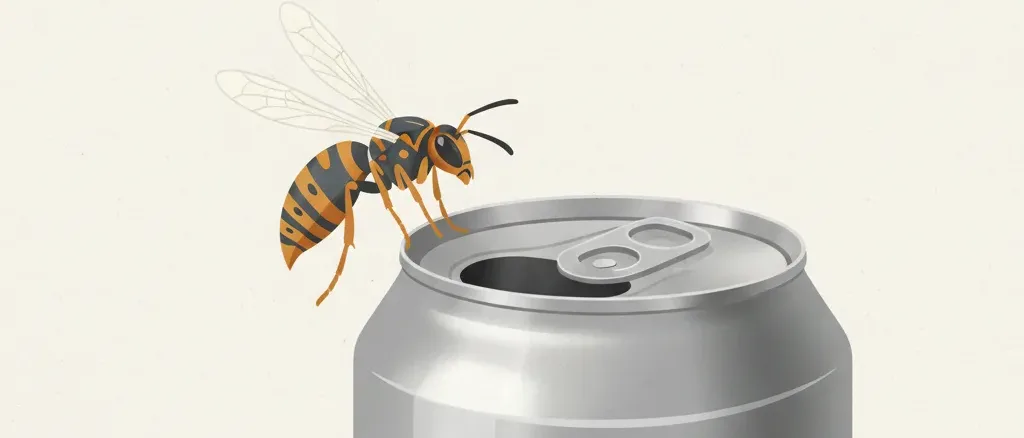
Het scenario «bij in het frisdrankblikje» is een van de levendigere en breed verspreide verhalen over gevaren buitenshuis. Sociale media versterken incidentele casusrapporten van mensen die een insect inslikten, een steek in de keel voelden en spoedbehandeling nodig hadden, wat de waargenomen frequentie aanzienlijk opblaast ten opzichte van het werkelijke cijfer. De meeste mensen die zomers buiten hebben gedronken overschatten hoe vaak dit slecht afloopt.
Ruwe schatting: de meeste mensen die buiten drinken nemen aan dat dit meerdere keren per jaar gebeurt bij iemand die ze vaag kennen
Bron: redactionele intuïtie, niet gepeild
Werkelijk
~195 geschatte spoedbezoeken door orofaryngeale (mond/keel) steken per jaar, Verenigde Staten
totale bevolking van de VS
Berekening tonen
Huff, Phillips en Keith (Wilderness & Environmental Medicine, 2025) gebruikten NEISS-data (2004–2023) en schatten rechtstreeks dat er tussen 2004 en 2023 ongeveer 3.890 (95 %-BI, 2.458,55–5.320,79) mensen waren met orofaryngeale (mond en keel) steken van bijen, horzels, gele wespen of wespen die zich meldden op Amerikaanse spoedeisende hulpen — ruwweg 195 per jaar over het venster van 20 jaar. Jaarlijkse kans: 195 / 335.000.000 ≈ 5,8 × 10^-7. Samengesteld over 59 jaar resterend volwassen leven: 1 - (1 - 5,8e-7)^59 ≈ 3,4 × 10^-5 ≈ 1 op de 29.000. De onzekerheidsband draagt het eigen 95 %-BI van de studie door dezelfde levenslange samenstelling (2.458,55–5.320,79 over 20 jaar → ~123–266/jaar). «Orofaryngeale steek» is breder dan het specifieke scenario van drinken uit blik/fles, maar de NEISS-studie is de enige Amerikaanse surveillancebron die deze route rechtstreeks kwantificeert.
Kanttekeningen: Het mechanisme hier is geen mechanische verstikking — bijen en wespen zijn te kl…
Het mechanisme hier is geen mechanische verstikking — bijen en wespen zijn te klein om de luchtweg als fysiek object te blokkeren. Het gevaar is de steek zelf: in de mond of keel veroorzaakt hij lokaal inflammatoir oedeem dat de luchtweg kan vernauwen, zelfs bij niet-allergische personen, en bij mensen met een gifallergie kan hij volledige systemische anafylaxie uitlokken. Het cijfer van ~195/jaar is de eigen nationale schatting van de NEISS-studie uit 2025 van orofaryngeale steek-SEH-presentaties (~3.890 over 2004–2023); het is geen directe telling van «insect ingeslikt tijdens het drinken» en kan andere routes van orale steken omvatten (bijv. eten). Sterfgevallen door specifiek ingeslikte insecten worden niet apart bijgehouden.
Gerelateerde risico’s
Andere risico’s over vergelijkbare thema’s — om gerelateerde angsten te verkennen.

Anafylaxie na steek
Wat is de kans dat een bijen- of wespensteek een anafylactische shock veroorzaakt waarvoor een adrenaline-injectie nodig is?

Dodelijke bijsteek
Hoe groot is de kans om te overlijden aan een bij-, wesp- of horzelsteek?



Kies vergelijking
A bee or wasp inside a can or bottle is a genuine, if rare, hazard — and the mechanism is less obvious than most people assume. The danger is not that the insect physically blocks your airway; bees and wasps are small enough to swallow without obstruction. The danger is the sting: delivered inside the mouth, posterior pharynx, or esophagus, it triggers localized inflammatory edema in confined anatomy where even modest swelling can produce stridor, difficulty swallowing, and in severe cases airway compromise — even in people with no prior venom allergy. In those who do have venom allergy (roughly 3% of US adults), an oropharyngeal sting can trigger full systemic anaphylaxis.
A 2025 NEISS analysis by Huff, Phillips, and Keith directly estimated that between 2004 and 2023 approximately 3,890 people presented to US emergency departments with an oropharyngeal (mouth or throat) sting from a bee, hornet, yellow jacket, or wasp — about 195 per year, roughly 5% of all sting ED visits. Spread over 335 million people and 59 remaining adult years, that comes to roughly 1 in 29,000 over a lifetime. The large majority were minor: about 98% of oropharyngeal sting patients were not admitted to the hospital. Deaths from this specific route are not separately tracked in US surveillance; they are absorbed into the ICD-10 X23 “sting” category that averages ~72 per year from all mechanisms combined.
The fear is real but the framing matters: the scenario to worry about is not “the insect itself gets stuck” but “the sting triggers swelling or anaphylaxis in a place the body finds very hard to manage.” Practical risk reduction is simple — check the opening of outdoor cans and bottles before drinking, pour into a clear glass, or use a cup with a lid. These are low-friction habits that effectively eliminate the exposure route without any change to outdoor behavior otherwise.
Gerelateerde weetjes
Steken in mond en keel, vaak door een met eten of drinken ingeslikt insect, brengen in de VS jaarlijks naar schatting 11,000 mensen naar de spoedeisende hulp. De levenslange kans is ongeveer 1 in 500.
Bronnenverantwoording
Elk getal hieronder is wat elke bron rapporteerde, met het letterlijke citaat waarop we ons baseerden en hoe we tot ons cijfer kwamen. Klik op een link om rechtstreeks te verifiëren.
4/4 bronnen onafhankelijk woordelijk geverifieerd tegenover de geciteerde bron
-
[1] Wilderness & Environmental Medicine (Huff, Phillips, Keith) — Oropharyngeal Bee, Hornet, Yellow Jacket, and Wasp Stings: A National Electronic Injury Surveillance System Analysis and Scoping Review Geverifieerd
Oropharyngeal Bee, Hornet, Yellow Jacket, and Wasp Stings: A National Electronic Injury Surveillance System Analysis and Scoping Review- Statistiek
An estimated 3890 (95% CI, 2458.55–5320.79) oropharyngeal sting ED presentations in the US over 2004–2023 (~195/year); oropharyngeal stings were ~5.08% of all stings; 98.08% of oropharyngeal sting victims were not admitted- Fragment
“"Between 2004 and 2023, there were an estimated 3890 (95% CI, 2458.55–5320.79) people with oropharyngeal stings from bees, hornets, yellow jackets, or wasps in the United States who presented to emergency departments." "Stings to the oropharyngeal region represented an estimated 5.08% (95% CI, 3.59–6.56) of all stings." "Overall, 98.08% (95% CI, 94.25–100.00) of victims of oropharyngeal stings were not admitted to the hospital." ”
- Brongegevens van
- 2025-03-01
- Geraadpleegd
- 2026-05-04 · gearchiveerde kopie
- Verificatie
- Fragment onafhankelijk opnieuw opgehaald en woord voor woord bevestigd tegenover de geciteerde bron tijdens onze onderbouwingsaudit.
- Berekening
- Used for the direct national estimate: ~3890 oropharyngeal sting ED presentations over 2004–2023 = ~195/year. Annual probability 195/335,000,000 ≈ 5.8e-7; compounded over 59 years ≈ 3.4e-5 ≈ 1 in 29,000. The 95% CI (2458.55–5320.79 over 20 years) is carried through the same compounding for the uncertainty band. The ~1.92% hospitalization sub-fraction (98.08% not admitted) is a severity anchor.
- Onafhankelijkheid
- Based on NEISS (National Electronic Injury Surveillance System) consumer product injury data, methodologically independent of NCHS death-certificate mortality counts.
-
[2] Frontiers in Veterinary Science (Marinho & Soto-Blanco) — Toxicological Risk Assessment of the Accidental Ingestion of a Honeybee (Apis mellifera L.) Present in Food Geverifieerd
Toxicological Risk Assessment of the Accidental Ingestion of a Honeybee (Apis mellifera L.) Present in Food- Statistiek
The actual number of accidental honeybee ingestion incidents remains unknown; though a rare condition, ingestion may induce an allergic reaction in sensitive individuals- Fragment
“A number of anecdotal reports of accidental ingestion of insects are largely available, but the actual number remains unknown. Thus, although it is a rare condition, there is the risk that the ingestion of a honeybee may induce an allergic reaction to some venom components in sensitive individuals. ”
- Brongegevens van
- 2020-10-01
- Geraadpleegd
- 2026-05-04 · gearchiveerde kopie
- Verificatie
- Fragment onafhankelijk opnieuw opgehaald en woord voor woord bevestigd tegenover de geciteerde bron tijdens onze onderbouwingsaudit.
- Berekening
- Supports the surveillance gap: the peer-reviewed toxicological assessment states that the actual number of accidental ingestion incidents remains unknown (reports are anecdotal). Used to justify the wide uncertainty band and to establish that the Huff 2025 oropharyngeal fraction is the best available approximation. Note: this source addresses honeybees only and does not itself quantify deaths or ER visits.
- Onafhankelijkheid
- Toxicological review drawing on venom-composition and clinical toxicology literature, independent of NEISS and NCHS data streams.
-
[3] American Family Physician (Golden DB) — Stinging Insect Allergy Geverifieerd
Stinging Insect AllergySee all 2 Likelier entries citing this source →
- Statistiek
Systemic allergic reactions to insect stings are estimated to occur in about 3% of US adults (and about 1% of children)- Fragment
“"Systemic allergic reactions to insect stings are estimated to occur in about 1 percent of children and 3 percent of adults." ”
- Brongegevens van
- 2003-06-15
- Geraadpleegd
- 2026-07-03 · gearchiveerde kopie
- Verificatie
- Fragment onafhankelijk opnieuw opgehaald en woord voor woord bevestigd tegenover de geciteerde bron tijdens onze onderbouwingsaudit.
- Berekening
- Supports the body-prose reference to venom-allergy prevalence (~3% of US adults) used as context for anaphylaxis risk from an oropharyngeal sting. Not used in the native/normalized probability calculation, which is based on the Huff 2025 NEISS oropharyngeal-fraction analysis.
- Onafhankelijkheid
- Independent clinical epidemiology review (American Family Physician), methodologically distinct from the NEISS-based Huff 2025 analysis and the honeybee-ingestion toxicological review.
-
[4] Centers for Disease Control and Prevention — Morbidity and Mortality Weekly Report — QuickStats: Number of Deaths from Hornet, Wasp, and Bee Stings Among Males and Females — National Vital Statistics System, United States, 2011-2021 Geverifieerd
QuickStats: Number of Deaths from Hornet, Wasp, and Bee Stings Among Males and Females — National Vital Statistics System, United States, 2011-2021- Statistiek
788 total US deaths from hornet, wasp, and bee stings during 2011-2021, an average of 72 deaths per year; classified under ICD-10 code X23- Fragment
“"During 2011-2021, a total of 788 deaths from hornet, wasp, and bee stings occurred (an average of 72 deaths per year). [...] Deaths from hornet, wasp, and bee sting as underlying cause of death were coded as X23, according to the International Classification of Diseases, Tenth Revision." ”
- Brongegevens van
- 2023-07-07
- Geraadpleegd
- 2026-07-03 · gearchiveerde kopie
- Verificatie
- Fragment onafhankelijk opnieuw opgehaald en woord voor woord bevestigd tegenover de geciteerde bron tijdens onze onderbouwingsaudit.
- Berekening
- Supports the body-prose reference to overall Hymenoptera sting deaths (~72/year, ICD-10 X23) used as a severity anchor and to explain why deaths from the specific swallowed-insect/oropharyngeal route are not separately tracked in US surveillance. Not used in the native/normalized oropharyngeal-ED-visit calculation.
- Onafhankelijkheid
- NCHS death-certificate mortality data (National Vital Statistics System), methodologically independent of the NEISS-based Huff 2025 ED-visit analysis.