Kwaliteit van bewijs 4.0/5
Beoordelingsscore op acht dimensies volgens de kwaliteitsrubriek . Elke dimensie krijgt een score van 1 tot 5.
- D1 Verankering in bronnen
- 4/5
- D2 Autoriteit van bronnen
- 5/5
- D3 Rekenkunde
- 4/5
- D4 Onzekerheid
- 3/5
- D5 Bereik
- 4/5
- D6 Proza
- 4/5
- D7 Eerlijkheid over perceptie
- 4/5
- D8 Volledigheid van voorbehouden
- 4/5
≈ Net zo waarschijnlijk als
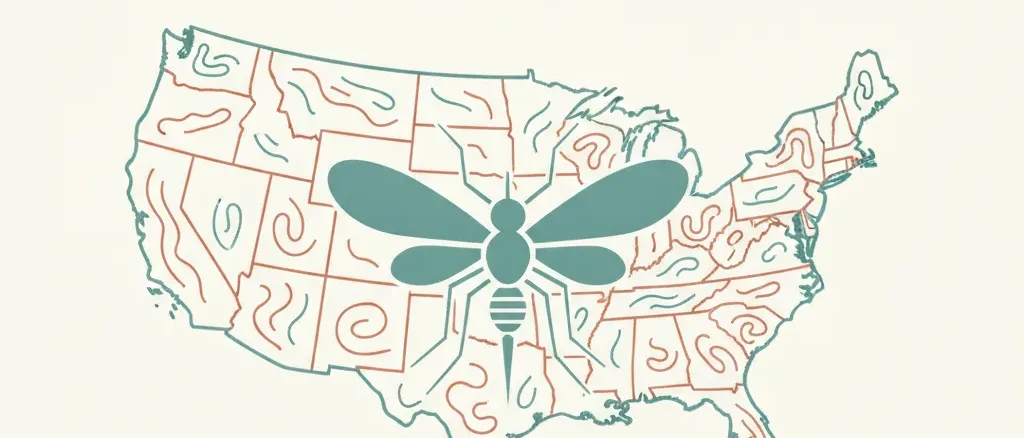
Waargenomen
De meeste Amerikaanse inwoners scharen dengue onder «tropische reisziekte» en gaan uit van nul risico terwijl ze thuisblijven. Geen enkel gepubliceerd onderzoek meet de angst om binnenlands dengue op te lopen, dus dit is een intuïtieve inschatting: het waargenomen binnenlandse risico is voor bijna iedereen praktisch nul, wat het kleine maar stijgende risico op lokale transmissie in enkele zuidelijke staten onderschat en het bijna-nulrisico overal elders overschat. De mismatch is er een van categoriefout in plaats van omvang.
Ruwe schatting: ≈ 0 (verondersteld een uitsluitend reisgebonden ziekte te zijn)
Bron: redactionele intuïtie, niet gepeild
Werkelijk
105 lokaal opgelopen gevallen onder ~338 miljoen inwoners van het continentale VS in 2024
Inwoners van de 48 aaneengesloten Amerikaanse staten + DC, 2024
Berekening tonen
Subgroep = een persoon die in het continentale VS woont (48 staten + DC); horizon = 59-jarig resterend volwassen leven (sitestandaard vanaf 18 jaar). Het kerncijfer telt een GEDIAGNOSTICEERD klinisch dengue-geval, geen infectie (40-80 % van de dengue-infecties is asymptomatisch en veel symptomatische gevallen worden niet getest, dus het werkelijke infectierisico is hoger — dit duwt de bovengrens omhoog). Basisjaarpercentage uit CDC MMWR 2024: 105 lokaal opgelopen gevallen (Florida 85, Californië 18, Texas 2) / ~338 miljoen inwoners van het continentale VS = 3,1e-7 per persoonsjaar. Samengesteld over 59 jaar: 1-(1-3,1e-7)^59 = 1,83e-5 (~1 op de 54.600), wat het RECORDJAAR-2024-percentage is. 2024 was een piek van +359 %; vóór 2023 was lokale transmissie op het vasteland in de meeste jaren bijna nul. De puntschatting is iets ONDER het cijfer van alleen 2024 gezet, op 1,5e-5 (~1 op de 67.000), om de recente piek te middelen tegen de veel lagere historische basislijn, terwijl er richting persistentie wordt geleund omdat de hele premisse van dit item — uitbreiding van het Aedes-verspreidingsgebied en opwarming — een opwaartse trend is. Ondergrens 1,5e-6 weerspiegelt de jaren van vóór 2023 met bijna nul lokale transmissie (~10x onder 2024). Bovengrens 1,5e-4 weerspiegelt klinische onderrapportage plus een scenario van verslechterende transmissie (~10x boven 2024). De band van 2 ordes van grootte is eerlijk over een volatiel, geografisch geconcentreerd, uitbreidend risico in plaats van vals-precies.
Kanttekeningen: Dit is een momentopname van een volatiel, geografisch geconcentreerd en kennelij…
Dit is een momentopname van een volatiel, geografisch geconcentreerd en kennelijk uitbreidend risico, geen stabiele constante over het leven. De puntschatting berust op één recordjaar (2024, +359 % boven het gemiddelde van 2010–2023), en dat percentage projecteren over een horizon van 59 jaar veronderstelt dat lokale transmissie op het niveau van 2024 aanhoudt — een bewuste neiging richting de opwaartse trend in Aedes-verspreiding en opwarming die dit item beschrijft. De onzekerheidsband beslaat twee ordes van grootte (~1 op de 670.000 tot ~1 op de 6.700), juist omdat de aantallen lokale gevallen van jaar tot jaar sterk schommelen en het werkelijke infectiepercentage wordt onderteld: 40–80 % van de dengue-infecties is asymptomatisch en veel symptomatische gevallen worden niet getest, dus het kerncijfer voor «gediagnosticeerde gevallen» is een ondergrens voor de werkelijke blootstelling. Het risico is overweldigend een fenomeen van Florida (vooral Miami-Dade) en focaal Californië; voor een inwoner van het grootste deel van het continentale VS ligt het nabij de ondergrens. Geen enkel gepubliceerd onderzoek meet de angst om binnenlands dengue op te lopen, dus de perceptie-inschatting is een intuïtie, geen peiling. Omdat de band breed is en de noemer nationaal terwijl het risico lokaal is, zijn D4 (onzekerheid) en D5 (scope) de zwakste dimensies; beide worden expliciet behandeld via subgroep-scope en een regional_breakdown in plaats van één misleidend nationaal kerncijfer. Het item stelt niet dat dengue ergens in het continentale VS endemisch is — geen enkele Amerikaanse jurisdictie is officieel als endemisch geclassificeerd.
Hoe het risico varieert
Het hoofdcijfer is een gemiddelde over zeer verschillende situaties. Zo varieert de waarschijnlijkheid per scenario of context:
1 op 4.545
85 of the 105 continental locally-acquired cases in 2024 (81%) were in Florida, across 10 counties but concentrated in the Miami-Dade area. 85 / ~23M Florida residents = 3.7e-6/yr → ~2.2e-4 (~1 in 4,600) over 59 yr; the Miami-Dade sub-rate is higher still. Florida is not officially endemic but reports local cases every year.
1 op 50.000
18 local cases statewide in 2024; LA County had 14 of them, all clustered within small radii consistent with focal outbreaks (some within a 1-mile radius over 7 weeks). 18 / ~39M = 4.6e-7/yr → ~2.7e-5 over 59 yr, but risk is concentrated in a few neighborhoods, not statewide.
1 op 666.667
Northern and interior states reported zero locally-acquired cases in 2024. Risk there is driven by occasional vector spread and remains near the lower bound.
De lengte en tint van de balk rangschikken deze scenario's ten opzichte van elkaar, niet ten opzichte van andere risico's. De exacte kansen staan naast elk scenario.
Gerelateerde risico’s
Andere risico’s over vergelijkbare thema’s — om gerelateerde angsten te verkennen.

Vibrio vulnificus-wondinfectie
Hoe groot is de kans dat een Amerikaanse volwassene een vleesetende Vibrio vulnificus-infectie oploopt na blootstelling aan warm kustwater?
Aluminium & alzheimer
Hoe groot is de kans op alzheimer door koken met aluminium pannen of folie?

Gaslek in woning
Hoe groot is de kans om te overlijden bij een explosie of brand door een gaslek in huis?

Hersenzwelling door griep bij kind
Hoe waarschijnlijk is het dat een kind met griep plotselinge hersenzwelling krijgt (influenza-geassocieerde encefalopathie of acute necrotiserende encefalopathie)?


Kind gestorven in hete auto
Hoe groot is de kans dat een kind overlijdt door in een hete auto achtergelaten te worden?

Hond overlijdt in hete auto
Hoe groot is de kans dat een hond overlijdt door in een hete auto achtergelaten te worden?
Kies vergelijking
For most of the country, dengue is filed under tropical travel: a fever you bring back from Southeast Asia or the Caribbean, not something the mosquito on your own patio can give you. That filing is mostly correct and slowly going stale. In 2024 the United States recorded 3,798 dengue cases, a 359 percent jump above the 2010–2023 average. The headline number is dominated by travelers (97.2 percent), but 2.8 percent — 105 cases in the contiguous states — were locally acquired, meaning the patient had not left the reporting jurisdiction in the two weeks before symptoms began. Florida accounted for 85 of those, California 18, and Texas 2. The mosquito did the importing.
The national per-resident rate is small. Spread 105 cases across roughly 338 million continental residents and the annual odds are about 3 in 10 million; compounded over a typical adult lifetime, that lands near 1 in 67,000, in the same neighborhood as dying in a plane crash and a few times above being struck by lightning. The number is also nearly meaningless as a national figure, because the cases are not spread out. Eighty-one percent were in Florida, clustered around Miami-Dade, and California’s were not statewide but focal: a Los Angeles County investigation found 14 local cases between August and November 2024, several within a one-mile radius over seven weeks. For a resident of Miami the lifetime odds run into the low thousands; for a resident of Minnesota they sit at the floor.
Two things make the lifetime figure soft rather than firm. First, 2024 was a record year, and projecting a peak across 59 years assumes the surge holds — a bet the underlying trend supports, since Aedes aegypti and albopictus are established across the southeastern and southwestern US and continue to spread as temperatures climb. Second, the count undercounts: 40 to 80 percent of dengue infections produce no symptoms, and many that do are never tested, so 105 diagnosed cases is a floor on actual local exposure, not a ceiling. No US jurisdiction is officially endemic, and Florida’s health department still reports cases as locally acquired rather than expected. The honest summary is a wide band around a rising number, concentrated in a handful of southern counties, for a disease that no longer requires a passport.
Gerelateerde weetjes
Dengue wordt meestal als een reisziekte beschouwd, maar thuis is het niet nul. In 2024 waren er 105 lokaal opgelopen gevallen in het continentale deel van de VS, wat de levenslange kans op ongeveer 1 op 67.000 brengt. Zeldzaam, geografisch geclusterd en niet langer puur geïmporteerd.
Bronnenverantwoording
Elk getal hieronder is wat elke bron rapporteerde, met het letterlijke citaat waarop we ons baseerden en hoe we tot ons cijfer kwamen. Klik op een link om rechtstreeks te verifiëren.
2/5 bronnen onafhankelijk woordelijk geverifieerd tegenover de geciteerde bron
-
[1] CDC Morbidity and Mortality Weekly Report (MMWR) — Increase in Travel-Associated and Locally Acquired Dengue Cases — United States, 2024
Increase in Travel-Associated and Locally Acquired Dengue Cases — United States, 2024See all 2 Likelier entries citing this source →
- Statistiek
3,798 total US dengue cases in 2024 (+359% above the 2010–2023 average); 97.2% travel-associated, 2.8% locally acquired; continental US locally-acquired cases: Florida 85 (10 counties), California 18 (3 counties), Texas 2 (2 counties) = 105.- Fragment
“During 2024, a record 3,798 dengue cases were reported [...] a 359% increase above the 2010–2023 annual average. Among these 3,798 cases, 97.2% were associated with travel outside the reporting jurisdiction during the 2 weeks preceding symptom onset; the remaining 2.8% were locally acquired. [...] Three jurisdictions reported locally acquired cases, including Florida (85 cases reported from 10 counties), California (18 from three counties), and Texas (two from two counties).”
- Brongegevens van
- 2026-05-14
- Geraadpleegd
- 2026-06-13 · gearchiveerde kopie
- Berekening
- Locally-acquired continental total = 85+18+2 = 105. Annual rate = 105 / 338,000,000 continental residents = 3.1e-7/person-year. 59-year compounded = 1-(1-3.1e-7)^59 = 1.83e-5. This is the authoritative FINAL count; an earlier CDC HAN (March 2025) listed Florida as 91 preliminarily — the MMWR's 85 supersedes it.
-
[2] CDC Emerging Infectious Diseases — Investigation of and Response to Autochthonous Dengue, Los Angeles County, California, USA, August–November 2024 Geverifieerd
Investigation of and Response to Autochthonous Dengue, Los Angeles County, California, USA, August–November 2024- Statistiek
14 locally-acquired dengue cases in LA County Aug–Nov 2024, geographically clustered (some within a 1-mile radius over 7 weeks), consistent with focal local transmission rather than diffuse community spread.- Fragment
“During August–November 2024, a total of 14 locally acquired cases of dengue were identified in Los Angeles County, California, USA. [...] All 6 cases were identified within a 1-mile radius over a 7-week period, consistent with an outbreak involving ongoing local transmission.”
- Brongegevens van
- 2026-05-06
- Geraadpleegd
- 2026-06-13 · gearchiveerde kopie
- Verificatie
- Fragment onafhankelijk opnieuw opgehaald en woord voor woord bevestigd tegenover de geciteerde bron tijdens onze onderbouwingsaudit.
- Berekening
- Grounds the regional_breakdown claim that California's 18 cases were not statewide-uniform but concentrated in a few LA-area clusters. Supports treating local dengue as a focal/neighborhood risk, not a flat per-capita state rate.
- Onafhankelijkheid
- Same publisher family (CDC) as the MMWR source but a distinct peer-reviewed field investigation with separate authors and data.
-
[3] CDC Health Alert Network (HAN) — Ongoing Risk of Dengue Virus Infections and Updated Testing Recommendations in the United States
Ongoing Risk of Dengue Virus Infections and Updated Testing Recommendations in the United States- Statistiek
CDC advisory that dengue activity remained high into 2025 and that spring/summer raise both travel-associated and locally-acquired risk; 2024 local cases listed as Florida 91 (preliminary), California 18, Texas 1.- Fragment
“Dengue activity remains high in some parts of the United States [...] Spring and summer travel coincide with the peak season for dengue in many countries, increasing the risk of both travel-associated and locally acquired cases.”
- Brongegevens van
- 2025-03-18
- Geraadpleegd
- 2026-06-13 · gearchiveerde kopie
- Berekening
- Used to establish that the risk is ongoing/elevated rather than a one-off 2024 spike, supporting the upward-trend framing. Its preliminary Florida count (91) differs from the MMWR final (85); the entry uses the MMWR figure and flags the discrepancy in assumptions.
-
[4] CIDRAP, University of Minnesota — US dengue cases jumped 359% in 2024 amid global surge Geverifieerd
US dengue cases jumped 359% in 2024 amid global surge- Statistiek
Confirms 3,798 total cases, 359% increase, 2.8% locally acquired, 105 locally-acquired nationwide with Florida 85 (81%); notes Aedes aegypti and albopictus are established across the southeastern/southwestern US and continue to spread as temperatures rise.- Fragment
“Florida accounting for 85 of the 105 locally acquired cases (81%) reported nationwide [...] Ae aegypti and albopictus mosquitoes are found throughout large areas of the southeastern and southwestern United States and continue to spread to other regions [...] Vector presence and distribution might be further affected by increasing temperatures, which can expand the range of mosquitoes that spread dengue.”
- Brongegevens van
- 2026-05-15
- Geraadpleegd
- 2026-06-13 · gearchiveerde kopie
- Verificatie
- Fragment onafhankelijk opnieuw opgehaald en woord voor woord bevestigd tegenover de geciteerde bron tijdens onze onderbouwingsaudit.
- Berekening
- Independent confirmation of the MMWR 85/105 split and the vector-range-expansion premise that motivates the entry. Used for the Aedes-range and warming framing in the prose.
- Onafhankelijkheid
- Independent academic center summarizing the MMWR; not a CDC publication.
-
[5] University of Florida Emerging Pathogens Institute — Dengue in Florida: What to know
Dengue in Florida: What to know- Statistiek
Florida reported 1,044 local + travel-associated dengue cases in 2024 (most in the continental US); local cases concentrate in Miami-Dade County; no part of the US is officially endemic for dengue despite recurring local transmission.- Fragment
“Although no part of the United States is officially labeled as endemic for dengue, Florida's health department continues to report cases acquired locally or linked to travel in 2025. [...] one case of locally acquired dengue in Miami-Dade County”
- Brongegevens van
- 2025-06-24
- Geraadpleegd
- 2026-06-13 · gearchiveerde kopie
- Berekening
- Grounds the Florida/Miami-Dade concentration in the regional_breakdown and the 'not endemic' caveat. The 1,044 figure is local+travel combined (most are travel-associated); only the locally-acquired subset (85) feeds the native rate.