Качество доказательств 4.25/5
Оценка по восьми измерениям согласно рубрике качества . Каждое измерение оценивается от 1 до 5.
- D1 Обоснованность источниками
- 4/5
- D2 Авторитетность источника
- 5/5
- D3 Арифметика
- 4/5
- D4 Неопределённость
- 4/5
- D5 Охват
- 4/5
- D6 Текст
- 4/5
- D7 Честность восприятия
- 4/5
- D8 Полнота оговорок
- 5/5
● ваши факторы — нажмите на этот риск ▾ для отображения
- Ваши факторы
≈ Так же вероятно, как
Воспринимаемый
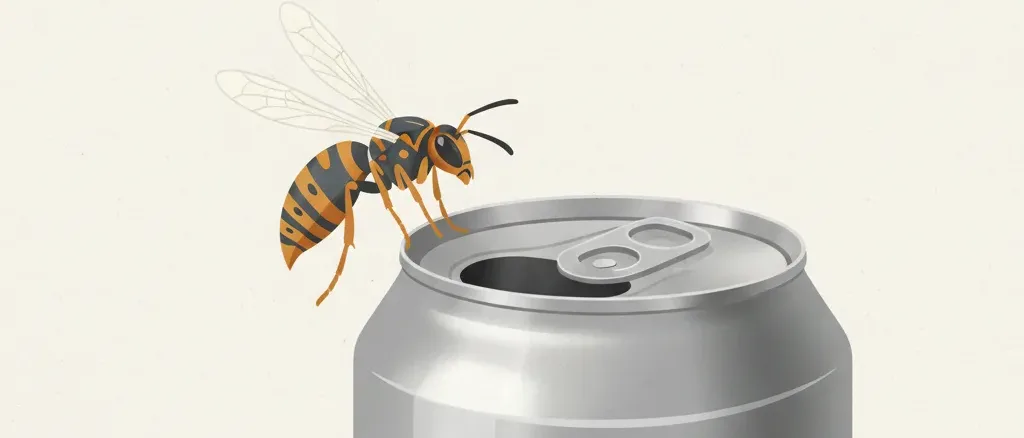
Сценарий «пчела в банке газировки» — одна из наиболее ярких и широко распространённых историй об уличных опасностях. Соцсети раздувают отдельные сообщения о людях, которые проглотили насекомое, почувствовали укус в горле и потребовали неотложной помощи, что значительно завышает воспринимаемую частоту относительно фактической. Большинство тех, кто провёл лета за напитками на открытом воздухе, переоценивают, как часто это заканчивается плохо.
Грубая оценка: большинство тех, кто пьёт на открытом воздухе, полагают, что это случается несколько раз в год с кем-то из их дальних знакомых
Источник: редакционная интуиция, не опрос
Фактический
~195 оценочных обращений в неотложную помощь с ротоглоточными (рот/горло) укусами в год, США
всё население США
Показать вычисления
Huff, Phillips и Keith (Wilderness & Environmental Medicine, 2025) использовали данные NEISS (2004–2023) и напрямую оценили, что между 2004 и 2023 годами было примерно 3890 (95 % ДИ, 2458,55–5320,79) человек с ротоглоточными (рот и горло) укусами пчёл, шершней, земляных ос или обычных ос, обратившихся в отделения неотложной помощи в США, — примерно 195 в год за 20-летний период. Годовая вероятность: 195 / 335 000 000 ≈ 5,8 × 10^-7. С накоплением за 59 лет оставшейся взрослой жизни: 1 − (1 − 5,8e-7)^59 ≈ 3,4 × 10^-5 ≈ 1 из 29 000. Диапазон неопределённости переносит собственный 95 % ДИ исследования через то же пожизненное накопление (2458,55–5320,79 за 20 лет → ~123–266 в год). «Ротоглоточный укус» шире, чем конкретный сценарий питья из банки/бутылки, но исследование NEISS — единственный источник надзора в США, который напрямую количественно оценивает этот путь.
Оговорки: Механизм здесь не механическое удушье — пчёлы и осы слишком малы, чтобы перекрыт…
Механизм здесь не механическое удушье — пчёлы и осы слишком малы, чтобы перекрыть дыхательные пути как физический объект. Опасность — сам укус: во рту или горле он вызывает локальный воспалительный отёк, способный сузить дыхательные пути даже у неаллергичных людей, а у людей с аллергией на яд может запустить полную системную анафилаксию. Показатель ~195 в год — собственная национальная оценка исследования NEISS 2025 года по обращениям в неотложную помощь с ротоглоточными укусами (~3890 за 2004–2023); это не прямой подсчёт «проглоченного насекомого во время питья» и может включать другие пути укуса в полости рта (например, при еде). Смерти именно от проглоченных насекомых отдельно не отслеживаются.
Связанные риски
Другие риски на схожие темы — для изучения связанных страхов.

Анафилаксия от укуса
Каковы шансы, что укус пчелы или осы вызовет анафилактический шок, требующий инъекции адреналина?



Удушье у малышей
Каковы шансы младенца или ребенка ясельного возраста задохнуться до смерти во время еды?

Выбрать сравниваемый
A bee or wasp inside a can or bottle is a genuine, if rare, hazard — and the mechanism is less obvious than most people assume. The danger is not that the insect physically blocks your airway; bees and wasps are small enough to swallow without obstruction. The danger is the sting: delivered inside the mouth, posterior pharynx, or esophagus, it triggers localized inflammatory edema in confined anatomy where even modest swelling can produce stridor, difficulty swallowing, and in severe cases airway compromise — even in people with no prior venom allergy. In those who do have venom allergy (roughly 3% of US adults), an oropharyngeal sting can trigger full systemic anaphylaxis.
A 2025 NEISS analysis by Huff, Phillips, and Keith directly estimated that between 2004 and 2023 approximately 3,890 people presented to US emergency departments with an oropharyngeal (mouth or throat) sting from a bee, hornet, yellow jacket, or wasp — about 195 per year, roughly 5% of all sting ED visits. Spread over 335 million people and 59 remaining adult years, that comes to roughly 1 in 29,000 over a lifetime. The large majority were minor: about 98% of oropharyngeal sting patients were not admitted to the hospital. Deaths from this specific route are not separately tracked in US surveillance; they are absorbed into the ICD-10 X23 “sting” category that averages ~72 per year from all mechanisms combined.
The fear is real but the framing matters: the scenario to worry about is not “the insect itself gets stuck” but “the sting triggers swelling or anaphylaxis in a place the body finds very hard to manage.” Practical risk reduction is simple — check the opening of outdoor cans and bottles before drinking, pour into a clear glass, or use a cup with a lid. These are low-friction habits that effectively eliminate the exposure route without any change to outdoor behavior otherwise.
Связанные факты
Укусы во рту и горле, часто от насекомого, проглоченного с едой или питьём, ежегодно отправляют около 11,000 человек в приёмные отделения США. Пожизненная вероятность составляет около 1 in 500.
Реестр утверждений
Каждое число ниже — это то, что сообщил источник, с дословной цитатой, на которую мы опирались, и тем, как мы пришли к нашей цифре. Нажмите на ссылку, чтобы проверить самостоятельно.
4/4 источников независимо дословно сверены с указанным источником
-
[1] Wilderness & Environmental Medicine (Huff, Phillips, Keith) — Oropharyngeal Bee, Hornet, Yellow Jacket, and Wasp Stings: A National Electronic Injury Surveillance System Analysis and Scoping Review Проверено
Oropharyngeal Bee, Hornet, Yellow Jacket, and Wasp Stings: A National Electronic Injury Surveillance System Analysis and Scoping Review- Статистика
An estimated 3890 (95% CI, 2458.55–5320.79) oropharyngeal sting ED presentations in the US over 2004–2023 (~195/year); oropharyngeal stings were ~5.08% of all stings; 98.08% of oropharyngeal sting victims were not admitted- Выдержка
“"Between 2004 and 2023, there were an estimated 3890 (95% CI, 2458.55–5320.79) people with oropharyngeal stings from bees, hornets, yellow jackets, or wasps in the United States who presented to emergency departments." "Stings to the oropharyngeal region represented an estimated 5.08% (95% CI, 3.59–6.56) of all stings." "Overall, 98.08% (95% CI, 94.25–100.00) of victims of oropharyngeal stings were not admitted to the hospital." ”
- Данные источника:
- 2025-03-01
- Дата обращения
- 2026-05-04 · архивная копия
- Проверка
- Выдержка независимо повторно загружена и подтверждена слово в слово по указанному источнику в ходе нашей проверки достоверности.
- Расчёт
- Used for the direct national estimate: ~3890 oropharyngeal sting ED presentations over 2004–2023 = ~195/year. Annual probability 195/335,000,000 ≈ 5.8e-7; compounded over 59 years ≈ 3.4e-5 ≈ 1 in 29,000. The 95% CI (2458.55–5320.79 over 20 years) is carried through the same compounding for the uncertainty band. The ~1.92% hospitalization sub-fraction (98.08% not admitted) is a severity anchor.
- Независимость
- Based on NEISS (National Electronic Injury Surveillance System) consumer product injury data, methodologically independent of NCHS death-certificate mortality counts.
-
[2] Frontiers in Veterinary Science (Marinho & Soto-Blanco) — Toxicological Risk Assessment of the Accidental Ingestion of a Honeybee (Apis mellifera L.) Present in Food Проверено
Toxicological Risk Assessment of the Accidental Ingestion of a Honeybee (Apis mellifera L.) Present in Food- Статистика
The actual number of accidental honeybee ingestion incidents remains unknown; though a rare condition, ingestion may induce an allergic reaction in sensitive individuals- Выдержка
“A number of anecdotal reports of accidental ingestion of insects are largely available, but the actual number remains unknown. Thus, although it is a rare condition, there is the risk that the ingestion of a honeybee may induce an allergic reaction to some venom components in sensitive individuals. ”
- Данные источника:
- 2020-10-01
- Дата обращения
- 2026-05-04 · архивная копия
- Проверка
- Выдержка независимо повторно загружена и подтверждена слово в слово по указанному источнику в ходе нашей проверки достоверности.
- Расчёт
- Supports the surveillance gap: the peer-reviewed toxicological assessment states that the actual number of accidental ingestion incidents remains unknown (reports are anecdotal). Used to justify the wide uncertainty band and to establish that the Huff 2025 oropharyngeal fraction is the best available approximation. Note: this source addresses honeybees only and does not itself quantify deaths or ER visits.
- Независимость
- Toxicological review drawing on venom-composition and clinical toxicology literature, independent of NEISS and NCHS data streams.
-
[3] American Family Physician (Golden DB) — Stinging Insect Allergy Проверено
Stinging Insect AllergySee all 2 Likelier entries citing this source →
- Статистика
Systemic allergic reactions to insect stings are estimated to occur in about 3% of US adults (and about 1% of children)- Выдержка
“"Systemic allergic reactions to insect stings are estimated to occur in about 1 percent of children and 3 percent of adults." ”
- Данные источника:
- 2003-06-15
- Дата обращения
- 2026-07-03 · архивная копия
- Проверка
- Выдержка независимо повторно загружена и подтверждена слово в слово по указанному источнику в ходе нашей проверки достоверности.
- Расчёт
- Supports the body-prose reference to venom-allergy prevalence (~3% of US adults) used as context for anaphylaxis risk from an oropharyngeal sting. Not used in the native/normalized probability calculation, which is based on the Huff 2025 NEISS oropharyngeal-fraction analysis.
- Независимость
- Independent clinical epidemiology review (American Family Physician), methodologically distinct from the NEISS-based Huff 2025 analysis and the honeybee-ingestion toxicological review.
-
[4] Centers for Disease Control and Prevention — Morbidity and Mortality Weekly Report — QuickStats: Number of Deaths from Hornet, Wasp, and Bee Stings Among Males and Females — National Vital Statistics System, United States, 2011-2021 Проверено
QuickStats: Number of Deaths from Hornet, Wasp, and Bee Stings Among Males and Females — National Vital Statistics System, United States, 2011-2021- Статистика
788 total US deaths from hornet, wasp, and bee stings during 2011-2021, an average of 72 deaths per year; classified under ICD-10 code X23- Выдержка
“"During 2011-2021, a total of 788 deaths from hornet, wasp, and bee stings occurred (an average of 72 deaths per year). [...] Deaths from hornet, wasp, and bee sting as underlying cause of death were coded as X23, according to the International Classification of Diseases, Tenth Revision." ”
- Данные источника:
- 2023-07-07
- Дата обращения
- 2026-07-03 · архивная копия
- Проверка
- Выдержка независимо повторно загружена и подтверждена слово в слово по указанному источнику в ходе нашей проверки достоверности.
- Расчёт
- Supports the body-prose reference to overall Hymenoptera sting deaths (~72/year, ICD-10 X23) used as a severity anchor and to explain why deaths from the specific swallowed-insect/oropharyngeal route are not separately tracked in US surveillance. Not used in the native/normalized oropharyngeal-ED-visit calculation.
- Независимость
- NCHS death-certificate mortality data (National Vital Statistics System), methodologically independent of the NEISS-based Huff 2025 ED-visit analysis.