Evidenzqualität 4.88/5
Bewertungsergebnis nach acht Dimensionen gemäß der Qualitätsrubrik . Jede Dimension wird mit 1–5 bewertet.
- D1 Quellenverankerung
- 5/5
- D2 Quellenautorität
- 5/5
- D3 Arithmetik
- 5/5
- D4 Unsicherheit
- 4/5
- D5 Geltungsbereich
- 5/5
- D6 Prosa
- 5/5
- D7 Ehrlichkeit zur Wahrnehmung
- 5/5
- D8 Vollständigkeit der Einschränkungen
- 5/5
● Ihre Faktoren — auf dieses Risiko ▾ klicken zum Anzeigen
- Deine Faktoren
≈ Genauso wahrscheinlich wie

Wahrgenommen
Das Verschlucken von Knopfzellen ist eine der Kindersicherheitsängste, von der die meisten Eltern gehört haben, für die aber nur wenige ein genaues mentales Modell haben. Verglichen mit Ersticken, Ertrinken und Stürzen kommt es in Checklisten zur Kindersicherung selten vor, und wenn doch, wird es meist als »auf lose Batterien achten« formuliert statt als zeitkritischer pädiatrischer Notfall. Die Angst ist typischerweise vage statt numerisch — Eltern wissen, dass es schlimm ist, aber nicht, wie schlimm, wie schnell oder welche Batterien am wichtigsten sind.
Grobe Schätzung: Die meisten Eltern haben für diese Angst überhaupt keine Zahl im Kopf — die Gefahr ist als existent bekannt, aber die Schwere, das 2-Stunden-Fenster und die spezifische Rolle von 20-mm-Lithium-Knopfzellen fehlen im mentalen Modell meist
Quelle: redaktionelle Einschätzung, nicht erhoben
Tatsächlich
~15 schwere pädiatrische Verletzungen pro Jahr (US-Kinder unter 6)
US-Kinder 0-6, schwere Knopfzellen-Verletzungen (Ösophagusverbrennungen, Perforationen, tracheoösophageale Fisteln, Stimmbandlähmung, Tod)
Berechnung anzeigen
Likelier gibt normalerweise Lebenszeit-Wahrscheinlichkeiten für US-Erwachsene an, aber dieser Eintrag ist auf das Altersfenster mit dem höchsten Risiko (0-6) für ein einzelnes US-Kind beschränkt. Die Schlagzeilenzahl zählt schwere Ergebnisse — Ösophagusverbrennungen, Perforationen, tracheoösophageale Fisteln, Stimmbandlähmung und Tod — nicht die viel grössere Zahl beliebiger Notaufnahmebesuche wegen einer Batterie-Exposition. Jatana und Kollegen (Pediatrics, 2022) schätzten etwa 7.032 batteriebezogene pädiatrische Notaufnahmebesuche pro Jahr in den USA über den Zeitraum 2010-2019, von denen 85 % Knopfzellen betrafen und 84 % Kinder im Alter von 5 Jahren oder jünger waren. Das ergibt rund 5.000 Knopfzellen-Notaufnahmebesuche pro Jahr in der Gruppe unter 6 — eine Grössenordnung von 1 zu 700 für jede Notaufnahme-Exposition über ein Sieben-Jahres-Fenster gegen eine Population von ~24 Millionen US-Kindern 0-6. Die Untergruppe mit schwerem Ausgang ist viel kleiner. Die CPSC dokumentierte 27 Todesfälle und geschätzte 54.300 batteriebezogene Verletzungen, die in US-Notaufnahmen über den Zeitraum 2011-2021 behandelt wurden, etwas mehr als 2 Todesfälle pro Jahr. Die Überwachung durch das National Capital Poison Center und Litovitz et al. beziffert die Zahl der »schweren oder tödlichen Ausgänge« auf etwa 10-20 pro Jahr, fast ausschliesslich konzentriert auf die Untergruppe der 20-mm+-Lithium-Knopfzellen. 15 schwere Verletzungen pro Jahr auf 24 Millionen Kinder, über ein Sieben-Jahres-Fenster kumuliert, sind 15 × 7 / 24.000.000 ≈ 4,4e-6, was auf etwa 1 zu 250.000 pro Kind während des 0-6-Fensters gerundet wird. Die tödliche Untergruppe allein ist rund eine Grössenordnung niedriger — in der Grössenordnung von 1 zu 2 bis 4 Millionen pro Kind im selben Fenster.
Einschränkungen: Die Schlagzeile zu schweren Verletzungen zählt Ösophagusverbrennungen, Perforati…
Die Schlagzeile zu schweren Verletzungen zählt Ösophagusverbrennungen, Perforationen, tracheoösophageale Fisteln, Stimmbandlähmung und Tod — nicht die viel grössere Gesamtzahl aller Expositionen, die in Jatanas Notaufnahmebesuch-Datensatz erscheint. Das Verhältnis zwischen beiden beträgt rund zwei Grössenordnungen und ist die Hauptquelle der Verwirrung beim Vergleich von Quellen: Litovitz und das NCPC-Register zählen Ergebnisse, Jatana zählt Fälle, und die beiden Zahlen wirken nur deshalb inkonsistent, weil sie unterschiedliche Dinge messen. Beide sind oben zitiert. Litovitz 2010 und Semple et al. 2017 stützen sich auf sich überschneidende Überwachungsdaten des National Capital Poison Center, sie sind also zwei Sichten auf denselben Datensatz, keine unabhängige Bestätigung. Die Untergruppe der 20-mm+-Lithium-Knopfzellen trägt die überwältigende Mehrheit der schweren Ausgänge — ältere 1,5-V-Alkali- und Silberoxidzellen sowie Zellen unter 15 mm sind pro Verschlucken deutlich weniger gefährlich, wenn auch nicht harmlos. Die Durchsetzung nach Reese's Law begann 2023-2024, was zu neu ist, als dass die veröffentlichte Überwachungsliteratur ihre Wirkung auflösen könnte; der schützende Multiplikator oben ist eine vorausschauende Schätzung statt einer gemessenen. Schliesslich behandelt dieser Eintrag Verschluckungs- und Einführungsverletzungen zusammen, weil die CPSC-Zahl sie bündelt; rund 90 % der Notaufnahmebesuche in Jatanas Daten waren Verschluckungen und der Rest nasale, Ohr- oder Mundexpositionen.
Wie das Risiko variiert
Die Hauptzahl mittelt über sehr unterschiedliche Situationen. So variiert die Wahrscheinlichkeit nach Szenario oder Kontext:
1 zu 250.000
~15 severe pediatric injuries per year — esophageal burns, perforations, tracheoesophageal fistulae, vocal cord paralysis, death — concentrated almost entirely in the 20mm+ lithium coin-cell subset. Compounded across the 0-6 window against a US population of ~24 million children in that age band.
1 zu 667
Jatana et al. reported 24.5 battery-related ED visits per 100,000 US children aged 5 or younger per year across 2010-2019. Compounded across six years of the peak-risk window, cumulative exposure rate is roughly 1.5 per 1,000 — about 400 times the severe-injury rate. Most of these are uneventful radiographs and observation discharges, not major complications.
1 zu 1.428.571
CPSC counted 27 pediatric battery deaths in the US across 2011-2021, or roughly 2-3 deaths per year. Spread across 24 million children in the 0-6 band and compounded across the seven-year window, fatal-outcome risk is on the order of 1 in 1.5 million per child — roughly an order of magnitude below the all-severe-injury headline.
Balkenlänge und Schattierung ordnen diese Szenarien untereinander ein, nicht gegenüber anderen Risiken. Die genauen Wahrscheinlichkeiten stehen jeweils daneben.
Verwandte Risiken
Andere Risiken zu ähnlichen Themen — zum Erkunden verwandter Ängste.

Erdrosselung durch Jalousiekordel
Wie groß ist das Risiko, dass ein Kind durch Jalousie- oder Rollo-Schnüre stranguliert wird?

Erstickung durch Plastiktüte
Wie hoch ist das Risiko, dass ein Kind beim Spielen mit einer Plastiktüte erstickt?

Schraegliegesitz Tod
Wie hoch war die Wahrscheinlichkeit, dass ein Saeugling, der in einen Schraegliegesitz (Rock 'n Play und aehnliche) gelegt wurde, an Lageasphyxie starb?

Babyschaukel Tod
Wie hoch ist die Wahrscheinlichkeit, dass ein Saeugling in einer elektrischen Schaukel oder Wippe durch Strangulation oder Erstickung stirbt?

Trauben-Ersticken
Wie hoch ist die Wahrscheinlichkeit, dass ein kleines Kind tödlich an einer ganzen Weintraube erstickt?
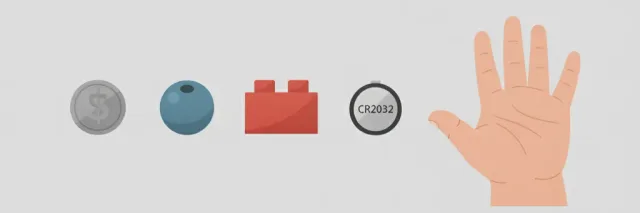
Kind verschluckt Objekt (Notfall)
Wie hoch ist die Wahrscheinlichkeit, dass ein Kleinkind einen Gegenstand verschluckt und medizinische Versorgung braucht?

Waschmittelkapsel verschluckt
Wie hoch ist die Wahrscheinlichkeit, dass ein Kleinkind durch das Schlucken oder Zerdrücken einer Waschmittelkapsel ernsthaft verletzt wird?

Magnete verschluckt
Wie hoch ist die Wahrscheinlichkeit, dass ein Kind mehrere Hochleistungsmagnete verschluckt und ins Krankenhaus muss?
Vergleichsrisiko wählen
Roughly 15 severe injuries and about 2 to 3 deaths per year in US children
are attributable to button battery ingestion — esophageal burns, perforations,
tracheoesophageal fistulae, vocal cord paralysis, and fatal outcomes. Against a US
population of about 24 million children in the 0-6 window, compounded across seven
years, that works out to roughly 1 in 250,000 per child for any severe outcome
and on the order of 1 in 1.5 million per child for a fatal one. Those are small
numbers in absolute terms — comparable in magnitude to the lifetime odds of dying
in a plane crash — and they are the reason button battery ingestion is tagged
underrated rather than a top-ten parental fear. The shape of the risk is wrong
for availability bias: low frequency, high severity, and concentrated in a single
product subtype most parents cannot name.
The interesting feature is the two-hour window. Button batteries lodged in the esophagus cause injury not by mechanical obstruction but by electrolysis — the tissue contacting the anode and cathode completes a local circuit and generates alkaline fluid, which can burn through the esophageal wall in as little as two hours. Semple and colleagues, in a 2018 review in The British Journal of Radiology, document full-thickness burns and perforations occurring inside that window. Litovitz and colleagues, in the canonical 2010 Pediatrics surveillance paper, reported a 6.7-fold increase in major or fatal outcomes from 1985 to 2009 — an increase that tracked the rise of 20mm lithium coin cells (CR2032 and similar) in remote controls, key fobs, greeting cards, and small electronics. The same paper found that 92% of fatal ingestions were not witnessed and at least 54% of fatal cases were initially misdiagnosed, usually as coins on radiography. The two-hour clock is often already running before anyone knows there is a clock.
Reese’s Law, named for Reese Hamsmith, an 18-month-old who died in 2020 after ingesting a button cell from a remote control, was signed on August 16, 2022. It directs the CPSC to mandate child-resistant packaging for button and coin batteries and secured battery compartments in consumer products — either tool access or two independent simultaneous movements to open. In September 2023 the CPSC adopted ANSI/UL 4200A-2023 as the mandatory federal standard. That the law was passed in 2022 rather than earlier is the most economical summary of this entry: the hazard has been documented in the peer-reviewed literature since the 1980s, the severe-outcome rate was rising rather than falling, and federal regulatory action took two decades and a named fatality. Post-enforcement epidemiology will take several more years to resolve, so the 1-in-250,000 headline is a pre-Reese’s-Law number and should be expected to drift downward for the compliant subset.
Verwandte Fakten
Etwa 1 von 90 US-Kindern kommt vor dem sechsten Lebensjahr wegen eines verschluckten Gegenstands in die Notaufnahme — meist eine Münze, und 80 bis 90 % gehen von selbst ab. Die Ausnahmen, bei denen nicht alles von selbst abgeht: Knopfzellen, die binnen Stunden durchbrennen, und mehrere Magnete, die den Darm einklemmen.
Eine schwere Verletzung liegt bei etwa 1 zu 250.000 pro Kind im Zeitfenster 0-6 Jahre, rund 15 schwere pädiatrische Fälle pro Jahr in den USA. Die Gefahr, die die meisten Eltern unterschätzen, ist das Tempo: Eine verschluckte 20-mm-Knopfzelle kann Gewebe binnen Stunden verätzen.
Quellenregister
Jede Zahl unten ist das, was die jeweilige Quelle berichtet hat — mit dem wörtlichen Zitat, auf das wir uns stützen, und wie wir zu unserer Zahl gelangt sind. Klicke auf einen Link, um direkt zu prüfen.
2/4 Quellen unabhängig wortwörtlich mit der zitierten Quelle abgeglichen
-
[1] Pediatrics — Jatana KR, Rhoades K, Melchionna A, Fosnight AM, Smith GA — Pediatric Battery-Related Emergency Department Visits in the United States: 2010-2019 Verifiziert
Pediatric Battery-Related Emergency Department Visits in the United States: 2010-2019- Statistik
An estimated 70,322 (95% CI: 51,275-89,369) battery-related pediatric ED visits in the US across 2010-2019, or 9.5 per 100,000 children annually; 24.5 per 100,000 per year among children 0-5; button batteries implicated in 84.7% of cases where battery type was described; ingestions accounted for 90.0% of ED visits- Auszug
“"An estimated 70 322 (95% confidence interval: 51 275-89 369) battery-related ED visits [occurred in the United States from 2010 through 2019] or 9.5 per 100 000 children annually. [...] The ED visit rate was highest among children aged ≤5 years compared with those 6 to 17 years (24.5 and 2.2 per 100 000 children, respectively). The mean patient age was 3.2 years (95% confidence interval: 2.9-3.4). [...] Button batteries were implicated in 84.7% of visits where battery type was described. [...] Ingestions accounted for 90.0% of ED visits, followed by nasal insertions (5.7%), ear insertions (2.5%), and mouth exposures (1.8%)." ”
- Quelldaten von
- 2022-09-01
- Abgerufen
- 2026-04-11 · archivierte Kopie
- Verifizierung
- Der Auszug wurde bei unserer Grounding-Prüfung unabhängig erneut abgerufen und Wort für Wort mit der zitierten Quelle abgeglichen.
- Berechnung
- Jatana et al. is the anchor for the all-exposures denominator. 9.5 per 100,000 children per year across all ages 0-17 translates to 24.5 per 100,000 per year in the under-6 peak-risk band. Compounded across the seven-year 0-6 window, cumulative ED-visit risk for any battery exposure is roughly 1.7e-3, or about 1 in 580 per child. Restricting to button batteries (85% of visits) drops that to about 1 in 680. This is the "any exposure" figure, which is two orders of magnitude higher than the severe-outcome headline. The severe-outcome headline comes from the Litovitz 2010 surveillance data and NCPC fatal-case registry rather than from Jatana's all-cause ED visits, because Jatana's dataset is designed to count encounters rather than outcomes.
- Unabhängigkeit
- Jatana et al. draws from the NEISS product-injury sampling system (CPSC), which is a distinct pipeline from the National Capital Poison Center surveillance that feeds Litovitz 2010 and Semple et al. 2017. Genuine independent corroboration on the ED-encounter side of the problem, though both ultimately describe US pediatric battery exposures.
-
[2] Pediatrics — Litovitz T, Whitaker N, Clark L, White NC, Marsolek M — Preventing Battery Ingestions: An Analysis of 8648 Cases
Preventing Battery Ingestions: An Analysis of 8648 Cases- Statistik
8,648 battery ingestions reported to the National Battery Ingestion Hotline (1990-2008); 6.7-fold increase in major or fatal outcomes from 1985 to 2009; 20-25mm cell ingestions rose from 1% to 18%; lithium-cell ingestions rose from 1.3% to 24%; outcomes significantly worse for 20mm+ lithium cells in children under 4; 92% of fatal and 56% of major outcome ingestions were not witnessed; at least 27% of major outcome and 54% of fatal cases were initially misdiagnosed- Auszug
“"All 3 data sets showed worsening outcomes, with a 6.7-fold increase in the percentage of button battery ingestions with major or fatal outcomes from 1985 to 2009. [...] Ingestions of 20- to 25-mm-diameter cells increased from 1% to 18% of ingested button batteries between 1990 and 2008, paralleling a rise in lithium-cell ingestions from 1.3% to 24%. [...] Outcomes were significantly worse for large-diameter lithium cells [...] and children younger than 4 years. The 20-mm lithium cell was implicated in most severe outcomes. Most fatal (92%) or major outcome (56%) ingestions were not witnessed. At least 27% of major outcome and 54% of fatal cases were misdiagnosed, usually because of nonspecific presentations." ”
- Quelldaten von
- 2010-05-24
- Abgerufen
- 2026-04-11 · archivierte Kopie
- Berechnung
- Litovitz et al. is the canonical surveillance paper for the severe-outcome side of button battery ingestion. The 6.7-fold rise in major or fatal outcomes from 1985 to 2009, concentrated in 20mm+ lithium coin cells, is the empirical basis for the "underrated" myth framing and for the 20-fold personal multiplier on 20mm+ lithium cells. The under-4 age concentration is the basis for the 0-6 scope. This study is also the source for the "not witnessed" and "frequently misdiagnosed" caveats — the reason the 2-hour window matters is that parents and clinicians often do not know the clock has started.
- Unabhängigkeit
- Litovitz draws from the National Battery Ingestion Hotline and the NCPC fatal-case registry — the primary US pipeline for severe-outcome tracking. Semple et al. 2017 is a downstream review of the same NCPC data. Methodologically distinct from Jatana's NEISS-based encounter counts and from CPSC's product-incident database, which together bracket the denominator.
-
[3] The British Journal of Radiology — Semple T, Calder AD, Ramaswamy M, McHugh K — Button battery ingestion in children — a potentially catastrophic event of which all radiologists must be aware Verifiziert
Button battery ingestion in children — a potentially catastrophic event of which all radiologists must be aware- Statistik
~3,300 battery-related ED attendances per year in the US between 1990 and 2009; 13 fatalities and 73 major complications over 1985-2009; 4.4-fold increase in clinically significant events over the final 3 years vs the initial 3 years; 12.6% of children under 6 ingesting 20-25mm cells had a major complication or death; full-thickness burns and esophageal perforation can occur within 2 hours- Auszug
“"[...] an annual incidence of 3300 battery-related emergency department attendances in the USA between 1990 and 2009 [...] 13 fatalities and 73 major complications [...] a 4.4-fold increase in clinically significant events and a 6.7-fold increase in major or fatal outcomes over the final 3 years compared to the initial 3 years. [...] 12.6% of children under 6 years ingesting 20-25 mm battery cells experiencing a major complication or death. [...] full thickness burns and oesophageal perforation which may occur within as little as 2 h following the ingestion of button batteries [via] electrolytic production of alkaline fluid via formation of a local circuit by oesophageal tissue contacting both the anode and cathode." ”
- Quelldaten von
- 2018-04-24
- Abgerufen
- 2026-04-11 · archivierte Kopie
- Verifizierung
- Der Auszug wurde bei unserer Grounding-Prüfung unabhängig erneut abgerufen und Wort für Wort mit der zitierten Quelle abgeglichen.
- Berechnung
- The Semple et al. review is the cleanest source for the 2-hour window and the electrolytic injury mechanism, both of which are load-bearing for the "underrated" framing and for the >2-hour personal multiplier. The 12.6% major-complication rate among under-6 ingesting 20-25mm cells is also the empirical anchor for the 20mm+ lithium subgroup multiplier. This review and Litovitz 2010 draw on overlapping NCPC surveillance data, so treat them as two views of the same underlying dataset rather than independent estimates.
- Unabhängigkeit
- Semple et al.'s numbers trace back to the same National Capital Poison Center surveillance that Litovitz maintains, so this source corroborates rather than independently verifies the Litovitz figures.
-
[4] US Consumer Product Safety Commission (CPSC) — Making Families Safer from Button Cell or Coin Battery Dangers; Reese's Law Leads to New Federal Mandatory Safety Standard
Making Families Safer from Button Cell or Coin Battery Dangers; Reese's Law Leads to New Federal Mandatory Safety Standard- Statistik
At least 27 deaths and an estimated 54,300 injuries treated in US emergency rooms from button cell or coin battery ingestions or insertions, 2011-2021; Reese's Law signed August 16, 2022; CPSC voted to adopt ANSI/UL 4200A-2023 as mandatory safety standard in September 2023- Auszug
“"Between 2011 and 2021 in the United States, there were at least 27 deaths and an estimated 54,300 injuries treated in emergency rooms resulting from button cell or coin batteries being ingested or inserted. [...] Reese's Law, named in honor of Reese Hamsmith, an 18-month-old child who died after ingesting a button cell battery from a remote control, was enacted on August 16, 2022 [and] mandates that CPSC implement federal safety requirements for button cell or coin batteries and consumer products containing such batteries." ”
- Quelldaten von
- 2023-09-20
- Abgerufen
- 2026-04-11 · archivierte Kopie
- Berechnung
- 27 deaths / 11 years ≈ 2.5 pediatric battery deaths per year in the US; 54,300 injuries / 11 years ≈ 4,900 ED injury visits per year, consistent with Jatana's 7,000 all-age battery-related ED visits per year once restricted to severe injuries and/or under-18. Used to anchor the mortality sub-figure (~1 in 2-4 million per child 0-6) and the "severe injury" count cited in the native figure. Also the authoritative citation for Reese's Law dates and requirements.
- Unabhängigkeit
- CPSC's product-incident database integrates death-certificate data with hospital and consumer hazard reports. Partially overlaps with Litovitz's NCPC surveillance (both track US pediatric battery deaths) but adds product-identification metadata. Treat as complementary to NCPC and NEISS rather than independent.