Evidenzqualität 4.88/5
Bewertungsergebnis nach acht Dimensionen gemäß der Qualitätsrubrik . Jede Dimension wird mit 1–5 bewertet.
- D1 Quellenverankerung
- 4/5
- D2 Quellenautorität
- 5/5
- D3 Arithmetik
- 5/5
- D4 Unsicherheit
- 5/5
- D5 Geltungsbereich
- 5/5
- D6 Prosa
- 5/5
- D7 Ehrlichkeit zur Wahrnehmung
- 5/5
- D8 Vollständigkeit der Einschränkungen
- 5/5
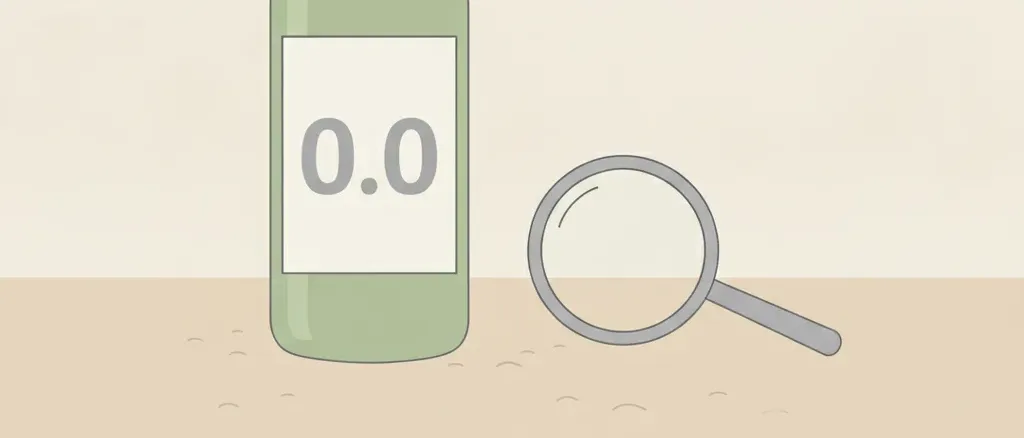
Ein wirklich alkoholfreies Bier ist das beruhigende Ende dieser Kategorie, und das US-Kennzeichnungsrecht ist darin ungewöhnlich unmissverständlich. Nach den Regeln der TTB bedeuten „alkoholfrei” und eine „0.0%“-Angabe, dass das Produkt überhaupt keinen Alkohol enthält, ohne zugelassene Toleranz, und ein Malzgetränk darf keine 0.0%-Angabe tragen, wenn es nicht auch als alkoholfrei einzustufen ist. Ein Produkt, das diesen Standard tatsächlich erfüllt, hat nichts, was es an einen Fötus oder in die Muttermilch weitergeben könnte, weshalb dieser Eintrag keine Schadenszahl trägt: Die Wahrscheinlichkeit eines Schadens durch eine buchstäblich Null-Dosis ist nichts, das sinnvoll zu messen wäre. Die nützliche Frage lautet nicht „wie gefährlich ist der Alkohol in einem 0.0%-Bier”, sondern „wie sicher kann irgendjemand sein, dass die 0.0% echt sind”.
Diese Sicherheit hängt davon ab, wie die Zahl zustande kam. Die meisten Alkoholangaben auf Bier stammen aus der Dichtemessung, die billig ist und bei üblichen Stärken gut funktioniert, aber nahe null unzuverlässig wird, weil Zucker, gelöstes Kohlendioxid und andere gelöste Stoffe die Dichte im selben Bereich verschieben wie die letzten Spuren von Ethanol. Die Gaschromatographie, die Ethanol direkt bis hinunter zu etwa 0.005% Vol. nachweist, erzählt eine weniger ordentliche Geschichte. Eine Analyse von 1980 fand Getränke mit der Kennzeichnung „alkoholfrei”, die zwischen 0.009% und 0.385% Ethanol nach Volumen enthielten; eine Motherisk-Studie von 2010 fand sechs Produkte, die behaupteten, keinen Alkohol zu enthalten, mit Testwerten über 1%. Auf der Standardgetränk-Skala, auf der ein US-Getränk 14 g Ethanol enthält, ergibt das obere Ende von 0.385% etwa 1.1 g in einer 12-oz-Portion, grob ein Dreizehntel eines Getränks und ungefähr so viel wie ein „nicht-alkoholisches” Bier, während die 1%-Produkte rund 2.8 g erreichen, ein Fünftel eines Getränks. Das untere Ende, 0.009%, liegt bei etwa einem Fünfhundertstel eines Getränks und ist wirklich vernachlässigbar. Das eine Etikett „enthält keinen Alkohol” hat in Tests diesen gesamten Bereich abgedeckt.
Nichts davon macht ein verifiziert-alkoholfreies Bier riskant; es macht das Etikett zu dem, was man prüfen sollte, statt ihm standardmäßig zu vertrauen. Daraus folgen zwei praktische Unterscheidungen. „Entalkoholisiert” beschreibt ein Verfahren, keine Stärke, und erlaubt für sich genommen bis zu 0.5% nach Volumen, ist also nicht dieselbe Behauptung wie „0.0%” — der Schwester-Eintrag Alkoholfreies Bier, schwanger behandelt diese Klasse unter 0.5%. Und eine Marke, die die Null durch Chromatographie bestätigt, hat einen stärkeren Anspruch auf das Etikett als eine, die sie über die Dichte schätzt. Die großen geburtshilflichen Fachgesellschaften halten daran fest, dass keine Alkoholmenge in der Schwangerschaft als sicher erwiesen ist; für ein wirklich alkoholfreies Produkt stehen diese Leitlinie und die Dosis nicht im Widerspruch, weil es keine Dosis gibt. Die ehrliche Zusammenfassung lautet, dass ein echtes 0.0% praktisch expositionsfrei und die sicherste Option in dieser Kategorie ist, dass „0.0%” eine Behauptung über eine Messung und keine Garantie ist, und dass der einzige dokumentierte, bezifferte Haken darin besteht, wie oft genau diese Behauptung eine unabhängige Analyse nicht bestanden hat.
Verwandte Fakten
US-Kennzeichnungen unterscheiden zwei Wege: "alkoholfrei" erlaubt gesetzlich bis zu 0.5% Alkohol nach Volumen, während "0.0%"/"ohne Alkohol" gar keinen enthalten darf. Doch Labortests fanden "kein Alkohol"-Etiketten über 1% (eine Studie von 2010). Das strengere Versprechen ist nicht automatisch das zuverlässigere.
Quellenregister
Jede Zahl unten ist das, was die jeweilige Quelle berichtet hat — mit dem wörtlichen Zitat, auf das wir uns stützen, und wie wir zu unserer Zahl gelangt sind. Klicke auf einen Link, um direkt zu prüfen.
-
[1] US Alcohol and Tobacco Tax and Trade Bureau (TTB), via Cornell Legal Information Institute — 27 CFR 7.65 — Alcohol content (malt beverage labeling)
27 CFR 7.65 — Alcohol content (malt beverage labeling)- Statistik
'Alcohol free' may be used only on malt beverages containing no alcohol, with no tolerances permitted; a malt beverage may not be labeled 0.0% ABV unless it is also labeled 'alcohol free' and contains no alcohol. 'Non-alcoholic' requires an adjacent 'contains less than 0.5 percent alcohol by volume' statement- Auszug
“"A malt beverage may not be labeled with an alcohol content of 0.0 percent alcohol by volume, unless it is also labeled as 'alcohol free' ... and contains no alcohol." "No tolerances are permitted for 'alcohol free' malt beverages." ”
- Quelldaten von
- 2023-01-01
- Abgerufen
- 2026-08-01
- Berechnung
- Establishes the regulatory absolutism this entry turns on. In the US, "alcohol free" and a "0.0%" claim legally mean the product contains no alcohol at all, with zero tolerance — unlike the "non-alcoholic" class, which is defined as under 0.5% ABV. So a genuine 0.0% product should deliver 0 g ethanol and therefore no fetal or breastmilk exposure. The rule constrains the label, not the assay: it defines what "0.0%" must mean, which is precisely why measured deviations from it (see the two chromatography sources) are the load-bearing hazard rather than the labeled dose. Regulatory text, not a harm-rate study.
-
[2] Chromatographia — Morad, Hikal & Buchanan, 1980 — Gas-liquid chromatographic determination of ethanol in 'Alcohol-Free' beverages and fruit juices
Gas-liquid chromatographic determination of ethanol in 'Alcohol-Free' beverages and fruit juices- Statistik
Beverages labeled 'Alcohol-Free' (five beers plus grape and apple juices) measured 0.009% to 0.385% ethanol by volume via gas chromatography — i.e., not truly alcohol-free but alcohol-low [Paraphrase from abstract — full text paywalled]- Auszug
“"[Paraphrase from abstract — full text paywalled] Products labeled 'Alcohol-Free' were found by gas–liquid chromatography to contain ethanol from 0.009% to 0.385% by volume, indicating they are not alcohol-free but alcohol-low." ”
- Quelldaten von
- 1980-01-01
- Abgerufen
- 2026-08-01
- Berechnung
- Direct evidence that an "alcohol-free" label is a claim about a measurement, not a guarantee of literal zero. Gas chromatography (which detects ethanol directly, down to ~0.005% v/v) found "alcohol-free" beverages spanning 0.009–0.385% v/v. Dose translation via NIAAA's 14 g standard drink: at the 0.385% upper end a 12 fl oz (355 mL) serving holds 355 × 0.00385 × 0.789 g/mL = 1.08 g ethanol ≈ 1/13 of a standard drink — comparable to a "non-alcoholic" (≤0.5%) beer; at the 0.009% low end, ~0.025 g ≈ 1/560 of a standard drink, negligible. Caveat: this is a 1980 study with a small brand sample and older market practices; cited for the qualitative point (measured ethanol in "alcohol-free" labels), not as a current prevalence.
-
[3] Canadian Journal of Clinical Pharmacology — Goh, Verjee & Koren (Motherisk, Hospital for Sick Children), 2010 — Alcohol content in declared non- or low alcoholic beverages: implications to pregnancy
Alcohol content in declared non- or low alcoholic beverages: implications to pregnancySee all 2 Likelier entries citing this source →
- Statistik
Of 45 beverages labeled non- or low-alcohol, 6 that claimed to contain no alcohol were found to contain greater than 1% ethanol; 13 of 45 (29%) exceeded their declared alcohol content- Auszug
“"Six beverages claiming to contain no alcohol were found to contain greater than 1% ethanol." ”
- Quelldaten von
- 2010-01-01
- Abgerufen
- 2026-08-01
- Berechnung
- The more recent corroboration, and the sharper one: six products that claimed to contain no alcohol tested above 1% ABV. At 1% v/v a 12 fl oz serving is 355 × 0.01 × 0.789 = 2.8 g ethanol ≈ 1/5 of a standard drink — so a "no alcohol" label spanned, in testing, from genuinely negligible to a fifth of a real drink. Establishes that the zero-claim label class is the one testing catches above zero, which is the entry's core point. Canadian market, 2010; read as order-of-magnitude, not a current rate. See also the sibling entry [[non-alcoholic-beer-pregnancy]] for the under-0.5% "non-alcoholic" class.
-
[4] National Institute on Alcohol Abuse and Alcoholism (NIAAA), NIH — What Is A Standard Drink?
What Is A Standard Drink?See all 2 Likelier entries citing this source →
- Statistik
A US standard drink contains 14 grams (about 0.6 fluid ounces) of pure ethanol, the amount in 12 oz of regular 5% ABV beer- Auszug
“"In the United States, one 'standard' drink (or one alcoholic drink equivalent) contains roughly 14 grams of pure alcohol, which is found in: 12 ounces of regular beer, which is usually about 5% alcohol." ”
- Quelldaten von
- 2023-01-01
- Abgerufen
- 2026-08-01
- Berechnung
- The 14 g standard-drink anchor used for every dose translation in this entry (0.385% → ~1.08 g ≈ 1/13; 0.009% → ~0.025 g ≈ 1/560; 1% → ~2.8 g ≈ 1/5). Density of ethanol 0.789 g/mL; 12 fl oz = 355 mL. A genuine 0.0% product contributes 0 g and thus no term in this arithmetic — the whole reason the entry is about verification rather than dose.
-
[5] American Journal of Obstetrics & Gynecology (author manuscript, PMC), 2025 — Perinatal use of non-alcoholic beverages that mirror alcohol
Perinatal use of non-alcoholic beverages that mirror alcoholSee all 2 Likelier entries citing this source →
- Statistik
'Alcohol-free' products contain no detectable alcohol; 'non-alcoholic' products legally contain up to 0.5% ABV. Providers interpret the ACOG/CDC 'no safe level of alcohol' guidance for these products differently- Auszug
“"Providers offer varying advice on use of non-alcoholic beverages in the perinatal period, suggesting they interpret the 'no safe level of alcohol' guidance from ACOG and the CDC differently." ”
- Quelldaten von
- 2025-03-01
- Abgerufen
- 2026-08-01
- Berechnung
- Confirms the "alcohol-free = no detectable alcohol" pole of the taxonomy (against "non-alcoholic" ≤0.5%) and situates the question in perinatal care: ACOG and the CDC hold that no amount of alcohol is established as safe in pregnancy. For a genuinely 0.0% product that guidance is not in tension with the dose (there is none); the residual concern it leaves is entirely about whether the 0.0% claim is accurate. No harm rate for verified-zero products exists, consistent with this entry carrying no probability.